

Mobileye Earns Less on Each Chip It Ships and Banks Its Growth on a 2028 Audi Launch
Hypothesis Opus 5 · Research Opus 5 · Writing Opus 5 · Prompt v1.7
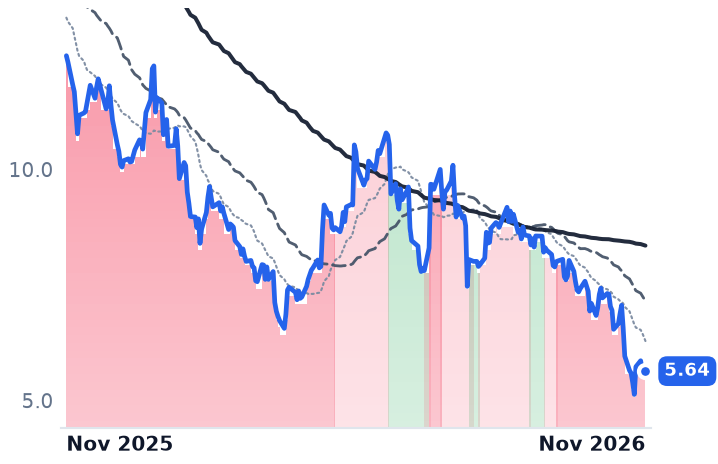
Mobileye's shares have halved in a year while the business improved: September-quarter gross profit rose 7.4% on revenue down 2.4%, the operating loss narrowed by a quarter, and full-year guidance went up. What is deflating is the money per shipped unit.
The company moved 9.5 million EyeQ vision chips, up 3%, at an average system price of $49.10, roughly a dollar below a year earlier, because Chinese automakers' export volumes carry less software content. No launch date slipped: the Porsche and Audi programs were reaffirmed on production hardware and new named programs were added.
So the markdown is about when the content gets paid, not whether. Consensus earnings for 2027 now sit below 2026, with the step to higher-content systems deferred to the year after.
| Ticker | Company | Segment | Trend · 13mo | 30D | 1Y |
|---|---|---|---|---|---|
| The subject · what this brief is about | |||||
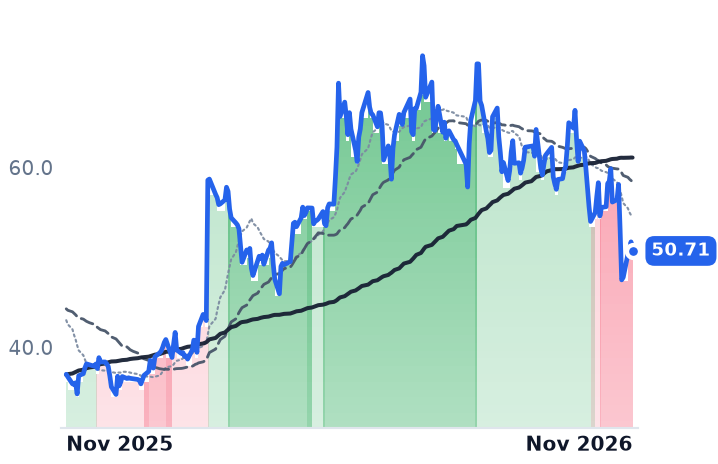
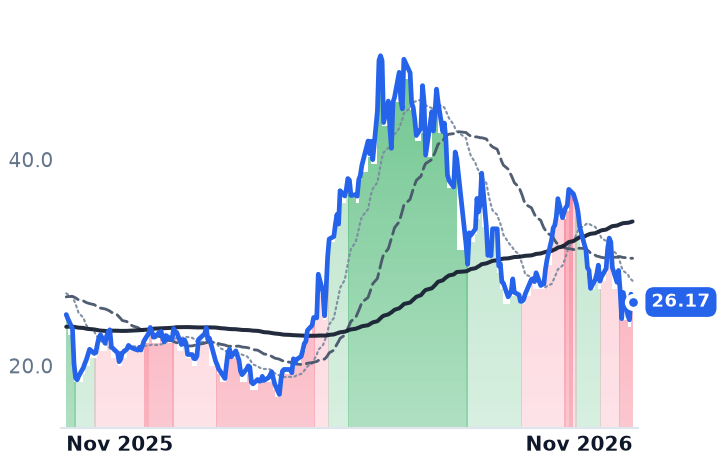
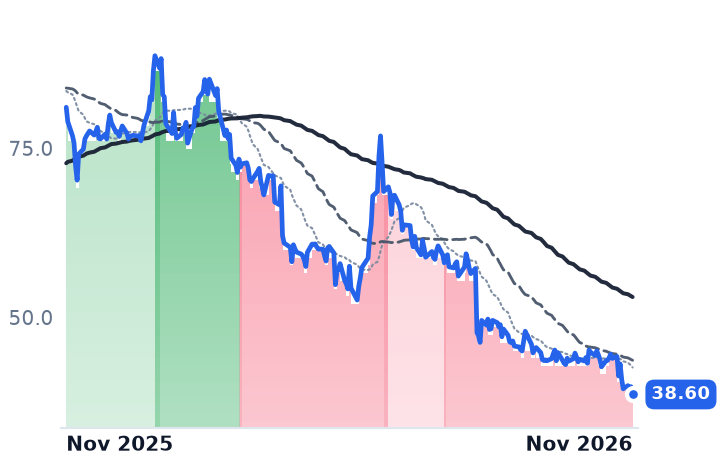
MBLY | Mobileye Global | Autonomous Driving & Electronics | 🔴 Cont. Bear | −22.8% | −54.8% |
AMBA | Ambarella | Sensors & Specialized Semiconductors | 🔴 Cont. Bear | −2.1% | −31.2% |
OUST | Ouster | Sensors & Specialized Semiconductors | 🌱 Emerging Bull | +14.8% | +65.1% |
| Compared against · context, not the story | |||||
HSAI | Hesai | Autonomous Driving & Electronics | 🔴 Cont. Bear | −0.9% | −29.5% |
CGNX | Cognex | Test & Measurement | ⚠️ Emerging Bear | −12.3% | +37.1% |
CEVA | CEVA | Sensors & Specialized Semiconductors | 🔴 Cont. Bear | −11.3% | +4.9% |
APTV | Aptiv | Autonomous Driving & Electronics | 🔴 Cont. Bear | −10.7% | −52.4% |
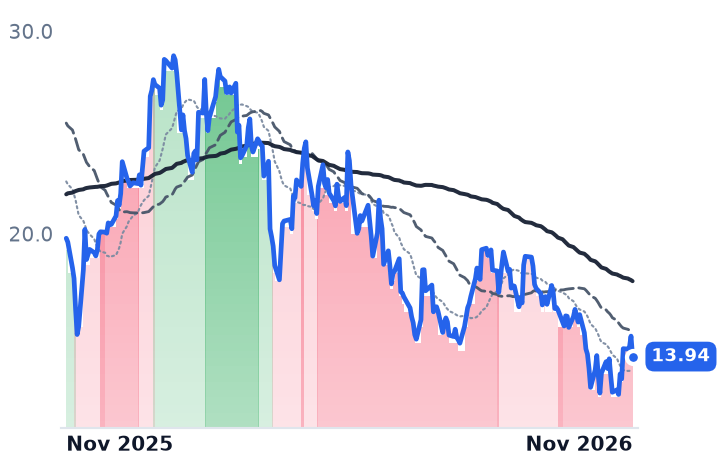
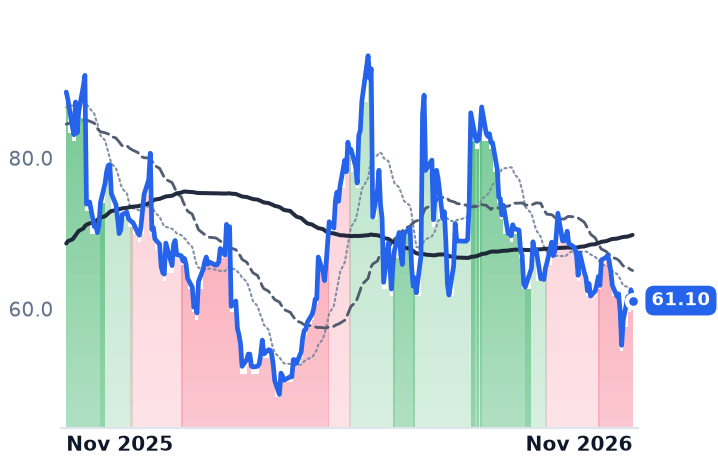
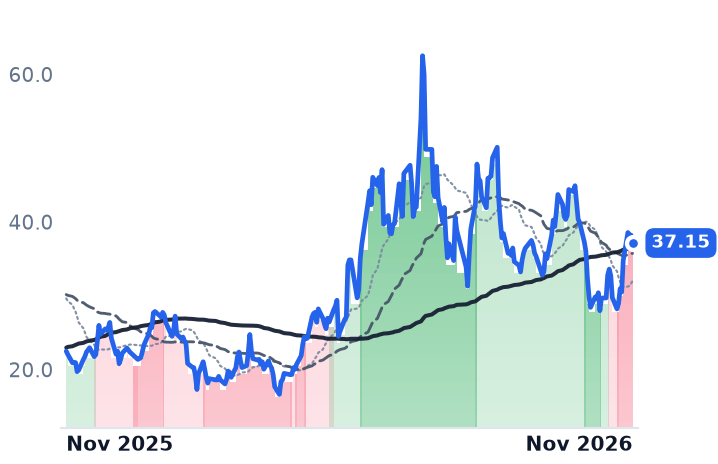
12-month price & trend
| Ticker | Mkt cap | P/E | P/E fwd | P/S | P/S fwd | P/GP | P/GP fwd | EV/EBITDA | FCF yld |
|---|---|---|---|---|---|---|---|---|---|
MBLY | $4.8B | n/m | 11.2x | 2.4x | 2.4x | 4.9x | 4.9x | n/m | 6.7% |
HSAI | $2.7B | 37.3x | — | 5.5x | — | 13.6x | — | 32.2x | 0.0% |
AMBA | $2.7B | n/m | 76.0x | 6.5x | 6.1x | 11.1x | 10.5x | n/m | 0.3% |
| Ticker | Mkt cap | P/E | P/E fwd | P/S | P/S fwd | P/GP | P/GP fwd | EV/EBITDA | FCF yld |
|---|---|---|---|---|---|---|---|---|---|
OUST | $2.7B | n/m | — | 11.9x | 11.9x | 24.2x | 24.2x | n/m | -3.6% |
CGNX | $8.8B | 36.2x | 30.6x | 7.8x | 7.6x | 11.2x | 10.9x | 26.1x | 3.3% |
CEVA | $746.4M | n/m | 50.4x | 6.4x | 6.1x | 7.4x | 7.1x | n/m | 0.8% |
| Ticker | Mkt cap | P/E | P/E fwd | P/S | P/S fwd | P/GP | P/GP fwd | EV/EBITDA | FCF yld |
|---|---|---|---|---|---|---|---|---|---|
APTV | $9.3B | 41.7x | 7.6x | 0.5x | 0.7x | 2.5x | 3.7x | 7.3x | 8.2% |
Consensus projections
| Ticker | FY2026E | FY2027E | FY2028E | |
|---|---|---|---|---|
MBLY | Revenue | +6.9% | +7.4% | +19.3% |
| EPS | +40.2% | −4.0% | +35.7% | |
HSAI | Revenue | +37.8% | +40.9% | +30.8% |
| EPS | −75.8% | +39.4% | +12.5% | |
AMBA | Revenue | +39.8% | +12.9% | +11.6% |
| EPS | −310.6% | +34.9% | +31.8% | |
OUST | Revenue | +51.9% | +34.8% | +35.8% |
| EPS | −65.7% | −118.2% | +890.8% | |
CGNX | Revenue | +17.5% | +11.4% | +9.7% |
| EPS | +76.7% | +16.4% | +14.4% | |
CEVA | Revenue | +11.1% | +13.8% | +13.6% |
| EPS | +26.5% | +42.7% | +41.0% | |
APTV | Revenue | −37.5% | +4.2% | +4.6% |
| EPS | −13.3% | +13.4% | +14.6% |
Forward fiscal years only. Blank means no analyst coverage for that year.
Mobileye Global, which sells the EyeQ vision chips and higher-content SuperVision and Chauffeur driving stacks that let a car see, shipped 9.5 million of those chips in the September quarter and was paid about a dollar less for each of them than a year earlier. The business around that number got better, not worse: gross profit rose 7.4% to $261m on revenue down 2.4% to $492m, the operating loss narrowed to $82m from $109m, and the company raised its full-year revenue range to $1,995m–$2,020m while lifting adjusted operating income guidance to $400m. The shares closed on 12 November at $5.635, down 54.9% in twelve months, after touching a closing low of $5.13 on 5 November.
The slide has been read as an autonomy timeline sliding right. The disclosures say the opposite. Chief executive Amnon Shashua told investors on 29 October that the Volkswagen Group programs are on track, SuperVision at Porsche in 2027 and Chauffeur at Audi in 2028, both running on production hardware, and Mobileye added named wins in the quarter: Surround advanced driver-assistance systems with Volkswagen, Mahindra and a large US automaker, and cloud-enhanced driver assistance with Stellantis plus a top-five Asian and a top-ten Japanese automaker. What was repriced is the shape of the earnings path. Consensus has earnings per share falling to $0.483 in 2027 from $0.503 this year, with the whole growth step — revenue up 19.3% — waiting until 2028.
A dollar off a fifty-dollar chip
Unit volumes are not the problem. The 9.5 million chips came in at the high end of guidance, grew 3% against declining global vehicle output, and full-year shipments are expected to rise about 10%; Shashua said the top ten customers' volumes should grow 7% while their aggregate production falls 5%.
The price is the problem. Average system price was $49.10, roughly $1 lower year on year, because more shipments went to Chinese automakers building for emerging markets, where the chip carries less software. Management put the full-2026 decline at about $2 and expects 2027 pricing to be "more flat." On top of that, roughly $7m of passed-through memory cost entered revenue at zero gross margin, costing about one percentage point of corporate gross margin; non-GAAP gross margin fell to 64% from 67%.
Per-unit deflation is the perception layer's condition this year, not Mobileye's alone. Hesai shipped 65.3% more lidars in its own September quarter for 34.3% more revenue, which works out to about 19% less revenue per unit.
The content ladder is real and it is small
Mobileye's answer to a flat chip price is content per car. Surround ADAS carries two to three times base pricing at similar margin; SuperVision is above $1,000 a car and Chauffeur about $2,500, both at roughly 40% gross margin. The scale is the catch. SuperVision deliveries exceeded 15,000 in the quarter and the full-year outlook went up to about 65,000 from about 60,000, against an EyeQ base running near 38 million units a year.
And the concentration is deliberate. "We put all our resources and focus into bringing four new platforms to production simultaneously with our leading customer, that's Volkswagen Group," Shashua said on 29 October. "We believe that scaling a proven production-grade product is a stronger position than productizing across many customers at once."
What the fall accounts for
Part of the thirty-day drop was not Mobileye's. Between 3 and 5 November the whole chip complex was sold after Democratic midterm gains and a call for a national data-center moratorium, with Cognex down 18.3% and Ambarella 11.0% over those sessions, and Mobileye's low landed inside that window. The company-specific part is the earnings shape: at least nine brokers cut targets in early November, UBS to $7.00 and JPMorgan to $7.50, with TD Cowen moving to hold.
At $5.635 the stock trades at 11.2x forward earnings and 2.39x trailing sales, against roughly 5.3x sales implied a year ago on broadly flat revenue — the multiple has halved while the revenue line has not. Book value is 0.565x and $1.5bn of cash and securities sits against a $4.79bn market capitalization. Two things qualify the arithmetic: an Israeli research incentive supplied $51m of the quarter's adjusted operating income and about $190m for the year, with the cash arriving roughly two years later, from 2028; and Intel's funding subsidiary is selling 45 million Class A shares, worth about $900m, cutting its holding from roughly 88% to about 80%.
The open question is the 2027 price list. Mobileye is still negotiating next year's pricing with customers while automotive memory costs climb, and Team Group's chief executive said on 10 November that the shortage is worst from now through the middle of 2027, with "no downward price trend whatsoever" next year. A flat chip price that absorbs rising memory is not flat.
Mobileye has repurchased about $33m of its own stock since April at an average of $9.36, well above where it trades. Its majority owner is selling into the same market. Both are decisions about the same launch calendar, taken from opposite sides of it.