

Chip Foundries Are Raising Wafer Prices Again After Three Years of Erosion
Hypothesis Opus 5 · Research Opus 5 · Writing Opus 5 · Prompt v1.7
The price of a finished wafer has turned up at three contract chipmakers at once, and the market marked all three down inside a single week in November. GlobalFoundries posted its first year-on-year blended price increase since 2023, up 4.8%, alongside a record 31.4% non-IFRS gross margin; UMC's loading went from 85% to 92% on record shipments and its chief executive guided a roughly 10% blended price rise for 2027.
TSMC's October revenue of NT$586.89bn was up 59.7% from a year earlier, and advanced nodes are 79% of its wafer revenue. None of that describes the markdown: the sell-off was an index-level repricing of artificial-intelligence exposure that hit UMC four times as hard as TSMC, and it was mostly retraced within a week.
| Ticker | Company | Segment | Trend · 13mo | 30D | 1Y |
|---|---|---|---|---|---|
| The subject · what this brief is about | |||||
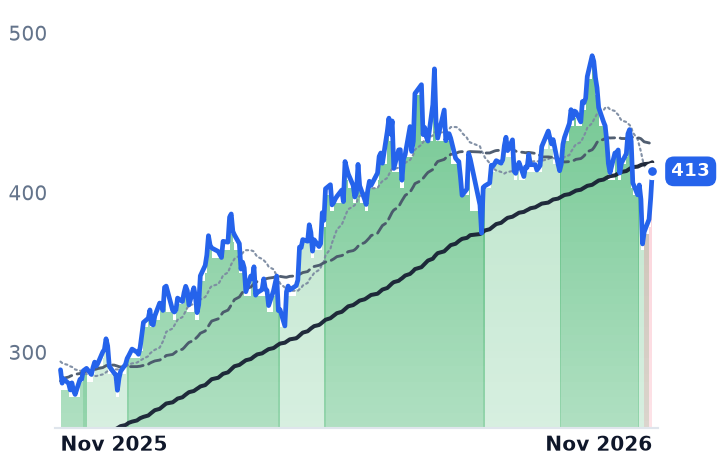
TSM | Taiwan Semiconductor Manufacturing | Foundries | 🟢 Cont. Bull | −6.4% | +43.0% |
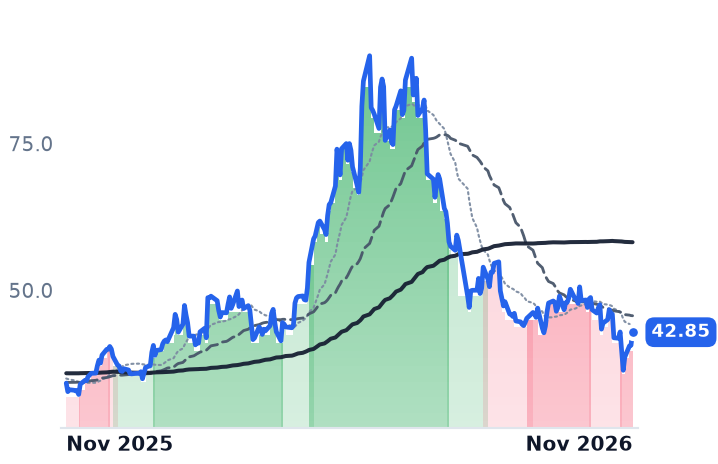
GFS | GLOBALFOUNDRIES | Foundries | 🔴 Cont. Bear | −8.9% | +25.4% |
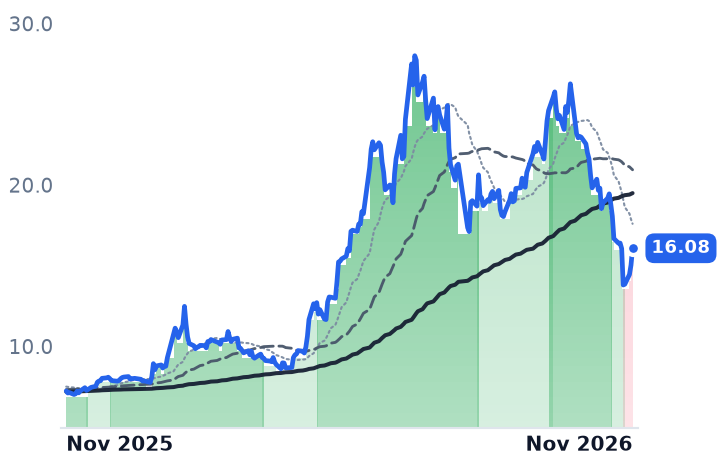
UMC | United Microelectronics | Foundries | 🟢 Cont. Bull | −26.9% | +122.1% |
| Compared against · context, not the story | |||||
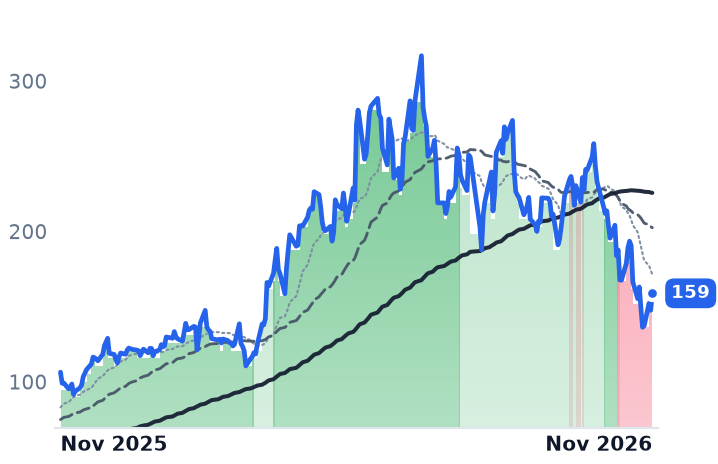
TSEM | Tower Semiconductor | Foundries | 🟢 Cont. Bull | −25.1% | +49.3% |
12-month price & trend
| Ticker | Mkt cap | P/E | P/E fwd | P/S | P/S fwd | P/GP | P/GP fwd | EV/EBITDA | FCF yld |
|---|---|---|---|---|---|---|---|---|---|
TSM | $2.1T | 23.8x | — | 12.3x | — | 18.6x | — | 15.8x | 2.5% |
GFS | $23.5B | 119.0x | 21.5x | 3.3x | 3.2x | 11.4x | 11.2x | 11.4x | 1.8% |
UMC | $40.1B | 14.8x | — | 4.8x | — | 15.2x | — | 7.4x | 5.5% |
| Ticker | Mkt cap | P/E | P/E fwd | P/S | P/S fwd | P/GP | P/GP fwd | EV/EBITDA | FCF yld |
|---|---|---|---|---|---|---|---|---|---|
TSEM | $18.0B | 48.9x | 39.1x | 9.5x | 9.0x | 31.9x | 30.4x | 26.7x | 1.5% |
Consensus projections
| Ticker | FY2026E | FY2027E | FY2028E | |
|---|---|---|---|---|
TSM | Revenue | +43.8% | +38.6% | +26.1% |
| EPS | +68.6% | +34.6% | +27.4% | |
GFS | Revenue | +8.3% | +13.1% | +15.1% |
| EPS | +21.0% | +29.2% | +33.6% | |
UMC | Revenue | +16.3% | +25.2% | +16.3% |
| EPS | +112.4% | −1.4% | +25.1% | |
TSEM | Revenue | +27.5% | +41.1% | +32.0% |
| EPS | +86.2% | +75.7% | +52.0% |
Forward fiscal years only. Blank means no analyst coverage for that year.
Three contract chipmakers spent the better part of three years watching what they charge for a finished wafer fall. In their September-quarter disclosures, all three said that direction has changed, and one of them has already told customers roughly what next year will cost.
The group was marked down hard in early November along with everything else attached to artificial-intelligence capital spending. A gauge of US semiconductor stocks plunged 12% on 5 November, its worst day since the onset of the pandemic in March 2020, on speculation that a Democratic sweep of Congress would bring tighter regulation of US data centers. That repricing treated the foundries as a proxy for AI demand. The filings record something else: loading, wafer prices and prepaid capacity reservations all moved up in the quarter, at the leading edge and at mature nodes alike.
The same wafer, three price lists
Taiwan Semiconductor Manufacturing Company, which manufactures, packages and tests chips to other companies' designs, is paid an annually negotiated price per leading-edge wafer plus separately constrained advanced-packaging capacity. On its 15 October call it put 7nm-and-below at 79% of wafer revenue, with 3nm alone at 33%. Quarterly revenue growth accelerated through the year, from 35.1% to 36.0% to 50.9%, and third-quarter gross margin reached 66.4% against 59.5% a year earlier. "The gap between demand and supply are still quite big, and that is why we put all our strengths to increase the capacity," chairman and chief executive C.C. Wei told investors that day. October revenue, filed on Form 6-K on 10 November, was NT$586.89bn, up 59.7% year on year. TrendForce reported in late October that the company is eyeing a roughly 20% price increase on its CoWoS packaging.
GlobalFoundries, the Malta, New York specialty foundry selling radio-frequency, power-management and embedded-memory processes, is paid partly for reserved capacity under long-term agreements with customer prepayments. Its blended selling prices rose 4.8% year on year, "the first quarter of year-over-year blended pricing improvement since 2023," chief financial officer Sam Franklin said on 4 November. Non-IFRS gross margin hit a record 31.4%, up 540 basis points from a year earlier, and gross profit grew 36% on 12.5% revenue growth. The reserved-capacity economics are expanding: about one third of roughly $4bn of 2027 net capital spending is to be funded by customer prepayments, and third-quarter free cash flow of $136m included $150m of prepayments and government grants. "We are absolutely booked out through 2027, increasingly booked out through 2028," chief executive Tim Breen said.
UMC, the Hsinchu mature-node merchant whose margin is set quarter by quarter by how full the fabs run, lifted utilization to 92% from 85% on record shipments of 1.2m 12-inch equivalent wafers, with gross margin at 34%. "We expect 2027 to mark a turning point in our blended ASP trajectory, moving from an environment of ASP erosion toward a meaningful positive uplift beginning in the first quarter," chief executive Jason Wang said on 28 October, guiding to a 10% increase. October sales were up 18.3% year on year.
What the six sessions actually priced
The decline was concentrated and uneven. Over the 30 days to 11 November, UMC fell 28.7% and GlobalFoundries 11.4%, against 7.0% for TSMC — dispersion that tracks how much AI narrative each name had accumulated rather than anything in its wafer economics. Two of the moves were company-specific and real: GlobalFoundries fell 8.6% on 4 November on the capital-spending step-up and a further equity issuance to the US government taking its stake to roughly 7%, and UMC's quarterly earnings per American depositary share of $0.206 came in under the $0.214 consensus. By 11 November all three had recovered 12% to 18% from their 5 November lows.
So the results account for almost none of the markdown and the valuation anchors are where the episode left a mark. GlobalFoundries trades at 11.4x trailing gross profit, against 20.4x in early May, while that gross profit grew 36%. TSMC's trailing earnings multiple is 23.8x, and consensus estimates on a currency-consistent basis put it near 21.5x this year's earnings, against the 33.7x recorded in May. UMC is the cheapest of the three on a capital-structure-neutral basis at 7.4x trailing enterprise value to earnings before interest, taxes, depreciation and amortization, which is the right measure for a company whose own finance chief, Chitung Liu, named depreciation and raw-material cost as what will pressure reported gross margin for at least two years.
The pricing turn is not yet in anyone's reported numbers for a full year, and that is the open question. UMC said in late October it was at a "very late stage" of 2027 price negotiations with customers; GlobalFoundries said its prepayment discussions should largely close in the fourth quarter and into early 2027. The next wafer price list is being written now, and it will settle whether three years of erosion ended in the September quarter or merely paused.