
Alphabet Said Ads Inside Its AI Answers Earn Less Than Ads Beside Search Links
Hypothesis Opus 5 · Research Opus 5 · Writing Opus 5 · Prompt v1.7
Three companies are sold as one "AI answers kill the search box" trade, and they are paid on three incompatible meters. Only one meter is deteriorating, and it belongs to the company the market marked down least.
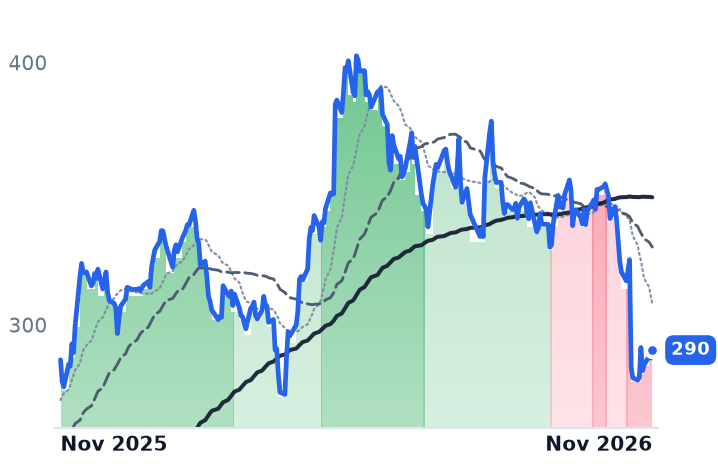
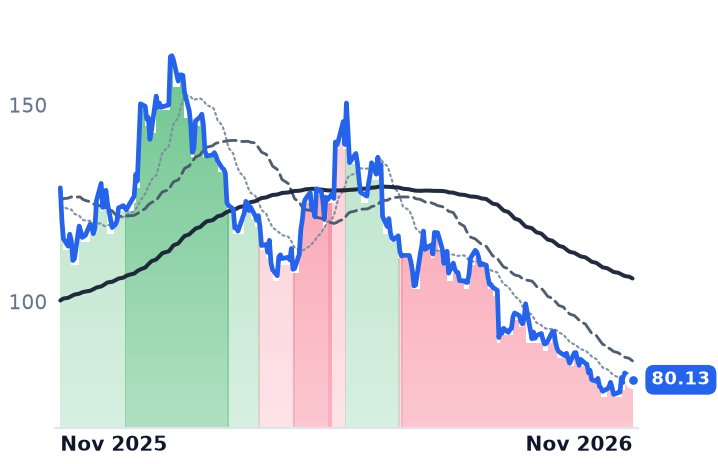
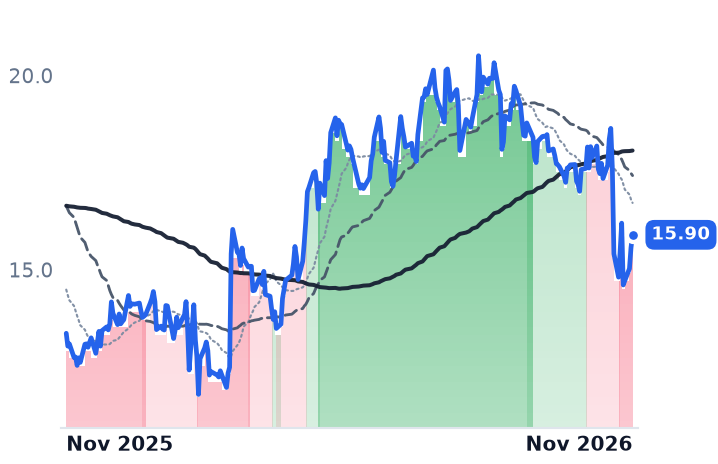
Alphabet's 28 October report put Search and other revenue up 12% to $63.35bn, with paid clicks up 8% against an 11% average over the first nine months, and its chief business officer named weaker monetization of AI Mode as one cause. The shares fell 12.6% the next session. Over the 30 sessions to 11 November Alphabet fell 17.9%, Opera 12.4% and Baidu, the only operator that has actually replaced most of its result page with generated answers, 4.7%.
Baidu's decline is doing honest work: online marketing revenue fell 19% in its June quarter. Opera's was read-through from the partner that pays it, and landed days before a quarter that beat guidance.
| Ticker | Company | Segment | Trend · 13mo | 30D | 1Y |
|---|---|---|---|---|---|
| The subject · what this brief is about | |||||
BIDU | Baidu | Search Engines & Browsers | 🔴 Cont. Bear | −4.7% | −37.9% |
OPRA | Opera | Search Engines & Browsers | 🔴 Cont. Bear | −12.4% | +19.0% |
| Compared against · context, not the story | |||||
GOOGL | Alphabet | Search & Advertising | ⚠️ Emerging Bear | −17.9% | +1.3% |
12-month price & trend
| Ticker | Mkt cap | P/E | P/E fwd | P/S | P/S fwd | P/GP | P/GP fwd | EV/EBITDA | FCF yld |
|---|---|---|---|---|---|---|---|---|---|
GOOGL | $3.6T | 15.0x | 14.9x | 7.6x | 7.1x | 12.4x | 11.7x | 11.5x | 0.6% |
BIDU | $27.2B | n/m | — | 1.4x | — | 3.3x | — | 46.0x | -9.4% |
OPRA | $1.4B | 11.3x | 13.5x | 2.1x | 1.9x | 3.9x | 3.6x | 7.7x | 8.5% |
Consensus projections
| Ticker | FY2026E | FY2027E | FY2028E | |
|---|---|---|---|---|
GOOGL | Revenue | +24.9% | +27.7% | +22.5% |
| EPS | +84.7% | −23.4% | +21.1% | |
BIDU | Revenue | −0.8% | +6.4% | +10.9% |
| EPS | −32.3% | +22.6% | +20.6% | |
OPRA | Revenue | +22.9% | +15.3% | +14.1% |
| EPS | +39.3% | +23.8% | +11.3% |
Forward fiscal years only. Blank means no analyst coverage for that year.
Alphabet told investors on 28 October that advertising inside its AI-generated answers earns less than advertising beside a list of links. Search and other revenue grew 12% to $63.35bn in the September quarter, and Chief Business Officer Philipp Schindler named "lower monetization we were seeing in AI Mode" as one reason the line slowed, behind currency and the retail and media verticals. Management did not quantify the gap. The next session the shares fell 12.6%, the worst day in their history and about $500bn of market value, with press coverage tying the fall as much to September-quarter capital expenditure of $51.4bn, free cash flow of -$9.1bn and a halted buyback as to Search.
The belief that quarter was supposed to test is that AI answers punish whoever does not own the index. On that reading the exposed names are Opera, the Oslo browser company that hands its queries to a third-party engine for a contracted cut, and Baidu, which has spent two years converting its Chinese result page to generated answers. The month ran the other way. Over the 30 sessions to 11 November Alphabet fell 17.9%, Opera 12.4% and Baidu 4.7%, so the segment's one-month markdown is arithmetically Alphabet's.
One query, three meters
Alphabet is paid per click on inventory it controls end to end, and that meter is still rising. Paid clicks grew 8% in the September quarter against an 11% average across the first nine months of 2026, while average cost per click rose 4%. Everything around Search accelerated: group revenue rose 24.7% to $127.58bn, gross profit 24.9%, and Google Cloud doubled to $30.7bn on a backlog of $561bn. Management is expanding ads in AI Mode globally for the first time and says click-through rates on sponsored items there already match organic product listings.
Opera is not paid per query at all. It takes a contracted share of what its search partner earns, and Google is roughly 32% of Opera's revenue under an agreement that, for markets outside the United States, runs only to 31 December 2026. Advertising was $115.4m of June-quarter revenue against $62.1m of query revenue, with annualized revenue per user up 25% to $2.46. Opera fell 12.6% on 30 October, the session after Alphabet's drop, with no company news of its own. Four sessions later it pre-announced September-quarter revenue of $182.8m, up 20%, query revenue up 17%, advertising up 22% and adjusted EBITDA of $43.2m, above the guided high end, with desktop monthly active users reaching 100 million in October.
The one cannibalizing itself discloses it
Baidu's meter is the deteriorating one. Online marketing revenue fell 19% to RMB13.1bn in the June quarter while AI-powered new business reached RMB12.5bn, up 25% and now half of core revenue. The substitution is disclosed in the product itself: the share of result pages carrying AI-generated content rose from 11% in mid-May 2024 to roughly 70% of mobile searches by October 2025. The offset has not covered the hole. Group revenue fell 4.5%, gross margin compressed to 39.0% from 43.9%, net income fell 68%, and revenue has now declined year on year for four straight reported quarters with gross profit falling roughly three times as fast.
"While our online marketing business remains under pressure, the growing momentum in our core AI-powered business reaffirms Baidu's transition from an internet-centric company to an AI-first company," founder and chief executive Robin Li said on 18 August. Some of that pressure is the market's: China's digital ad spending is forecast to grow 7.5% in 2026, down from 8.7%, with budgets concentrating on closed-loop platforms.
Only one of the three markdowns is doing work
Baidu's is. Its trailing price-to-earnings multiple is unusable because trailing earnings are negative after the RMB11.2bn charge booked in the September-2025 quarter, leaving price-to-book of 0.66x as the one clean anchor: two-thirds of the carrying value of its own equity, for a business consensus expects to shrink again this year.
The other two fell for reasons their results do not carry. Alphabet trades at 12.4x trailing gross profit against 17.6x in early May, a compression of roughly 29% while that gross profit grew 24.9%; the quarter repriced the spending, not the franchise. Opera sits at 13.5x forward earnings and 7.7x trailing enterprise value to EBITDA, with a trailing free-cash-flow yield of 8.5% and a dividend of $0.80 a year, 5.0% at the current price, against consensus for FY2026 revenue up 23% and earnings per share up 39%. Neither company had reported a September quarter when the markdown happened: Baidu's lands on 16 November and Opera's full results on 17 November.
Opera's sharpest exposure sits in a calendar entry rather than a monetization rate. The contract that routes its non-US queries to Google and pays it a share of the proceeds expires at the end of December, and the company that decides what those queries are worth next year is the same one whose own bad session dragged Opera down with it.