

Amkor and ASE Widened Packaging Margins to Records, Then Voters Turned on Data Centers
Hypothesis Opus 5 · Research Opus 5 · Writing Opus 5 · Prompt v1.7
The two listed companies that package and test other people's chips both just earned more gross profit per revenue dollar than at any point in the prior two years, and both have been marked down about a third since early October. The cause is traceable and it is not in the filings.
Amkor's gross margin reached 18.26% in the September quarter against 14.32% a year earlier, on revenue that was flat as the memory shortage starved its smartphone book. ASE's assembly-and-test arm earned a 30.6% gross margin and its chief financial officer called that the base rather than the ceiling; management raised 2026 leading-edge packaging revenue guidance mid-call to over $4bn.
The results do not explain the fall. A Democratic midterm sweep and data-center restrictions on ballots in at least ten states repriced the whole AI buildout on 5 November, and mature-node foundry UMC, with no advanced-packaging exposure, fell further than either.
| Ticker | Company | Segment | Trend · 13mo | 30D | 1Y |
|---|---|---|---|---|---|
| The subject · what this brief is about | |||||
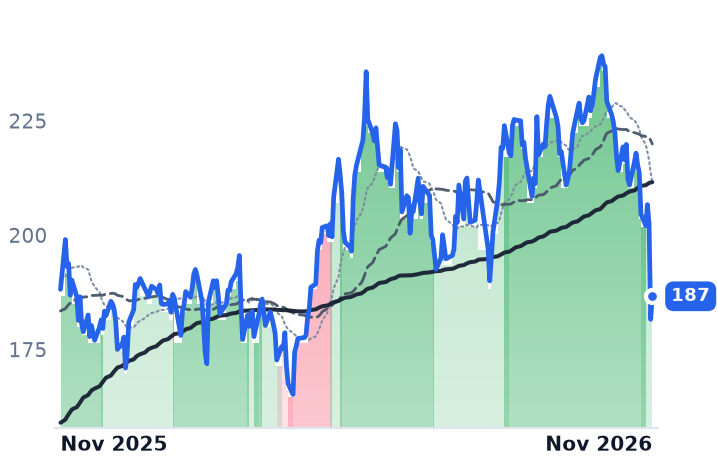
AMKR | Amkor Technology | Test & Assembly Services | ⚠️ Emerging Bear | −37.0% | −5.3% |
ASX | ASE Technology | Test & Assembly Services | 🟢 Cont. Bull | −31.4% | +107.8% |
| Compared against · context, not the story | |||||
TSM | Taiwan Semiconductor Manufacturing | Foundries | 🟢 Cont. Bull | −19.4% | +31.8% |
UMC | United Microelectronics | Foundries | 🟢 Cont. Bull | −39.8% | +86.9% |
NVDA | NVIDIA | Processors & Accelerators | 🟢 Cont. Bull | −21.2% | −0.8% |
12-month price & trend
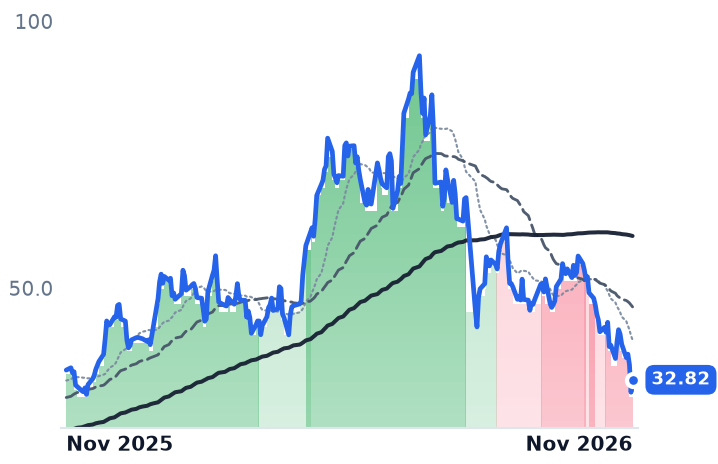
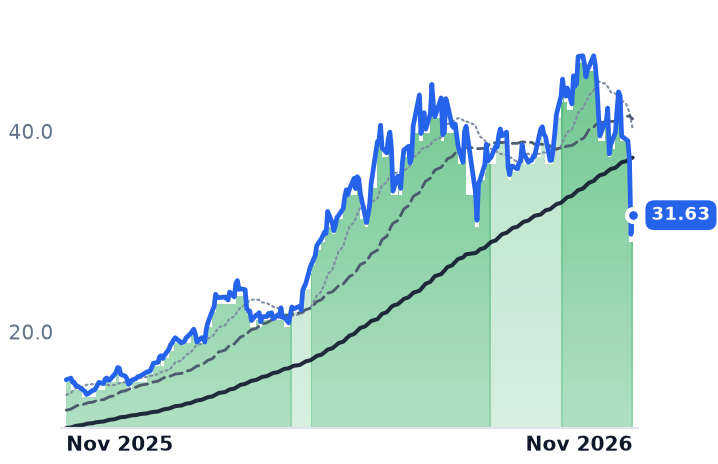
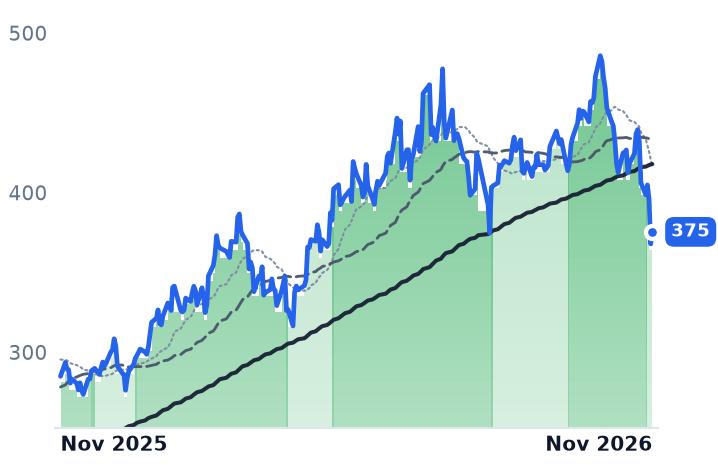
| Ticker | Mkt cap | P/E | P/E fwd | P/S | P/S fwd | P/GP | P/GP fwd | EV/EBITDA | FCF yld |
|---|---|---|---|---|---|---|---|---|---|
AMKR | $8.1B | 13.1x | 13.0x | 1.1x | 1.1x | 6.6x | 6.5x | 6.1x | 6.5% |
ASX | $69.8B | 30.0x | — | 3.0x | — | 14.2x | — | 14.9x | -3.1% |
TSM | $1.9T | 21.7x | — | 11.2x | — | 17.0x | — | 14.4x | 2.7% |
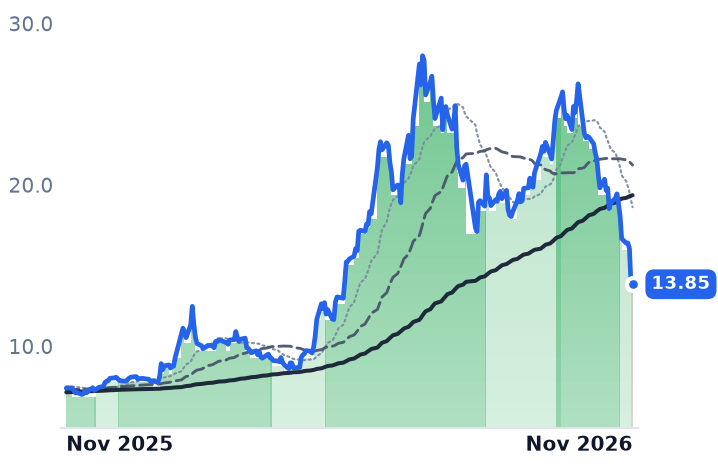
| Ticker | Mkt cap | P/E | P/E fwd | P/S | P/S fwd | P/GP | P/GP fwd | EV/EBITDA | FCF yld |
|---|---|---|---|---|---|---|---|---|---|
UMC | $34.5B | 13.5x | — | 4.3x | — | 13.9x | — | 6.7x | 6.0% |
NVDA | $5.5T | 34.3x | 25.0x | 21.5x | 13.9x | 29.0x | 18.7x | 28.3x | 2.2% |
Consensus projections
| Ticker | FY2026E | FY2027E | FY2028E | |
|---|---|---|---|---|
AMKR | Revenue | +13.5% | +13.3% | +11.1% |
| EPS | +100.7% | +9.1% | +16.5% | |
ASX | Revenue | +30.7% | +29.8% | +19.1% |
| EPS | +130.9% | +60.5% | +33.0% | |
TSM | Revenue | +43.9% | +38.6% | +26.0% |
| EPS | +68.7% | +34.6% | +27.3% | |
UMC | Revenue | +16.3% | +25.1% | +16.4% |
| EPS | +112.4% | −1.4% | +25.3% | |
NVDA | Revenue | +65.1% | +84.2% | +43.2% |
| EPS | +59.0% | +91.7% | +42.0% |
Forward fiscal years only. Blank means no analyst coverage for that year.
The two companies that do most of the world's outsourced chip packaging and test reported the best quarters in their histories inside four days in late October. By the first week of November their shares had lost roughly a third of their value, and the explanation sits in election returns rather than in either income statement.
The shelf was supposed to work the other way. The standing belief about outsourced assembly and test is that the rent from the AI buildout's tightest physical step stays upstream with Taiwan Semiconductor Manufacturing's in-house chip-on-wafer-on-substrate lines, while the listed packagers get paid out of smartphone and automotive volumes at thin, mainstream rates. Both September quarters say otherwise. Gross profit per revenue dollar rose at each, the advanced work is now a disclosed dollar line, and the compression the theory predicts shows up in only one place: contract manufacturing.
The repricing arrived from the ballot box
The 3 November midterms produced a Democratic sweep of Congress, and voters in at least ten states backed restrictions on data-center expansion over electricity costs and land use. Two days later the Nasdaq Composite fell a record 1,421.52 points, or 5.52%, with the Philadelphia Semiconductor Index down more than 12% as the buildout became a political variable rather than an engineering one.
Almost half the month's decline landed in that single session: ASE Technology's American depositary receipts fell 20.1% and Amkor 14.5%, and both rebounded the next day. Over the 30 days to 6 November Amkor was down 38.5% and ASE 32.4%. The cleanest check that this was not a verdict on packaging is United Microelectronics, a mature-node foundry with roughly $300m of AI-related revenue in 2026 and no advanced-packaging socket at all: it fell 40.3% over the same stretch, more than either packager.
Amkor's phone book shrank as its computing book set a record
Amkor, which sells wafer bumping, flip-chip, fan-out and wirebond assembly and test to fabless designers and foundries from Tempe, Arizona, grew third-quarter revenue just 0.18% year-on-year to $1,990.6m, after 25.6% growth the quarter before. Gross profit rose 27.8% on that flat top line. Margin reached 18.26% against 14.32% a year earlier, a fourth consecutive quarterly expansion and above the 13.99% the company earned for all of 2025.
The mix did it. Computing — data center, infrastructure, storage — hit a record 26% of net sales against 19% a year earlier, while Communications fell to 37% from 51%. Advanced products, meaning flip chip, memory and wafer-level processing with related test, were $1,632m of the total, about 82%. The stalled top line is the phone side: AI data centers are absorbing memory, and IDC now expects global smartphone shipments to fall 16.7% in 2026.
"Customers are not only planning further ahead, but are also making long-term commitments and providing advance payments tied to future capacity requirements," chief executive Kevin Engel told investors on 26 October. Roughly $3bn of such prepayments have arrived since 2025, including $1.5bn from Nvidia for the Peoria, Arizona campus, which carries a finalized $407m CHIPS and Science Act award and begins volume production in early 2028. It earns nothing before then, and consensus has 2027 earnings per share at $2.76 against $2.53 this year — 9.1% growth, the depreciation eating the leverage. Amkor costs 13.1x trailing earnings and 6.58x trailing gross profit, against 10.8x gross profit on 21 August.
ASE put a number on AI packaging and raised it mid-call
ASE, the largest outsourced assembly-and-test provider, posted record consolidated revenue of TWD 244.03bn, up 44.8%, with growth accelerating through the year from 17.4% in the first quarter. Its assembly-and-test arm earned a 30.6% gross margin, eight points better than a year earlier, and delivered 91% of group operating profit on 62% of revenue. The electronic manufacturing services arm is where input costs bite: its margin slipped 0.6 points to 8.3% on component pass-throughs, for 9% of group operating profit.
"The so-called structural margin ceiling has now become the base for us," chief financial officer Joseph Tung said on 29 October. Management lifted 2026 leading-edge advanced packaging revenue guidance to over $4bn from $3.7bn during the call — roughly 15% of expected group sales — disclosed $300m of full-process chip-on-wafer-on-substrate work this year ramping above $1bn in 2027, and guided co-packaged optics past $0.5bn next year. Quotes for advanced packaging went up more than 20% in July.
The bill is cash. Capital spending was raised to $11.5bn, about 43% of expected revenue; net debt stands at 66% of equity and trailing free cash flow is negative 3.1% of market value. At 30.0x trailing earnings, down from roughly 42x in August, the cheap reading rests on 2027 consensus, which implies 60.5% net income growth.
Why the overflow reaches them at all
Neither company won these accounts from TSMC, which still earns 66.41% gross margin and says customers prefer its own flow. The packagers' share is set by TSMC's shortfall: non-TSMC players are estimated to add capacity equivalent to 110,000 advanced-packaging wafers a month by end-2028, and TSMC has transferred work to ASE and Amkor rather than see orders reach Samsung. Tool orders corroborate the ramp: ASMPT booked a record $1.13bn in the September quarter, up 138%, at a 1.69x book-to-bill, including thermocompression bonders ordered by packaging partners.
So the quarters account for none of the fall, and the two names were never one tape. Amkor is down 6.6% over twelve months and has been in a downtrend since 10 August, because 37% of its sales sit in a phone market losing units; ASE is up 105.8% and held an uptrend until 4 November, because its assembly arm is sold out and priced up. What the election changed is the terminal demand both are building into, and that is a question about permits and power, not about packaging yields.
Amkor's Arizona phase one completes late 2027 on a two-phase program management now sizes at $12bn. Every ton of that concrete was poured on the assumption that someone will be allowed to plug the finished chips in.