

Rambus Is Paid Per Module Shipped, So Record DRAM Prices Left Its Royalties Falling
Hypothesis Opus 5 · Research Opus 5 · Writing Opus 5 · Prompt v1.7
A memory shortage that has sent server DRAM contract prices up double digits has not reached the company whose chips make those modules work — except as a cost. Rambus reported record revenue on 26 October and guided its licensing royalties lower for a third straight quarter, to $68–74m from the $84.2m booked in June.
The upside arrives instead through chipsets: product revenue of $114.3m, a record, guided to $127–133m, at a 60.4% product gross margin management put at the low end of its target band because wafer, substrate and assembly costs are rising. Content per module is the lever, with a multiplexed server module carrying roughly four times the silicon of a standard one.
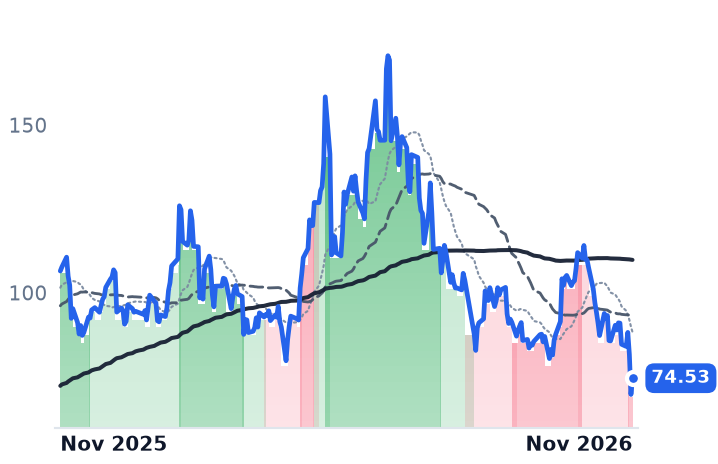
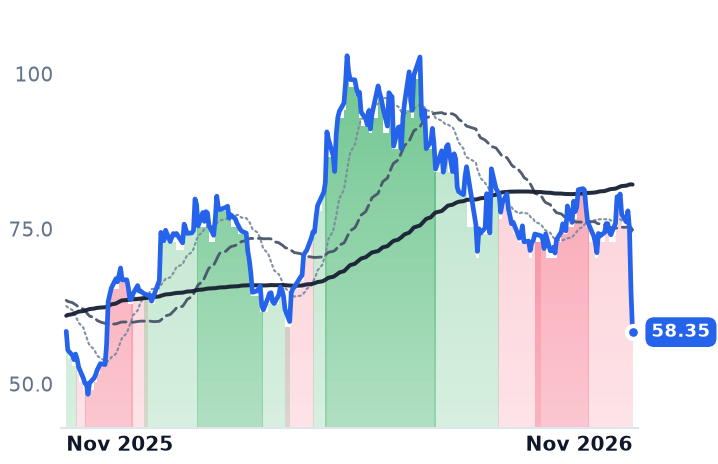
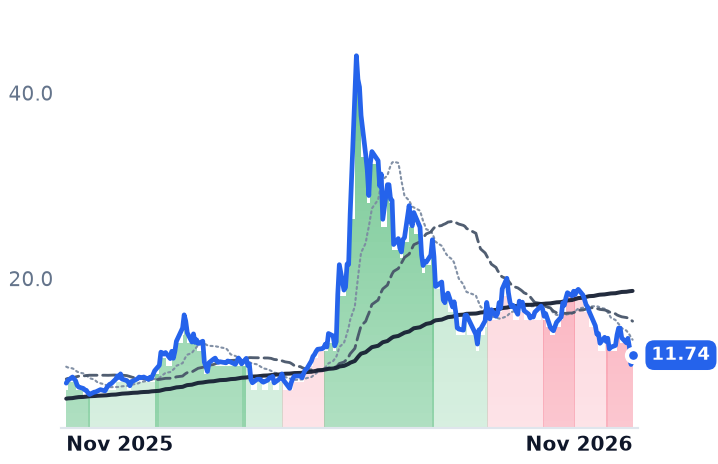
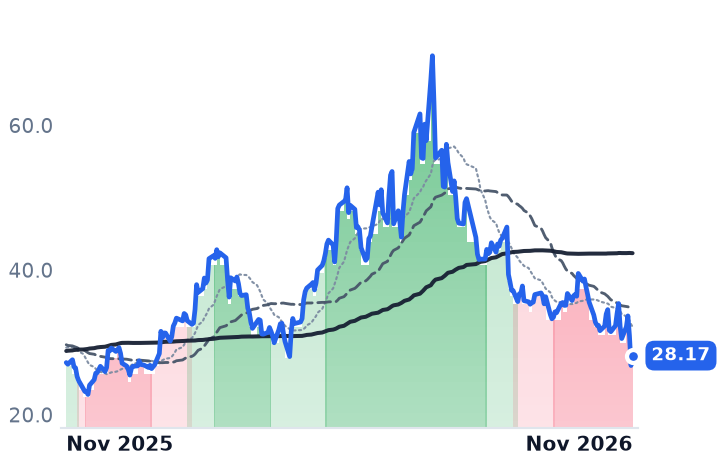
Rambus shares are down 30% in twelve months; Micron nearly tripled. Microchip's data-centre growth is switch silicon, and Everspin's memory-pooling revenue is a 2029 event.
| Ticker | Company | Segment | Trend · 13mo | 30D | 1Y |
|---|---|---|---|---|---|
| The subject · what this brief is about | |||||
RMBS | Rambus | Memory & Storage | 🔴 Cont. Bear | −32.2% | −30.0% |
MCHP | Microchip Technology Incorporated | Processors & Accelerators | ⚠️ Emerging Bear | −25.6% | −0.2% |
MRAM | Everspin Technologies | Memory (DRAM/NAND) | 🔴 Cont. Bear | −31.7% | +34.6% |
ALGM | Allegro MicroSystems | Analog & Power Management | ⚠️ Emerging Bear | −25.2% | +3.5% |
| Compared against · context, not the story | |||||
CEVA | CEVA | Sensors & Specialized Semiconductors | 🔴 Cont. Bear | −23.9% | +1.3% |
MU | Micron Technology | Memory & Storage | 🟢 Cont. Bull | −32.9% | +189.8% |
SNDK | Sandisk | Consumer Hardware | 🟢 Cont. Bull | −46.3% | +328.0% |
12-month price & trend
| Ticker | Mkt cap | P/E | P/E fwd | P/S | P/S fwd | P/GP | P/GP fwd | EV/EBITDA | FCF yld |
|---|---|---|---|---|---|---|---|---|---|
RMBS | $8.0B | 30.3x | — | 10.0x | — | 12.7x | — | 21.8x | 3.9% |
MCHP | $31.7B | 43.7x | — | 5.7x | — | 9.0x | — | 18.0x | 4.6% |
MRAM | $285.9M | n/m | — | 4.1x | — | 7.9x | — | n/m | -2.3% |
| Ticker | Mkt cap | P/E | P/E fwd | P/S | P/S fwd | P/GP | P/GP fwd | EV/EBITDA | FCF yld |
|---|---|---|---|---|---|---|---|---|---|
ALGM | $5.3B | 169.9x | — | 5.2x | — | 10.9x | — | 40.0x | 2.0% |
CEVA | $831.1M | n/m | 53.9x | 7.2x | 6.6x | 8.2x | 7.6x | n/m | -0.1% |
MU | $1.0T | 19.9x | 12.2x | 11.2x | 7.8x | 15.4x | 10.7x | 14.5x | 2.6% |
| Ticker | Mkt cap | P/E | P/E fwd | P/S | P/S fwd | P/GP | P/GP fwd | EV/EBITDA | FCF yld |
|---|---|---|---|---|---|---|---|---|---|
SNDK | $232.3B | 20.2x | 7.5x | 11.5x | 4.8x | 16.1x | 6.7x | 17.4x | 4.9% |
Consensus projections
| Ticker | FY2026E | FY2027E | FY2028E | |
|---|---|---|---|---|
RMBS | Revenue | +18.8% | +20.9% | +25.4% |
| EPS | +24.8% | +24.6% | +25.8% | |
MCHP | Revenue | +6.2% | +37.3% | +16.6% |
| EPS | +20.7% | +132.9% | +25.7% | |
MRAM | Revenue | +38.2% | +16.6% | +7.8% |
| EPS | +1620.0% | −155.0% | +64.8% | |
ALGM | Revenue | +23.0% | +26.1% | +17.6% |
| EPS | +131.1% | +96.7% | +48.1% | |
CEVA | Revenue | +14.3% | +13.3% | +12.9% |
| EPS | +31.8% | +46.4% | +36.5% | |
MU | Revenue | +248.0% | +92.8% | +11.4% |
| EPS | +804.9% | +111.2% | +7.9% | |
SNDK | Revenue | +174.4% | +143.0% | +18.2% |
| EPS | +2369.0% | +214.5% | +22.1% |
Forward fiscal years only. Blank means no analyst coverage for that year.
On 26 October Rambus, which sells the interface chips that sit on server memory modules and licenses the patents behind them, posted its best quarter on record and guided its royalty line down for the third time in a row. Product revenue reached $114.3m, up 22% from a year earlier, while royalties slipped to $77.0m from $84.2m in the June quarter and were guided to $68–74m for December.
Those are the quarters in which server memory went short. TrendForce projects conventional DRAM contract prices rising 10–15% quarter on quarter in the fourth quarter, with server supply tight as makers steer advanced capacity toward high-performance parts. A shortage of that size was taken to pay everyone standing near a memory module. Rambus's own disclosure says what the pass-through is: modules shipped and silicon per module, with a higher bill for making that silicon.
Ten data buffers where there used to be one chip
The content step is specified. A standard registered server module carries a single registering clock driver. Rambus's multiplexed version carries one multiplexed registering clock driver plus ten multiplexed data buffers, an SPD hub and two temperature sensors — roughly four times the silicon on the same socket. Platform memory channels are going from eight to between twelve and sixteen. And "de-specing" — cutting density per module so a server needs more of them — lifts unit counts even as revenue per module is squeezed.
The size of that prize is modest. Rambus put the whole multiplexed-module market at $600m and said the ramp will be shallower than for the standard clock driver, with Qualcomm in pre-production and AMD early. Renesas and Shanghai-listed Montage Technology compete for the same clock-driver content; the memory-pooling controller socket is contested by better-capitalized rivals, Astera Labs, whose Leo controllers went into Microsoft Azure's M-series in late 2025, and Marvell, which bought the switch designer XConn for about $540m in February 2026.
The shortage also sends Rambus a bill
Product gross margin was 60.4%, the bottom of a 60–63% target band, on rising wafer, substrate and packaging-and-test costs. Rambus spent roughly $12m pre-building inventory in the quarter out of $777m of cash, with a similar amount planned, because lead times are stretching. "Demand is strong going into 2027. Supply will remain tight," chief executive Luc Seraphin told investors on 26 October. Group margins still expanded: gross margin of 78.3% and an operating margin of 38.3%, both up from a year earlier.
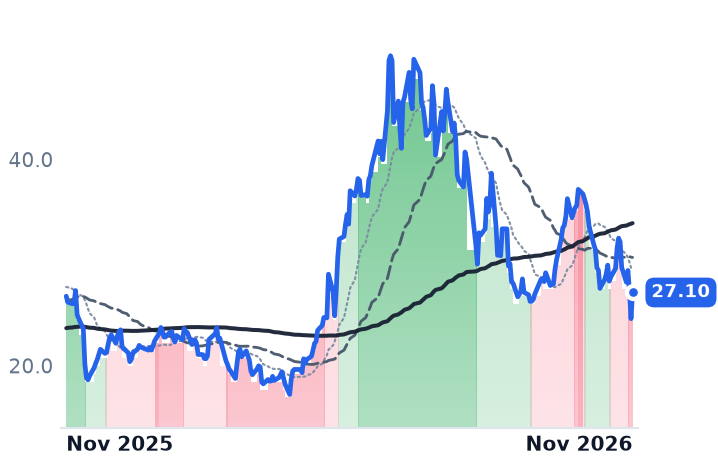
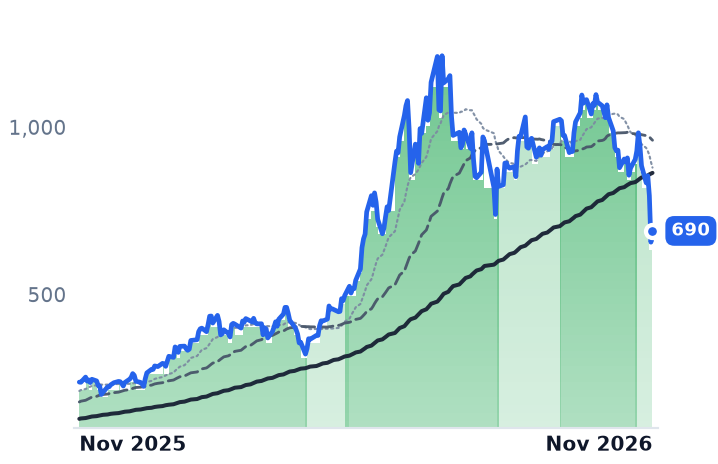
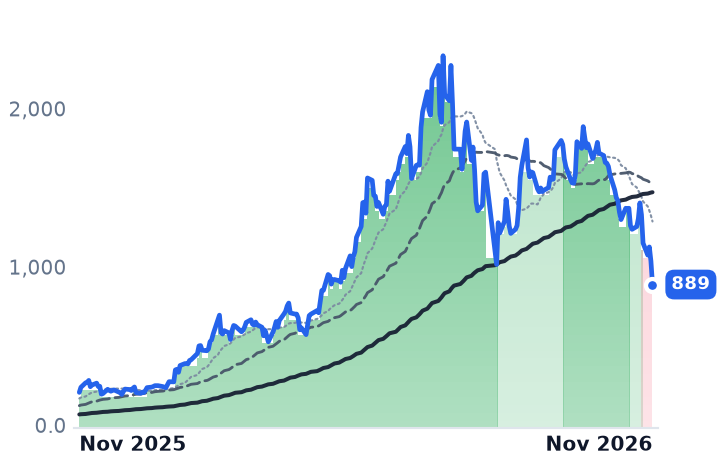
Most of the share damage arrived in one session. Rambus fell 14.6% on 5 November as the Philadelphia Semiconductor Index dropped 12.2% on post-midterm fears of restrictions on data-centre development, then recovered 7.0% the next day. Over twelve months the stock is down 30%, to $74.53, while Micron rose 194%. It trades at 19.2x consensus FY2027 earnings against 30.3x trailing, and 21.8x trailing EBITDA against roughly 25x recorded in May at a higher price.
The two neighbors on the same shelf
Microchip, the embedded-control supplier whose microcontrollers and interface chips go into cars and factories, does sell memory-pooling controllers — the SMC 2000 and SMC 2100 series — with no revenue disclosed for them. Data centre was 16.7% of September-quarter sales, and the disclosed momentum is switches and retimers: 24 cumulative design wins, double June's count. Revenue grew 42.2% with gross margin up about 1,000 basis points to 65.9%, yet the shares fell about 10% on a December guide 1% lower sequentially at the midpoint. "I have been saying it, that data center is in the bubble," chief executive Steve Sanghi said on 5 November. The stock sits at 16.0x FY2027 consensus earnings against 43.7x trailing.
Everspin, which makes magnetoresistive memory for industrial, aerospace and storage customers, grew 46.9% to a record $20.65m, of which $16.9m was product. Its memory-pooling demonstration is a 2029 revenue event by its own account. What the shortage does pay it is substitution: "we are seeing our distributors actually ask for MRAM parts that would actually replace NOR Flash," chief executive Sanjeev Aggarwal said on 28 October, as flash fabs convert to DRAM. Operating margin went from −11.0% to −38.4%, mostly on a $6m litigation provision; the shares trade at 3.2x consensus FY2027 revenue against 4.1x trailing sales, and much of the 73% fall from the high is that margin.
What the quarters account for
Almost none of the 30-day markdown at Rambus or Everspin is in the reported numbers: both printed records, and both bounced when the macro session reversed. Microchip is the exception, and it falls for a disclosed reason — $53m of one-time full-margin items that do not repeat, gross margin guided to 64–65%, and net debt at 2.36x EBITDA with buybacks deferred to deleveraging. Rambus's growth is accelerating into consensus that still models FY2027 revenue above $1bn.
The real fundamental datum against Rambus is the one the company published itself. Royalties are near-100% margin and contractual; chipsets must be fabricated, packaged and inventoried in a year its chief executive says supply stays tight. A shortage that lifts the price of DRAM raises the cost of the silicon that addresses it and pays Rambus only when another module ships.
Three quarters into the biggest memory squeeze in years, the tollbooth line is shrinking and the factory line is the one growing. That is a lower-quality dollar, and the market has been repricing the quality long before it repriced the growth.