

Containerboard Mills Idled Machines, and Their Recycled Fiber Fell $88 a Ton
Hypothesis Opus 5 · Research Opus 5 · Writing Opus 5 · Prompt v1.7
The cheapest relief in a containerboard mill's cost stack arrived this autumn for the worst possible reason: nobody was buying the fiber. Every major US paper and board mill was taking market-related downtime with inventories full, recovered fiber fell for a third straight month, and recognized board prices then sat flat through October.
Only Packaging Corp turned that into margin, with operating margin reaching 16.2% in the third quarter from 11.5% in the first — and every ton of its volume growth came from the Greif mills it bought. Smurfit Westrock's North American price rose about 5% sequentially while operating income fell 19.6% year on year and full-year guidance was cut to about $4.7bn. Graphic Packaging, which owns paperboard mills but makes no containerboard, moved most on self-help.
| Ticker | Company | Segment | Trend · 13mo | 30D | 1Y |
|---|---|---|---|---|---|
| The subject · what this brief is about | |||||
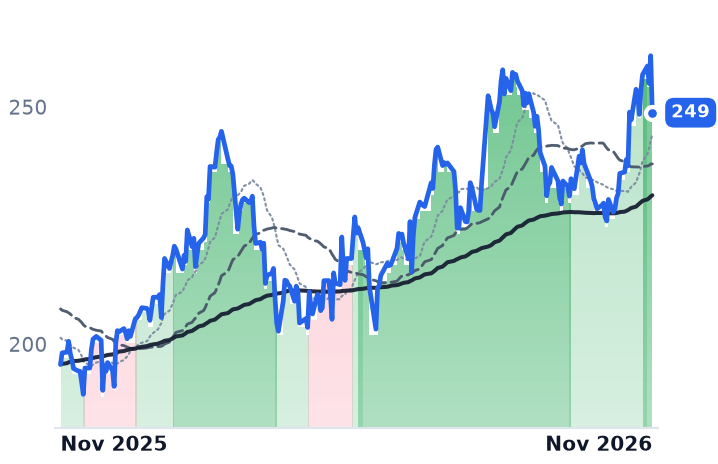
PKG | Packaging Corporation of America | Fiber-Based Packaging | 🟢 Cont. Bull | +9.7% | +27.1% |
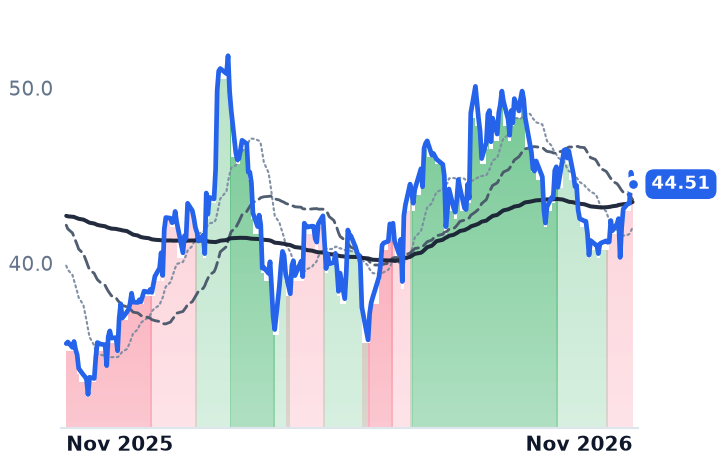
SW | Smurfit Westrock | Fiber-Based Packaging | 🌱 Emerging Bull | +6.8% | +25.7% |
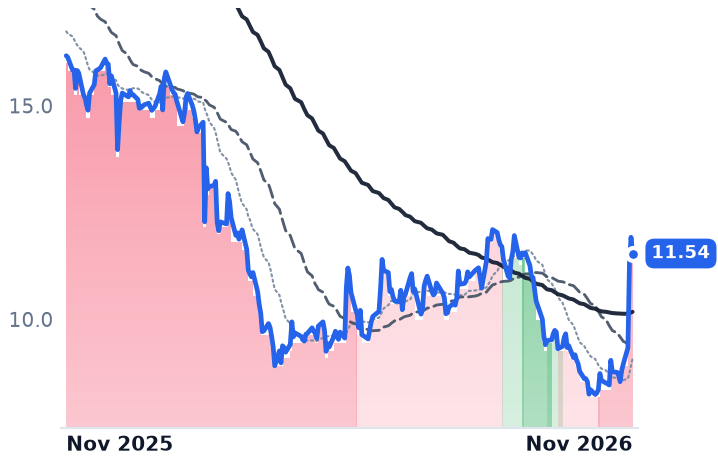
GPK | Graphic Packaging | Fiber-Based Packaging | 🔴 Cont. Bear | +35.2% | −28.6% |
| Compared against · context, not the story | |||||
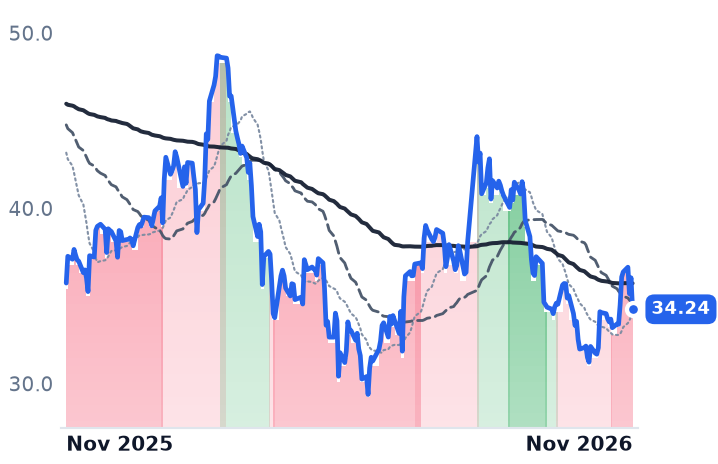
IP | International Paper | Containerboard & Packaging | 🔴 Cont. Bear | +8.7% | −4.2% |
12-month price & trend
| Ticker | Mkt cap | P/E | P/E fwd | P/S | P/S fwd | P/GP | P/GP fwd | EV/EBITDA | FCF yld |
|---|---|---|---|---|---|---|---|---|---|
PKG | $22.2B | 30.5x | 23.4x | 2.3x | 2.2x | 11.0x | 10.7x | 13.4x | 3.1% |
SW | $23.3B | 49.5x | 22.7x | 0.8x | 0.7x | 4.4x | 4.1x | 8.7x | 3.6% |
GPK | $3.4B | 46.2x | 17.5x | 0.4x | 0.4x | 2.8x | 2.8x | 9.0x | 12.1% |
| Ticker | Mkt cap | P/E | P/E fwd | P/S | P/S fwd | P/GP | P/GP fwd | EV/EBITDA | FCF yld |
|---|---|---|---|---|---|---|---|---|---|
IP | $16.8B | n/m | 25.0x | 0.7x | 0.7x | 2.5x | 2.5x | n/m | 2.9% |
Consensus projections
| Ticker | FY2026E | FY2027E | FY2028E | |
|---|---|---|---|---|
PKG | Revenue | +11.0% | +9.2% | +3.0% |
| EPS | +6.9% | +36.2% | +6.5% | |
SW | Revenue | +3.1% | +7.2% | +2.8% |
| EPS | −18.3% | +66.3% | +15.9% | |
GPK | Revenue | +0.9% | +1.9% | +1.6% |
| EPS | −64.5% | +47.4% | +18.6% | |
IP | Revenue | +0.2% | +6.5% | +1.7% |
| EPS | +426.8% | +143.8% | +12.1% |
Forward fiscal years only. Blank means no analyst coverage for that year.
Mills collected a price increase and paid less for fiber in the same quarter, and the two facts have one cause.
Fastmarkets RISI recognized a $70-a-ton rise in North American linerboard and $100 a ton in medium in September, then nothing further in October, leaving board prices flat for the month. Over the same stretch the recycled mill's main furnish went the other way. US prices for old corrugated containers were cut by up to $45 a ton in October, a cumulative $88 fall in three months, which Fastmarkets attributed to high mill inventories and market-related downtime at every major US paper and board mill, with mills unable to take outside-contract tons at any price and mixed paper being landfilled.
September's recognition was read as proof that supply discipline had restored pricing power, after roughly 3.9m tons of capacity, about a tenth of the US total, was permanently retired from February 2025 onward. The quarters reported between 22 October and 3 November say the spread genuinely widened. They also say the fiber relief is the bill for the machines that stopped running, and that one producer kept it.
The low-cost mills banked the increase
Packaging Corporation of America, which runs containerboard mills and the box plants that convert their output, earned $262m, or $3.04 a share excluding special items, on net sales of $2.6bn against $2.3bn a year earlier. Operating margin ran 11.5%, 13.4% and 16.2% through 2026's three quarters; Packaging-segment earnings before interest, taxes, depreciation and amortization (EBITDA) were $578m on $2.4bn of sales, a 23.9% margin against 23.1%.
"We have realized substantially all of the first net $50 increase and about half of the second $50 increase," Thomas A. Hassfurther, PCA's president, told investors on 22 October. Realization of the $70 increase, he said, "will be split between Q4 and Q1 and skewed more towards Q1 in terms of timing" — a third of the year's announced price is still unbanked.
Volume is where the premium is argued. Total corrugated shipments rose 10.6% per day, but legacy PCA shipments fell 0.5% per workday against an industry decline of 1.6% per workday. The growth is bought: the $1.8bn Greif containerboard business, two mills and roughly 800,000 tons, closed in September 2025, and synergies now run at "between $40 million and $50 million," chief financial officer Kent A. Pflederer said the same day, against an original $30m target. Costs still bit: freight cost $0.26 a share and fiber $0.12, with diesel about $6.32 a gallon on 25 October. Fourth-quarter guidance is $2.81 a share, $0.23 below the third, with three mills down for maintenance. The shares carry 30.5x trailing and 23.4x forward earnings, against 21.8x forward in early October.
Smurfit Westrock's price rose and its guidance fell
Smurfit Westrock, the Dublin-headquartered maker of containerboard, corrugated boxes and consumer packaging with 97,000 employees, reported $8,161m of net sales and $1,205m of adjusted EBITDA at a 14.8% margin, and cut full-year guidance to about $4.7bn. North American price rose about 5% sequentially and operating margin recovered to 5.97% from 3.85%, yet operating income fell 19.6% year on year.
The cause is energy. "Energy costs alone expected to represent approximately $700 million year on year headwind in 2026," chief executive Anthony Smurfit said on 28 October, with Dutch TTF gas up about 214% on the year. On the price itself he was blunter: "The first $100 [per ton] is really just basically recovering the cost." The company has permanently removed over 500,000 tons at St. Paul and Forney and a 127,000-ton machine at La Tuque. It trades at 8.7x trailing EV/EBITDA and 1.31x book, or 13.7x 2027 consensus earnings of $3.26 a share.
The name that moved the shelf makes no containerboard
Graphic Packaging converts its own coated recycled and bleached paperboard into folding cartons, cups and food containers for consumer-goods firms and quick-service restaurants. It rose 34% over the 30 days to 5 November, 21.2% of it on 3 November, supplying most of the three-name average gain — after falling 32.1% over the year.
Its quarter was not a board-price quarter. Volumes rose 1% while industry box shipments fell, adjusted EBITDA margin reached 13.2%, up 1.9 percentage points sequentially for a second quarter, and about $90m of full-year structural cost reductions offset $83m of Q3 inflation in chemicals, resins, secondary fiber and logistics. "Margin recovery is especially encouraging to see, given the heightened inflationary environment experienced in 2026," chief executive Robbert Rietbroek said on 3 November. At 8.97x trailing EV/EBITDA it sits near Smurfit Westrock's 8.7x and well below Packaging Corp's 13.4x, on a 12.1% trailing free-cash-flow yield; 4.7x expected year-end leverage on $5.2bn of net debt is the reason it is priced where it is.
What the three quarters account for
The month's gains have three different engines. PKG's inflection is real and its margin moved in the quarter the price did, so the business explains the move, with the caveat that the volume came from an acquisition and the remaining price lands mostly in 2027. Smurfit Westrock's sequential recovery is genuine while its year is not, and the gap is European gas at roughly ten times the US price, which its own chief executive describes as making some mills unaffordable to run. Graphic Packaging re-rated off cost cuts and pricing in paperboard grades, sharing the recovered-fiber basket but none of the containerboard spread.
The shares moved together on 5 November, PKG down 4.6% and the others less, without discoverable company news; the likelier reading is a sector or positioning move. International Paper sat out the year entirely, down 5.7%, having taken a $1.38bn goodwill impairment against its European packaging business.
The awkward part is what cheap fiber means. It is cheap because mills stopped buying it, and the moment box demand returns the furnish bill returns with it, while the announced increases are still arriving in instalments. The spread that looks widest today is the one being paid for by tons nobody is making.