

Texas's Governor-Elect Promised a Data-Center Freeze; EMCOR Just Booked a Record Backlog
Hypothesis Opus 5 · Research Opus 5 · Writing Opus 5 · Prompt v1.7
Three mechanical and electrical contractors reported accelerating revenue, expanding operating margins and record order books in late October. Within two sessions of the 3 November midterm elections they had lost between a sixth and a third of their market value, and nothing in those quarters explains it.
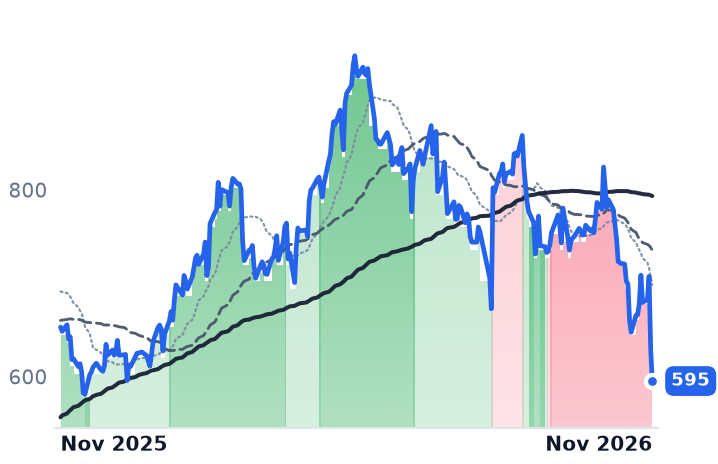
What got repriced is the permit, not the invoice. Democratic governors elected in Texas, Georgia and Ohio campaigned against data-center development, and UBS Securities put about 30% of expected 2028 US capacity additions at risk. EMCOR's remaining performance obligations reached $18.57bn, up 47% year on year, and it now trades at 17.1x forward earnings against roughly 31x in May.
Comfort Systems, with technology customers at 59% of nine-month revenue, is the most exposed of the three; EMCOR, whose healthcare work grew 31%, the least.
| Ticker | Company | Segment | Trend · 13mo | 30D | 1Y |
|---|---|---|---|---|---|
EME | EMCOR | Power Grid & Distribution | 🔴 Cont. Bear | −25.9% | −8.8% |
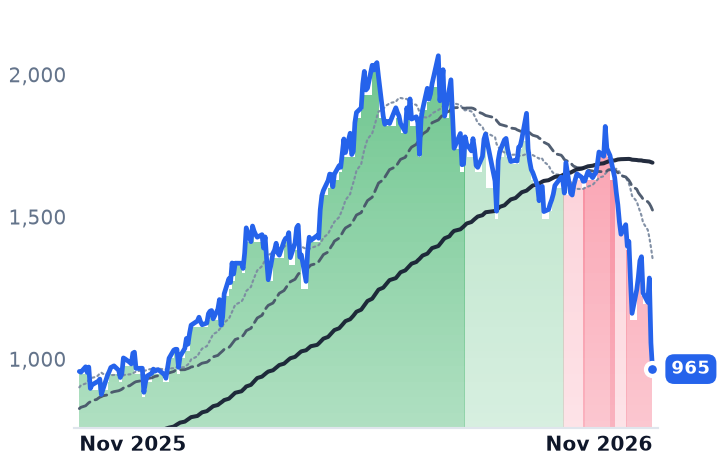
FIX | Comfort Systems USA | Building Systems | ⚠️ Emerging Bear | −44.6% | +0.9% |
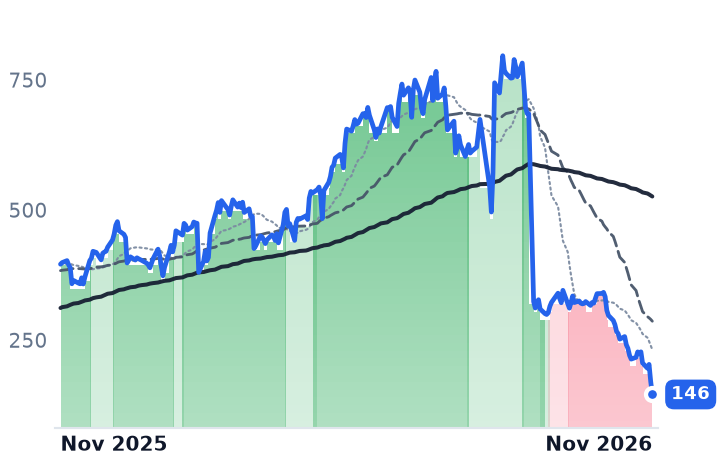
IESC | IES | Building Systems | ⚠️ Emerging Bear | −56.3% | −63.2% |
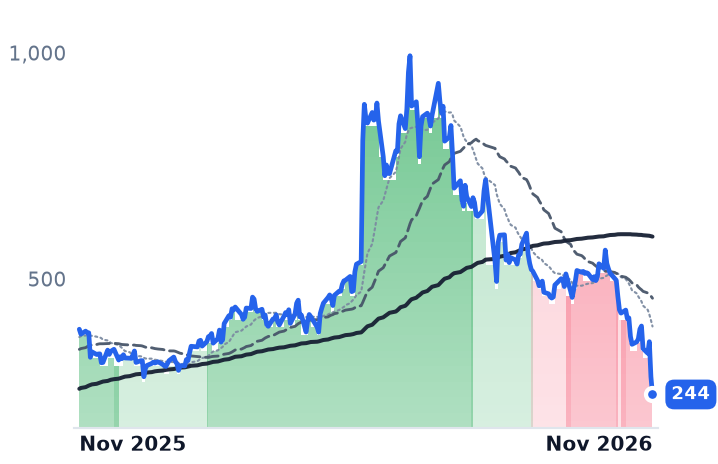
STRL | Sterling Infrastructure | Civil Infrastructure | ⚠️ Emerging Bear | −54.3% | −37.1% |
12-month price & trend
| Ticker | Mkt cap | P/E | P/E fwd | P/S | P/S fwd | P/GP | P/GP fwd | EV/EBITDA | FCF yld |
|---|---|---|---|---|---|---|---|---|---|
EME | $26.1B | 17.2x | 17.1x | 1.3x | 1.2x | 6.6x | 6.3x | 10.8x | 5.7% |
FIX | $34.0B | 20.8x | 18.9x | 2.7x | 2.5x | 10.6x | 9.7x | 14.2x | 7.2% |
IESC | $5.9B | 12.8x | 10.8x | 1.5x | 0.9x | 5.7x | 3.6x | 9.6x | 3.9% |
| Ticker | Mkt cap | P/E | P/E fwd | P/S | P/S fwd | P/GP | P/GP fwd | EV/EBITDA | FCF yld |
|---|---|---|---|---|---|---|---|---|---|
STRL | $7.5B | 13.5x | 11.3x | 1.7x | 1.6x | 7.3x | 6.8x | 8.3x | 6.3% |
Consensus projections
| Ticker | FY2026E | FY2027E | FY2028E | |
|---|---|---|---|---|
EME | Revenue | +24.5% | +14.1% | +8.9% |
| EPS | +37.3% | +17.5% | +13.9% | |
FIX | Revenue | +56.0% | +26.7% | +16.0% |
| EPS | +93.9% | +31.2% | +19.5% | |
IESC | Revenue | +27.7% | +48.1% | +18.8% |
| EPS | +76.1% | +16.8% | +17.2% | |
STRL | Revenue | +94.8% | +24.5% | +15.6% |
| EPS | +108.3% | +30.6% | +20.6% |
Forward fiscal years only. Blank means no analyst coverage for that year.
On 29 October EMCOR Group, which designs and installs power distribution, high-purity piping, HVAC and fire protection for building owners in the US and UK, raised its full-year guidance to $20.6–$21.0bn of revenue and $34.50–$35.50 of earnings per share, and disclosed remaining performance obligations of $18.57bn, a record. Five days later Texas elected a governor who had campaigned on an immediate moratorium on data-center development. EMCOR shares fell 15.9% across 4 and 5 November. Comfort Systems lost 24.9%, IES Holdings 28.4%.
The markdown has been read as the AI construction cycle cracking, and the risks these contractors themselves list are operational: skilled-trade labour inflation, hyperscaler concentration, margin damage from scaling too fast. At the operating line none of that happened. What changed is the gate in front of the 2028 order book, and no quarter any of these companies can report will settle it.
The permit, not the demand
The constraint arriving is administrative. Projects that already hold power, permits and steel proceed; projects with power but no state environmental permits slip 12 to 18 months; projects with neither move to Louisiana or Oklahoma. Most 2027 capacity is already under construction, which pushes the exposure into 2028 — the year UBS Securities says has about 30% of expected US additions at risk. Texas matters out of proportion: Wells Fargo puts 27% of planned US gigawatts there, roughly 13GW immediately exposed, and governor-elect Gina Hinojosa, who also campaigned on ending developer tax breaks, is sworn in on 17 January. The pause is not new in kind: Greg Abbott suspended permits and grid connections pending an audit in September.
That it was a pipeline event and not a market event shows in what rose. The Dow gained 1,569 points in its best post-midterm session in 44 years, and Microsoft and Amazon each added more than 6% while their contractors fell double digits. Owners of finished capacity get scarcer competition; the firms paid to build the next tranche do not.
EMCOR's margin widened where the fear said it would narrow
September-quarter revenue rose 28.8% to $5.542bn with operating margin at 9.85% against 9.43%, so operating income grew 34.5% — faster than sales. Data-center work is now roughly half of construction revenue and $8.74bn of the backlog, more than double a year earlier. The electrical segment printed 13.3% and mechanical 12.1%, with about 75% of growth organic.
The one compression disclosed cuts the other way on risk. Mechanical lost 80 basis points because AI work is shifting toward guaranteed-maximum-price and cost-plus contracts, which trims markup while moving fixed-price exposure off the contractor. "I think as we enter 2027, that decline goes away," chief financial officer Jason Nalbandian told investors on 29 October, putting mechanical on a rolling basis in a 12% to 12.5% range. Chairman and chief executive Tony Guzzi was blunter about who holds the leverage: "We have more data center constructors that want to work with us than we can serve."
Comfort Systems has the order book and the customer-list problem
Revenue at Comfort Systems, which installs mechanical, electrical and plumbing systems and builds modules off site, rose 53.7% to $3.766bn with operating margin at 16.58% against 15.46%. Backlog reached $17.81bn, up 90% year on year, an eighth consecutive sequential rise; against $3.766bn of revenue recognised, that implies by subtraction roughly $7.5bn of new bookings, order intake at about twice the conversion rate. Gross margin at 24.81% has plateaued from March's 26.33% record, attributed to higher equipment content, a $12m increase in purchase-accounting charges and early-stage job mix rather than wages.
The same filing carries the exposure: technology customers were 59% of nine-month revenue, up from 42%. Same-store growth of 47% over nine months says the concentration is organic, not bought. "Our backlog's the best it is ever been," chief financial officer Bill George said on 23 October, adding that he knew of no project whose trajectory the moratorium talk had changed. That call predated the vote.
IES is the cheapest and was marked down hardest
IES Holdings, which installs electrical and network infrastructure for co-location and managed-hosting operators alongside its residential and motor-repair units, grew June-quarter revenue 39.6% at a record 27.4% gross margin. Communications earned an 18.5% operating margin against 16.0%, Commercial & Industrial 22.5% against 11.2%. Backlog rose 91% to about $4.5bn, and in its largest deal ever IES agreed to buy structural steel fabricator DBM Global for about $650m. It trades at 12.75x trailing earnings, against roughly 34x in May. Part of its apparent collapse is arithmetic: the shares split two for one effective 24 August, making the true three-month fall 63.4% rather than 78%.
What the quarters can and cannot answer
None of the two-day move came from reported results, and little of the 30-day move did either: EMCOR is 17.1x forward earnings against roughly 31x in May, Comfort Systems 18.9x against the 36x–46x recorded then. Consensus has not followed, still carrying 14.1% revenue growth and 17.5% earnings growth for EMCOR in 2027. Analysts cut EMCOR targets to $925 at UBS, $1,000 at Oppenheimer and $920 at Cantor Fitzgerald, all far above the $595.32 close.
The split within the group has a cause. Comfort Systems fell hardest of the two large names because 59% of its revenue now comes from one end market with a newly political permit queue. EMCOR has the cushion its diversification claim promised, with healthcare up 31% and water and wastewater up 38% in the quarter. Sterling Infrastructure, whose site-development crews do earthmoving ahead of the fit-out rather than the fit-out itself, lost 21.5% on 4 November alone for a reason its chief executive Joe Cutillo had articulated on 29 October: "Our bigger challenge right now is how do we grow capacity fast enough to capture as much of Texas as is being thrown at us."
These order books run 18 to 24 months, extended from a historical nine. That is long enough for every contractor here to convert work already awarded and permitted, and short enough that the jobs now stuck in a Texas environmental queue are the ones they were counting on booking next. The test is not what gets built in 2027. It is what gets approved after 17 January.