

Symbotic's Gross Profit Grew Twice as Fast as Revenue, Then Walmart Committed $6bn More
Hypothesis Opus 5 · Research Opus 5 · Writing Opus 5 · Prompt v1.7
The warehouse-automation maker whose shares have halved in a year is getting more out of each system it installs, and its largest customer just enlarged the order book by about a third. Neither fact has done anything for the stock.
Symbotic's June quarter put gross margin at 22.3% against 18.2% a year earlier on revenue of $720.8m, with 11 new deployments started and 56 of 77 systems now operational; software and operation-services revenue grew 57% and 49%. On 29 October Walmart signed an agreement committing roughly $6bn across 25 US regional distribution centers.
The business does not explain the fall. Within the same robotics shelf, Teradyne's drop is a semiconductor-test event wearing a robotics label, and Rockwell Automation, improving and flat on the month, never declined at all.
| Ticker | Company | Segment | Trend · 13mo | 30D | 1Y |
|---|---|---|---|---|---|
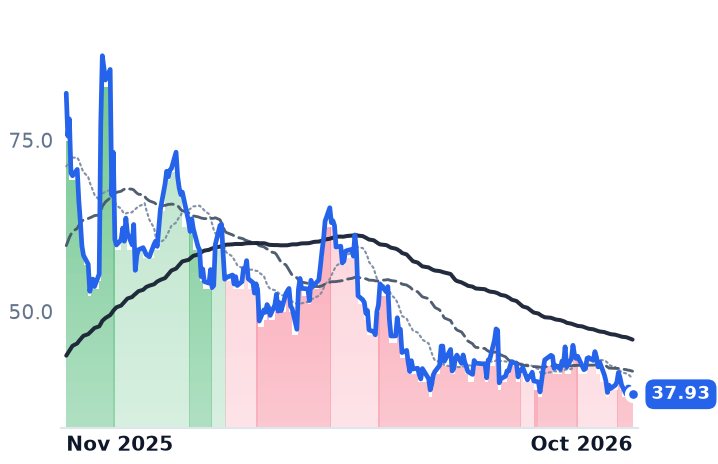
SYM | Symbotic | Industrial Automation & Motion Control | 🔴 Cont. Bear | −12.4% | −53.6% |
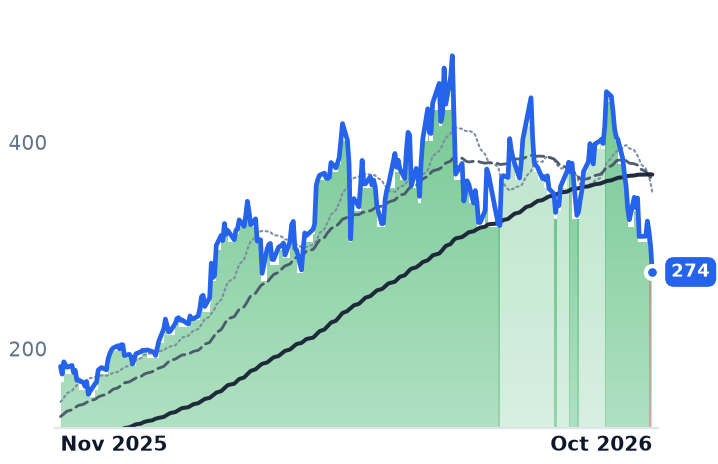
TER | Teradyne | Test & Assembly Services | 🟢 Cont. Bull | −38.9% | +50.0% |
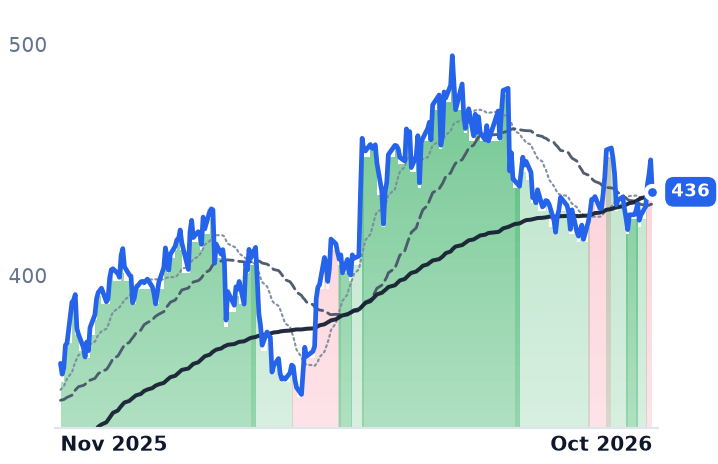
ROK | Rockwell Automation | Industrial Automation & Motion Control | 🟢 Cont. Bull | −4.0% | +20.5% |
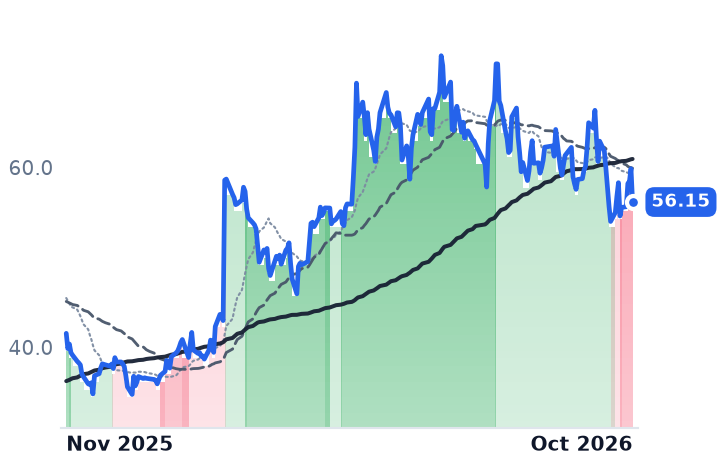
CGNX | Cognex | Test & Measurement | ⚠️ Emerging Bear | −13.6% | +35.2% |
12-month price & trend
| Ticker | Mkt cap | P/E | P/E fwd | P/S | P/S fwd | P/GP | P/GP fwd | EV/EBITDA | FCF yld |
|---|---|---|---|---|---|---|---|---|---|
SYM | $23.0B | 395.9x | 92.3x | 8.7x | 6.4x | 40.2x | 29.6x | 360.2x | 3.2% |
TER | $42.9B | 31.3x | 28.9x | 8.6x | 8.2x | 14.5x | 13.8x | 23.8x | 2.4% |
ROK | $48.5B | 40.8x | 29.3x | 5.4x | 5.1x | 9.9x | 9.3x | 29.2x | 3.1% |
| Ticker | Mkt cap | P/E | P/E fwd | P/S | P/S fwd | P/GP | P/GP fwd | EV/EBITDA | FCF yld |
|---|---|---|---|---|---|---|---|---|---|
CGNX | $9.4B | 53.5x | 33.4x | 8.7x | 8.2x | 12.6x | 12.0x | 33.0x | 2.8% |
Consensus projections
| Ticker | FY2026E | FY2027E | FY2028E | |
|---|---|---|---|---|
SYM | Revenue | +25.6% | +28.3% | +25.8% |
| EPS | −15.8% | +101.1% | +105.7% | |
TER | Revenue | +69.7% | +24.6% | +22.3% |
| EPS | +167.0% | +30.0% | +30.9% | |
ROK | Revenue | +10.1% | +5.8% | +6.2% |
| EPS | +31.8% | +12.6% | +11.4% | |
CGNX | Revenue | +16.8% | +11.0% | +10.8% |
| EPS | +74.9% | +17.9% | +14.5% |
Forward fiscal years only. Blank means no analyst coverage for that year.
Walmart signed an Enterprise Master Automation Agreement with Symbotic on 29 October, committing roughly $6bn of spend over several years across 25 US regional distribution centers and selected Americas markets, plus $125m for next-generation racking and inventory technology. Symbotic, which sells an end-to-end automated warehousing system of robots and software to wholesalers and retailers, expects the commitments to add up to $6.92bn to its future backlog — about 31% on top of the $22.5bn it carried at the end of June. The shares rose 3.7% premarket on 30 October, then closed at $37.93, below the $38.97 close of the last session before the agreement was signed.
The month's selling across robotics names has been read as a verdict on robot demand. What a deployed Symbotic system actually earns its maker says the opposite.
Fifty-six systems running, and each one earns more
In the quarter ended 27 June, revenue reached $720.8m, up 21.7%, while gross profit grew 49.5% to $160.9m — more than twice the pace of sales. Gross margin went to 22.3% from 18.2%, and the company swung to a $32.9m operating profit from a $20.2m loss. It started 11 new system deployments, brought four more into operation to reach 56 operational of 77 in deployment, and recorded adjusted EBITDA of $95m against $45m a year earlier.
The layer that compounds behind the hardware is growing faster than the hardware. Systems revenue was $671m, up 20%; software revenue was $13m, up 57%; operation services $37m, up 49%. Founder and chief executive Rick Cohen told investors the margin move was not a structural step: "it just has, once again, to do with the mix of deployments," he said on the third-quarter call, "it really then comes down, when you're tracking it, just really comes down to the 11 deployments we are putting in the quarter, just what those pricing adjustments were." The multi-year line is steadier than that caveat implies — full-year gross margin was 18.8% in fiscal 2025 on $2.247bn of revenue, against 15.6% on $1.788bn the year before.
The shares fell from $77.26 a year ago to $37.93, a decline of 50.9%, with 9.0% of that in the past month, and the trend has been bearish since early August rather than breaking in one session. On trailing earnings the stock is at 396x, which measures nothing at a 1.6% net margin. Against gross profit, the measure that fits a hardware deployer, it is 29.6x forward against 40.2x trailing — still 92x forward earnings.
Teradyne's 31% fall is about chip testers
Teradyne carries the robotics label on this shelf and supplied roughly two-thirds of its monthly drawdown, falling 31.2% in October. Its Robotics segment — Universal Robots collaborative arms and MiR autonomous mobile robots — did $96m in the September quarter, up 28% and profitable for the first time, with the Gen7 cobot launched in the period. That is 7.3% of the $1.306bn the company billed. Semiconductor Test passed $1bn, up 77%, and total operating margin went to 30.8% from 18.9%.
The shares fell after a beat: adjusted earnings of $2.29 against $2.06 expected, spoiled by a December-quarter guide whose $1.30bn midpoint sits fractionally below the quarter just reported and gross margin guided down to 57.5–58.5%. Then came 30 October, when the semiconductor index slid 7.2% and Intel fell nearly 29%. Chief executive Gregory Smith framed robots as the next thing, not the current thing: "with the growth of physical AI, the capabilities of physical AI, we think that that is going to unlock significant growth in the robotics group." Management puts broad physical-AI deployment at 2028 and later. At 28.9x this year's consensus earnings and 22.2x next year's, against the 30–35x the stock carried in May, the de-rating arrived while estimates rose.
The one that never fell
Rockwell Automation, which sells control hardware, industrial software and lifecycle services to factory operators, is flat over the 30-day window and up 19.3% over the year. Its June quarter had organic sales up 10% and Software & Control revenue of $751m, up 19%, at a 34.8% segment margin against 31.6%, with full-year guidance raised. Software & Control book-to-bill came in at 0.97, the one number pointing the other way, and on the call management said "the book-to-bill is in good shape." No deferral of discrete-automation spending was flagged. At 40.8x trailing and 29.3x forward earnings, Rockwell is below the 45.9x it carried in early May.
So the drawdown is a repricing, and most of it is not about robots at all. Teradyne's fall traces to a flat sequential guide inside a sector that lost a fifth of its value, and its robot line is too small to move the share price either way. Rockwell has no drawdown to explain. That leaves Symbotic, where the gap is real and one-directional: deployments started, systems brought live, margin per system and recurring revenue all moved up through fiscal 2026 while the equity lost half its value, and the single largest customer has now underwritten the next several years of installs.
What the agreement does not fix is the thing that makes the stock fragile. Walmart is getting a board nomination recommendation and non-voting observers in the boardroom of the supplier it has just committed $6bn to, and Symbotic accepted certain restrictions on whom it sells to. The customer concentration investors call Symbotic's chief risk is now also the reason its order book is growing.