

Comfort Systems Says Its Limit Is How Many Electricians It Can Get to the Job Site
Hypothesis Opus 5 · Research Opus 5 · Writing Opus 5 · Prompt v1.7
The contractors that install the pipe, conduit and switchgear inside AI data centers have lost between a fifth and a third of their market value since early October, and nothing in their filings turned. Comfort Systems' September quarter grew revenue 53.7% with gross margin flat at 24.8%, on a record $17.81bn backlog that was 97.6% same-store.
EMCOR's one visible margin give-back runs opposite to the labor-squeeze story: US Mechanical gave up 110 basis points to 12.5% because it took on more cost-plus and guaranteed-maximum-price data-center work, trading markup for protection against wage inflation.
Of the three, only IES Holdings has cheapness it earned, with consensus putting next year's EBITDA margin at 13.0% against 16.5% after it bolted on $1.5bn of structural-steel revenue. Comfort Systems at 25.4x forward earnings, against roughly 46x in May, is the price of money at its customers, not a change in its own book.
| Ticker | Company | Segment | Trend · 13mo | 30D | 1Y |
|---|---|---|---|---|---|
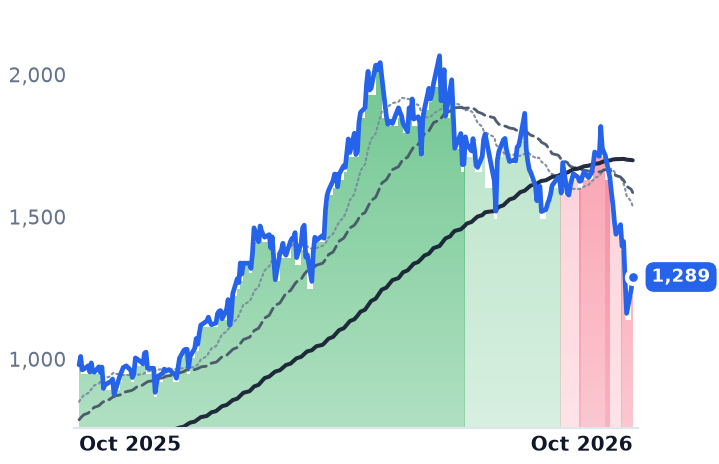
FIX | Comfort Systems USA | Building Systems | ⚠️ Emerging Bear | −21.3% | +31.5% |
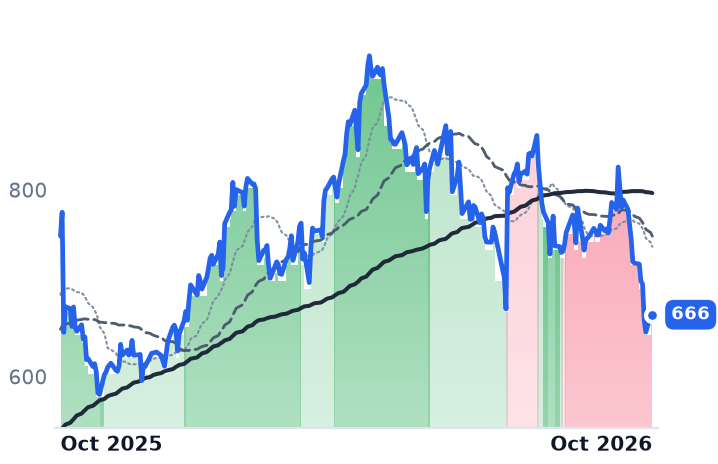
EME | EMCOR | Power Grid & Distribution | ⚠️ Emerging Bear | −11.8% | −11.2% |
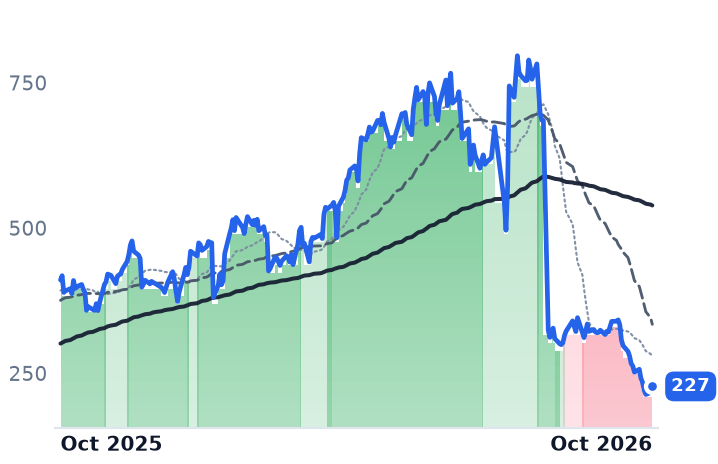
IESC | IES | Building Systems | ⚠️ Emerging Bear | −28.2% | −44.6% |
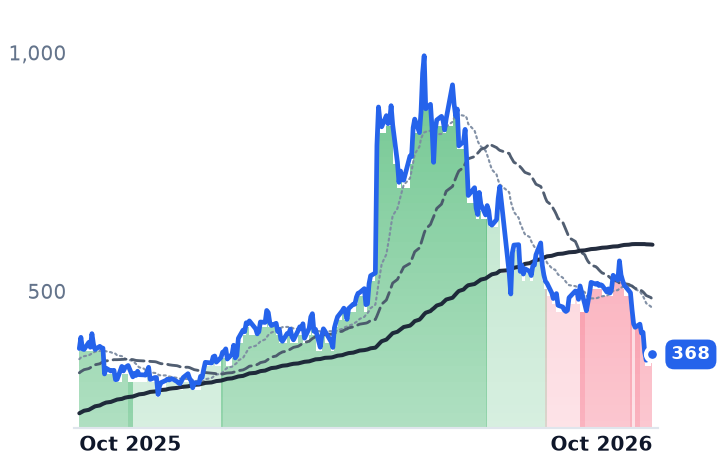
STRL | Sterling Infrastructure | Civil Infrastructure | ⚠️ Emerging Bear | −26.3% | −3.3% |
12-month price & trend
| Ticker | Mkt cap | P/E | P/E fwd | P/S | P/S fwd | P/GP | P/GP fwd | EV/EBITDA | FCF yld |
|---|---|---|---|---|---|---|---|---|---|
FIX | $45.4B | 27.8x | 25.4x | 3.6x | 3.3x | 14.1x | 13.0x | 19.2x | 5.4% |
EME | $29.4B | 20.7x | 20.2x | 1.6x | 1.4x | 8.0x | 7.4x | 12.9x | 4.0% |
IESC | $9.2B | 19.9x | 16.8x | 2.3x | 1.5x | 8.9x | 5.6x | 15.0x | 2.5% |
| Ticker | Mkt cap | P/E | P/E fwd | P/S | P/S fwd | P/GP | P/GP fwd | EV/EBITDA | FCF yld |
|---|---|---|---|---|---|---|---|---|---|
STRL | $11.2B | 26.2x | 18.4x | 3.3x | 2.7x | 13.7x | 11.5x | 15.7x | 4.3% |
Consensus projections
| Ticker | FY2026E | FY2027E | FY2028E | |
|---|---|---|---|---|
FIX | Revenue | +55.1% | +25.0% | +18.2% |
| EPS | +93.1% | +29.9% | +21.2% | |
EME | Revenue | +21.4% | +11.1% | +8.1% |
| EPS | +30.2% | +13.3% | +13.4% | |
IESC | Revenue | +27.7% | +48.1% | +18.8% |
| EPS | +76.1% | +16.8% | +17.2% | |
STRL | Revenue | +73.3% | +21.8% | +19.0% |
| EPS | +93.3% | +28.7% | +22.2% |
Forward fiscal years only. Blank means no analyst coverage for that year.
Comfort Systems USA, which installs heating, cooling, piping, electrical and fire-protection systems in commercial and industrial buildings and fabricates modules off site, closed its September quarter with an order book nearly double a year earlier and a gross margin that did not move. Then its president told investors what decides how much of that book becomes revenue: the number of electricians and pipefitters the company can get onto a job site.
The selloff across mechanical and electrical contracting since early October has been read as the AI build-out cracking at the trade that actually swings the conduit, the first place a capital-spending pause would show. The filings of all three contractors say demand is intact, with records in backlog, margin and guidance at each. What repriced is the cost of capital at the companies signing the work.
Labor is the governor, and the wage premium has not come in
"The governor is not the man... the governor's really just labor. The ability to be able to get the labor to the work," Comfort Systems president Trent McKenna said on the 23 October call. Chief financial officer Bill George, who is retiring after 30 years, put the order book plainly: "Our backlog's the best it is ever been."
Backlog reached $17.81bn at 30 September against $9.38bn a year earlier, an eighth consecutive sequential increase, and $17.39bn of it was same-store, so 97.6% of the record was won organically rather than acquired. Set the $3.75bn sequential gain against the $3.766bn of revenue recognized and the implied book-to-bill is roughly 2.0x. Technology work, the data-center line, reached 59% of nine-month revenue from 42%. Operating margin widened to 16.58% from 15.46%.
The price of hands has not come in either. IBEW Local 26 journeymen in Northern Virginia's data-center corridor are at $62.00 an hour plus a benefit package worth $28.66, construction labor costs in primary North American markets have been rising 8% to 12% a year, and journeyman pipefitters under local United Association agreements run $68 to $72 all-in.
Comfort Systems absorbed none of it at the gross line, which is what a 17% year-to-date modular share and capacity going from more than 4M to a targeted 6M sq ft buys.
EMCOR paid 110 basis points to stop carrying wage inflation
EMCOR, which designs and maintains power distribution, low-voltage networks, process piping and HVAC systems in the US and UK, posted the only visible margin give-back among the three, and it runs backwards to a labor squeeze. US Electrical Construction margin rose 210 basis points to 13.9%; US Mechanical fell 110 basis points to 12.5% on a higher mix of construction-manager roles and guaranteed-maximum-price and cost-plus contracts carrying lower markups, including more complex data-center projects. The company sold markup to make the owner carry material and wage inflation.
Its contracted book supports the trade. Remaining performance obligations reached $17.14bn, up 43.9%, with the largest gains in network and communications, and guidance went to $32.00–33.25 a share. An AI data center carries a mechanical content multiplier of "1.5 to 2" against a conventional facility, chief executive Anthony Guzzi told investors on 30 July. On an unchanged 44,000 headcount, the guidance midpoint implies about $460,000 of revenue per employee against roughly $386,000 in FY2025, a derived 19% gain in output per head.
IES bought revenue that earns less per worker
IES Holdings, which engineers and installs electrical and technology systems for commercial, data-center, industrial and residential customers, grew June-quarter revenue 39.6% to $1.243bn at a record 27.41% gross margin, with non-GAAP backlog near $4.5bn, up 91% since fiscal year-end. On 5 October it closed the largest acquisition in its history, paying about $691m for DBM Global, a structural-steel fabricator with roughly $1.5bn of trailing revenue and about 4,000 employees. Consensus has FY2027 revenue up 48.1% while EBITDA margin falls to 12.99% from 16.53%, leaving earnings per share ahead only 16.8%, and that forecast rests on one analyst.
What actually got repriced
The decline began before the numbers did: Comfort Systems fell 5.89% on 7 October after a Zacks Research downgrade, two weeks ahead of any third-quarter figures, then 9.3% the session after the 22 October report, leaving it 29.1% below its 6 October close.
Meanwhile the buyers' funding tightened. Meta's third-quarter capital spending of $34.91bn exceeded its cash from operations and free cash flow swung to minus $2.12bn from positive $10.63bn, with chief financial officer Susan Li calling capital planning "highly dynamic" and no 2027 figure given, even as the company said its plans are "geared towards maximizing 2026 and 2027 capacity." Further down the buyer list, CoreWeave's unsecured bonds yield close to 16%. Comfort Systems has stretched backlog duration to 18–24 months from roughly nine historically, and nearly half of about 140 US data-center projects slated to open in 2026 have slipped or been canceled on power and parts. A longer book is more exposed to a slip in timing, which discounts the backlog without touching the bid margin inside it.
The spread among the three says the repricing sits with the buyer, not the trade. Over the 30 days to 27 October the most diversified name fell least, EMCOR by 12.6%, while Comfort Systems, the purest data-center exposure at 59% technology revenue, fell 22.3% and IES fell 29.8% on its own steel deal. Comfort Systems now trades at 25.4x forward earnings and 14.1x trailing gross profit, against roughly 46x forward and 27.2x in May; EMCOR sits at 20.8x trailing against 31.4x then. Only IES, cheapest at 16.8x forward, has disclosed margin dilution to justify the gap. Price-target cuts at Oppenheimer, KeyCorp and DA Davidson all still sit far above the market price, which is what multiple compression without an earnings revision looks like.
EMCOR reports third-quarter results before the open on 29 October, with consensus at $8.37 a share. The line that will settle the argument is the order book: a backlog that keeps lengthening while its owners' borrowing costs climb is a different asset than it was in May.