

Truckload Rates Rose on a Record Fuel Surcharge; the Rate Carriers Keep Went Backwards
Hypothesis Opus 5 · Research Opus 5 · Writing Opus 5 · Prompt v1.7
September looked like the month the freight recovery arrived: spot and contract rates rose across every trailer type. Strip out the fuel surcharge, which reaches a carrier and leaves again at zero margin, and dry-van pricing fell in both the spot and contract markets.
The second prop softened in the same window. The average retail price of a used Class 8 truck slipped 1.5% from August to $61,000, with retail sales off 7%. That line matters most at Heartland Express, where gains on selling trucks ran at 13.6% of June-quarter revenue and delivered a profit on top of an operating loss.
Werner's dedicated contracts are repricing up 3-5%, and refrigerated rates rose, which separates Marten from the dry-van pair. All three were marked down about a quarter in three months, and the compressed margins behind that are doing rational work.
| Ticker | Company | Segment | Trend · 13mo | 30D | 1Y |
|---|---|---|---|---|---|
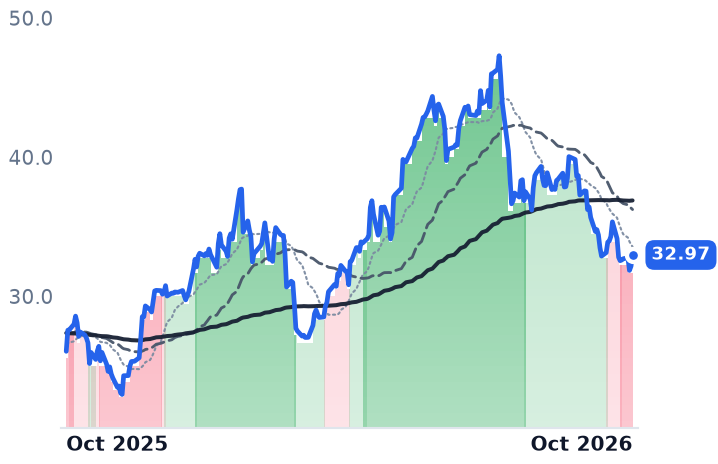
WERN | Werner Enterprises | Truckload & Dedicated | ⚠️ Emerging Bear | −12.2% | +26.6% |
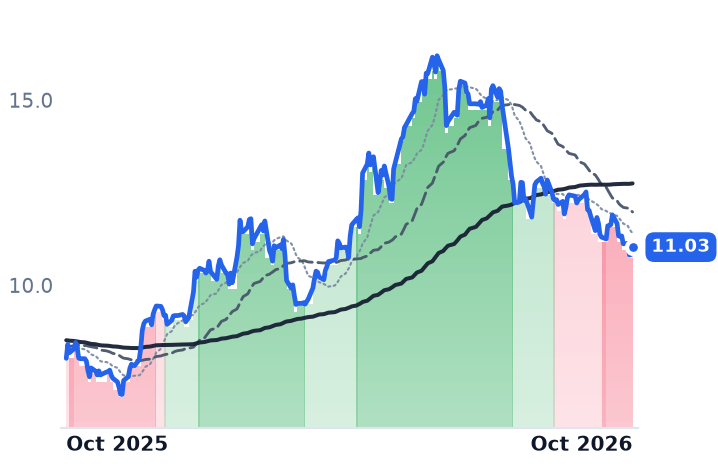
HTLD | Heartland Express | Truckload & Dedicated | ⚠️ Emerging Bear | −11.9% | +37.4% |
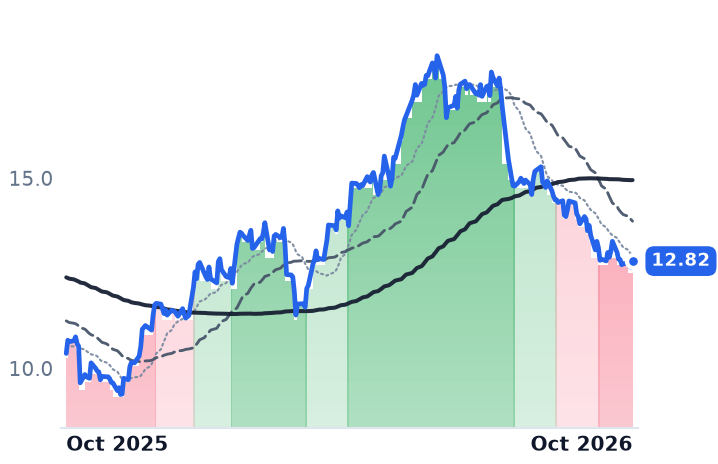
MRTN | Marten Transport | Truckload & Dedicated | ⚠️ Emerging Bear | −8.0% | +23.3% |
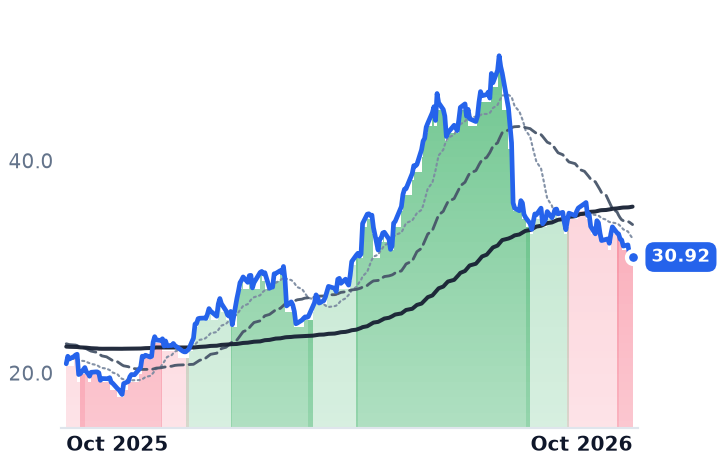
CVLG | Covenant Logistics | Truckload & Dedicated | ⚠️ Emerging Bear | −14.2% | +48.2% |
12-month price & trend
| Ticker | Mkt cap | P/E | P/E fwd | P/S | P/S fwd | P/GP | P/GP fwd | EV/EBITDA | FCF yld |
|---|---|---|---|---|---|---|---|---|---|
WERN | $2.0B | n/m | 29.2x | 0.6x | 0.5x | 8.4x | 7.5x | 9.9x | 2.7% |
HTLD | $854.5M | n/m | 75.3x | 1.2x | 1.2x | 15.5x | 16.0x | 9.2x | -10.0% |
MRTN | $1.0B | 82.7x | 46.9x | 1.2x | 1.2x | 101.4x | 97.2x | 8.3x | 0.1% |
| Ticker | Mkt cap | P/E | P/E fwd | P/S | P/S fwd | P/GP | P/GP fwd | EV/EBITDA | FCF yld |
|---|---|---|---|---|---|---|---|---|---|
CVLG | $784.6M | 206.1x | 18.6x | 0.6x | 0.6x | 6.0x | 5.6x | 8.1x | 14.0% |
Consensus projections
| Ticker | FY2026E | FY2027E | FY2028E | |
|---|---|---|---|---|
WERN | Revenue | +21.5% | +7.8% | +5.9% |
| EPS | +1669.2% | +98.4% | +37.5% | |
HTLD | Revenue | −12.7% | +7.4% | +8.4% |
| EPS | −130.1% | +244.6% | +39.8% | |
MRTN | Revenue | +1.7% | +9.7% | — |
| EPS | +39.5% | +137.8% | — | |
CVLG | Revenue | +12.7% | +8.4% | +6.9% |
| EPS | +6.9% | +62.2% | +30.1% |
Forward fiscal years only. Blank means no analyst coverage for that year.
Two freight data sets published on 13 October took away the arithmetic the truckload trade had been running on. DAT's monthly release reported that spot and contract rates including fuel rose for all three equipment types in September, as the monthly national average on-highway diesel price passed $6 a gallon for the first time. Excluding fuel, van and flatbed rates declined in both the spot and the contract market. Only refrigerated pricing rose.
That distinction is the whole business. An asset-based carrier is paid revenue per mile net of fuel surcharge, multiplied by the miles each tractor runs in a week, multiplied by the number of trucks it can put a driver in. DAT estimates the surcharge reached a record 84 cents a mile for dry van in September, up 14 cents from August, inside an all-in spot rate of $3.01. September's rate print was widely read as the capacity squeeze finally reaching price. What reached price was diesel.
None of those 84 cents pays a driver or a depreciation charge.
The prop under Heartland's profit was the resale lot
The other leg under these shares was used-equipment value. ACT Research's September flash put the same-dealer average retail price of a used Class 8 truck down 1.5% from August to $61,000, softening more than seasonally expected, and retail sales fell 7% from August in a second consecutive monthly decline.
Heartland Express, the North Liberty, Iowa short-to-medium-haul dry-van carrier, is where that line does the heaviest lifting. Gains on the sale of revenue equipment ran at 13.6% of June-quarter revenue against a 2015-25 average of 4.1%, and without them the operating ratio would have been nearer 103% than the 91.0% reported. Net income of $10.6m sat above an operating loss of $8.5m. Heartland holds no quarterly earnings call and discloses no rate or utilisation metrics, so the resale line is the clearest window the company offers. The shares trade at 9.17x enterprise value to trailing earnings before interest, tax, depreciation and amortisation and 1.13x book, the cheapest book value of the three, while 75.3x on 2026 consensus earnings falls to roughly 21.8x on 2027 — a 245% per-share increase the price already pays for.
Werner is repricing truck-weeks by the year
Werner Enterprises, the Omaha full-truckload and logistics operator, took the other route out of the spot market. More than 70% of its truckload fleet, about 7,400 trucks, sits under dedicated agreements, and the one-way fleet shrank from nearly 3,300 tractors in 2022 to under 2,400 at the end of 2025. Dedicated revenue per tractor per week rose 5.4% net of fuel surcharge in the June quarter, and the company raised dedicated pricing guidance to up 3-5%. The pace is contractual. Renewals should bring "up low to mid-single digit type increases," senior vice-president of pricing Chris Neal said, and chief executive Derek Leathers added that "you need a couple of years of that to really get dedicated back to its traditional long-term run rate".
Reported earnings flatter and then punish. Revenue grew 24.0% to $933.9m in the June quarter, helped by a dedicated-carrier acquisition completed in January. Operating income fell 74.5% to $16.9m, against a prior-year quarter that carried a $45.7m insurance-and-claims reversal. At 9.93x trailing EV/EBITDA, Werner's forward path runs from 29.2x on 2026 consensus to about 14.8x on 2027, on a 97% jump in net income.
Marten's refrigerated rates helped; its dedicated book did not
Marten Transport hauls temperature-controlled food and consumer goods, and was the one name September's data favored: refrigerated spot rates rose 24 cents from August to $3.62 a mile. Its dedicated segment went the other way, the operating ratio deteriorating to 96.4% from 92.4% a year earlier. Revenue fell 2.8% to $223.5m and operating margin compressed to 2.35% from 4.23%. At 8.31x trailing EV/EBITDA, the cheapest of the three, 46.9x on 2026 consensus falls to roughly 19.7x on 2027.
What the de-rating already accounts for
Revenue trajectories improved at all three: Heartland's year-over-year decline narrowed from 26.1% to 12.5% over three quarters, Marten's from 8.8% to 2.8%. Margins compressed at every one of them. The two lines disagree because what improved was the part of the dollar nobody is paid on, and because the capacity story the shares were bought for has no revenue in it yet. "The truck market has certainly flipped this year, but recent tonnage levels confirm this is due to reduced capacity, not robust demand," American Trucking Associations chief economist Bob Costello said in the September tonnage release, which showed the index down 0.9% to 114.2.
Capacity exit sets a floor under future price; it does not fill a quarter. UBS cut Werner and Heartland to hold from buy and JP Morgan moved both to underweight, arguing a truckload rate recovery would be pushed out. With ex-fuel van pricing lower, used-truck values easing and the weekly national diesel average down from its $6.529 peak in the week of 21 September to $6.199 by 5 October, a markdown from an expensive multiple is doing rational work. The near-identical 8.3x-to-9.9x band across three structurally different fleets says the market repriced a shelf.
Diesel has turned back down from its late-September record, which takes the flattery out of the top line before it takes anything out of cost. Marten prints first, after the close on 22 October, and what it reports will carry less surcharge in it than September's rates did.