

Delta and United Carry the Fuel Risk on Four-Fifths of SkyWest's Revenue
Hypothesis Opus 5 · Research Opus 5 · Writing Opus 5 · Prompt v1.7
Jet fuel in the US Gulf has nearly doubled in a year, and the regional carrier that flies for Delta, United, American and Alaska has been the steadiest airline on the board while its own customers' shares fell by a fifth and more. The reason is contractual rather than commercial: SkyWest is paid a fixed monthly rate per contracted aircraft plus a rate per block hour, and the partner usually buys the gas.
That covered $864m of SkyWest's $1,102.8m June-quarter revenue. The exposed slice is the prorate and charter flying where SkyWest sells the ticket and buys the fuel itself, 18.2% of revenue and growing 38%, and management recovered only about 60% of the fuel increase there. It is enough to turn rising block hours into falling profit: operating income was down 8.4% year on year, at 8.7x forward earnings against Delta's 14.0x.
| Ticker | Company | Segment | Trend · 13mo | 30D | 1Y |
|---|---|---|---|---|---|
| The subject · what this brief is about | |||||
SKYW | SkyWest | Regional & Emerging Airlines | 🟢 Cont. Bull | −4.5% | −10.0% |
RJET | Republic Airways | Regional & Emerging Airlines | ⚠️ Emerging Bear | −8.5% | −26.2% |
SNCY | Sun Country Airlines | Regional & Emerging Airlines | 🟢 Cont. Bull | — | +38.1% |
| Compared against · context, not the story | |||||
DAL | Delta Air Lines | Major Network Carriers | 🟢 Cont. Bull | −3.3% | +24.7% |
ALGT | Allegiant Travel | Low-Cost Carriers | ⚠️ Emerging Bear | −14.9% | +1.4% |
UAL | United Airlines | Major Network Carriers | 🟢 Cont. Bull | −7.8% | −5.3% |
ALK | Alaska Air | Other | 🔴 Cont. Bear | −9.9% | −26.4% |
AAL | American Airlines | Major Network Carriers | ⚠️ Emerging Bear | −7.7% | −5.7% |
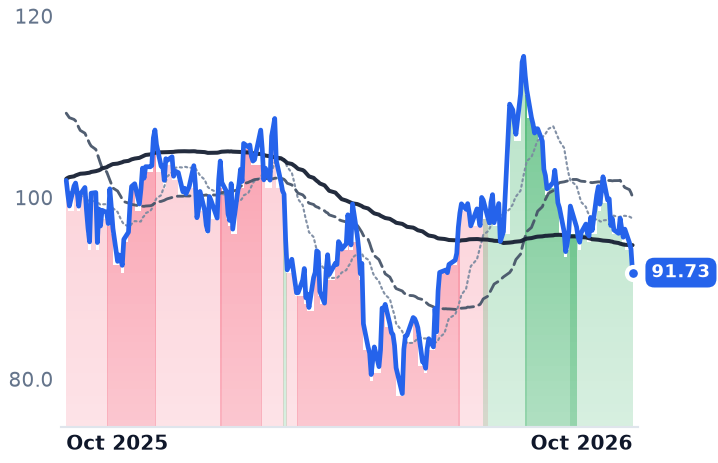
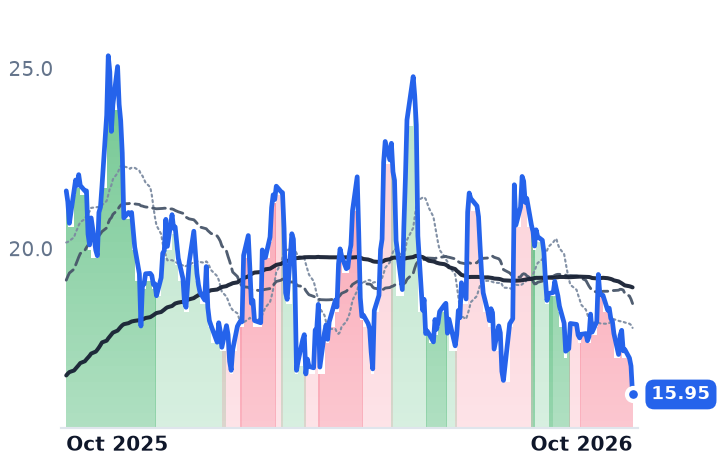
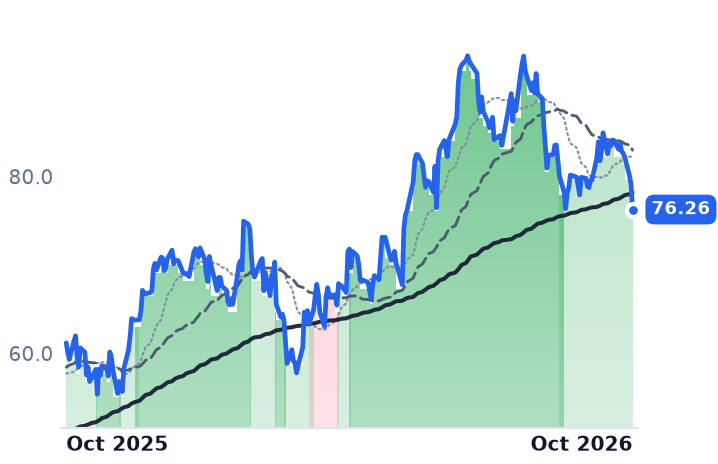
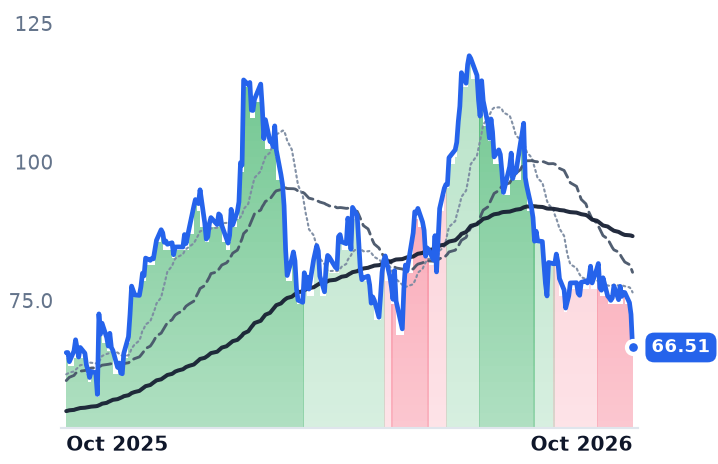
12-month price & trend
| Ticker | Mkt cap | P/E | P/E fwd | P/S | P/S fwd | P/GP | P/GP fwd | EV/EBITDA | FCF yld |
|---|---|---|---|---|---|---|---|---|---|
SKYW | $3.6B | 9.0x | 8.7x | 0.9x | 0.8x | 1.2x | 1.2x | 5.9x | 8.8% |
RJET | $737.9M | n/m | — | 0.4x | — | 1.7x | — | 6.8x | -5.8% |
DAL | $50.4B | 15.2x | 14.0x | 0.7x | 0.8x | 2.3x | 2.5x | 8.9x | 11.3% |
| Ticker | Mkt cap | P/E | P/E fwd | P/S | P/S fwd | P/GP | P/GP fwd | EV/EBITDA | FCF yld |
|---|---|---|---|---|---|---|---|---|---|
ALGT | $1.8B | 47.1x | 11.9x | 0.6x | 0.5x | 1.4x | 1.1x | 10.2x | 6.5% |
UAL | $32.1B | 9.2x | 12.3x | 0.5x | 0.5x | 0.8x | 0.7x | 6.7x | 7.9% |
ALK | $4.1B | 57.8x | — | 0.3x | 0.3x | 0.4x | 0.3x | 9.3x | -11.6% |
| Ticker | Mkt cap | P/E | P/E fwd | P/S | P/S fwd | P/GP | P/GP fwd | EV/EBITDA | FCF yld |
|---|---|---|---|---|---|---|---|---|---|
AAL | $8.1B | 40.3x | — | 0.1x | 0.1x | 0.7x | 0.6x | 10.1x | 13.5% |
SNCY | $876.4M | 21.6x | 20.5x | 0.8x | 0.7x | 1.2x | 1.1x | 5.7x | 8.2% |
Consensus projections
| Ticker | FY2026E | FY2027E | FY2028E | |
|---|---|---|---|---|
SKYW | Revenue | +8.5% | +5.8% | +4.2% |
| EPS | +3.5% | +14.6% | +11.1% | |
DAL | Revenue | +14.6% | +6.7% | +4.2% |
| EPS | −5.4% | +37.0% | +31.9% | |
ALGT | Revenue | +43.5% | +22.1% | +5.2% |
| EPS | +91.2% | +74.7% | +42.9% | |
UAL | Revenue | +15.9% | +6.3% | +4.9% |
| EPS | −23.8% | +60.0% | +38.2% | |
ALK | Revenue | +10.8% | +6.0% | +6.3% |
| EPS | −138.6% | −861.0% | +36.7% | |
AAL | Revenue | +14.0% | +4.1% | +5.3% |
| EPS | −128.6% | −1506.1% | +38.4% | |
SNCY | Revenue | +11.8% | +6.8% | +9.2% |
| EPS | −26.0% | +112.6% | +32.3% |
Forward fiscal years only. Blank means no analyst coverage for that year.
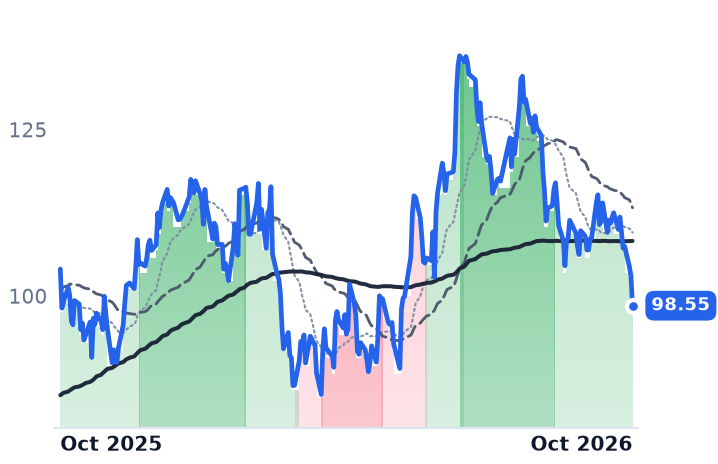
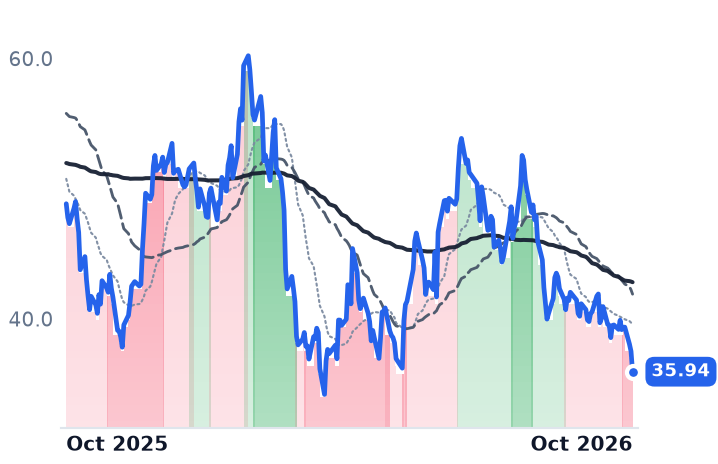
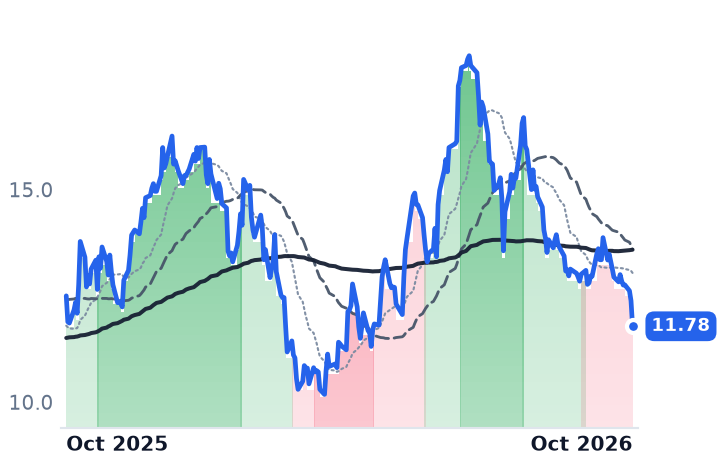
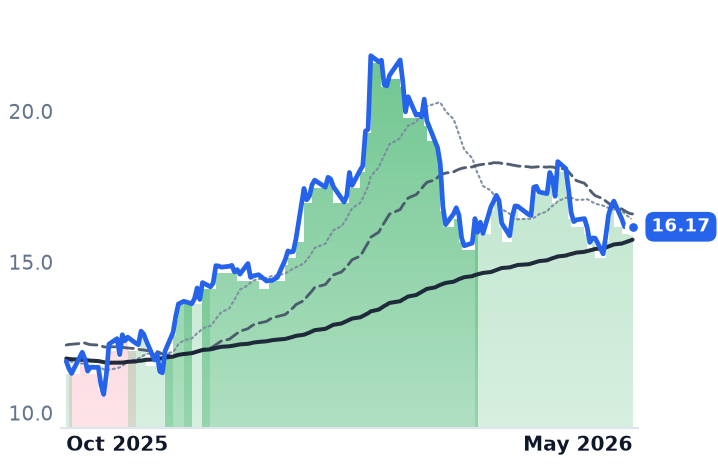
SkyWest flies 517 regional jets in four other airlines' liveries, and on the contracts that produce most of its revenue the carrier whose name is on the fuselage buys the fuel. That arrangement is why a company sitting inside an energy shock has been the calmest airline on the American board. In the three months to October 14, SkyWest shares fell 5.6%, while Delta fell 10.8%, United 18.1% and American 24.8%.
The outperformance has been read as insulation. It is mostly real, and the fifth of the business the contract does not cover is where SkyWest's earnings are going.
How a regional dollar actually gets paid
SkyWest Airlines, the St. George, Utah operator that flies passenger and cargo service under the Delta, United, American and Alaska codes, is paid under capacity purchase agreements: a fixed rate per contracted aircraft each month plus variable rates per block hour and departure. The major owns the ticket and the route decision. In the June quarter, contract revenue was $864m of $1,102.8m in total, or 78.4%. A fare war does not reach that line, and neither does $4.34-a-gallon jet fuel, nearly double the $2.19 of a year earlier, which took Delta's full-year adjusted earnings guidance down to $5.10–$5.60 a share from $6.50–$7.50.
What SkyWest sells instead is hours. Block hours rose 5.4% year on year and pre-tax income of $139m ran 29% above the March quarter on a 9% sequential gain in hours. "Our block hour production outlook remains solid, as we prepare to invest in owning and operating 34 more E175s through the end of 2028," chief executive Chip Childs said in the July 23 release. Capacity is also coming from reseating metal SkyWest already owns: CRJ550 revenue hours reached 28,102 in the first half against 16,268 a year earlier, and a 41-seat CRJ450 conversion is due in scheduled service by the end of 2026.
The slice that buys its own gas
Prorate and charter flying, where SkyWest takes the fare and the fuel risk, rose $55.4m to $201m, up 38.1%, lifting that share of revenue to 18.2% from roughly 13%. On the second-quarter call management said prorate fuel expense nearly doubled and that strong demand let the company recover about 60% of the fuel increase in fares. The uncovered remainder, plus higher hiring and training cost, is why revenue growth decelerated to 6.5% from 15.0% in the September 2025 quarter while operating income fell 8.4% and net income 16.3%. Operating margin, at 14.1%, is about 2.5 points below the year-ago quarter.
The customer list is the other exposure. Of aircraft in scheduled service or under contract at June 30, 46.2% flew for United, 26.9% for Delta, 18.6% for American and 8.3% for Alaska. The contraction already disclosed is at Delta: 19 Delta-owned CRJ900s that SkyWest plans to return over the next two years, each taking its fixed rate with it. Against that, a Q2 agreement to buy and operate 11 new E175s for American, deliveries committed into 2028, debt down to $2.3bn from $2.4bn, and a $250m addition to the buyback.
Republic raised guidance and fell anyway
Republic Airways, the Indianapolis operator paid on the same per-departure and per-block-hour meter, raised full-year adjusted EBITDAR guidance to $395m–$405m and block hours to about 880,000, and its shares are down 27% over twelve months. Its reported growth is arithmetic from the Mesa combination that closed on November 25, 2025: diluted shares were 46.2m last quarter against 2.78m a year earlier, and the block-hour jump came with 60 additional United E175s. Trailing earnings are unusable; the only anchor is 0.52x book, against SkyWest's 1.33x. The third name on this shelf is gone — Allegiant completed its roughly $1.5bn purchase of Sun Country on May 13, 2026, taking the charter and Amazon freighter operations with it.
What the contract does and does not buy
SkyWest's fixed fee explains the share-price gap against its own customers almost entirely, and explains nothing about its earnings direction. At 8.7x forward earnings, 5.9x trailing EV/EBITDA and an 8.8% trailing free-cash-flow yield, it is the cheapest partner-linked carrier here — Delta trades at 14.0x forward, Allegiant at 11.9x. But a year ago SkyWest traded near 9.6x trailing earnings and now trades near 9.1x on the same calculation, so the 9% decline over twelve months has tracked earnings rather than compressed the multiple. Consensus has full-year 2027 earnings per share at $12.12 against $10.57 this year, which requires the 2026 margin squeeze to reverse; the reported trend is still the other way. Sell-side targets average $113 with a hold rating across five brokers, with TD Cowen trimming to $116 on October 2 and Goldman Sachs moving to neutral at $115.
The contract spared SkyWest the fuel bill and also fixed its rate per hour; it cannot ask United for more because crude went up. What it can do is fly more hours — and the Delta CRJ900s it has agreed to hand back are hours already scheduled to leave the book, on a decision that was never SkyWest's to make.