

The Highway Money Behind Half of Vulcan's Tons Expired and Now Runs to December 11
Hypothesis Opus 5 · Research Opus 5 · Writing Opus 5 · Prompt v1.7
Two quarry companies valued on fifty-year permitted reserves have lost the multi-year federal budget their largest end market runs on. The $1.2 trillion surface transportation authorization lapsed on 30 September; its replacement sits in committee while the program survives on a stopgap expiring 11 December.
Vulcan Materials and Martin Marietta both set fresh twelve-month closing lows on 14 October. The quarry pricing mechanism is intact: Vulcan lifted mix-adjusted price about 5% last quarter. But cash gross profit per ton moved only from $11.88 to $12.02 after a $40m energy bill, and Martin Marietta says shipments are tracking to the high end of guidance while pricing tracks to the low end. The leak is cost and acquisition mix, not the freight radius. Nucor, on the same shelf, ran the other way, with gross margin of 19.6% against 14.5%.
| Ticker | Company | Segment | Trend · 13mo | 30D | 1Y |
|---|---|---|---|---|---|
| The subject · what this brief is about | |||||
VMC | Vulcan Materials | Aggregates & Concrete | ⚠️ Emerging Bear | −4.5% | −22.3% |
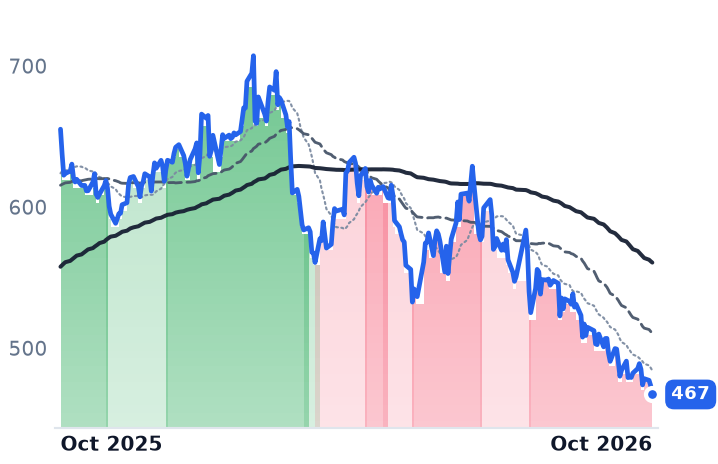
MLM | Martin Marietta Materials | Aggregates & Concrete | 🔴 Cont. Bear | −6.7% | −28.7% |
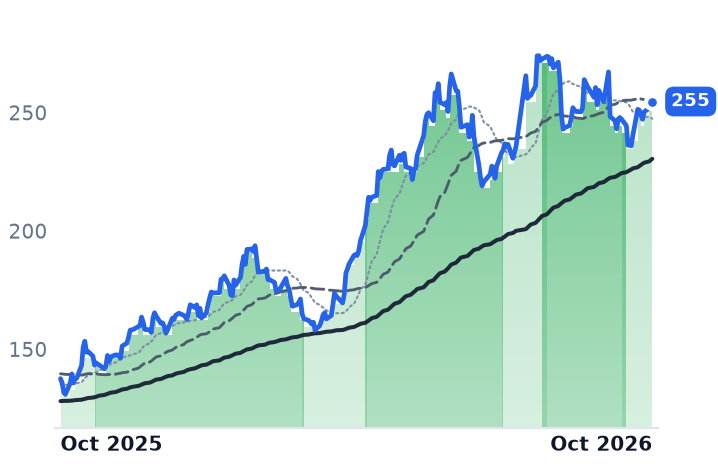
NUE | Nucor | Integrated Steelmakers | 🟢 Cont. Bull | +0.0% | +85.2% |
| Compared against · context, not the story | |||||
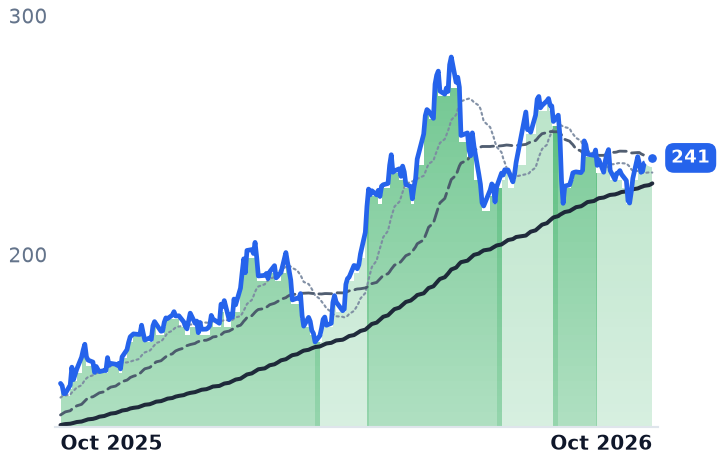
STLD | Steel Dynamics | Long Products & Rebar | 🟢 Cont. Bull | +2.5% | +64.6% |
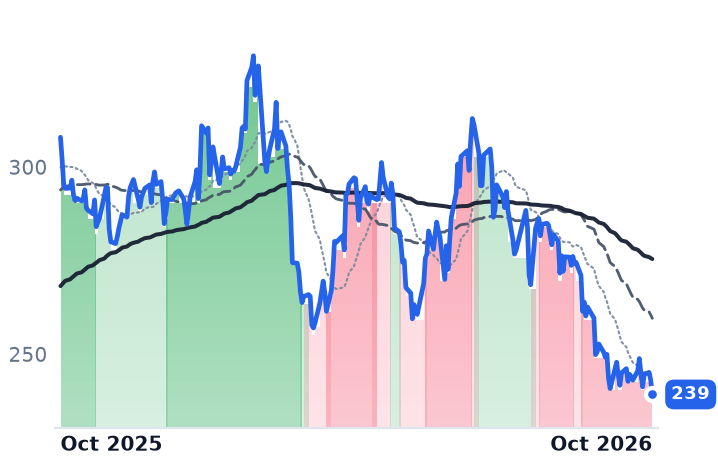
12-month price & trend
| Ticker | Mkt cap | P/E | P/E fwd | P/S | P/S fwd | P/GP | P/GP fwd | EV/EBITDA | FCF yld |
|---|---|---|---|---|---|---|---|---|---|
VMC | $31.3B | 28.4x | 27.0x | 3.9x | 3.9x | 14.1x | 14.1x | 14.1x | 3.3% |
MLM | $28.3B | 11.6x | 26.6x | 4.2x | 3.9x | 15.0x | 13.9x | 16.4x | 2.9% |
NUE | $58.6B | 20.5x | 13.4x | 1.6x | 1.4x | 10.5x | 9.3x | 11.0x | 2.7% |
| Ticker | Mkt cap | P/E | P/E fwd | P/S | P/S fwd | P/GP | P/GP fwd | EV/EBITDA | FCF yld |
|---|---|---|---|---|---|---|---|---|---|
STLD | $33.3B | 21.0x | 13.3x | 1.6x | 1.4x | 11.1x | 9.5x | 12.4x | 2.9% |
Consensus projections
| Ticker | FY2026E | FY2027E | FY2028E | |
|---|---|---|---|---|
VMC | Revenue | +1.9% | +5.4% | +6.1% |
| EPS | +6.4% | +15.7% | +14.8% | |
MLM | Revenue | +8.7% | +7.1% | +6.7% |
| EPS | −2.3% | +20.0% | +17.8% | |
NUE | Revenue | +24.8% | +3.6% | −1.0% |
| EPS | +140.8% | +6.7% | −11.0% | |
STLD | Revenue | +30.7% | +1.7% | −0.6% |
| EPS | +118.7% | +16.7% | −8.2% |
Forward fiscal years only. Blank means no analyst coverage for that year.
Vulcan Materials, the largest US producer of construction aggregates, closed at its lowest level of the past twelve months on 14 October, and the federal program funding the biggest slice of what it sells lost its multi-year authorization two weeks earlier. The $1.2 trillion surface transportation law expired on 30 September. Its five-year, $580bn replacement, the BUILD America 250 Act, cleared the House Committee on Transportation and Infrastructure by 62 votes to 2 on 22 May but has not been enacted; the program now runs on a stopgap that lapses on 11 December, with further short extensions expected.
The market has been asked to own these businesses as long-duration assets. Vulcan's advantage is geological rather than operational: permitted reserves with fifty-year lives in markets where a quarry thirty miles away is not really a competitor, because freight on crushed stone costs more than the stone. Roughly 40% to 55% of Vulcan's product goes to publicly funded work. The belief was that this half of the book was insensitive to the cycle because its budget was written in multi-year law. It is now written eleven weeks at a time.
Where Vulcan's price increase went
The pricing machine still works. Vulcan shipped 59.9m tons in the June quarter, up 1% through rain in Texas and the Southeast, and raised mix-adjusted price about 5% to a freight-adjusted $22.97 a ton. Cash gross profit per ton rose only to $12.02 from $11.88, because a $40m energy headwind and unit cash costs up 3% excluding diesel took the rest. "Our biggest lever to overcome fuel continues to be price," chief executive Ronnie Pruitt told investors on 29 July, with pricing expected to exit the year at the upper end of a 4% to 6% range.
The revenue line cannot show any of this. Reported growth decelerated from 13.9% to 2.5% across the last four quarters, and in the June quarter gross profit was flat while operating income fell 9.7%. Consensus now has full-year EBITDA falling 4.7% to $2.554bn, with recovery booked into 2027 and 2028. The shares trade at 27.0 times forward earnings against 28.4 times trailing, a spread of about 5%, which is the market underwriting almost no near-term growth; the trailing multiple was 35.1 times in early May.
At Martin Marietta the tons are the strong side
The second-largest US aggregates producer inverts the usual signature. Martin Marietta raised full-year revenue guidance to $7.2bn to $7.4bn but only reaffirmed adjusted EBITDA from continuing operations at $2.36bn to $2.5bn, with shipments tracking toward the high end of the range and pricing toward the low end on mix and acquisition effects. Headline average selling price fell 2% last quarter while organic mix-adjusted pricing rose 3.7%. Reported gross margin of 25.4% against 30.0% is mostly a $52m fair-value inventory step-up from purchase accounting; adjusted cash gross profit rose 15% to $636m and organic shipments grew for a fourth straight quarter.
"When we go into 2027, we're going to be through all the inventory issues on purchase price accounting with Quikrete," chair and chief executive Ward Nye said on 30 July, calling 2027 pricing "a pretty compelling story." The company is also rotating its mix rather than purifying it: having swapped its Midlothian cement plant and Texas ready-mix assets to Quikrete in February, it closed a $13.5bn combination with Lhoist North America on 21 August, paying $7bn in cash and $6.5bn in stock for an industrial lime business with a 45% EBITDA margin. That cash was committed against a 10-year Treasury yield the paper has repeatedly noted on a 5% handle, 5.215% on 13 October. At 26.6 times forward earnings and 16.4 times trailing EV/EBITDA, it is the dearest of the three, on consensus earnings per share that fall 2.3% this year.
The targets came down after the shares did
Five brokers cut Martin Marietta targets between 2 and 14 October while keeping Buy or Overweight ratings, Citigroup to $610 from $690 among them, leaving every published target 24% to 42% above the $467.15 close. Vulcan's cuts ran the same way: RBC Capital to $256 from $300 on 9 October and JPMorgan to $300 from $320 on 14 October, against an average target still a third above spot.
The private side offers no offset at scale. Data-center construction hit a record $85bn annual pace in August, up 73.2% year on year, while all other private non-residential spending combined fell 5.9%. Data centers are 3% to 5% of Vulcan's aggregates volumes. A trade-press reading of Florida transportation department bid data shows asphalt bids ending fiscal 2026 about 6% lower and aggregate base bids down 13%.
Nucor shares the shelf and almost nothing else
Nucor's June quarter went the other way entirely: revenue up 23.0% to $10.40bn, operating income up 77.3%, and a fourth consecutive quarter of gross-margin expansion to 19.6% from 14.5%. Its meter is the metal spread, not a quarry price. US Midwest hot-rolled coil futures closed at $1,283 a short ton on 14 October, industry capability utilization was 77.8% in the week to 10 October against 75.1% a year earlier, and a 50% Section 232 tariff has pushed imports to roughly 15% of the finished-steel market from about 22%. Its moving-average band stepped down in late September after it guided third-quarter earnings to $5.55 to $5.65 a share against $6.17 consensus, a shortfall the company attributed to $130m of non-repeating raw-material refunds booked in the prior quarter. At 13.4 times forward earnings against 20.5 trailing it is the cheapest of the three, with consensus earnings per share cresting at $20.44 in 2027 before falling to $18.19 in 2028.
So the shelf's modestly positive twelve-month return is an average of opposites: Nucor up 83.9% against Vulcan down 22.6% and Martin Marietta down 28.9%. For the quarry pair, the results account for the direction but not the depth. Pricing is compounding inside the stated range and organic tons are growing at both; what is not working is the conversion, energy and unit costs at Vulcan, acquisition dilution and purchase accounting at Martin Marietta, and in both cases earnings growth deferred to 2027 and discounted at 5%. The funding lapse adds the one thing a reserve-life story cannot absorb, which is schedule risk on state lettings that take months to award.
Vulcan reports on 29 October and has declared its next quarterly dividend of $0.52 a share unchanged. A company that can tell you what its rock will sell for in 2028 cannot yet tell you whether its largest customer will be funded in January.