
ONE Gas Raised Guidance on Falling Revenue; the Shares Lost a Fifth in Six Months
Hypothesis Opus 5 · Research Opus 5 · Writing Opus 5 · Prompt v1.7
A gas distributor's sales line cannot say whether its business improved, because the molecule inside the pipe is resold at no markup. ONE Gas proved the point this year: first-half revenue fell about 8.5% while the cost of gas it passes through fell 23%, so distribution margin rose 4.2% and the company lifted its 2026 adjusted earnings range in August to $4.89-$4.95 a share from $4.65-$4.77.
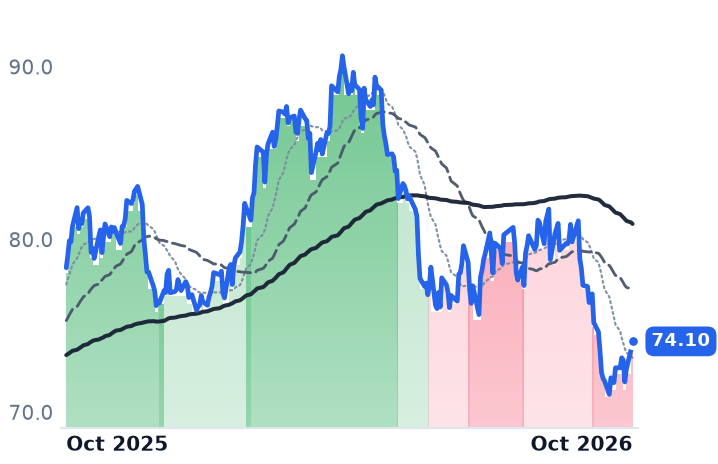
The shares went the other way, down roughly 17% over six months, with the trailing earnings multiple compressed to 15.9x from 20.2x in early May. Southwest Gas reaffirmed guidance and raised its Great Basin pipeline build to about $2.3bn. New Jersey Resources is the exception: more than a fifth of guided earnings come from a wholesale gas trading book, and consensus has fiscal 2027 earnings below fiscal 2026.
None of the three reported a worse margin. What changed was the price of money.
| Ticker | Company | Segment | Trend · 13mo | 30D | 1Y |
|---|---|---|---|---|---|
OGS | ONE Gas | Natural Gas Distribution | 🔴 Cont. Bear | −4.1% | −5.4% |
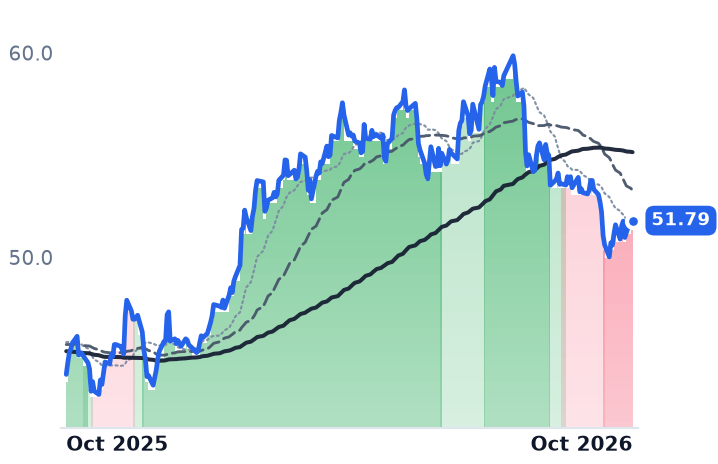
NJR | New Jersey Resources | Natural Gas Distribution | ⚠️ Emerging Bear | −2.5% | +17.0% |
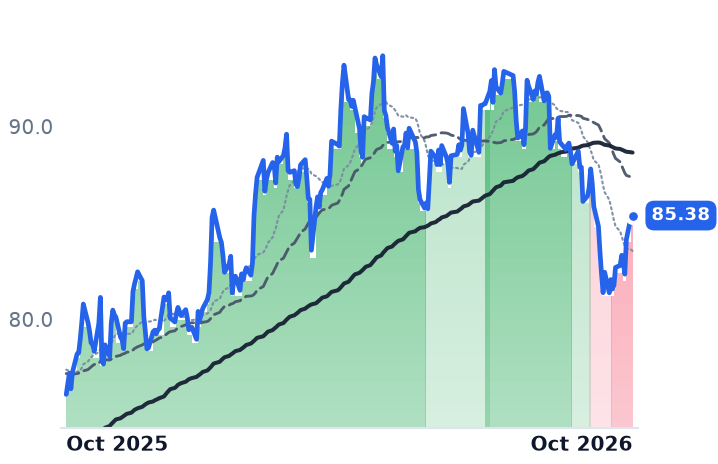
SWX | Southwest Gas | Natural Gas Distribution | 🟢 Cont. Bull | −1.2% | +12.2% |
12-month price & trend
| Ticker | Mkt cap | P/E | P/E fwd | P/S | P/S fwd | P/GP | P/GP fwd | EV/EBITDA | FCF yld |
|---|---|---|---|---|---|---|---|---|---|
OGS | $4.6B | 15.9x | 15.1x | 2.0x | 1.9x | 2.7x | 2.5x | 10.2x | -3.7% |
NJR | $5.2B | 14.2x | 15.1x | 2.3x | 2.4x | 8.3x | 8.6x | 11.5x | 1.5% |
SWX | $6.2B | 11.9x | 20.0x | 3.5x | 3.2x | 6.3x | 5.6x | 10.7x | -13.4% |
Consensus projections
| Ticker | FY2026E | FY2027E | FY2028E | |
|---|---|---|---|---|
OGS | Revenue | −2.6% | +3.9% | +3.7% |
| EPS | +11.8% | +2.8% | +8.5% | |
NJR | Revenue | +12.7% | −2.7% | +4.7% |
| EPS | +10.0% | −4.0% | +7.6% | |
SWX | Revenue | −46.3% | +5.7% | +6.0% |
| EPS | −21.9% | +17.4% | +18.4% |
Forward fiscal years only. Blank means no analyst coverage for that year.
ONE Gas bought cheaper gas this year, resold it to 2.2 million households at no markup, and kept more of what was left. Revenue for the first half fell about 8.5% while the cost of that gas fell 23%, so distribution margin rose 4.2% and net income rose with it. In August the company raised its 2026 adjusted earnings expectation to $4.89-$4.95 a share from $4.65-$4.77.
The shares did the opposite, falling about 17% over six months, with the trailing earnings multiple down to 15.9x from 20.2x in early May. A flat year across the eight listed gas distributors has been read as a flat business. The margins say otherwise: at each of the three pure-play distributors examined here the earning line either grew or was reaffirmed, and what moved underneath them was the discount rate applied to a regulated dollar.
The molecule is a pass-through; the pipe is the business
In the June quarter ONE Gas, which operates as Oklahoma Natural Gas, Kansas Gas Service and Texas Gas Service, booked $411.6m of revenue against a $90.3m cost of natural gas, versus $423.7m and $117.9m a year earlier. Revenue fell 2.9%; margin net of gas cost rose about 5.1%. That gas cost is recovered dollar for dollar through periodic adjustment clauses, so a cold winter or a spot spike inflates both lines and leaves the earning line untouched.
What does move it is approved capital recovery. ONE Gas attributed its first-quarter operating income gain "primarily" to "an increase of $27.3 million from new rates". Its 2026 docket is a stack of between-case trackers: a $28.7m Oklahoma performance-based increase recommended by an administrative law judge in June, a $36.9m Texas increase approved in June, a $14.3m Kansas reliability surcharge requested, all against authorized returns on equity of 9.4% to 9.8%. One Texas statute, House Bill 4384, which lets a gas utility defer carrying costs on plant not yet in rates, is worth about $0.42 of 2026 adjusted earnings per share, roughly 9% of guidance. Capital spending runs near $800m against a $6.3bn average rate base, while customer count grew 0.43%.
"This performance gives us the confidence to raise our adjusted earnings expectations for the full year," chief executive Robert S. McAnnally said in the second-quarter results release.
The cash wedge the pass-through famously creates has closed. At 30 June ONE Gas carried $19.8m of under-recovered gas costs against $22.4m over-recovered; the Winter Storm Uri bill was refinanced with ratepayer-backed securitized bonds, including $336m of Kansas bonds in November 2022. Its negative 3.7% trailing free-cash-flow yield is the capex program, not the molecule.
A fifth of New Jersey Resources has no customer bill behind it
New Jersey Resources owns New Jersey Natural Gas, with about 564,000 customers in six counties, and guides 21%-23% of fiscal 2026 net financial earnings to Energy Services, an unregulated wholesale gas book. That segment earned $84.5m in the nine months to June against $39.4m a year earlier, "primarily due to higher natural gas price volatility." The market reads it as a windfall: the forward earnings multiple of 15.1x sits above the trailing 14.3x because consensus has fiscal 2027 earnings per share at $3.44 against $3.58 this year.
Its September filings show who the real counterparty is. The utility cut customer bills 8.9%, about $158 a year, in the same month it asked to recover roughly $950m of system investment across a 7,500-mile network, a 12.7% increase if granted as filed. None of these three competes with the others for a single delivery customer; the rival is not another distributor but the ratepayer advocate arguing the bill is already high enough. ONE Gas describes the same discipline as holding average bills flat while it invests.
Southwest Gas is a pipeline build with a utility attached
Southwest Gas finished separating from Centuri, the utility-infrastructure contractor it owned, for about $1.35bn of net proceeds. The 62% revenue drop in 2025 is that deconsolidation, which also makes its 11.9x trailing multiple unusable. On forward earnings it is 20.0x, down from 28.2x in early May and still about a third richer than ONE Gas for rate-base growth of 9.5%-11.5% a year. Roughly $1.7bn of its $6.3bn five-year plan is the Great Basin 2028 expansion, now about $2.3bn in cost with $270m-$300m of expected incremental annual margin. Its year turns on an Arizona case seeking about $101m, a $5.18 monthly residential increase, plus Nevada and California proceedings. "We're encouraged by the progress our team made this quarter, advancing rate cases in all three states," chief executive Justin Brown said with the second-quarter results.
What repriced was the spread on a regulated dollar
No single session reset this group. First entries into falling trends ran from late May to mid-September, sixteen weeks apart, and the worst of the six sessions when all eight members fell together averaged 2.79%. Over that stretch the ten-year Treasury yield went from 4.639% on 25 August to 5.24% on 9 October and the Federal Reserve raised its target range to 3.75%-4.00% on 16 September, its first increase since 2023. Set 5.24% against ONE Gas's authorized returns of 9.4% to 9.8% and the gap an equity investor is paid for taking regulatory risk narrowed by about 60 basis points in six weeks without any commission writing a word. The selling reached the whole complex: the Utilities Select Sector SPDR fell 6% over the month to early October while the S&P 500 rose less than 1%.
So the likelier reading is a repricing of income, landing on businesses whose delivered margin never deteriorated. It explains the drip without conceding anything about the pipe, and it leaves the twelve-month comfort of the category average looking thin: New Jersey Resources, Northwest Natural and Southwest Gas carry that average, while five of the eight members sit below where they were a year ago.
ONE Gas reports its third quarter on 2 November, and the line to read is the one net of gas cost. Everything these companies earn comes from a commission agreeing that more pipe can go into rate base, and in Oklahoma, New Jersey and Arizona alike the household bill is now the ceiling on how much pipe that is.