

EMCOR's Record Order Book Doesn't Say How Much of It Carries Fixed-Price Risk
Hypothesis Opus 5 · Research Opus 5 · Writing Opus 5 · Prompt v1.7
The contractors that install the switchgear and pull the conduit for data centers have all been marked down with the rest of the buildout, but only one of the three large ones has a fundamental reason. EMCOR's contracted-but-undone work reached $17.14bn at the end of June, up 43.9% in a year, and the company raised full-year guidance to $32.00–33.25 of diluted earnings a share.
Under percentage-of-completion accounting, revenue is an estimate of progress and margin is management's forecast of each job's final cost, so the figure that decides the outcome is the share of backlog carrying fixed-price risk. EMCOR does not disclose it. Argan shows what that risk looks like when it lands: consolidated gross margin stepped from 25.0% to 19.3% over three quarters, with its industrial segment at 7.3% on two jobs that cost more than it bid. Dycom sits on a different meter entirely, with three carriers supplying about half of fiscal 2026 revenue.
| Ticker | Company | Segment | Trend · 13mo | 30D | 1Y |
|---|---|---|---|---|---|
| The subject · what this brief is about | |||||
EME | EMCOR | Electrical & Power Infrastructure | ⚠️ Emerging Bear | +5.3% | +16.8% |
AGX | Argan | Energy & Power Project Solutions | ⚠️ Emerging Bear | +0.0% | +33.7% |
DY | Dycom Industries | Electrical & Power Infrastructure | ⚠️ Emerging Bear | −6.1% | −7.4% |
| Compared against · context, not the story | |||||
FIX | Comfort Systems USA | MEP & Building Systems | ⚠️ Emerging Bear | +8.4% | +103.0% |
STRL | Sterling Infrastructure | Infrastructure & Civil Construction | ⚠️ Emerging Bear | +8.5% | +44.4% |
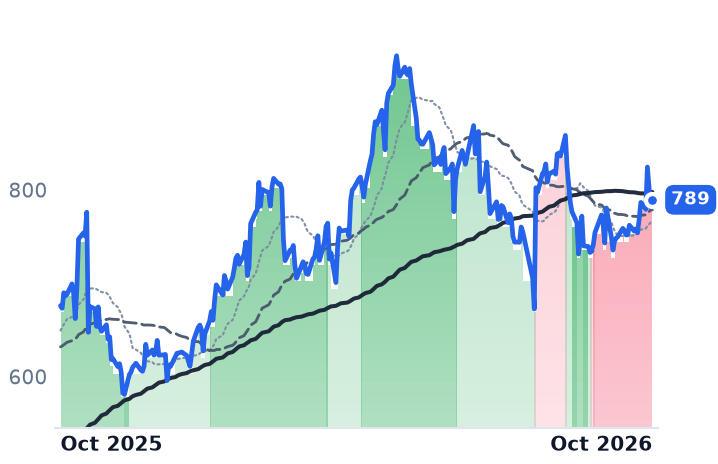
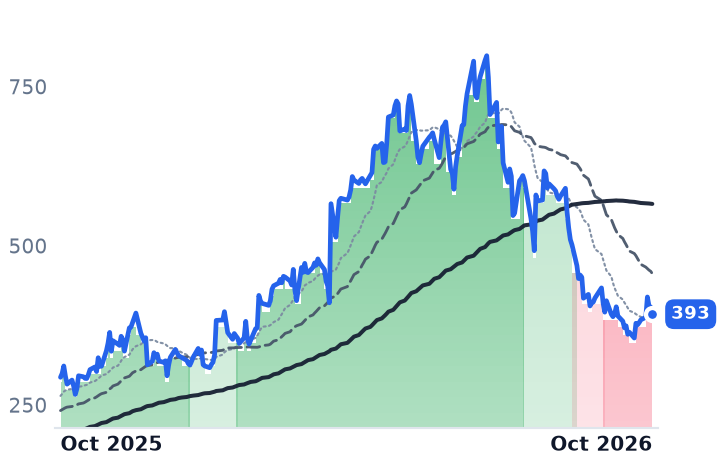
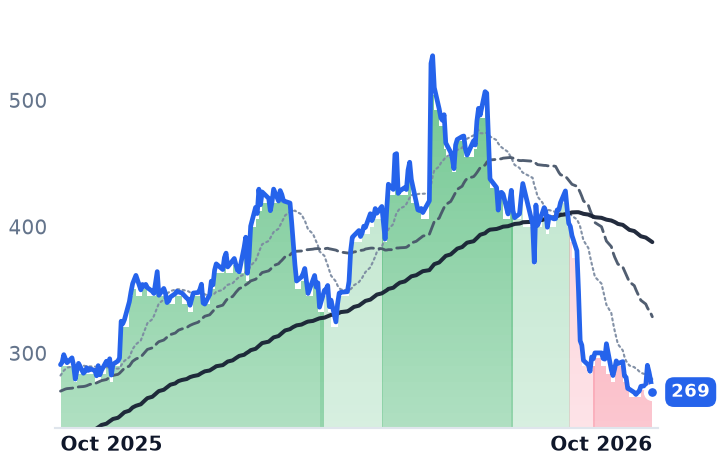
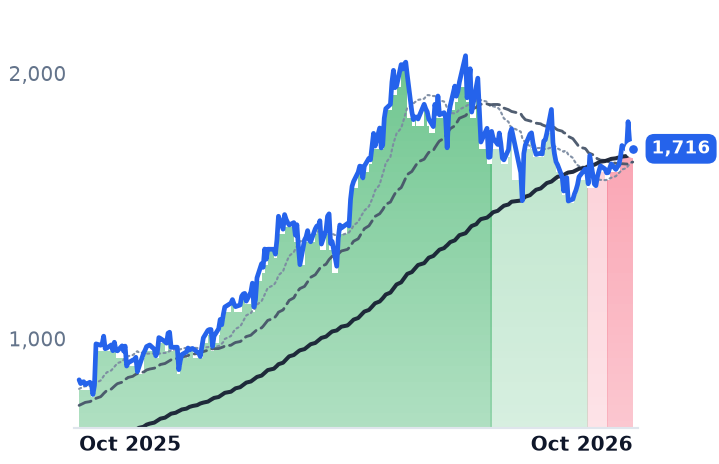
12-month price & trend
| Ticker | Mkt cap | P/E | P/E fwd | P/S | P/S fwd | P/GP | P/GP fwd | EV/EBITDA | FCF yld |
|---|---|---|---|---|---|---|---|---|---|
EME | $34.8B | 24.6x | 24.0x | 1.9x | 1.7x | 9.5x | 8.7x | 15.3x | 3.4% |
AGX | $5.5B | 30.5x | 29.7x | 4.6x | 3.9x | 22.2x | 18.8x | 23.6x | 9.9% |
DY | $8.1B | 24.3x | 15.8x | 1.2x | 1.1x | 6.2x | 5.6x | 9.2x | 5.8% |
| Ticker | Mkt cap | P/E | P/E fwd | P/S | P/S fwd | P/GP | P/GP fwd | EV/EBITDA | FCF yld |
|---|---|---|---|---|---|---|---|---|---|
FIX | $60.4B | 42.2x | 35.0x | 5.4x | 4.7x | 21.0x | 18.1x | 29.5x | 3.6% |
STRL | $16.4B | 38.0x | 26.9x | 4.8x | 4.0x | 20.2x | 17.0x | 22.6x | 2.9% |
Consensus projections
| Ticker | FY2026E | FY2027E | FY2028E | |
|---|---|---|---|---|
EME | Revenue | +21.4% | +10.9% | +8.3% |
| EPS | +30.1% | +13.0% | +13.2% | |
AGX | Revenue | +12.1% | +48.9% | +20.4% |
| EPS | +65.8% | +57.7% | +19.4% | |
DY | Revenue | +17.1% | +39.6% | +12.7% |
| EPS | +39.5% | +51.2% | +19.7% | |
FIX | Revenue | +47.7% | +19.0% | +14.1% |
| EPS | +86.6% | +22.8% | +23.4% | |
STRL | Revenue | +71.5% | +21.2% | +17.3% |
| EPS | +91.2% | +28.0% | +20.6% |
Forward fiscal years only. Blank means no analyst coverage for that year.
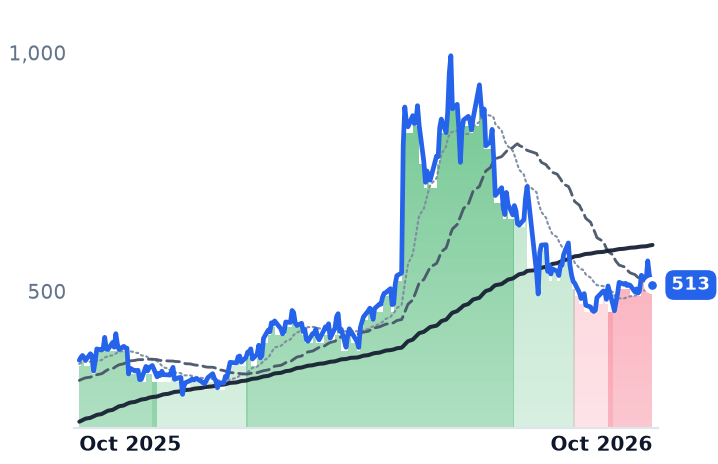
EMCOR Group, the US and UK specialty contractor that designs, installs and commissions the electrical and mechanical systems inside buildings, finished June with more work under contract than at any point in its history and raised its profit forecast for the year. Its shares have gone nowhere since the summer and sit 16% below their 2026 high.
The layer of the artificial-intelligence buildout that actually pulls the conduit has been sold off since industry executives publicly called for the industry to slow its own spending, which Reuters described as investors repricing AI capital-expenditure risk across the supply chain. A contractor's revenue line cannot settle whether that worry is right. Under percentage-of-completion accounting, revenue is cost incurred to date measured against management's estimate of a job's total cost, so reported revenue is a progress estimate and reported margin is a forecast, revised every quarter, with jobs signed two years ago landing in the current period.
The order book grew faster than the work burned off
Remaining performance obligations, meaning contracted work not yet performed, reached $17.14bn at 30 June, up 43.9% from a year earlier, with the largest gains in network and communications, water and wastewater, and institutional and healthcare work. That balance was $13.25bn entering the year and $15.62bn at the end of March. Set the $1.52bn quarterly increase against the $5.155bn of revenue recognized, and the implied book-to-bill, derived from those two balances, is roughly 1.3x. Operating margin widened by about one percentage point to 10.6% on 19.8% revenue growth, and guidance went to $32.00–33.25 of diluted earnings a share on revenue of $20.00–20.50bn.
The buildout's effect on the work itself is scope, not square footage. An AI data center carries a content "multiplier of 1.5 to 2" for mechanical systems and "probably 1.5" for electrical work against a conventional facility, chief executive Anthony Guzzi told investors on 30 July. Electrical construction revenue in the network and communications sector rose 45% in the quarter.
Where the customer's cash actually goes
EMCOR holds $2.609bn of contract liabilities, amounts invoiced and advanced ahead of revenue recognized, against $377.3m of contract assets at the end of March, per its quarterly filing. That float is not an earnings engine: net interest income was $4.322m in the June quarter, under 1% of the $547.3m of operating income, and cash fell from $1.112bn to $924.4m over the half as the customer money financed unbilled work and growth.
What would settle the margin question is the split between fixed-price jobs, where labor inflation and an unpriced change order are the contractor's loss, and cost-reimbursable work, where they are the customer's. EMCOR's annual report describes that risk allocation without quantifying the mix.
The one meter that would settle it is not in the filings.
The exposure is not small in principle: electrical work runs 45% to 70% of a data center's construction cost, and construction labor costs in primary North American data-center markets rose 8% to 12% a year in 2024-25. Microsoft president Brad Smith has called the electrician shortage the "#1 problem" for US data-center expansion. EMCOR's answer is union labor mobility and prefabrication, and the trace shows in output per head: FY2025 revenue across 44,000 employees works out near $386,000 each, and the 2026 guidance midpoint near $460,000, a derived 19% gain without more bodies.
Argan is the undiversified version of the same accounting
Argan, a lump-sum engineering and construction firm that builds whole gas-fired power plants, is where estimate risk has already bitten. Consolidated gross margin stepped down from 25.0% to 21.0% to 19.3% over three quarters, and the industrial segment fell to a 7.3% margin on two projects with higher estimates-to-complete than initially estimated. "As projects ramp and get into their second and third year of construction, we expect to see higher revenues and with successful execution, we have the opportunity to enhance margin," chief financial officer Joshua Baugher said on 2 September. Backlog fell from $2.9bn to $2.5bn, 80% of it four US gas plants. Here the float does flatter earnings: FY2026 net income of $137.8m exceeded operating income of $134.7m despite tax, against cash and investments of $895.0m.
Dycom, the telecom-infrastructure contractor, is barely on the same meter. It is paid per unit of work under master service agreements, which were 76.9% of contract revenues in fiscal 2022, and AT&T, Verizon with Frontier, and Lumen together supplied about half of fiscal 2026 revenue. Its backlog rose 53.2% to $12.242bn, of which more than $1bn is fiber tied to data centers, about 8% of the book.
Three names, one shelf, three different reasons for the price
Over the three months to 9 October, EMCOR was up 0.8% while Argan fell 42.9% and Dycom 37.0%. Only Argan's decline has a reported business change behind it: a margin trajectory down three quarters, a backlog that shrank, and a year carried by a handful of jobs against a company capacity management puts at 10 to 12 at once. At 29.7x forward earnings and 23.6x trailing enterprise value to EBITDA after a 51% fall from its high, that reads as a justified re-rating. EMCOR's own multiple has compressed from 31.4x trailing in early May to 24.6x, against Comfort Systems at 42.2x trailing and 35.0x forward, a gap part-explained by Comfort's 50.3% June-quarter revenue growth. Dycom trades at 15.8x forward against 24.3x trailing. For EMCOR and Dycom the order books and guidance moved the other way from the shares, and the likelier reading is the group being repriced as one block; what cannot be checked from outside is whether EMCOR's growing book is taking on fixed-price risk as it goes.
That is the uncomfortable part of a business whose revenue is an estimate. EMCOR reports third-quarter results on 29 October, and the order book will be printed to the decimal. The figure that decides what it is worth will not be.