
CoreWeave Pays a Quarter of Its Revenue in Interest to Own the Chips; Hut 8 Rents Power
Hypothesis Opus 5 · Research Opus 5 · Writing Opus 5 · Prompt v1.7
The thirty sessions to 9 October split the data-center group by who finances its capacity. Microsoft, Meta, Alphabet and Amazon all rose; every member that borrows to buy its own accelerators fell, from Cipher Mining to Nebius.
CoreWeave's revenue still grew 112% year on year and its backlog reached $104.2bn, but sequential bookings growth slowed to 4.8% from nearly 50% in the March quarter, gross margin sits 8.3 points below a year ago, and net interest took 24.9% of June-quarter revenue with guidance pointing higher. Nebius runs the same rented-accelerator meter on issued equity, and its only profitable quarter this year rested on a revaluation of its ClickHouse stake.
Hut 8 earns roughly $1.84m per megawatt a year and borrows at 1.75 points over the bank floating rate because its tenants buy the chips. The cost side explains the decline; demand does not.
| Ticker | Company | Segment | Trend · 13mo | 30D | 1Y |
|---|---|---|---|---|---|
| The subject · what this brief is about | |||||
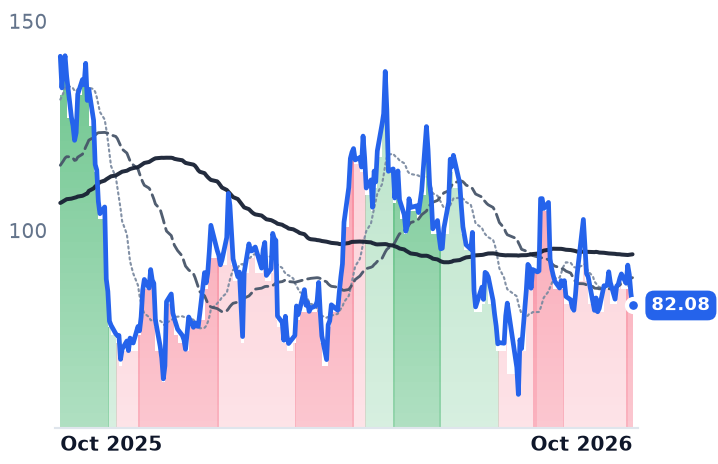
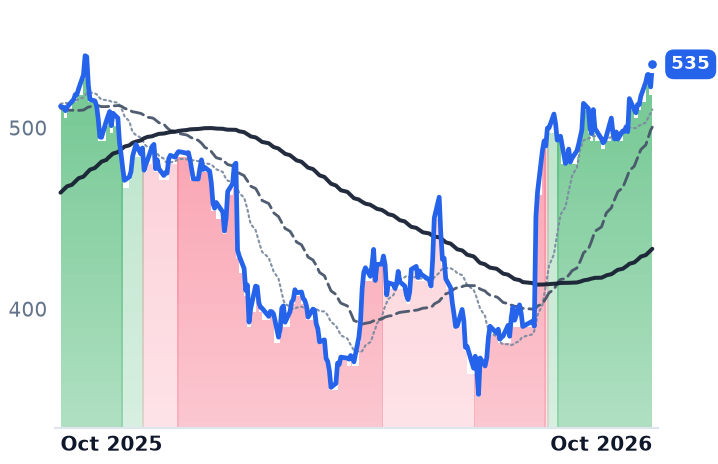
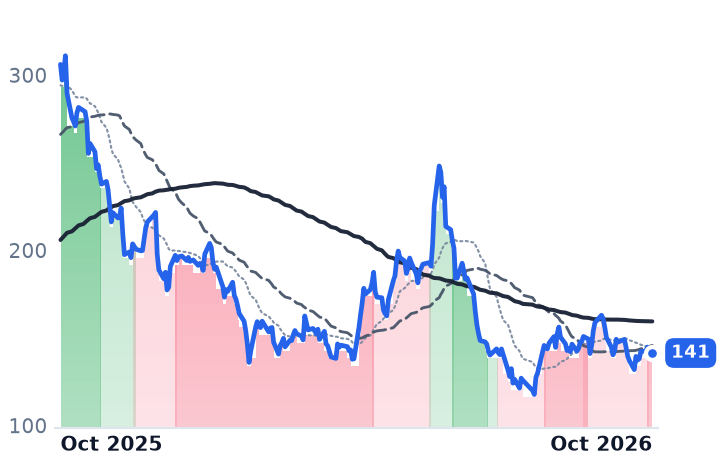
CRWV | CoreWeave | Cloud GPU Computing | 🔴 Cont. Bear | −7.8% | −42.0% |
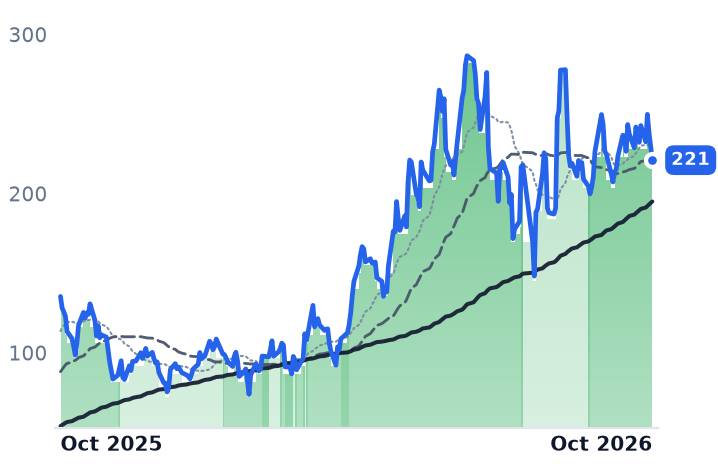
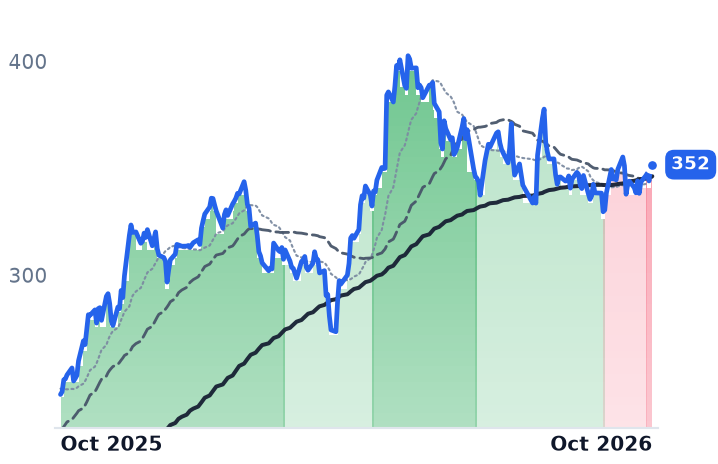
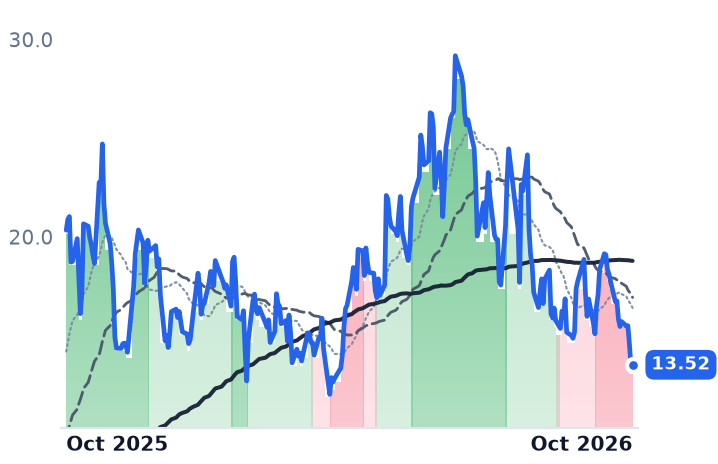
NBIS | Nebius | Cloud Infrastructure & AI | 🟢 Cont. Bull | −1.5% | +63.2% |
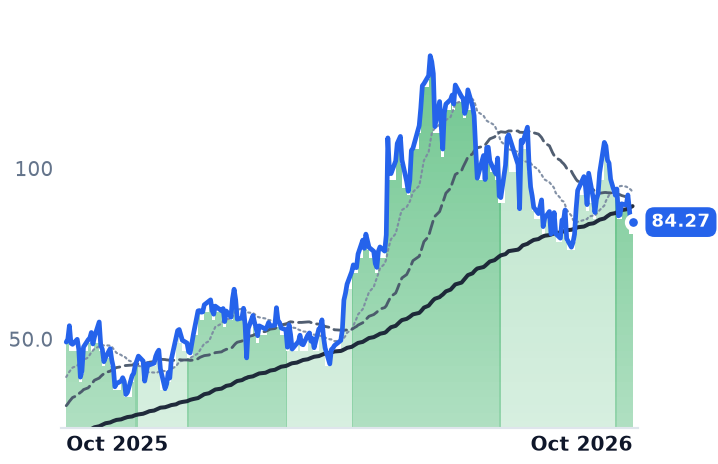
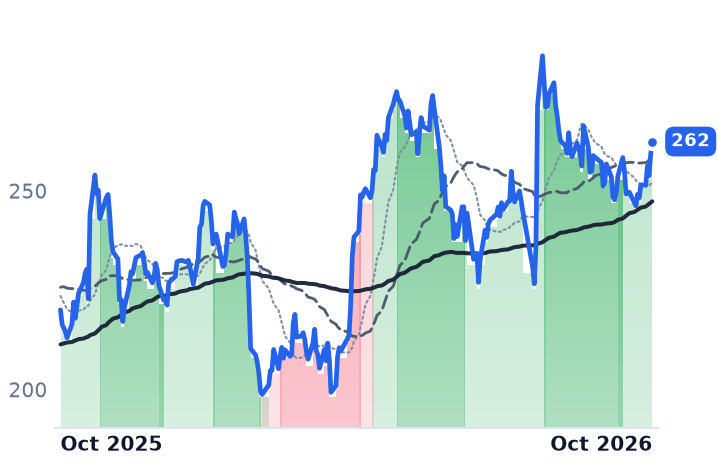
HUT | Hut 8 | Bitcoin Mining | 🟢 Cont. Bull | −14.5% | +71.6% |
| Compared against · context, not the story | |||||
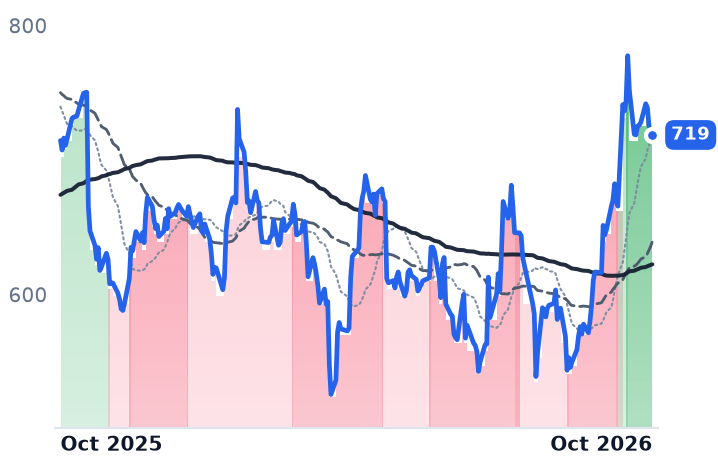
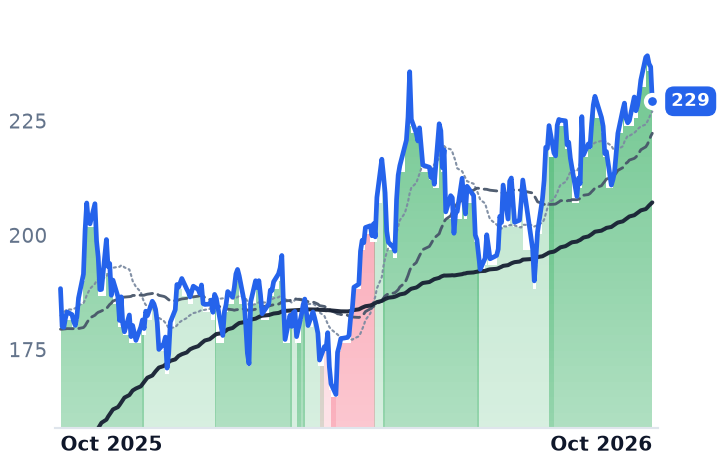
MSFT | Microsoft | Cloud Infrastructure & Platforms | 🌱 Emerging Bull | +8.0% | +4.5% |
GOOGL | Alphabet | Search & Advertising | ⚠️ Emerging Bear | +3.9% | +44.0% |
AMZN | Amazon.com | Online Marketplaces | 🟢 Cont. Bull | +2.2% | +19.2% |
META | Meta Platforms | Social Media & Messaging | 🔴 Cont. Bear | +10.9% | +0.6% |
ORCL | Oracle | Cloud Infrastructure & Platforms | 🔴 Cont. Bear | −5.9% | −53.8% |
CIFR | Cipher Mining | Bitcoin Mining | ⚠️ Emerging Bear | −19.8% | −33.5% |
NVDA | NVIDIA | AI & Data Center GPUs | 🟢 Cont. Bull | +5.0% | +21.8% |
12-month price & trend
| Ticker | Mkt cap | P/E | P/E fwd | P/S | P/S fwd | P/GP | P/GP fwd | EV/EBITDA | FCF yld |
|---|---|---|---|---|---|---|---|---|---|
CRWV | $44.8B | n/m | — | 5.9x | 3.5x | 8.8x | 5.2x | 22.8x | -30.5% |
NBIS | $53.1B | 850.3x | — | 39.2x | 15.9x | 52.7x | 21.4x | 54.9x | -11.1% |
HUT | $9.5B | n/m | — | 32.6x | 32.6x | 129.1x | 129.1x | 211.5x | -7.8% |
| Ticker | Mkt cap | P/E | P/E fwd | P/S | P/S fwd | P/GP | P/GP fwd | EV/EBITDA | FCF yld |
|---|---|---|---|---|---|---|---|---|---|
MSFT | $3.8T | 28.6x | 26.1x | 11.5x | 9.8x | 17.0x | 14.4x | 19.0x | 1.7% |
GOOGL | $4.2T | 17.3x | 17.0x | 9.5x | 8.5x | 15.6x | 13.9x | 13.1x | 1.3% |
AMZN | $2.9T | 21.2x | 21.1x | 3.7x | 3.5x | 7.3x | 6.8x | 11.9x | -0.4% |
| Ticker | Mkt cap | P/E | P/E fwd | P/S | P/S fwd | P/GP | P/GP fwd | EV/EBITDA | FCF yld |
|---|---|---|---|---|---|---|---|---|---|
META | $1.5T | 21.5x | 18.2x | 6.5x | 5.8x | 7.9x | 7.1x | 14.7x | 2.8% |
ORCL | $407.7B | 21.8x | 17.4x | 5.7x | 4.5x | 8.9x | 7.0x | 14.0x | -7.0% |
CIFR | $5.5B | n/m | — | 28.9x | 25.8x | — | — | n/m | -27.1% |
| Ticker | Mkt cap | P/E | P/E fwd | P/S | P/S fwd | P/GP | P/GP fwd | EV/EBITDA | FCF yld |
|---|---|---|---|---|---|---|---|---|---|
NVDA | $5.5T | 34.3x | 25.0x | 21.5x | 13.9x | 29.0x | 18.7x | 28.3x | 2.2% |
Consensus projections
| Ticker | FY2026E | FY2027E | FY2028E | |
|---|---|---|---|---|
CRWV | Revenue | +151.8% | +105.9% | +60.7% |
| EPS | +202.5% | −52.9% | −151.0% | |
NBIS | Revenue | +507.1% | +262.2% | +87.8% |
| EPS | +71.6% | +75.7% | −69.2% | |
HUT | Revenue | +20.9% | +95.5% | +132.7% |
| EPS | −1633.6% | −16.0% | −72.4% | |
MSFT | Revenue | +18.0% | +18.6% | +19.5% |
| EPS | +26.7% | +16.0% | +19.0% | |
GOOGL | Revenue | +24.3% | +22.9% | +19.1% |
| EPS | +93.4% | −26.6% | +18.2% | |
AMZN | Revenue | +15.9% | +14.6% | +16.0% |
| EPS | +76.8% | −16.1% | +30.8% | |
META | Revenue | +27.3% | +20.1% | +17.8% |
| EPS | +38.3% | +6.9% | +15.4% | |
ORCL | Revenue | +17.8% | +34.5% | +45.3% |
| EPS | +25.3% | +8.7% | +35.4% | |
CIFR | Revenue | −14.0% | +276.5% | +27.6% |
| EPS | +286.3% | −78.2% | −120.5% | |
NVDA | Revenue | +65.1% | +84.2% | +43.2% |
| EPS | +59.0% | +91.7% | +42.0% |
Forward fiscal years only. Blank means no analyst coverage for that year.
CoreWeave rents NVIDIA accelerators by the hour to companies training and serving AI models, and the price of that capacity has been going up. Short-dated contracts of roughly three to six months signed since the end of June priced at about $40m per megawatt of annualized revenue, the company said on 17 September. The money that bought the chips sitting inside those megawatts repriced faster.
Over the thirty sessions to 9 October the data-center group divided along one line: who pays for capacity out of operating cash flow and who pays for it with a lender's. Microsoft gained 8.8%, Meta 10.3%, Alphabet 6.7% and Amazon 4.5%. Every member that borrows fell, Cipher Mining by 20.9%, CoreWeave 14.8%, Oracle 12.2%, Hut 8 10.9% and Nebius 9.2%. The slide was read as the AI demand story cracking, helped by an 8 October report that OpenAI's annualized revenue was closer to $50bn than the roughly $70bn circulated to investors. The disclosures support something narrower and more durable: with the 10-year Treasury yield touching 5.36% on 7 October, its highest since 2002, the cost of building a rented-accelerator business moved, and it only moves the companies that finance the hardware.
CoreWeave's top line follows the power switch
CoreWeave defines its revenue backlog as remaining performance obligations plus other committed amounts "subject to the satisfaction of delivery and availability of service requirements." That makes the top line a function of how fast a shell gets power, not of how many customers want compute. The book reached $104.2bn at 30 June, up 246% in a year. The sequential path is where a slowing reservation would appear first: backlog ran to $99.4bn at 31 March on more than $40bn of new commitments, nearly 50% in one quarter, and then added 4.8%.
Delivery, meanwhile, caught up. Active power hit 1.5 gigawatts at 30 June after nearly 500MW was added in the quarter, against 3.7GW contracted, so 40.5% of contracted power was energized against roughly 29% three months earlier.
"Demand for CoreWeave cloud remains exceptionally strong across the entirety of the customer base," chief executive Mike Intrator told investors on 11 August. Revenue cannot corroborate that, and the counterparty list is short: the largest customer was 36% of June-quarter revenue and the second 26%, against a largest customer at 45% in the March quarter. Microsoft was the largest customer for fiscal 2025, and Meta signed an order form in March 2026 with an initial commitment of about $21bn — two buyers that can build the same halls themselves.
Two schedules management does not set
Gross margin has fallen 8.3 percentage points in four quarters, from 74.2% to 65.9%. The reason sits below it. Net interest expense was $640m in the June quarter, 24.9% of the quarter's $2,575m of revenue and more than double the $267m a year earlier, and the September quarter was guided to $860m-$940m. Total debt was $35.0bn at 30 June. New facilities price well wide of investment grade: a $3.1bn delayed-draw term loan closed in May at 450 basis points over the floating benchmark, and a proposed $2.6bn facility rated BB+ by Fitch was talked at 425 to 450 over, an 8.53% to 8.79% yield to maturity, with maturities clustering between 2026 and 2028. Free cash flow runs at minus 30.5% of market value.
The second schedule is depreciation. CoreWeave writes its accelerator-bearing equipment off straight-line over about six years, raised from five at the start of 2023; Nebius uses four years on the same class of hardware. Oracle's September quarter is the one public test of which assumption is right: on its 10 September call it reported 97.9% utilization and said renewed capacity was priced 20% above the prior contracts, on hardware four years old.
Nebius sells the same hour and funds it with stock
Nebius, the Amsterdam-based cloud that rents GPU clusters and developer tooling, reported $582.3m of June-quarter revenue, up 454%, with 98% of it from the AI cloud and an annualized run rate of $3.0bn at the end of June against $1.9bn in March. It has never posted an operating profit; the June quarter lost $175.9m at that line. Its one profitable quarter this year, $621.2m of net income in March, contained a $780.6m revaluation of its ClickHouse holding.
The build is funded from three places outside compute sales. Capital spending was $5.66bn in the June quarter against $20bn-$25bn guided for 2026, covered by an at-the-market program that issued shares for about $2.8bn at a weighted average $224, customer prepayments running at 50% to 60% of the associated capex, and a $775m asset-backed facility in July, its first secured debt. Its landmark 2026 deals yield $20m to $25m per megawatt, below CoreWeave's recent $40m, and chief executive Arkady Volozh said on 12 August: "We could sell today our entire 2027 capacity on these terms if we wanted to." The shares carry 15.88x forward sales against CoreWeave's 3.48x, with no forward earnings multiple available because consensus has the company loss-making at the operating line through 2028.
Hut 8 lets the tenant buy the accelerators
Hut 8, the energy-infrastructure platform that hosts data-center capacity and still mines bitcoin, has contracted 949MW with about $26.6bn of expected base-term value and more than $1.75bn of expected average annual net operating income. Divide one by the other and the landlord earns roughly $1.84m per megawatt a year, about a twenty-second of CoreWeave's $40m, and the difference is almost entirely the accelerator capex CoreWeave finances. Its River Bend campus carries a 15-year, $7.0bn lease on 245MW to Fluidstack, backstopped by Google and funded by a $3.25bn project bond — $1.90m per megawatt a year by the same arithmetic.
Lenders price that difference explicitly. Hut 8 closed a $1.07bn four-year secured revolver on 24 September with JPMorgan Chase as lead arranger at an initial margin of 175 basis points, under 40% of the spread on CoreWeave's May term loan. The cost of the model is time: the first River Bend data halls are targeted for the June quarter of 2027, which is why Hut 8's trailing and forward price-to-sales are identical at 32.61x, the dearest of the three, with consensus 2026 revenue only 21% above 2025. Its June-quarter net loss of $177.1m was, in the company's words, "driven primarily by $138 million loss in digital assets."
What actually got repriced
The results explain the thirty-day decline on the cost side only. Every disclosed demand meter improved: pricing per megawatt rose, the energized share of contracted power went up, and top-customer concentration came down. What deteriorated is the price and the quantity of debt, and the split follows the collateral. CoreWeave and Nebius buy depreciating silicon with borrowed or newly issued money, so a 5% handle on the long bond reaches them directly. Hut 8 signs triple-net leases with an investment-grade backstop and lets its tenant own the chips, which is why a bank syndicate funds it at bank spreads. Microsoft, Meta, Alphabet and Amazon spend from operating cash flow and cannot be de-rated by the same lender. Cipher Mining, the worst performer in the group over three months at minus 41.9%, is a separate case: its revenue fell 43% year on year as mining economics deteriorated.
CoreWeave's own multiple has done the arithmetic already, halving to 5.90x trailing sales from 11.76x in early May while revenue doubled.
The gap between a signed reservation and an energized megawatt is the only place a cancellation can surface before it reaches earnings, and it closes or widens one quarter at a time. Nebius reports next on 10 November, with CoreWeave historically a day ahead of it.