

Microchip Says the Distributor Destocking That Gutted Its Revenue Is Finished
Hypothesis Opus 5 · Research Opus 5 · Writing Opus 5 · Prompt v1.7
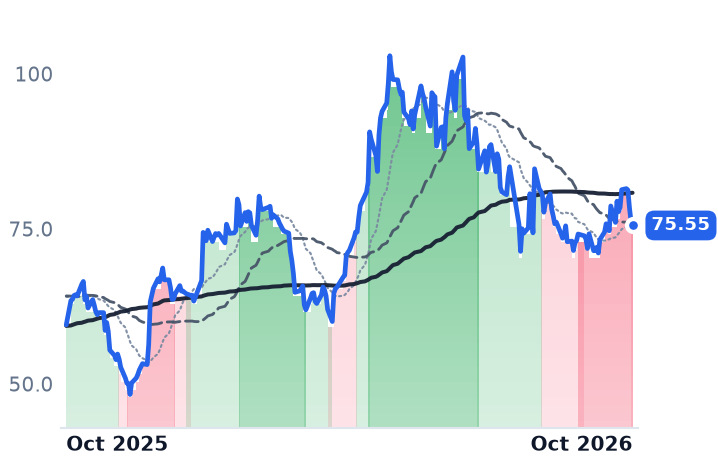
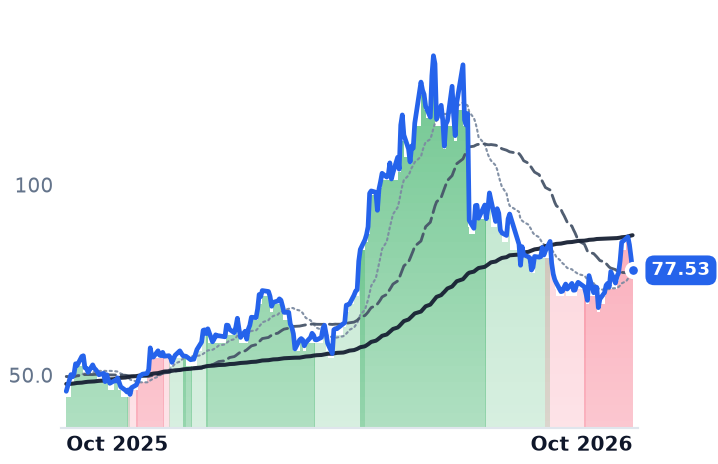
Microchip's distributors are holding stock at the low end of the company's history and ordering above what they take, yet the shares spent five weeks in a sustained downtrend that implies the inventory correction is still ahead of the company. The reported numbers say it is behind: revenue growth has accelerated four quarters running, to 38% year on year in the June quarter, and gross margin has expanded five quarters, reaching 63.2% as idle-plant charges shrink.
The de-rating is better explained by the discount rate than by demand — all six power-management and analog suppliers fell together in the week to 9 October on no company news. Microchip is the cheapest of the group on forward price-to-gross-profit at 10.65x, against Texas Instruments at 20.25x and Monolithic Power at 29.72x. What it has not yet shown is low channel stock turning into orders.
| Ticker | Company | Segment | Trend · 13mo | 30D | 1Y |
|---|---|---|---|---|---|
| The subject · what this brief is about | |||||
MCHP | Microchip Technology Incorporated | Analog & Mixed-Signal | ⚠️ Emerging Bear | +5.2% | +26.9% |
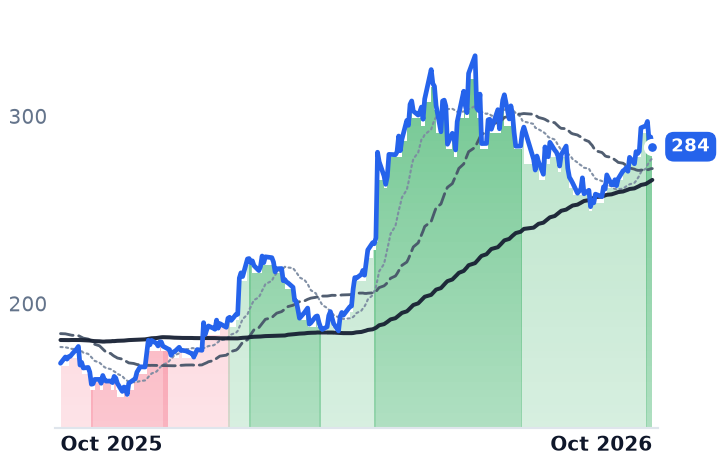
TXN | Texas Instruments Incorporated | Analog & Mixed-Signal | 🟢 Cont. Bull | +8.6% | +68.7% |
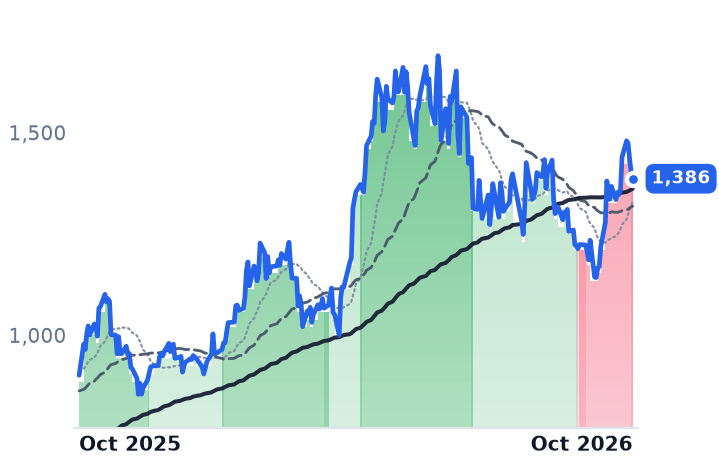
MPWR | Monolithic Power Systems | Analog & Mixed-Signal | ⚠️ Emerging Bear | +16.9% | +53.8% |
| Compared against · context, not the story | |||||
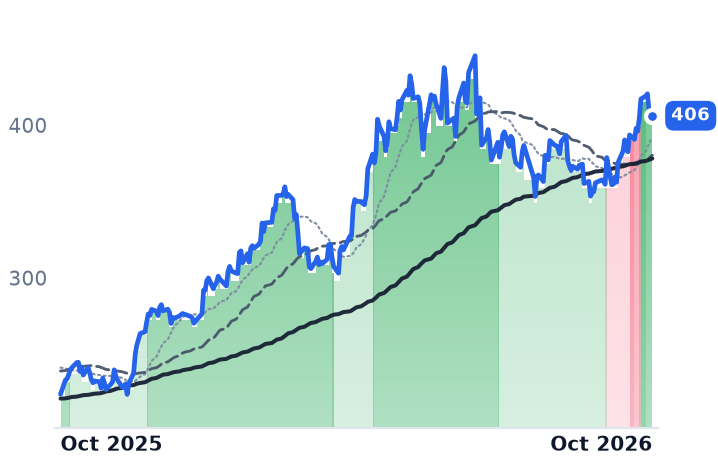
ADI | Analog Devices | Analog & Mixed-Signal | 🟢 Cont. Bull | +12.4% | +81.5% |
ON | ON Semiconductor | Analog & Mixed-Signal | ⚠️ Emerging Bear | +11.3% | +69.5% |
VICR | Vicor | Other | 🟢 Cont. Bull | +48.8% | +447.9% |
NVDA | NVIDIA | AI & Data Center GPUs | 🟢 Cont. Bull | +5.3% | +25.2% |
12-month price & trend
| Ticker | Mkt cap | P/E | P/E fwd | P/S | P/S fwd | P/GP | P/GP fwd | EV/EBITDA | FCF yld |
|---|---|---|---|---|---|---|---|---|---|
MCHP | $41.0B | 104.7x | 20.8x | 8.0x | 6.4x | 13.3x | 10.7x | 27.4x | 2.7% |
TXN | $259.1B | 42.9x | 33.3x | 13.3x | 11.8x | 22.8x | 20.3x | 27.9x | 2.1% |
MPWR | $68.1B | 84.5x | 50.5x | 20.8x | 16.4x | 37.7x | 29.7x | 64.3x | 0.9% |
| Ticker | Mkt cap | P/E | P/E fwd | P/S | P/S fwd | P/GP | P/GP fwd | EV/EBITDA | FCF yld |
|---|---|---|---|---|---|---|---|---|---|
ADI | $197.8B | 48.0x | 31.6x | 14.3x | 13.1x | 21.7x | 19.9x | 29.2x | 2.5% |
ON | $33.0B | 53.7x | 26.5x | 5.3x | 5.0x | 14.2x | 13.5x | 26.9x | 5.4% |
VICR | $11.9B | 82.2x | 66.6x | 25.1x | 18.7x | 44.3x | 33.1x | 86.1x | 0.4% |
| Ticker | Mkt cap | P/E | P/E fwd | P/S | P/S fwd | P/GP | P/GP fwd | EV/EBITDA | FCF yld |
|---|---|---|---|---|---|---|---|---|---|
NVDA | $5.5T | 34.3x | 25.0x | 21.5x | 13.9x | 29.0x | 18.7x | 28.3x | 2.2% |
Consensus projections
| Ticker | FY2026E | FY2027E | FY2028E | |
|---|---|---|---|---|
MCHP | Revenue | +6.2% | +37.1% | +16.4% |
| EPS | +20.7% | +132.2% | +25.6% | |
TXN | Revenue | +24.0% | +13.8% | +10.6% |
| EPS | +55.6% | +20.7% | +17.1% | |
MPWR | Revenue | +49.3% | +28.9% | +20.5% |
| EPS | +55.0% | +31.2% | +20.6% | |
ADI | Revenue | +37.8% | +22.1% | +11.6% |
| EPS | +65.8% | +29.4% | +18.0% | |
ON | Revenue | +9.2% | +13.1% | +13.9% |
| EPS | +37.1% | +40.9% | +30.2% | |
VICR | Revenue | +40.0% | +52.9% | +22.8% |
| EPS | +82.0% | +61.4% | +31.5% | |
NVDA | Revenue | +65.1% | +84.2% | +43.2% |
| EPS | +59.0% | +91.7% | +42.0% |
Forward fiscal years only. Blank means no analyst coverage for that year.
A supplier whose distributors are down to 25 days of stock, with orders running above shipments, has spent the last three months being priced as though the destocking were still ahead of it. Microchip's reported numbers say it is behind: revenue growth has accelerated four quarters in a row, to 38% year on year in the June quarter, and gross margin has expanded five quarters running, from 53.6% to 63.2%.
The margin recovery is mechanical. Idle plant is charged to cost of goods, and the under-utilisation charge is shrinking about $8m a quarter as the factories load. What the results do not explain is the share price, which fell with every other power-management and analog name in the week to 9 October on no company news.
Microchip Technology, which sells microcontrollers and analog parts to automotive, industrial and computing customers through authorized distributors, told investors in August that the correction in its sales channel was finished. Distributors held 25 days of stock, the lower end of the company's historical range and one day fewer than in March, with bookings well above shipments and sell-through rising. Management went further in the same release, saying channel inventory is now low and needs replenishing in coming quarters.
The shares have behaved as though none of that had been said.
Microchip sits 14.7% below its July level and spent the five weeks to 7 October in a sustained downtrend, easing only on 8 October. The belief embedded in that decline is that an inventory correction is still to come and has yet to reach reported revenue. The company's own figures test it: revenue growth went from a 2.0% year-on-year decline in September 2025 to 38.0% growth in the June quarter, on sales of $1.485bn.
The $38.5m of idle plant sitting inside the margin
An analog maker that owns its fabs reports under-loaded capacity inside cost of goods sold, so the margin recovers as the plant fills. June-quarter non-GAAP gross margin of 63.8% still carried $38.5m of capacity under-utilisation charges, worth about 260 basis points, down roughly $8m from the prior quarter and guided down by a similar amount again. Microchip also has around $450m of equipment in storage; the company says its internal fabs are not the constraint on growth, pointing instead to outside foundries, assembly-and-test subcontractors and its own production throughput.
That arithmetic is why gross profit grew 62.8% and operating income roughly tenfold on 38% more revenue. "Improving demand, continued inventory normalization, and stronger factory utilization contributed to better operational leverage," chief executive Steve Sanghi said in the 6 August release.
Priced under both comparisons on gross profit
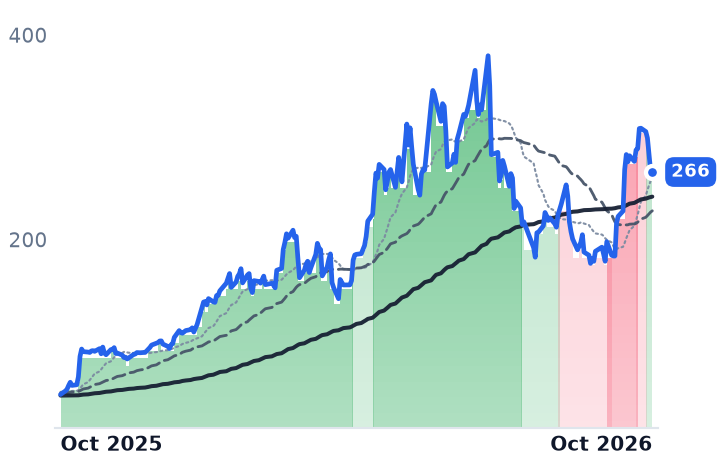
Trailing earnings are useless here. Revenue fell 42% in a single year, from $7.63bn in fiscal 2024 to $4.40bn in fiscal 2025, so the 104.7x trailing price-to-earnings ratio is struck on trough profits. On gross profit, the line that moves with fab loading, Microchip trades at 10.65x forward against 20.25x for Texas Instruments and 29.72x for Monolithic Power. Its trailing figure has fallen to 13.31x from 14.13x on 22 August, a stretch in which gross profit grew 62.8%.
The two comparisons are earned differently. Texas Instruments is paid for owning its plant, and said trailing cash flow from operations "underscored the strength of the business model, quality of the product portfolio and benefit of 300mm production" — free cash flow of $6.5bn against $1.8bn a year earlier, about a quarter of it $1.6bn of federal chip incentives, with 2026 depreciation guided to $2.2–2.4bn; it trades at 33.3x forward earnings after its trailing multiple compressed from 49.6x in May while the stock rose 32.1% over six months. Monolithic Power, at 50.5x forward earnings, is paid for data-center sockets: enterprise-data revenue of $380.6m was 38.8% of the June quarter and up 164% year on year.
The yield shock all six of them shared
Nothing in Microchip's reported results accounts for its de-rating. In the week to 9 October all six power-analog names fell together, by 2.6% to 13.9%, with no company-specific news at any of the three examined here, while the semiconductor index was down as much as 29% from its June peak on crude above $84 a barrel and Treasury yields near multi-decade highs — the long-yield pressure this page has already described. The likelier reading is a repricing of long-duration earnings rather than a demand event, against industry sales that hit a record $120.6bn in May.
The open question is mix. Microchip projects data-center revenue up about 69%, to roughly $1bn in calendar 2026, on memory and interconnect controller content; that is real and still small beside a company guiding toward about $6.4bn of annual revenue, with industrial and automotive customers dominating the consolidated statement. A rate shock does not empty a sales channel. Weak factory and car demand would.
September-quarter guidance of 7% to 9% sequential growth implies roughly 40% more revenue than a year earlier, and the results are due around 29 October.
A channel that has stopped shrinking is not yet a channel that has started ordering. That is the distinction the next print has to settle, and it is the one thing neither the margin arithmetic nor the bond market can settle for it.