
The Over-the-Counter Slump Widened Haleon's Margin and Squeezed Perrigo's
Hypothesis Opus 5 · Research Opus 5 · Writing Opus 5 · Prompt v1.7
Fewer packets of pain relief and cold remedy are selling in the United States and Europe, yet both the advertised brand and the store label next to it gained share of the smaller pile. That should make the two listed ways of earning an over-the-counter dollar one trade. It did the opposite.
Haleon expanded constant-currency gross margin by 1.4 points in the first half of 2026 and grew adjusted earnings per share 12%, with second-quarter growth finally coming more from volume than price. Perrigo, which makes retailers' store brands, saw its all-in adjusted gross margin fall 2.5 points to 35.6% on core organic sales down 3.5%.
Haleon collects a brand premium it buys with advertising worth 20.9% of sales; Perrigo earns a contract-like margin set by plant utilization and shipment timing. Perrigo's shares moved on asset sales and debt, not demand.
| Ticker | Company | Segment | Trend · 13mo | 30D | 1Y |
|---|---|---|---|---|---|
| The subject · what this brief is about | |||||
HLN | Haleon | OTC & Consumer Health | 🔴 Cont. Bear | +1.4% | +4.9% |
PRGO | Perrigo | OTC & Consumer Health | 🌱 Emerging Bull | +8.9% | −27.5% |
KVUE | Kenvue | Oral & Specialty Health | 🌱 Emerging Bull | −1.0% | +10.2% |
| Compared against · context, not the story | |||||
KMB | Kimberly-Clark | Tissue & Absorbent Products | 🌱 Emerging Bull | −1.7% | −16.4% |
CHD | Church & Dwight | Home Care & Cleaning | 🌱 Emerging Bull | +4.0% | +12.6% |
12-month price & trend
| Ticker | Mkt cap | P/E | P/E fwd | P/S | P/S fwd | P/GP | P/GP fwd | EV/EBITDA | FCF yld |
|---|---|---|---|---|---|---|---|---|---|
HLN | $41.0B | 19.3x | 22.2x | 2.8x | 3.6x | 4.2x | 5.5x | 13.1x | 3.9% |
PRGO | $2.1B | n/m | 6.8x | 0.5x | 0.5x | 1.5x | 1.5x | n/m | 8.4% |
KVUE | $34.0B | 20.3x | 15.1x | 2.2x | 2.2x | 3.8x | 3.7x | 13.1x | 6.2% |
| Ticker | Mkt cap | P/E | P/E fwd | P/S | P/S fwd | P/GP | P/GP fwd | EV/EBITDA | FCF yld |
|---|---|---|---|---|---|---|---|---|---|
KMB | $32.7B | 16.7x | 13.3x | 2.0x | 2.0x | 5.4x | 5.4x | 12.5x | 7.8% |
CHD | $23.2B | 31.4x | 26.0x | 3.7x | 3.7x | 8.2x | 8.2x | 20.0x | 4.8% |
Consensus projections
| Ticker | FY2026E | FY2027E | FY2028E | |
|---|---|---|---|---|
HLN | Revenue | +2.8% | +4.1% | +4.0% |
| EPS | +13.6% | +8.6% | +8.3% | |
PRGO | Revenue | −4.5% | +0.5% | +0.9% |
| EPS | −20.6% | +9.1% | +12.3% | |
KVUE | Revenue | +3.9% | +2.3% | +3.2% |
| EPS | +14.1% | +6.0% | +6.7% | |
KMB | Revenue | +0.9% | +2.6% | +2.7% |
| EPS | −1.4% | +0.3% | +7.6% | |
CHD | Revenue | +0.6% | +4.2% | +4.0% |
| EPS | +8.1% | +7.1% | +7.2% |
Forward fiscal years only. Blank means no analyst coverage for that year.
Fewer units of painkillers, cold remedies and vitamins are moving through American and European drugstores than a year ago, and both the advertised brand and the store label beside it took a bigger slice of the smaller pile. Haleon, the Sensodyne-to-Panadol consumer healthcare company spun out of GSK, reported that Advil gained share in a declining market in the first half of 2026. Perrigo, which manufactures the store-brand versions of those same medicines for retail chains, added another percentage point of US store-brand volume share in the first quarter, after 1.2 points across 2025.
A single industry classification holds both companies, which invites the reading that they are one trade on a self-care recovery and on shoppers trading back up from private label. The two most recent halves say otherwise. Haleon's productivity work delivered 1.4 points of constant-currency gross margin expansion, against a medium-term target of half a point to eight-tenths a year. Perrigo's all-in adjusted gross margin fell 2.5 points to 35.6% in its June quarter. The divergence is a pay structure, not a forecast.
The quarter the retailer decides
Neither company's revenue line measures what households consume. It measures shipments into a concentrated set of grocery, pharmacy and mass chains, and those chains decide how much stock to hold. Perrigo's Self Care net sales of $577m fell 3.7% in the quarter ended 27 June, which the company attributed to softness in category consumption across the US and Europe and a slower start to summer seasonal categories, leading to a continued reduction of retail inventory levels, most notably in Europe.
The same mechanism shows up at a third seller: Reckitt's first-quarter disclosure recorded European net revenue down 4.2% like-for-like on a 4.5% volume decline, with seasonal over-the-counter products down double digit and retailers destocking at the end of the season.
Volume finally did the work at Haleon
Haleon's organic growth accelerated to 3.1% in the second quarter from 2.2% in the first, and the composition inverted: 1.1% price and 2.0% volume/mix, where the half as a whole was 2.1% price and 0.5% volume. "We delivered a good first half performance in what remains a challenging consumer environment, with sequential improvement in Q2 and a more balanced price and volume/mix," chief executive Brian McNamara said on 30 July.
The shelf is four demand curves, not one. Oral Health grew 7.3% organically in the half on Sensodyne and parodontax, while Respiratory Health declined low single digit; in the first quarter respiratory fell 3.4% on £499m of revenue against Oral Health up 8.3% on £932m, the weakness concentrated in a soft North American cold and flu season.
That premium is rented, and the rent is media. Haleon raised advertising and promotion spend 3.2% at constant currency to 20.9% of sales, and still delivered 8.2% constant-currency adjusted operating profit growth, 12.0% adjusted earnings-per-share growth and £769m of free cash flow, with £457m of a £500m buyback completed. Guidance of 3% to 5% organic growth was reaffirmed. On a sterling reporting base, management expects roughly a one-point translation headwind to full-year revenue and adjusted operating profit, which is most of the gap between its organic and reported lines.
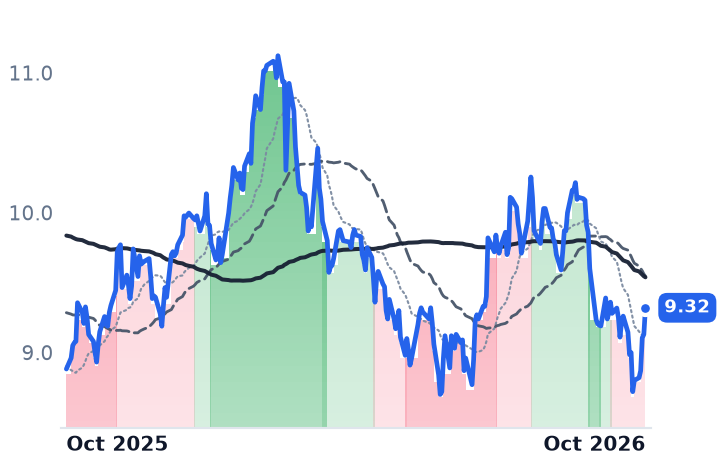
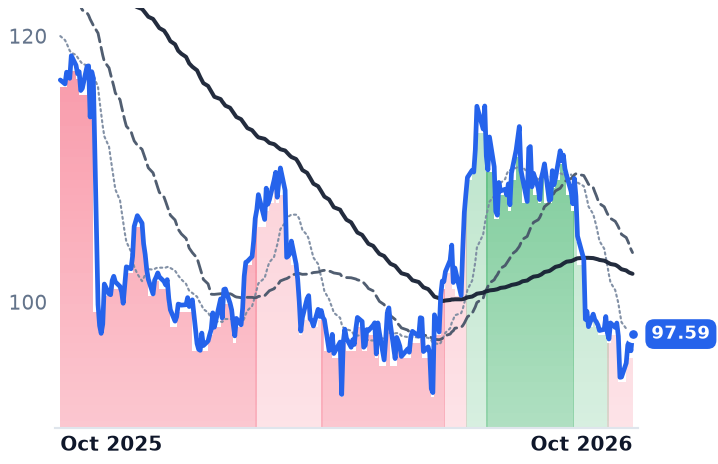
The shares have not followed. Haleon closed 9 October at $9.32, some 17% below its twelve-month high of $11.27 and 7% above the low. At 22.2x forward earnings it is cheaper than Church & Dwight, the branded peer behind Zicam and vitafusion, at 26.0x on consensus revenue growth of 0.6%.
What moved Perrigo was a sale, not a season
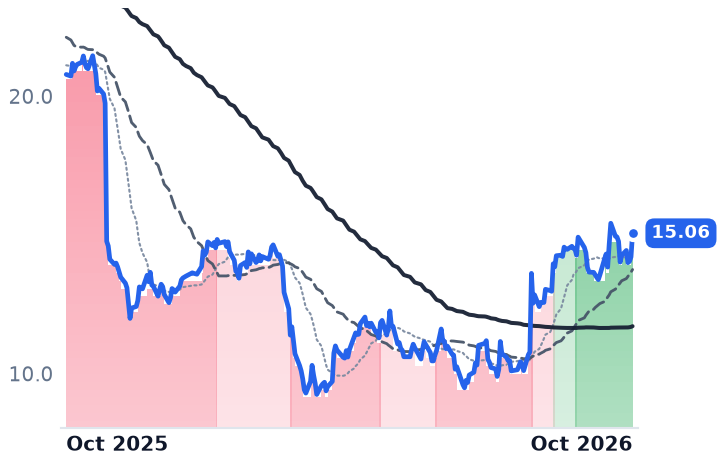
Perrigo rose 44.7% in three months and is still down 33.1% over twelve. The turn is dated: second-quarter results on 5 August lifted the stock about 25% in one session. Core net sales in that quarter fell 3.1% and core organic sales 3.5%, and consensus now has full-year earnings per share at $2.20, down 21%, inside company guidance of $2.00 to $2.30 all-in.
What improved was the balance sheet and the plants. Perrigo sold its Dermacosmetics business for about $359m and applied the substantial majority to debt, leaving $400m of cash against $3.3bn of debt and net leverage at or slightly below four times adjusted EBITDA. Infant formula net sales reached $101m, up 23.1% on the timing of contract shipments and higher store-brand volume, with operating income about $16m better after a capacity reduction in Vermont and a favorable FDA audit. A self-help program is sized at $80m to $100m of savings. "We continued to execute our Three-S plan in the second quarter, strengthening areas of the business within our control, improving operational performance, streamlining our portfolio, and further reducing debt," interim chief executive Albert Manzone said on 5 August; he took the role on 8 June after his predecessor resigned over personal conduct the board found inconsistent with its code. Reviews of the Infant Formula and Oral Care businesses remain open.
The equity is priced accordingly: 6.85x forward earnings and 0.83x book, with the trailing multiple unusable after a $1.3bn goodwill write-off produced a reported loss for 2025.
Two ways to be paid on the same aisle
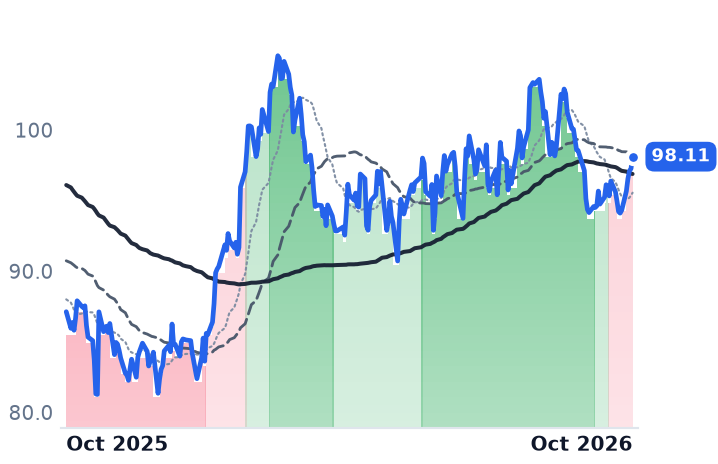
Haleon's half explains none of its share price, which sits near the bottom of its own year. Perrigo's share price explains none of its half: sales, gross margin and consensus earnings all went the wrong way while the stock rose by nearly half. The cause of the split is who owns the brand. Haleon keeps the premium as long as it keeps paying for the advertising, so category contraction reaches it as mix and productivity. Perrigo is paid a manufacturing margin by the retailer who owns the label, so the same contraction reaches it as destocking and idle plant, and what equity holders keep is decided by leverage and portfolio sales. A third large owner of over-the-counter brands offers no read on either: Kenvue's shares track the Kimberly-Clark acquisition approved by both shareholder bases on 29 January, not the aisle.
Trade-down has not reversed. Store brands are still taking units while branded share also rises, which is arithmetic only a shrinking category permits. Haleon's third-quarter trading statement is due 29 October and Perrigo reports on 4 November. Until the unit base stops falling, Haleon's extra margin has to come out of its own cost base and Perrigo's out of its debt.