

Adobe Dropped Its Subscriber Disclosure and Says It Chose Free Users Over Price Rises
Hypothesis Opus 5 · Research Opus 5 · Writing Opus 5 · Prompt v1.7
A year of selling design software short rested on one claim: generative AI shrinks the number of human seats a customer pays for. Adobe's own reporting can no longer test it. In fiscal 2026 the company retired Digital Media segment reporting for two broad customer groups, publishing total ending annual recurring revenue of $27.50bn, up 11.2%, and monthly active users past 1 billion, but no paid subscriber count.
What it does publish runs against a seat collapse and against the monetization case at once: creative free-tier users reached 100m, up more than 70%, while management said it deliberately deprioritized Creative Cloud price optimization. Revenue growth edged up to 12.9%; contracted backlog growth fell to 8%, the first single-digit reading since early fiscal 2023. Autodesk discloses no seat count either. Figma, which does, reported 136% net dollar retention.
| Ticker | Company | Segment | Trend · 13mo | 30D | 1Y |
|---|---|---|---|---|---|
| The subject · what this brief is about | |||||
ADBE | Adobe | Design & Content Creation | 🔴 Cont. Bear | −3.1% | −28.2% |
ADSK | Autodesk | Design & Content Creation | 🔴 Cont. Bear | +10.2% | −22.5% |
FIG | Figma | Design & Content Creation | 🌱 Emerging Bull | +1.6% | −63.2% |
| Compared against · context, not the story | |||||
PTC | PTC | Specialized Enterprise Solutions | 🌱 Emerging Bull | +49.6% | −1.4% |
GTLB | GitLab | Developer Tools & DevOps | 🟢 Cont. Bull | +15.6% | +22.7% |
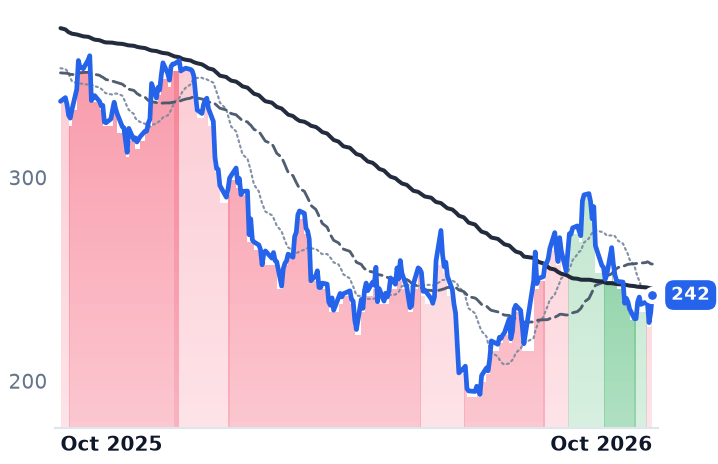
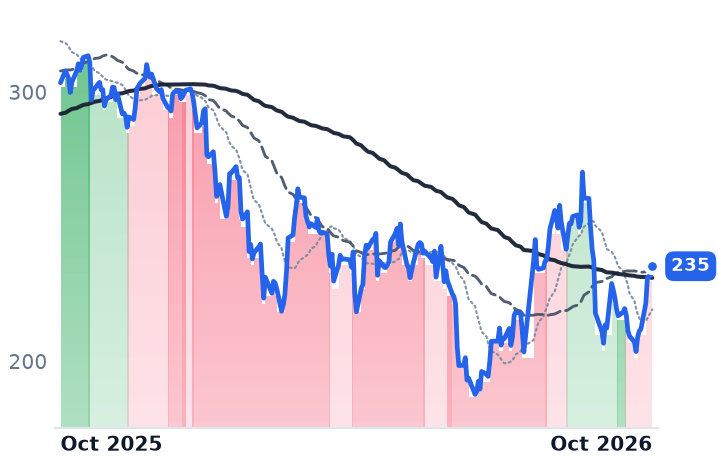
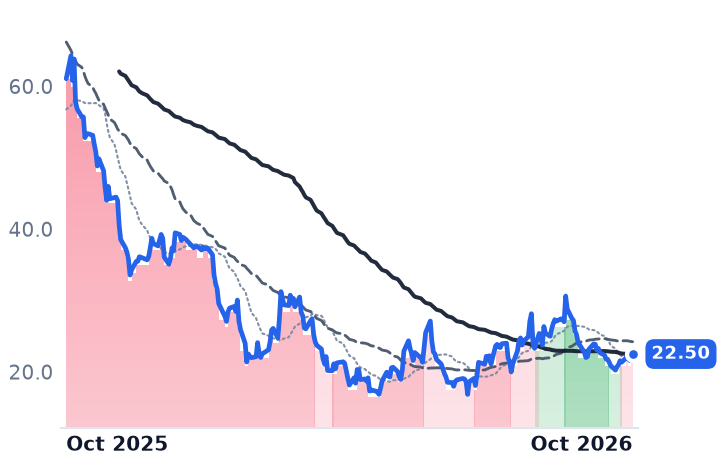
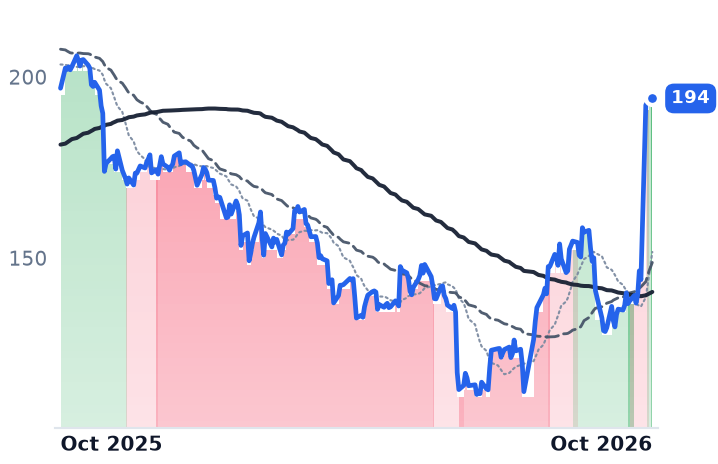
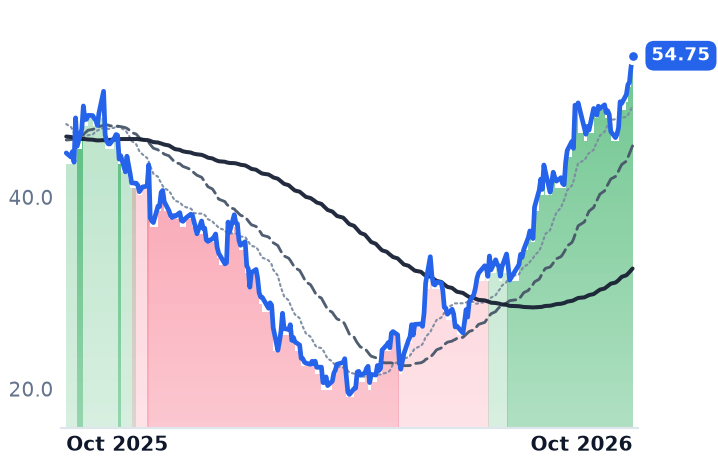
12-month price & trend
| Ticker | Mkt cap | P/E | P/E fwd | P/S | P/S fwd | P/GP | P/GP fwd | EV/EBITDA | FCF yld |
|---|---|---|---|---|---|---|---|---|---|
ADBE | $96.3B | 13.5x | 9.9x | 3.7x | 3.6x | 4.2x | 4.1x | 9.6x | 11.4% |
ADSK | $49.7B | 30.3x | 18.7x | 6.4x | 6.0x | 7.0x | 6.5x | 21.4x | 5.7% |
FIG | $11.0B | n/m | 78.7x | 8.6x | 7.5x | 10.8x | 9.4x | n/m | 2.1% |
| Ticker | Mkt cap | P/E | P/E fwd | P/S | P/S fwd | P/GP | P/GP fwd | EV/EBITDA | FCF yld |
|---|---|---|---|---|---|---|---|---|---|
PTC | $22.3B | 18.6x | 21.6x | 7.5x | 7.7x | 9.0x | 9.1x | 14.1x | 4.2% |
GTLB | $8.7B | n/m | 59.6x | 8.3x | 7.7x | 9.6x | 9.0x | n/m | 2.5% |
Consensus projections
| Ticker | FY2026E | FY2027E | FY2028E | |
|---|---|---|---|---|
ADBE | Revenue | +12.3% | +9.3% | +8.7% |
| EPS | +17.6% | +13.2% | +14.1% | |
ADSK | Revenue | +17.0% | +16.1% | +11.0% |
| EPS | +23.0% | +23.0% | +12.5% | |
FIG | Revenue | +40.6% | +24.0% | +24.7% |
| EPS | −24.6% | +25.3% | +33.3% | |
PTC | Revenue | +4.9% | +6.4% | +7.5% |
| EPS | +20.5% | +9.0% | +9.9% | |
GTLB | Revenue | +25.6% | +19.5% | +15.5% |
| EPS | +40.9% | −2.9% | +19.9% |
Forward fiscal years only. Blank means no analyst coverage for that year.
Adobe's August quarter was the largest in its history, and it grew faster than the two quarters before it. The disclosure an investor would need to learn whether paying creative seats are still being added is no longer published.
That matters because the de-rating of design software was built on seats, not revenue. Per-seat pricing fell from 21% to 15% of software companies in twelve months while hybrid pricing rose from 27% to 41%, and roughly $2 trillion of business software market value was erased in 2026 on the thesis that AI agents cut the number of human logins a customer needs. Settling that argument at Adobe, which sells Creative Cloud, Acrobat and a marketing suite by subscription to professional creators and enterprises, requires a subscriber count. In fiscal 2026 Adobe stopped reporting Digital Media and Digital Experience revenue and moved to two customer groups, reporting total company annual recurring revenue in place of Digital Media ARR, with no paid subscriber figure and no segment net new ARR.
Volume up, monetization postponed
What remains points away from a shrinking base. Ending ARR was $27.50bn, up 11.2%, with monthly active users past 1 billion and creative free-tier users above 100 million, up more than 70%. Revenue rose 12.9% to $6.76bn, after 12.7% and 12.0% in the two prior quarters.
The figure the market seized on was a roughly 36-37% year-over-year fall in net new ARR, arithmetic an analyst performed on the September 10 call that management did not validate or break into seats, price and free-tier effects. Management's explanation was a choice: it deprioritized Creative Cloud pricing optimization and redirected free-tier traffic to maximize user acquisition, calibrating conversion timing later. The lever exists and was recently pulled, with Creative Cloud Pro raised from $59.99 to $69.99 a month, 16.7%, effective June 17, 2025 in the US, alongside an increase in included Firefly generative credits from 3,000 to 4,000. It is being held in reserve.
"I see immense opportunity for Adobe to be the leader in Agentic software for creativity, productivity, and customer experience," said Anil Chakravarthy on the September 10 call. He becomes chief executive on December 1, 2026, succeeding Shantanu Narayen after 29 years.
The meters that did weaken
Remaining performance obligations, the contracted backlog, grew 8% — single-digit for the first time since early fiscal 2023 — with current obligations up 9%; management tied both to conversion timing and a focus on active users over near-term billings. Gross margin slipped to 88.1% from 89.3%, and operating income grew 8.3% against revenue's 12.9%. The AI products themselves are small and fast: total AI-first ending ARR above $650m, more than 150% higher, with Firefly ARR up 40% in a quarter.
The shares closed at $242.27 on October 9, down 30% over twelve months and 5% over thirty days, through a month in which the Federal Reserve raised its target range to 3.75-4.00%. At 13.5 times trailing earnings and 9.9 times forward, on consensus earnings of $24.48 a share for fiscal 2026 (up 17.6%), Adobe carries roughly half the forward multiple of Autodesk and an 11.4% trailing free-cash-flow yield.
Neither peer closes the gap
Autodesk, which sells AutoCAD, Revit and a construction platform to architects, engineers and contractors, discloses no seat count either, and its forward meters disagree with each other: billings up 10% and current obligations up 12% against total obligations up only 2%, all below revenue growth of 16%, with net revenue retention at the top of its 100-110% range and operating income up 33%. Its 11.0% gain over five sessions was a read-through from Schneider Electric's $23.7bn cash bid for PTC at about 9.4 times recurring revenue, not Autodesk news; it trades at 18.7 times forward earnings against 30.3 trailing.
Figma, the browser-based design platform that listed in 2025, is the one that counts: 136% net dollar retention and 15,964 customers above $10,000 of ARR, up 34%, with AI credits embedded inside the seat rather than sold beside it, as revenue accelerated to 48.2% growth. Its shares are down 66.9% over twelve months, part of that explained by an extended lock-up covering about 54.1% of Class A shares releasing in tranches. At 8.6 times trailing sales against consensus growth halving to 24% next year, it is normalized rather than cheap.
What the numbers can and cannot settle
Nothing in these three disclosures shows a creative seat base in retreat. Adobe is adding users at a rate that would be impossible if demand for its tools were collapsing, and Figma's expansion rate says customers buying AI features are buying more seats alongside them. But Adobe's revenue line would look the same whether its paid base were growing slowly at a higher price or shrinking behind the one-time 16.7% increase and credit consumption, and the company has removed the series that distinguished those cases. The weakening meters that remain — backlog growth at 8%, margin down a point, operating income growing slower than sales — are consistent with the deliberate trade-off described on the call, which is also what the bear case predicts. The likelier reading is deferred monetization rather than erosion, held as a judgment rather than a measurement.
Adobe is now asking to be valued on a free user base of 100 million people, which is a bet that conversion is a timing question. Its own reporting no longer contains the line that would show the conversion happening.