

MetLife and Prudential Keep Moving Reserves to Bermuda as Earnings Outgrow Their Equity
Hypothesis Opus 5 · Research Opus 5 · Writing Opus 5 · Prompt v1.7
Inside a single week, three of the largest life insurers moved blocks of in-force liabilities onto reinsurers' balance sheets, and the benefit lands in reported earnings well before it lands in equity.
MetLife's adjusted earnings per share rose 20% in the June quarter while its adjusted book value per share rose 3%. Prudential's operating income per share grew 14% against 4.7% on the same book-value measure. Prudential's Bermuda affiliate Prismic has now agreed to carry more than $22bn of its liabilities; Manulife closed a long-term-care cession to Munich Re on 1 October.
Nothing in the quarters was weak, which is why the split sits in valuation rather than in results: Prudential trades near 1.1x its adjusted book, the cheapest of the three, on a consensus earnings path that is flat while MetLife's rises.
| Ticker | Company | Segment | Trend · 13mo | 30D | 1Y |
|---|---|---|---|---|---|
| The subject · what this brief is about | |||||
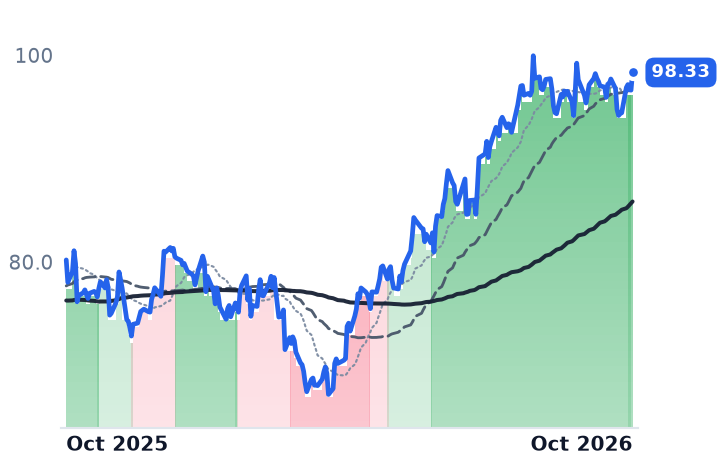
MET | MetLife | Comprehensive Life & Diversified | 🟢 Cont. Bull | +3.1% | +22.6% |
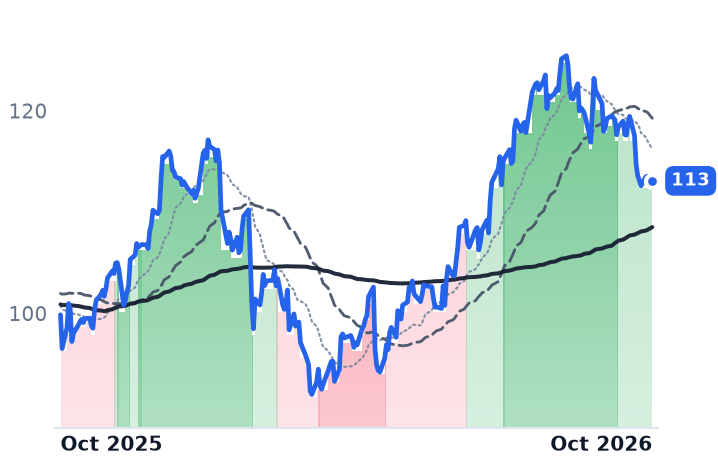
PRU | Prudential Financial | Comprehensive Life & Diversified | 🟢 Cont. Bull | −4.1% | +13.2% |
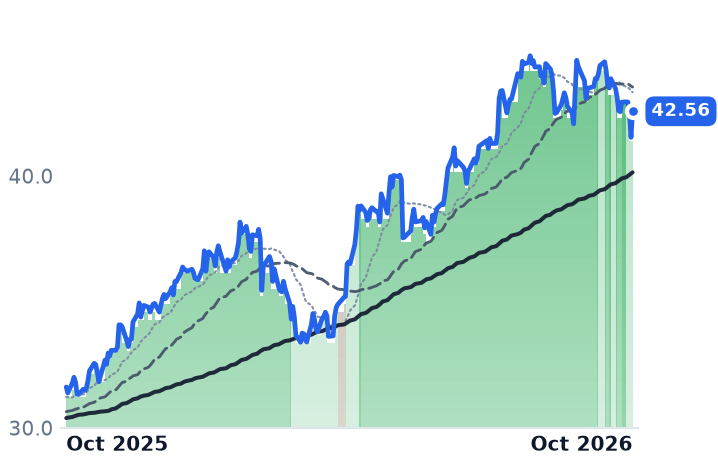
MFC | Manulife Financial | Comprehensive Life & Diversified | 🟢 Cont. Bull | −1.2% | +34.6% |
| Compared against · context, not the story | |||||
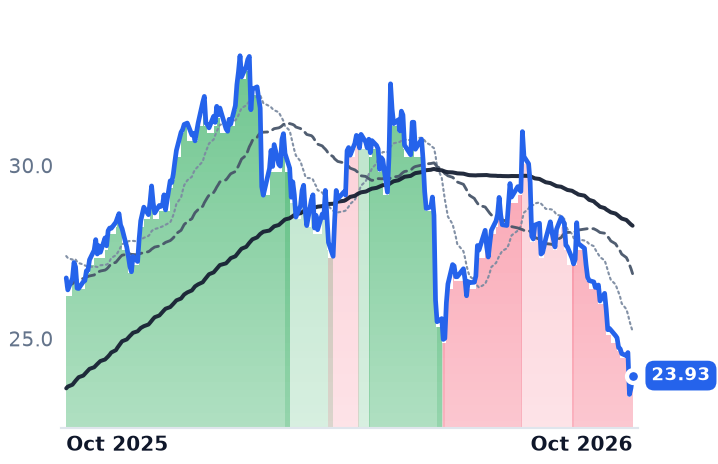
PUK | Prudential | Comprehensive Life & Diversified | 🔴 Cont. Bear | −11.8% | −10.5% |
PRH | Prudential Financial, Inc. 5.95 | Comprehensive Life & Diversified | 🔴 Cont. Bear | −5.4% | −16.1% |
PRS | Prudential Financial, Inc. 5.62 | Comprehensive Life & Diversified | 🔴 Cont. Bear | −4.0% | −17.5% |
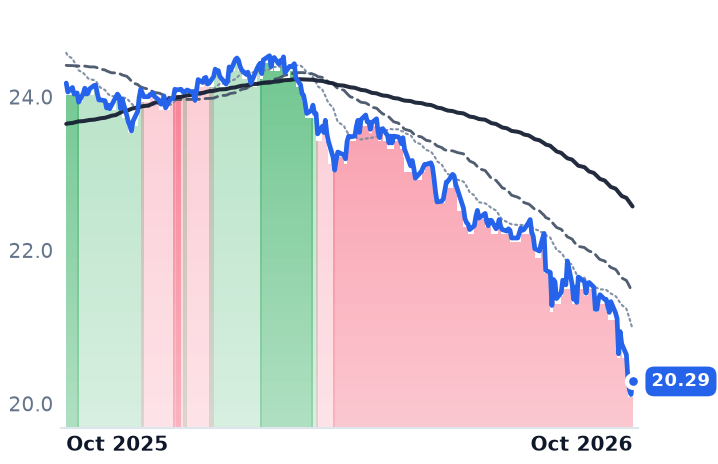
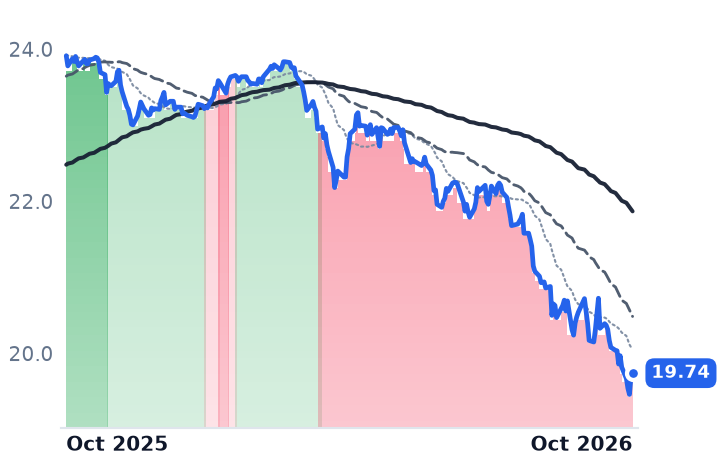
12-month price & trend
| Ticker | Mkt cap | P/E | P/E fwd | P/S | P/S fwd | P/GP | P/GP fwd | EV/EBITDA | FCF yld |
|---|---|---|---|---|---|---|---|---|---|
MET | $63.3B | 18.7x | 9.7x | 0.8x | 0.8x | 3.1x | 3.1x | 11.0x | 26.2% |
PRU | $39.2B | 10.1x | 7.8x | 0.6x | 0.7x | 2.0x | 2.1x | 8.5x | 28.0% |
MFC | $70.8B | 16.3x | 9.5x | 1.7x | 1.7x | 4.8x | 4.6x | 10.2x | 30.4% |
| Ticker | Mkt cap | P/E | P/E fwd | P/S | P/S fwd | P/GP | P/GP fwd | EV/EBITDA | FCF yld |
|---|---|---|---|---|---|---|---|---|---|
PUK | $38.7B | 10.5x | 12.5x | 1.5x | 5.7x | 1.5x | 5.7x | 7.4x | 5.9% |
PRH | $8.1B | 10.2x | — | 0.6x | — | 1.7x | — | 8.0x | 27.6% |
PRS | $7.9B | 10.2x | — | 0.6x | — | 1.7x | — | 8.0x | 27.6% |
Consensus projections
| Ticker | FY2026E | FY2027E | FY2028E | |
|---|---|---|---|---|
MET | Revenue | −4.6% | +5.2% | +4.0% |
| EPS | +16.8% | +9.8% | +11.9% | |
PRU | Revenue | +3.2% | +1.8% | +2.3% |
| EPS | −0.3% | +3.2% | +8.9% | |
MFC | Revenue | +22.0% | +6.7% | +5.4% |
| EPS | +8.1% | +12.3% | +10.1% | |
PUK | Revenue | +3.1% | +7.1% | +25.8% |
| EPS | +19.7% | +18.2% | +10.4% | |
PRH | Revenue | +0.9% | +3.3% | +1.3% |
| EPS | −0.8% | +7.6% | +7.1% | |
PRS | Revenue | +0.9% | +3.3% | +1.3% |
| EPS | −0.8% | +7.6% | +7.1% |
Forward fiscal years only. Blank means no analyst coverage for that year.
Prudential Financial announced on 5 October that Prismic Life Reinsurance, the Bermuda company it launched with Warburg Pincus in 2023 and took a 20% interest in, will reinsure about $5bn of reserves backing dollar-denominated Japanese whole-life policies written by its Japanese affiliates. That takes the liabilities Prismic has agreed to carry for Prudential past $22bn. Four days earlier, Manulife closed the cession of biometric risk on C$3.2bn of John Hancock long-term-care reserves to Munich American Reassurance.
The June quarter at these companies was read as the higher-yield story finally arriving: assets bought near 5% standing behind promises priced years ago. The disclosures describe something else doing much of the work. Liabilities are leaving the ceding company's books, the capital behind them is released and spent on shares, and adjusted earnings are growing several times faster than the equity they are earned on.
Twenty percent on earnings, three percent on the book
MetLife, which sells group life, dental and disability cover to employers alongside annuities, funding agreements and pension-risk-transfer buyouts, reported adjusted earnings up 15% to $1.6bn and adjusted earnings per share up 20% to $2.43, with adjusted return on equity of 17% for a second consecutive quarter, the top of its target range. Adjusted book value per share, the measure that strips out the mark on its bond portfolio, rose 3% to $57.71. Part of that gap is retired shares; part is the hedging and derivative marks that adjusted earnings exclude and book value absorbs.
Behind the buybacks sits Chariot Re, the Bermuda vehicle MetLife started with General Atlantic, whose inaugural $10bn transaction took on structured settlement annuities and group annuity contracts from pension risk transfers MetLife had originated, and which MetLife expected to raise available capital by roughly $1bn. At 30 June the arrangement carried an $11.1bn funds-withheld liability and a $10.9bn receivable. On 5 August the board authorized $3bn of fresh repurchases.
The spread dollar itself wobbled
The owned-asset half of the model had a poor quarter. Variable investment income, the private-equity and real-estate fund line reported on a one-quarter lag, came in at $231m against the roughly $400m a quarter implied by full-year guidance of about $1.6bn. "Total investment spread was 97 basis points in the second quarter, below our guidance range of 100 to 120 basis points, driven by weaker private equity returns within VII," chief financial officer John McCallion said on the second-quarter call.
That did not persist. Around 24 September MetLife pre-announced preliminary third-quarter variable investment income of at least $600m ahead of its 4 November release. The origination end was the softer one: US pension-risk-transfer buyout and buy-in sales totalled about $3bn in the second quarter, down 26% from a year earlier, on 176 contracts with no single deal above $250m.
Prudential's fee half has not cured its discount
Prudential's asset manager PGIM earned $294m of adjusted operating income against $229m a year earlier on $1.491 trillion of assets, with $4.6bn of third-party net inflows offset by $3.0bn of affiliated outflows. Group after-tax adjusted operating income reached $4.08 a share, up 14%, while adjusted book value per share grew 4.7% to $100.91.
Prudential is the cheapest of the three at 7.8x forward earnings against 10.1x trailing, roughly 1.1x that adjusted book. MetLife, on the same disclosed figures, trades near 1.7x. The likelier cause is the forward path rather than the printed quarter: consensus has Prudential earning $14.45 a share this year, a shade below last year's $14.50, and $14.91 next, while MetLife's is set to rise about 17% to $10.15.
Manulife's cession is the defensive version of the same trade. Core earnings rose 12% to C$1.923bn with Asia annualized premium equivalent sales up 21%, and the Munich Re deal was largely capital-neutral, worth about C$30m a year, while cutting cumulative long-term-care morbidity sensitivity by 24%. Its last annual actuarial assumption review was favourable, reducing pre-tax fulfilment cash flows by $605m; the next one is implemented in third-quarter results. The shares trade at 9.5x forward against 16.3x trailing.
What the twelve months do and do not explain
Over twelve months to 9 October, Manulife gained 33%, MetLife 20% and Prudential 10%, with Prudential down 4% over the trailing thirty days and its trend softening a notch on 17 September, Manulife's on 2 October.
The operating record covers the gains. It does not cover Prudential's discount, which tracks a flat earnings path and an unsettled question about what stands behind ceded reserves. US life insurers ceded $2.4 trillion of reserves in 2024, more than $1.1 trillion of it offshore, and state regulators are exploring capital charges for recapture risk and for weaker reinsurers' credit; Cayman-based reinsurers were contesting the proposals as of 7 October. The fee income meant to replace spread is still tiny: MetLife's newly separated investment-management segment earned $57m in the quarter, against $1.6bn for the group.
The capital freed offshore has already been converted into retired shares. The reserves it was holding sit with reinsurers whose required capital is still being argued over in front of the people who write the rules, and each of these three now reports its earnings on a balance sheet a little smaller than the business it sold.