

Only Dollar Loans to Vaca Muerta Exporters Still Grow at Argentina's Grupo Galicia
Hypothesis Opus 5 · Research Opus 5 · Writing Opus 5 · Prompt v1.7
Argentina's listed banks sold off through September on what looked like a household credit accident, and its oil producers were supposed to be insulated. Over the thirty days to 6 October both legs fell, and on 5 October both recovered together when the country-risk spread dropped 49 basis points to 599, with the banks bouncing roughly twice as hard as the energy names.
The linking fact sits inside Grupo Financiero Galicia's own loan book: dollar lending to oil, gas and export finance grew 48.8% over the year to June while its peso book shrank 4% in the quarter. Galicia's de-rating to about 1.1x book is earned, with bank non-performing loans at 8.3% and net interest margin guided down to roughly 16%. Vista Energy's is not: revenue doubled and gross margin widened to 57.4%.
| Ticker | Company | Segment | Trend · 13mo | 30D | 1Y |
|---|---|---|---|---|---|
| The subject · what this brief is about | |||||
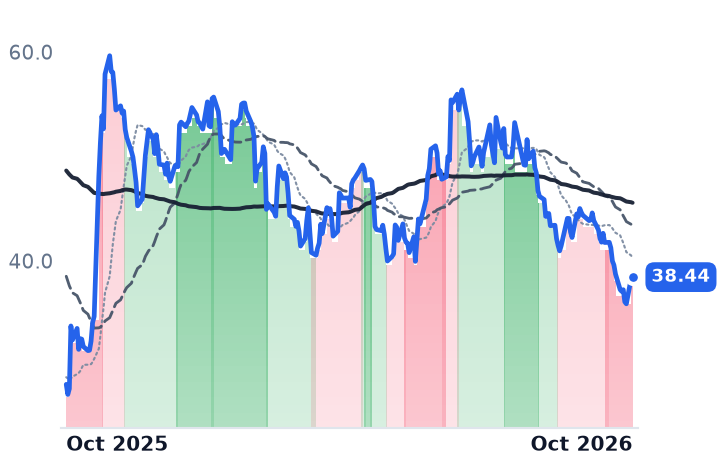
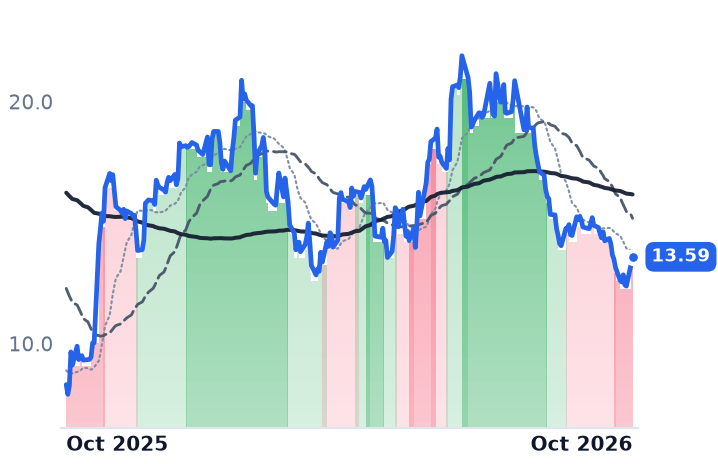
GGAL | Grupo Financiero Galicia | Latin America & Caribbean Banks | 🔴 Cont. Bear | −12.3% | +36.4% |
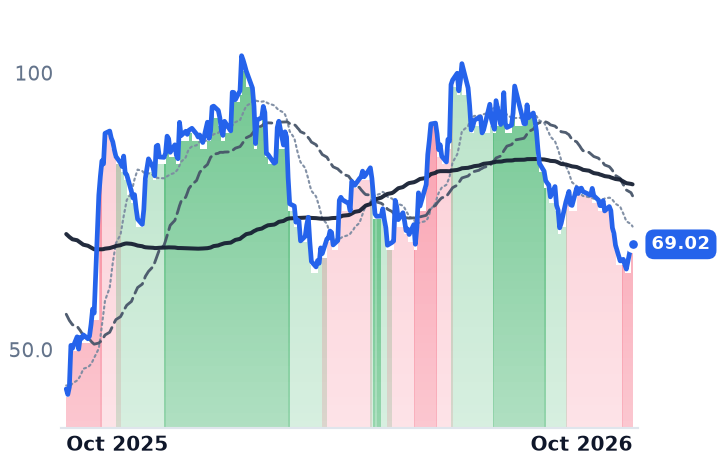
YPF | YPF Sociedad Anónima | Upstream Exploration & Production | 🟢 Cont. Bull | −3.5% | +107.8% |
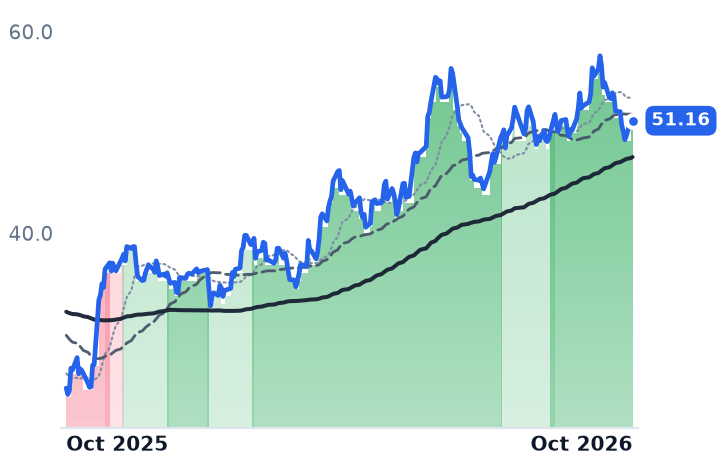
VIST | Vista Energy, S.A.B. de C.V | International & Offshore | 🟢 Cont. Bull | −11.7% | +86.0% |
| Compared against · context, not the story | |||||
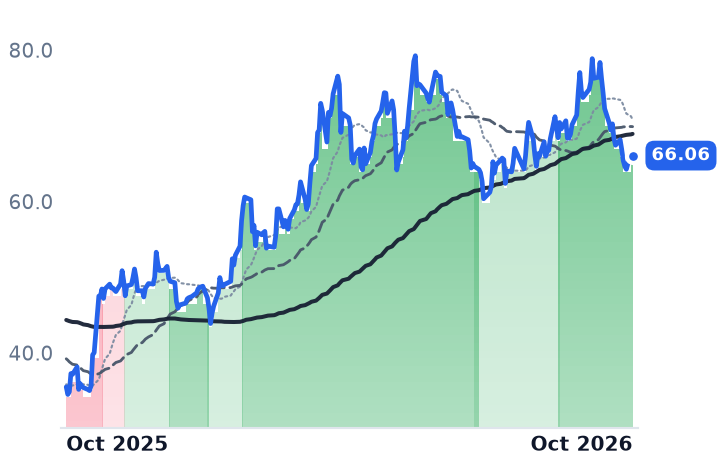
BMA | Banco Macro | Latin America & Caribbean Banks | ⚠️ Emerging Bear | −11.5% | +60.9% |
BBAR | Banco BBVA Argentina | Latin America & Caribbean Banks | ⚠️ Emerging Bear | −7.9% | +63.6% |
SUPV | Grupo Supervielle | Latin America & Caribbean Banks | 🔴 Cont. Bear | −13.0% | +48.6% |
PAM | Pampa Energía | Diversified Global Utilities | ⚠️ Emerging Bear | −5.0% | +34.6% |
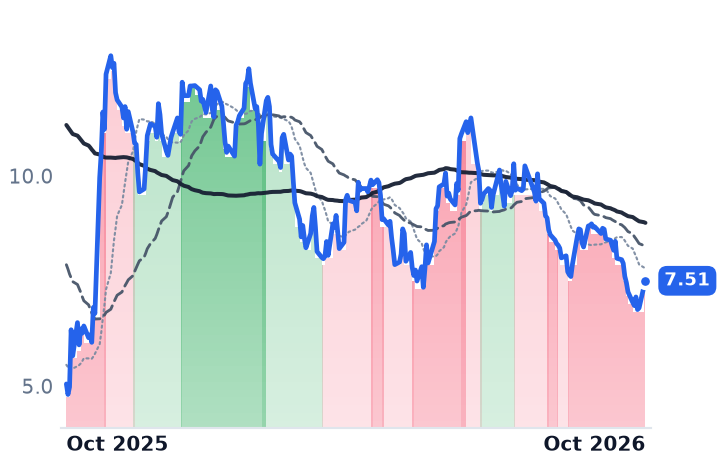
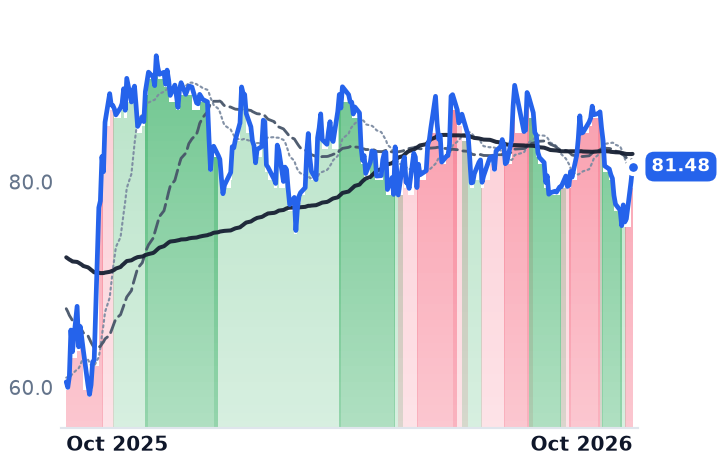
12-month price & trend
| Ticker | Mkt cap | P/E | P/E fwd | P/S | P/S fwd | P/GP | P/GP fwd | EV/EBITDA | FCF yld |
|---|---|---|---|---|---|---|---|---|---|
GGAL | $6.1B | 57.0x | — | 0.8x | — | 2.0x | — | 23.3x | -2.3% |
BMA | $4.1B | 15.8x | — | 1.0x | — | 1.7x | — | 6.5x | 34.5% |
YPF | $20.1B | n/m | — | 1.6x | — | 5.4x | — | 8.0x | 9.5% |
| Ticker | Mkt cap | P/E | P/E fwd | P/S | P/S fwd | P/GP | P/GP fwd | EV/EBITDA | FCF yld |
|---|---|---|---|---|---|---|---|---|---|
VIST | $6.9B | 8.3x | 7.5x | 2.1x | 1.7x | 4.2x | 3.4x | 4.6x | 3.9% |
BBAR | $2.5B | 14.1x | — | 0.7x | — | 1.6x | — | 4.4x | 239.7% |
SUPV | $600.6M | n/m | — | 0.5x | — | 1.2x | — | n/m | -110.9% |
| Ticker | Mkt cap | P/E | P/E fwd | P/S | P/S fwd | P/GP | P/GP fwd | EV/EBITDA | FCF yld |
|---|---|---|---|---|---|---|---|---|---|
PAM | $4.3B | 11.9x | 8.8x | 2.3x | 1.7x | 7.0x | 5.3x | 7.0x | -1539.3% |
Consensus projections
| Ticker | FY2026E | FY2027E | FY2028E | |
|---|---|---|---|---|
GGAL | Revenue | +25.0% | +22.2% | +18.6% |
| EPS | +187.6% | +68.4% | +50.8% | |
BMA | Revenue | +40.3% | +17.3% | +17.9% |
| EPS | +133.3% | +44.5% | +33.1% | |
YPF | Revenue | +26.8% | −6.6% | +3.3% |
| EPS | +1603.6% | −14.4% | +17.8% | |
VIST | Revenue | +70.3% | +4.5% | +8.9% |
| EPS | +35.2% | +2.9% | +12.3% | |
BBAR | Revenue | +40.9% | +24.3% | +20.3% |
| EPS | +169.1% | +42.4% | +44.9% | |
SUPV | Revenue | +35.3% | +27.2% | +21.8% |
| EPS | −369.1% | +116.0% | +38.6% | |
PAM | Revenue | +24.9% | +18.7% | +9.3% |
| EPS | +55.1% | +34.2% | +11.2% |
Forward fiscal years only. Blank means no analyst coverage for that year.
At Banco Galicia the only credit still expanding is written in dollars and lent to the companies drilling Vaca Muerta. Dollar loans grew 19% sequentially and 48.8% over the year to June, management told investors on 26 August, while the peso loan book shrank 4% in the quarter and full-year loan growth was guided to 10-15% with the majority of it in the dollar segment. Argentina's largest New York-listed bank by market value, at $6.13bn against Banco Macro's $4.13bn, now has its growth leg underwritten by the same shale exports that YPF and Vista Energy sell directly.
That shared exposure was invisible while the two legs moved apart. September's bank sell-off was read as a domestic credit accident, and it had the evidence for it: household loan delinquency across the Argentine system reached 12.9% in July, the highest since 2004 and more than double a year earlier, against 3.6% for companies. Then on 5 October the country-risk spread fell 49 basis points to 599, back below the 600 mark at which Argentina stays locked out of international debt markets, and everything rose at once.
The carry that paid for June is nearly spent
Galicia's June-quarter net income of ARS 258.3bn was up 49.6% year on year, and almost none of it came from lending. Net interest income fell 3% sequentially; income from financial instruments rose 275% on derivative gains and securities sales. Asset yields dropped 190 basis points to 21.1%, split 34.8% on pesos and 7.4% on dollars, and the group guides net interest margin down to about 16% for the year from 17.0%, with explicit compression in the second half.
The funding relief that produced the quarter is close to exhausted. Argentine deposit rates fell from 28.09% in January to 21.10% in July, which cannot repeat against a 29% policy rate and management's own assumption of roughly 29% inflation, leaving the real policy rate near zero. The central bank has meanwhile cut the daily minimum reserve requirement from 100% to 65% as part of what it calls gradual normalization.
The consumer book is where the damage shows. Bank non-performing loans reached 8.3%, up 60 basis points in the quarter, cost of risk ran 9.3%, and the Naranja X consumer-credit platform sat at 19.7%. "we see our ROE around 10% for the year... we see that that will continue improving, I would say, around 12%, try to end the year with something around 12%," chief operating and financial officer Gonzalo Covaro said on the 26 August call, against a medium-term aim he put at 15% to 20%.
Nothing in the barrels deteriorated
Vista Energy, a Mexico City-headquartered pure-play Vaca Muerta producer with 584 employees, grew June-quarter revenue 102.3% to $1.235bn, widened gross margin to 57.4% from 46.7% and earned $333.0m. Production reached 156.1 thousand barrels of oil equivalent a day and guidance was raised to about 158, with 72% of oil sales exported at export parity, after a $712m purchase of Equinor's Bandurria Sur and Bajo del Toro interests. "The recent addition of assets has given Vista greater scale: it allows us to make a significant leap in production, exports and development capacity in Vaca Muerta," chief executive Miguel Galuccio said of the deal.
At state-controlled YPF, shale output of 170,000 barrels a day was up 35.2% year on year inside total production of 523,000 barrels of oil equivalent, and shale lifting cost $4.0 a barrel of oil equivalent against $23.6 for mature conventional fields. The 440-km Vaca Muerta South line from Allen to Punta Colorada is planned to begin export operations in the second half of 2026 at roughly 390,000 barrels a day. Brent held at $100.84 on 6 October, supported by the 4 March closure of the Strait of Hormuz that removed nearly a fifth of global crude flows — the same closure that led OPEC and the International Energy Agency to cut 2026 demand forecasts.
What 5 October settled
Over the thirty days to 6 October, Supervielle fell 14.6%, Galicia 13.3%, Macro 12.2% and Vista 10.4%, with YPF down 2.8%. From the 2 October close, when the spread finished at 646 after an intraday 655, Galicia rose 7.1% and Macro 6.9% over two sessions against YPF's 3.0% and Vista's 2.8%.
The results account for the banks and not for the oil. A guided 10-12% inflation-adjusted peso return on equity at roughly 1.1x book, with Macro at 1.07x against 1.23x in mid-September, is thin against about 11.7% in dollars on Argentine sovereign paper, and the banks themselves withdrew the private-credit expansion that justified a premium: Macro cut its real loan growth target to 2-5% from 15-20%. Nothing comparable happened in the energy leg, where Vista trades at 4.59x trailing enterprise value to EBITDA and YPF at 7.95x with a 9.5% trailing free-cash-flow yield, and where basin output set a record near 400,000 barrels a day in the third quarter. Its thirty-day decline is a discount rate, and when the discount rate moved back the shares followed within two sessions.
Which leaves Galicia holding both ends of the same bet. The peso side of its balance sheet is a shrinking book funded by depositors whose rates can no longer fall; the growing side is credit to exporters whose dollars depend on a pipeline that has not yet started shipping.