

Jana Partners Told Fiserv to Lift Its Cost Target to $1.25bn and Adopt Palantir Software
Hypothesis Opus 5 · Research Opus 5 · Writing Opus 5 · Prompt v1.7
Fiserv's shares made fresh lows last week while the activist holding just under 1% of the company argued that the turnaround plan is half the size it should be. Jana Partners pressed on 28 September for the Project Elevate savings goal to more than double from $500m by 2029, and for Palantir software to retire accumulated technology debt, with the raised target announced alongside third-quarter results on 28 October.
The business behind that demand is shrinking. June-quarter revenue fell 4.1% and the operating margin came in at 19.2% against 30.7% a year earlier, a fourth straight quarter of deceleration. The faster-eroding half is the bank-software annuity, where organic revenue fell 8%, against a 1% decline in merchant acquiring.
At 6.1x forward earnings and 0.88x book, the price already assumes the meter keeps slipping. A cost number does not turn it.
| Ticker | Company | Segment | Trend · 13mo | 30D | 1Y |
|---|---|---|---|---|---|
| The subject · what this brief is about | |||||
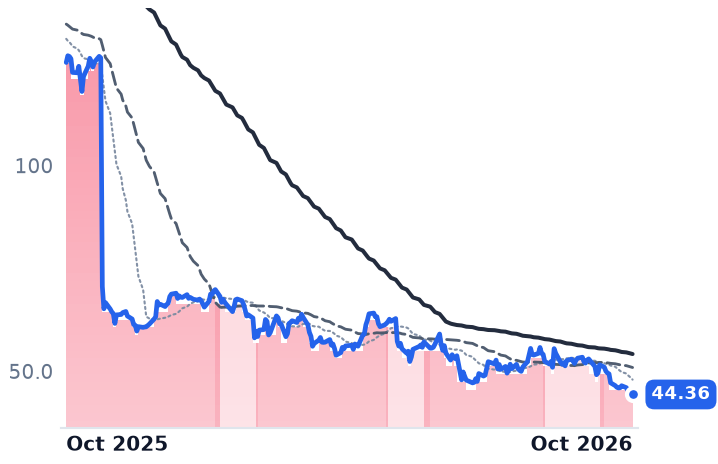
FISV | Fiserv | Financial Services Technology | 🔴 Cont. Bear | −13.3% | −64.5% |
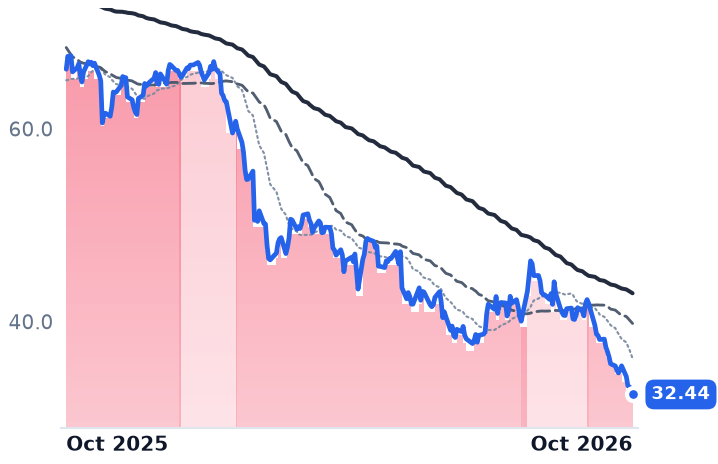
FIS | Fidelity National Information Services | Financial Services Technology | 🔴 Cont. Bear | −18.1% | −51.0% |
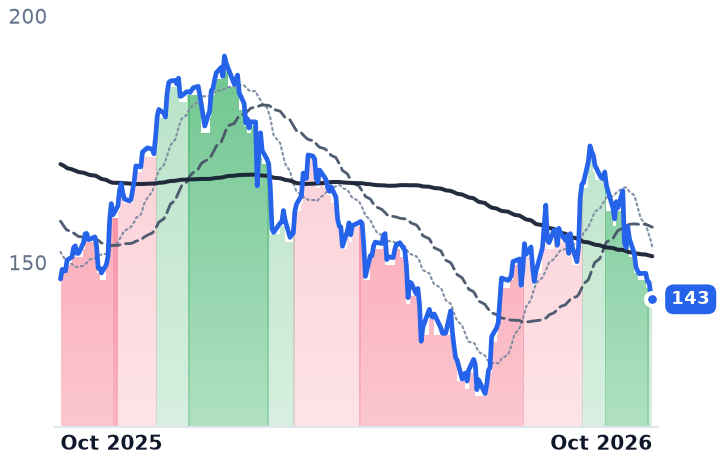
JKHY | Jack Henry & Associates | Financial Services Technology | 🌱 Emerging Bull | −11.5% | −2.8% |
| Compared against · context, not the story | |||||
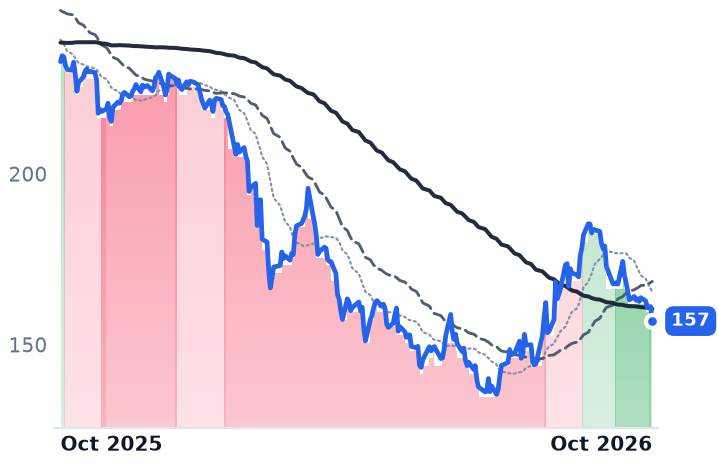
BR | Broadridge Financial Solutions | Financial Services Technology | 🌱 Emerging Bull | −6.5% | −32.6% |
SPY | State Street SPDR S&P 500 ETF Trust | Asset Management | 🟢 Cont. Bull | +0.3% | +15.2% |
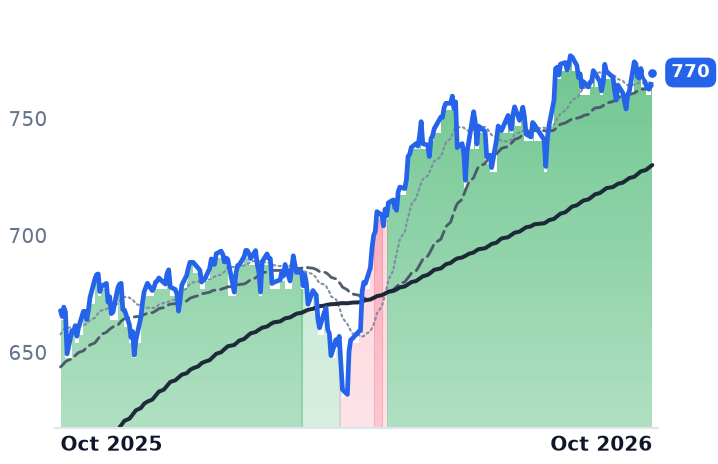
12-month price & trend
| Ticker | Mkt cap | P/E | P/E fwd | P/S | P/S fwd | P/GP | P/GP fwd | EV/EBITDA | FCF yld |
|---|---|---|---|---|---|---|---|---|---|
FISV | $23.7B | 8.5x | 6.1x | 1.1x | 1.2x | 2.4x | 2.6x | 7.4x | 16.6% |
FIS | $16.8B | 5.0x | 5.2x | 1.4x | 1.2x | 3.6x | 3.3x | 6.0x | 16.1% |
JKHY | $10.1B | 20.4x | 19.3x | 4.0x | 3.8x | 9.2x | 8.6x | 11.8x | 6.9% |
| Ticker | Mkt cap | P/E | P/E fwd | P/S | P/S fwd | P/GP | P/GP fwd | EV/EBITDA | FCF yld |
|---|---|---|---|---|---|---|---|---|---|
BR | $19.3B | 17.2x | 15.8x | 2.6x | 2.4x | 8.1x | 7.7x | 11.8x | 6.8% |
SPY | $773.0B | — | — | — | — | — | — | — | — |
Consensus projections
| Ticker | FY2026E | FY2027E | FY2028E | |
|---|---|---|---|---|
FISV | Revenue | −1.3% | +3.4% | +3.5% |
| EPS | −15.3% | +9.7% | +13.2% | |
FIS | Revenue | +28.8% | +4.4% | +3.4% |
| EPS | +7.4% | +8.0% | +10.3% | |
JKHY | Revenue | +7.0% | +6.4% | +7.0% |
| EPS | +12.6% | +7.7% | +9.5% | |
BR | Revenue | +8.0% | +5.8% | +4.8% |
| EPS | +12.5% | +10.5% | +9.5% |
Forward fiscal years only. Blank means no analyst coverage for that year.
Fiserv's turnaround plan now has an activist critic who thinks it is half the size it should be. On 28 September, Jana Partners pressed the card-acceptance and bank-processing company to more than double the savings target of its Project Elevate program, $500m by 2029, to $1.25bn, and to adopt Palantir software to simplify its technology estate, retire accumulated technology debt and cut spending on legacy vendors. Jana wants the bigger number announced with third-quarter results, scheduled for 28 October.
Jana owns just under 1% of Fiserv, a position built late in 2025 and added to in the first quarter of 2026. Managing partner Scott Ostfeld has also argued for further asset sales and a board refresh with deeper banking-software and payments expertise, criticizing what the firm calls repeated forecasting errors and guidance cuts. The implicit claim is that Fiserv's problem is cost and execution. The company's own disclosures locate it one line higher.
The meter, not the cost base
Fiserv earns a spread on volume it has to re-win. In the June quarter, Clover gross payment volume rose 9%, 11% excluding a gateway conversion, to $367bn annualized, while reported Clover revenue rose 2%, with weaker hardware and data revenue costing roughly nine points of growth. Value-added services grew 10% and reached 25% of Clover revenue from 24% a year earlier: one point of mix.
The geography that was supposed to flatter the growth line now subtracts from it. Argentina created a 90 basis point headwind to second-quarter adjusted revenue as inflation and rate volatility hit the anticipation business, and cut Clover revenue a further 2%. In the same quarter, Financial Solutions organic revenue fell 8% against Merchant Solutions' 1%: the annuity sold to banks and credit unions is deteriorating faster than the acquiring book.
On 6 August, management reset 2026 guidance to organic revenue of flat to -1%, from 1-3%, and adjusted earnings of $7.20 to $7.40 a share, from $8.00 to $8.30, attributing about two points to delayed contracted revenue and slower enterprise launches, a point to product and hardware, and roughly a point each to Argentina and planned business sales. It was the second reset in ten months. First-half free cash flow was $1.36bn against $1.54bn a year earlier, while acquisition-related intangible amortization still ran at $0.94 a share.
Chief executive Takis Georgakopoulos has told investors the noise ends soon. At the Goldman Sachs Communacopia + Technology Conference on 10 September he said the fourth quarter would be the first "clean" quarter in years, and of the gap between more than $5bn of trailing free cash flow and the market value then attached to it: "very hard to think of something that's more attractive." The shares rose 5.4% the next day, then kept falling, closing at a fresh 52-week low on 2 October.
The healthy neighbors fell too
The decline is not Fiserv's alone, which is the awkward part for a cost-cutting thesis.
FIS, levered to card issuance since it bought Global Payments' Issuer Solutions business and sold its remaining Worldpay stake, lost 22.5% over the same thirty days and also closed at a 52-week low, despite Banking revenue up 6% in the quarter excluding the acquisition, recurring sales up 14%, and consensus 2026 earnings revised up 7.4%. It trades at 5.2x forward earnings against roughly 11.1x a year ago.
Jack Henry, which sells core processing to community banks and logged a record 58 competitive core wins in the year to June, fell 14.7%. Its uptrend broke at the 15 September Investor Day, when fiscal 2027 operating margin was guided to 24.1-24.3% as cybersecurity, infrastructure and artificial-intelligence spending absorbed the leverage. At 19.3x forward earnings against 21.7x a year ago, it is the dearest of the three. Broadridge, in proxy voting and post-trade processing, fell 11.9%.
Two sector mechanisms are doing that work. The International Monetary Fund finds US stablecoin legislation cut the market value of listed incumbent payment firms by 18%, roughly $300bn, because stablecoin settlement lets payers bypass the card rails these companies take a spread on. And on 22 September, two weeks after Meta launched its Muse agent, banks, insurers and travel sites sold off on the risk that autonomous agents dissolve the consumer inertia those businesses monetize.
What $750m would and would not fix
Fiserv's own de-rating is earned: the forward multiple has halved to about 6.1x while estimates came down roughly 28%, and consensus now has 2026 revenue shrinking 1.3% to $19.55bn with adjusted earnings down 15.3%. Price and expectations finally agree on direction. The extra $750m Jana wants amounts, on that consensus revenue base, to under 4% of sales by the arithmetic here, which is an answer to the margin question in a year when the revenue question is the live one. Against that, the shares sit at 0.88x book with a 16.6% trailing free-cash-flow yield, which is what makes the marginal selling look less like judgment than momentum.
The three companies together serve more than 70% of banks surveyed by the Kansas City Fed and 90% of US banks with under $1bn of revenue. That concentration was the asset; it is now the renewal table everyone is pricing at once.
A year ago this month, Fiserv's first guidance reset took 44% out of the stock in a single session. The third-quarter call falls on the anniversary, with an activist asking the company to put a bigger number on the one line it still controls.