

Nucor Has Raised Steel Prices Eight Weeks Running While Vulcan's Growth Waits Until 2027
Hypothesis Opus 5 · Research Opus 5 · Writing Opus 5 · Prompt v1.7
Nucor's spot hot-rolled coil reached $1,230 a short ton on Monday, and the scrap it melts settled flat for October — a metal spread still widening into a run that has already lifted gross margin for four straight quarters. The market pays 13.3 times forward earnings for that, and 27.1 times for Vulcan Materials, the largest US aggregates producer and the one business here that genuinely sets its own price.
Demand is not what splits them. Nonresidential construction spending rose for a fifth straight month in August and data-center spending is up 73% year on year. The difference is timing: consensus has Vulcan's 2026 earnings before interest, taxes, depreciation and amortization falling, with the recovery booked into 2027 and 2028, while Nucor's 2026 earnings per share are set to rise 137% and then flatten. With long-bond yields at their highest since 2002, the near-dated stream is the one being paid for.
| Ticker | Company | Segment | Trend · 13mo | 30D | 1Y |
|---|---|---|---|---|---|
| The subject · what this brief is about | |||||
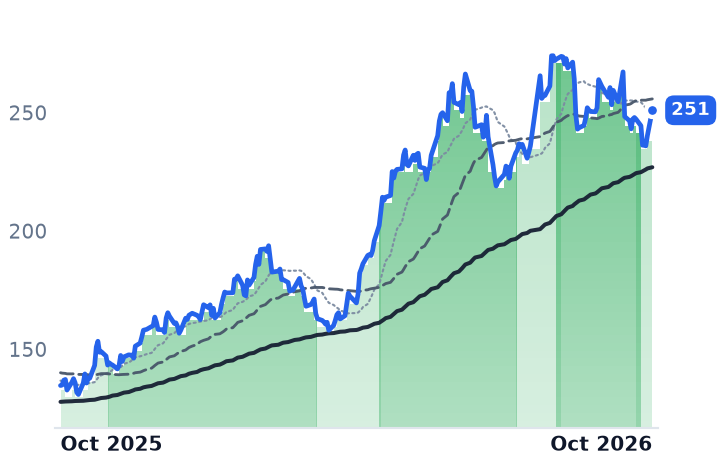
NUE | Nucor | Integrated Steelmakers | 🟢 Cont. Bull | −2.1% | +86.4% |
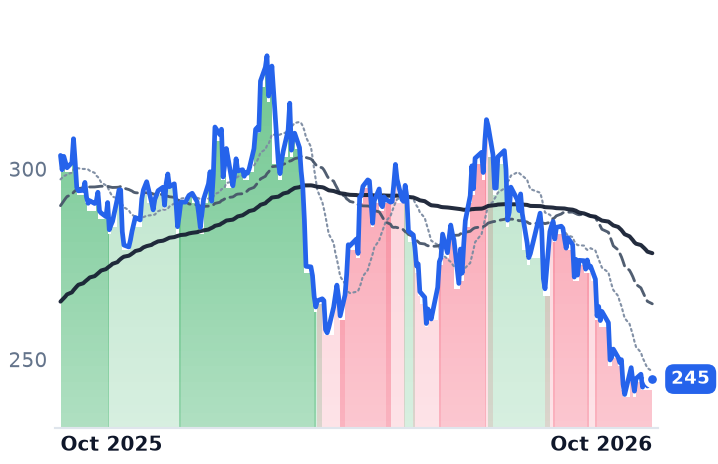
VMC | Vulcan Materials | Aggregates & Concrete | ⚠️ Emerging Bear | −5.7% | −19.3% |
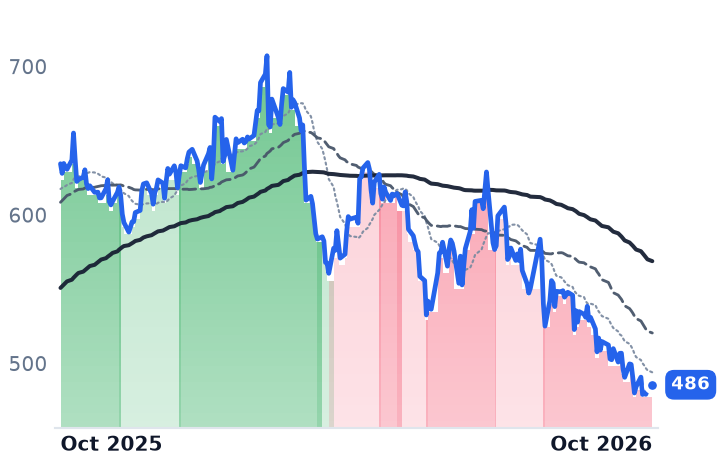
MLM | Martin Marietta Materials | Aggregates & Concrete | 🔴 Cont. Bear | −5.2% | −23.5% |
| Compared against · context, not the story | |||||
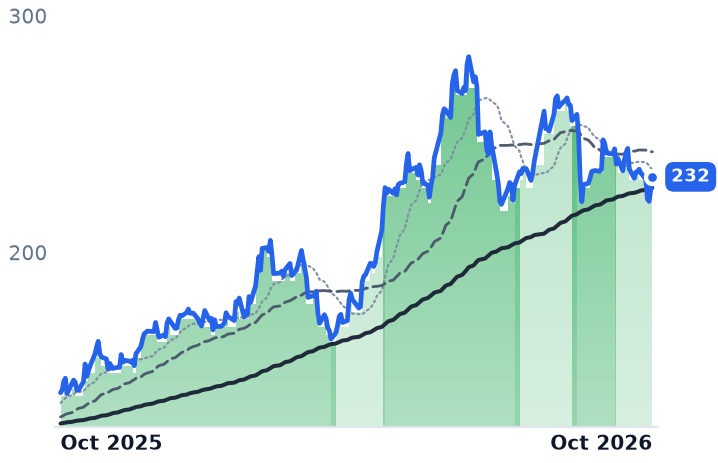
STLD | Steel Dynamics | Long Products & Rebar | 🟢 Cont. Bull | −4.0% | +64.8% |
CRH | CRH | Integrated Cement & Materials | 🔴 Cont. Bear | −11.0% | −30.4% |
EXP | Eagle Materials | Specialty Building Products | 🔴 Cont. Bear | −10.9% | −27.3% |
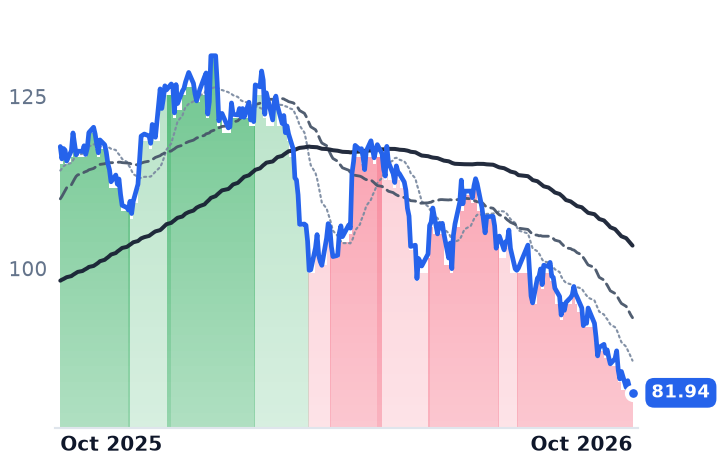
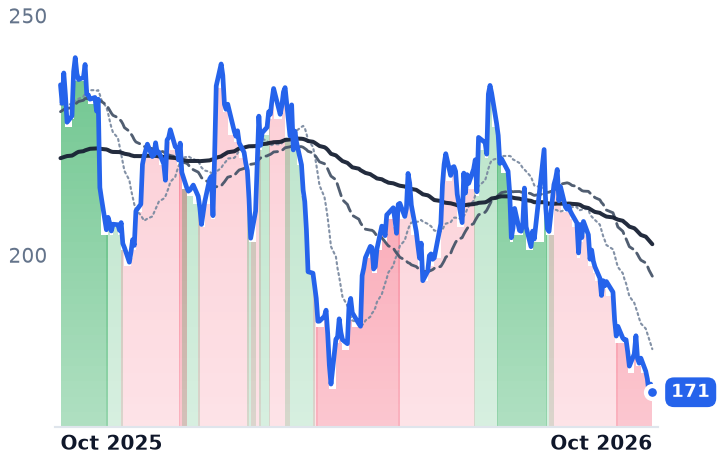
12-month price & trend
| Ticker | Mkt cap | P/E | P/E fwd | P/S | P/S fwd | P/GP | P/GP fwd | EV/EBITDA | FCF yld |
|---|---|---|---|---|---|---|---|---|---|
NUE | $57.2B | 20.0x | 13.3x | 1.6x | 1.4x | 10.2x | 9.1x | 11.0x | 2.8% |
VMC | $31.7B | 28.8x | 27.1x | 3.9x | 3.9x | 14.3x | 14.2x | 14.2x | 3.2% |
MLM | $29.2B | 11.9x | 27.0x | 4.4x | 4.0x | 15.5x | 14.3x | 16.8x | 2.8% |
| Ticker | Mkt cap | P/E | P/E fwd | P/S | P/S fwd | P/GP | P/GP fwd | EV/EBITDA | FCF yld |
|---|---|---|---|---|---|---|---|---|---|
STLD | $33.3B | 21.0x | 13.3x | 1.6x | 1.4x | 11.1x | 9.5x | 12.4x | 2.9% |
CRH | $55.0B | 18.5x | 14.2x | 2.5x | 1.4x | 6.4x | 3.5x | 12.4x | 3.4% |
EXP | $5.2B | 13.4x | 13.7x | 2.3x | 2.2x | 8.4x | 8.3x | 9.2x | 3.2% |
Consensus projections
| Ticker | FY2026E | FY2027E | FY2028E | |
|---|---|---|---|---|
NUE | Revenue | +24.3% | +2.6% | +0.3% |
| EPS | +137.3% | +4.2% | −5.1% | |
VMC | Revenue | +2.2% | +5.4% | +5.9% |
| EPS | +7.7% | +15.6% | +15.0% | |
MLM | Revenue | +8.9% | +6.9% | +9.4% |
| EPS | −0.8% | +19.7% | +17.1% | |
STLD | Revenue | +30.7% | +1.7% | −0.6% |
| EPS | +118.7% | +16.7% | −8.2% | |
CRH | Revenue | +5.6% | +6.2% | +5.9% |
| EPS | +3.6% | +11.9% | +13.0% | |
EXP | Revenue | +0.5% | +2.7% | +3.8% |
| EPS | −9.4% | −3.4% | +11.2% |
Forward fiscal years only. Blank means no analyst coverage for that year.
Monday's price letter, and the settlement that didn't follow
Nucor's price sheet moved again on Monday. The largest US electric-arc-furnace steelmaker, which melts recycled scrap into sheet, plate, bar and structural steel, lifted its spot hot-rolled coil offer by $10 to $1,230 a short ton, an eighth consecutive weekly increase that adds $30 over the month and more than $300 since October last year. The scrap side went nowhere: October's ferrous settlement came in "strong sideways", busheling near $450 a gross ton, with no one in the market calling a downward cycle. Nucor raised tubular prices on 2 October as well.
The companies grouped as data-center building materials were bought on the premise that the buildout pays whoever supplies the site. What the past twelve months actually paid for is the opposite of pricing power. Nucor is up 81.8% over that stretch and Steel Dynamics 60.7%, while Vulcan Materials is down 19.6%, Martin Marietta 23.5%, Eagle Materials 26.7% and CRH 32.4%. The two aggregates franchises whose quarries cannot be replicated are the de-rated half; the steelmaker whose realized price is reset weekly by spot indices, under an import floor set by a 50% Section 232 tariff on steel articles, is the half being paid up for.
What the spread is worth when scrap sits still
Nucor's June quarter shows the arithmetic. Its mills sold to outside customers at $1,145 a net ton, up 7% sequentially, while scrap and scrap substitutes cost $422 a gross ton; a gross ton is 2,240 pounds against a net ton's 2,000, so about $377 on the same basis, leaving a spread near $768 a ton on a record 7.1m tons shipped. Revenue rose 23.0% to $10.4bn, gross margin widened to 19.6% from 14.5%, and operating income rose 77%. That margin has now expanded four quarters running from 11.2%.
"The demand drivers across the spectrum are incredible," chief executive Leon Topalian told investors on the 28 July call. He has also described non-residential customers as "busier than anything" in his thirty-year career, with Nucor supplying roughly 95% of the steel content of a data center. The genuine data-center line is also the squeezed one: in the Steel Products segment, which fabricates joists, deck and insulated metal panels, earnings fell year on year because the rising mill price is an input cost there, and those plants ran near 65% utilization against 88% in the mills. The downstream backlog grew 10% sequentially.
At 13.3x forward earnings against 20.0x trailing, Nucor carries the largest compression on the shelf. The warning is in the estimates rather than the price: consensus has 2026 earnings per share at $18.88, up 137%, then $19.68 in 2027 and $18.68 in 2028.
Vulcan's lever still works; its operating leverage ran backwards
Vulcan's problem is not volume. It shipped 59.9m tons in the June quarter, up 1%, and public infrastructure awards in its markets were up 20%. Freight-adjusted price reached $22.97 a ton, yet cash gross profit per ton rose only to $12.02 from $11.88, because a $40m energy headwind and unit cash costs up 3% excluding diesel took the rest. Revenue growth has decelerated across four quarters, 13.9% to 3.2% to 7.4% to 2.5%, and in the June quarter operating income fell 9.7% to $425.3m on revenue up 2.5%.
"Price is our biggest lever when it comes to overcoming headwinds like this and inflationary pressures," chief executive Ronnie Pruitt said on the second-quarter call, with pricing expected to exit 2026 at the upper end of a 4-6% range. The lever is real and so is the geology: Vulcan is the largest US aggregates producer, first or second in markets worth about 90% of revenue, and freight costs make each pit a local franchise. Consensus still models 2026 EBITDA down 3.8% to $2.57bn, with the step-up arriving in 2027 and 2028. The shares hold 27.1x forward against 28.8x trailing, and the market capitalization is $31.7bn against $38.58bn and a 35.1x multiple in early May.
Martin Marietta, the number-two producer, is the harder read. Reported gross margin fell to 25.4% from 30.0%, but a $52m purchase-accounting inventory step-up on acquired assets drove most of that while adjusted cash gross profit rose 15% to $636m and organic shipments grew for a fourth straight quarter, up 2.3%. "When we go into 2027, we're going to be through all the inventory issues on purchase price accounting with Quikrete," chair and chief executive Ward Nye said on 30 July. It has since combined with Lhoist North America for $13.5bn, adding a lime book that generated $786m of adjusted EBITDA in the twelve months to December 2025 — industrial cost pass-throughs, not quarry pricing. At 27.0x forward and 16.8x trailing enterprise value to EBITDA it is the dearest name here; its 11.9x trailing price-to-earnings is unusable, inflated by a first-quarter divestiture gain. It set a 52-week low on 17 September and Wells Fargo cut its target to $585 from $609 five days later.
The calendar, not the construction site
End demand offers nothing to blame. Nonresidential construction spending ran at a $773.0bn annual rate in August, up 1.0% and a fifth consecutive monthly increase; data-center spending rose 73.2% year on year with year-to-date starts of $84.1bn, nearly three times a year earlier; single-family starts rose 7.6% to 918,000. Highway and transit authorities were extended at fiscal 2026 levels to 11 December rather than cut. Data centers are 3-5% of Vulcan's volumes; Martin Marietta reports its data-center backlog up 90% and says 70% of US data-center and manufacturing square footage sits within 55 miles of its operations.
So the results explain part of each move and the clock explains the rest. Vulcan's de-rating tracks its own income statement, where price gains are being eaten by energy and cash costs. Martin Marietta's does not: its operating numbers are better than its reported margin, and what has fallen is the price attached to a 2027 story. Nucor's advance is underwritten quarter by quarter, by a spread that widened again this week, and discounted as a peak that consensus expects to flatten. One clause finishes it: with the 10-year Treasury yield at its highest since 2002 and traders pricing roughly a 71% chance of an October rate rise, earnings dated 2028 cost more to hold than earnings banked this quarter. Steel Dynamics, whose revenue rose 33.4% and which trades at 13.3x forward, sits on the same side for the same reason; CRH at 14.2x forward and Eagle Materials at 13.7x are already priced for declining earnings.
The last thirty days hit everything — Nucor fell 3.9%, Martin Marietta 5.7%, Vulcan 6.8%, Eagle Materials 12.0% — which is what a discount-rate move looks like before the quarter sorts it out. All three report in late October.
Vulcan can put through 4-6% price again next year, and probably will. What no quarry franchise can do is move the year its earnings land.