

Warner's Per-Stream Rate Is Rising; Reservoir's Interest Bill Grew 143% in Four Years
Hypothesis Opus 5 · Research Opus 5 · Writing Opus 5 · Prompt v1.6
The music business spent three years braced for platforms to grind down what they pay per song. Warner Music's accounts say the reverse happened — and the rights owners have been marked down regardless.
Warner's June quarter put revenue up 10.4% and operating income up 80.5%, with margin at 16.4% against 10.0% a year earlier, and publishing growing faster than recorded music. Reservoir Media, a pure catalogue buyer, is the opposite case: net publisher share rose 62% since fiscal 2022 while interest expense rose 143%, and last quarter's $6.9m of interest absorbed about half of $13.7m of cash operating earnings.
So the squeeze is in the financing, not the royalty. Warner's de-rating is unexplained by its own numbers; Reservoir's is earned by its balance sheet, with a $10.50 cash proposal sitting under the shares.
| Ticker | Company | Segment | Trend · 13mo | 30D | 1Y |
|---|---|---|---|---|---|
| The subject · what this brief is about | |||||
WMG | Warner Music | Music & Audio | 🔴 Cont. Bear | −6.8% | −19.3% |
RSVR | Reservoir Media | Music & Audio | 🟢 Cont. Bull | −2.3% | +23.2% |
SIRI | Sirius XM | Music & Audio | 🟢 Cont. Bull | −11.3% | +16.0% |
| Compared against · context, not the story | |||||
SPOT | Spotify Technology | Music & Entertainment Streaming | 🌱 Emerging Bull | −12.8% | −30.5% |
LYV | Live Nation Entertainment | Live Events & Sports Properties | 🟢 Cont. Bull | −2.7% | +8.2% |
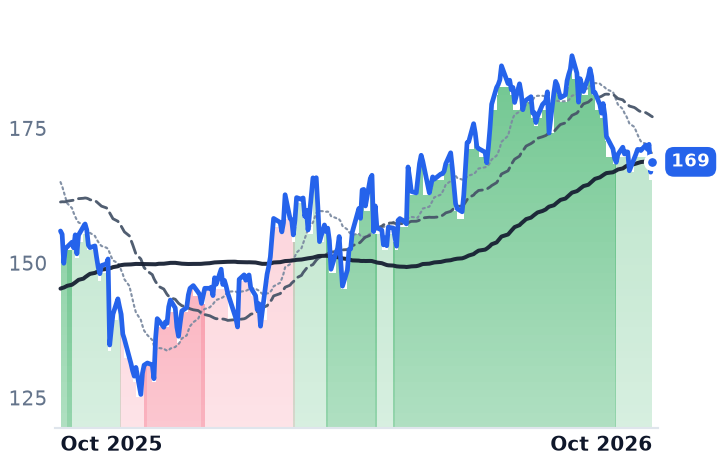
12-month price & trend
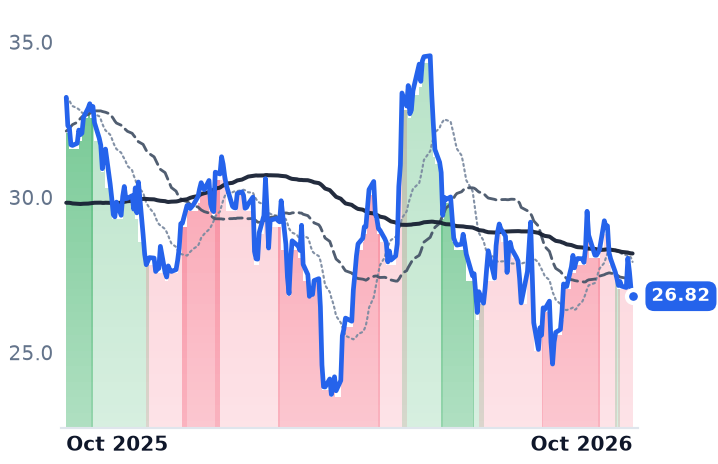
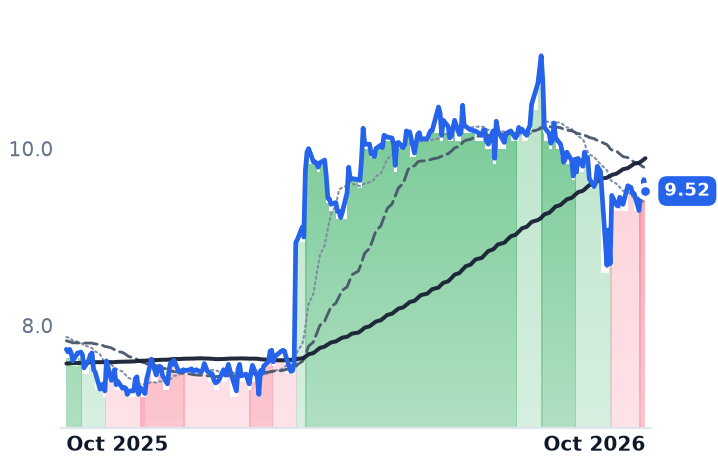
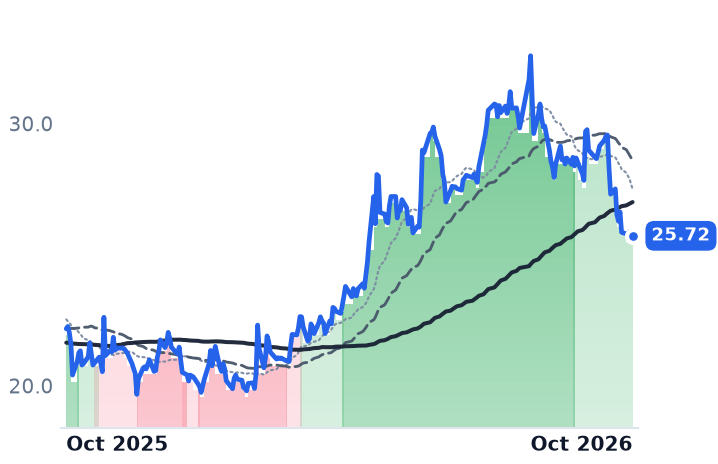
| Ticker | Mkt cap | P/E | P/E fwd | P/S | P/S fwd | P/GP | P/GP fwd | EV/EBITDA | FCF yld |
|---|---|---|---|---|---|---|---|---|---|
WMG | $14.0B | 20.8x | 14.9x | 1.9x | 1.8x | 4.2x | 3.9x | 11.9x | 5.8% |
RSVR | $626.6M | 69.4x | 76.2x | 3.5x | 3.3x | 5.4x | 5.2x | 15.2x | -245.3% |
SIRI | $8.7B | 9.9x | 8.6x | 1.0x | 1.0x | 2.2x | 2.2x | 7.8x | 17.9% |
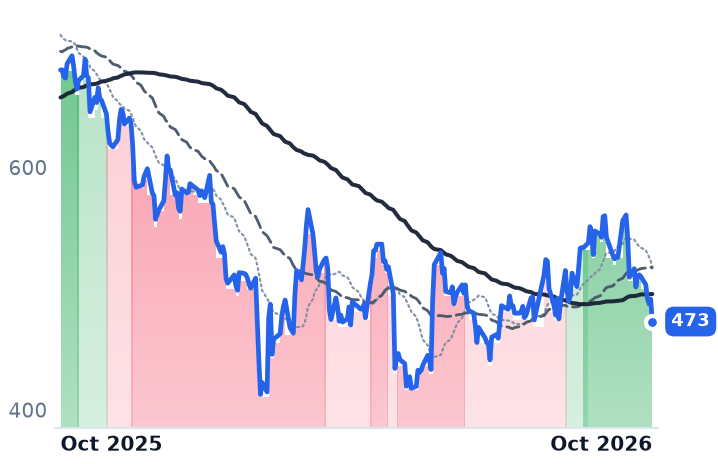
| Ticker | Mkt cap | P/E | P/E fwd | P/S | P/S fwd | P/GP | P/GP fwd | EV/EBITDA | FCF yld |
|---|---|---|---|---|---|---|---|---|---|
SPOT | $89.9B | 28.4x | 33.8x | 4.4x | 4.6x | 13.6x | 14.1x | 26.4x | 4.1% |
LYV | $39.5B | n/m | — | 1.5x | 1.4x | 3.3x | 3.1x | 24.3x | 3.5% |
Consensus projections
| Ticker | FY2026E | FY2027E | FY2028E | |
|---|---|---|---|---|
WMG | Revenue | +12.4% | +6.0% | +6.2% |
| EPS | +44.3% | +21.0% | +14.6% | |
RSVR | Revenue | +9.1% | +8.9% | +5.6% |
| EPS | −9.1% | +25.0% | +20.0% | |
SIRI | Revenue | +0.6% | +1.4% | +2.3% |
| EPS | +7.0% | +10.4% | +8.7% | |
SPOT | Revenue | +14.9% | +14.0% | +12.7% |
| EPS | +80.1% | +23.1% | +23.4% | |
LYV | Revenue | +12.4% | +9.5% | +9.3% |
| EPS | +65.7% | −653.8% | +52.5% |
Forward fiscal years only. Blank means no analyst coverage for that year.
For three years the fear in the music business was that streaming platforms would grind down what they pay for a song. Warner Music Group — the New York company behind Atlantic and Warner Records on one side and a publishing catalogue of roughly a million compositions on the other — reported the reverse. Acting chief financial officer Lou Dickler decomposed the June quarter for investors on the August 6 call: subscriber growth contributed six to seven percentage points of subscription-streaming growth, pricing about 3.5 points, market share about one.
That distinction matters well beyond one quarter, because the per-stream rate is the coupon on an asset class. Catalogues change hands at a multiple of the publisher's share of the royalties they produce, which makes them long-duration income streams priced against risk-free yields — an 18x multiple is defensible when the ten-year Treasury pays under 2% and indefensible at 4-5%. Owners of songs therefore live off two numbers: the royalty rate and the cost of money. The first is rising. The second rose faster.
The rate is going up, contractually
Spotify's US effective rate to rights holders reached $4.43 per 1,000 streams in January 2026, up 34% from the spring 2023 trough, as the individual premium tier climbed to $12.99 and a minimum-stream threshold reallocated money away from the long tail. Warner has been hard-wiring that in: chief executive Robert Kyncl said per-subscriber-minimum pricing clauses now cover 88% of the company's subscription streaming revenue, against none two years ago, with a renewed Apple deal completing the set. Its Spotify agreement also overrides the bundling structure that had cut US mechanical royalties to publishers.
The accounts follow. June-quarter revenue of $1,864m was up 10.4%, the third consecutive double-digit quarter, and operating income rose 80.5% to $305m for a 16.4% margin against 10.0% a year earlier — helped by a restructuring programme on track for $200m of savings this year. Publishing revenue grew 12% against recorded music's 10%, with publishing adjusted cash operating earnings up 14% at an expanding margin. Whatever is wrong here, it is not that the statutory side lags the negotiated side.
The shares disagree. Warner is down 21.7% over twelve months and trades at 14.9x forward earnings against 20.8x trailing, with enterprise value at 11.9x cash earnings, while consensus has fiscal 2026 earnings per share rising 44%. A forward multiple that far below trailing is the market declining to underwrite the inflection the company is reporting. The visible catalyst is sell-side: BofA Securities' Jessica Reif Ehrlich cut the stock to Underperform and her target to $30 from $33, against a consensus average near $38.
The cost of owning the songs
Reservoir Media, a 100-employee rights buyer that acquires publishing catalogues and signs songwriters, is where the mechanism bites. Its net publisher share grew from $42m in fiscal 2022 to $68m in fiscal 2026, a 62% gain; interest expense over the same span went from $10.9m to $26.5m, up 143%. Chief financial officer Jim Heindlmeyer said the latest increase, to $6.9m from $6.3m, was "driven primarily by increased debt balances used to fund acquisitions of music catalogs." That $6.9m consumed roughly half of the quarter's $13.7m of cash operating earnings.
So revenue up 11.6% to $41.5m — only six points of it organic — produced operating income down 1.3% and a small net loss. Debt ended fiscal 2026 at $455.7m against $98.9m of liquidity a quarter later. Meanwhile the asset itself has cheapened: catalogue prices that peaked at 18-25x net publisher's share in 2021 now clear around 12-18x. Buying cheaper assets with dearer money is a narrowing spread, and it is the whole model.
Reservoir is also in a takeover contest. Irenic Capital bid $10.00-$11.00 a share in February; Wesbild and Richmond Hill countered at $10.50 in cash. The October 2 close of $9.52 sits 9.3% below that standing proposal, which is the market assigning real odds to no deal. Any transaction needs Wesbild, holder of about 44% and controlled by the chief executive's father.
Nobody is listening less
The payer side rules out softening demand. Sirius XM, which licenses this music rather than owning it, added 22,000 self-pay subscribers in the June quarter — a 90,000 swing from a year earlier — at record-low 1.4% churn, with advertising up 5% and full-year guidance raised. Revenue grew 1.0% and operating income 29.3%; the shares trade at 0.73x book and a 17.9% trailing free-cash-flow yield. Sirius supplied most of the group's thirty-day decline all the same, giving back a run that had reached roughly 43% by late July. Spotify fell 15.6% over the same month and Live Nation 6.0%, which points to broad risk reduction across music equities rather than rights holders losing rate.
The verdict splits cleanly. Reservoir's markdown is earned — not by royalties, which are growing, but by a capital structure in which financing costs compounded at more than twice the rate of the income they bought, with a cash bid now acting as the floor. Warner's is not earned by anything in its filings: rate, mix, margin and publishing all moved the right way, and the explanation on offer is a downgrade. Rate compression was the wrong thing to watch.
The right thing arrives this week. The Copyright Royalty Board has split off interactive streaming mechanicals for 2028-2032 and told participants who cannot agree to file written direct statements by October 5, while objectors fight a proposed settlement that would reset the base mechanical rate to 12 cents from today's 13.1. The negotiated rate is finally working for the owners of songs. The statutory one is still being argued.