

Sunrun Borrowed at Its Tightest Spread in 18 Months as Its Shares Hit a 52-Week Low
Hypothesis Opus 5 · Research Opus 5 · Writing Opus 5 · Prompt v1.6
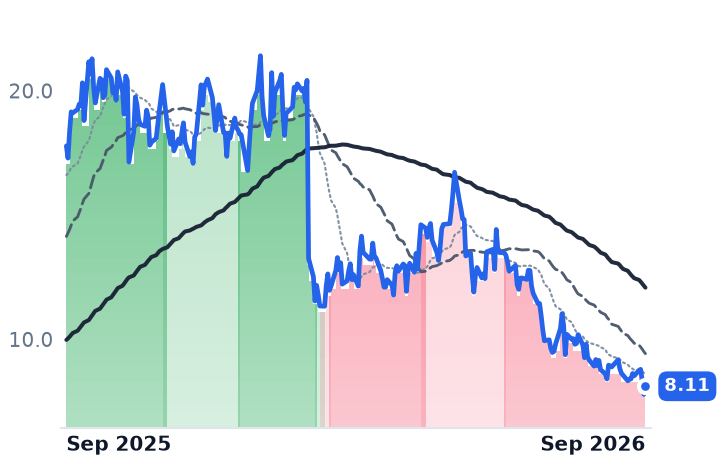
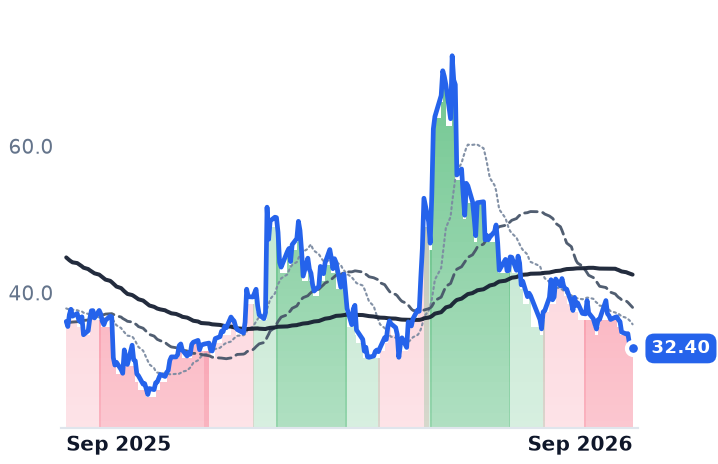
Two capital markets are pricing the same rooftop solar assets in opposite directions. Bond buyers took $267m of Sunrun's seasoned leases in August at a 6.33% yield on the publicly placed senior notes — a 200 basis-point spread, 20 tighter than April — while the equity fell to a 52-week low and now trades at 0.56x book, with a forward earnings multiple of 6.4x sitting above the trailing 4.7x.
What broke is the economics of the next customer, not the installed one: net value per new subscriber halved to $9,444 and additions fell 31%. The thirty-day leg is something else — the Federal Reserve's first rate rise in three years hit the names with no rooftop exposure hardest, First Solar down 8% in a single session. XPLR Infrastructure, up over twelve months with its cash guide untouched, is on the other side of the split.
| Ticker | Company | Segment | Trend · 13mo | 30D | 1Y |
|---|---|---|---|---|---|
| The subject · what this brief is about | |||||
RUN | Sunrun | Residential Solar Installers | 🔴 Cont. Bear | −7.6% | −54.4% |
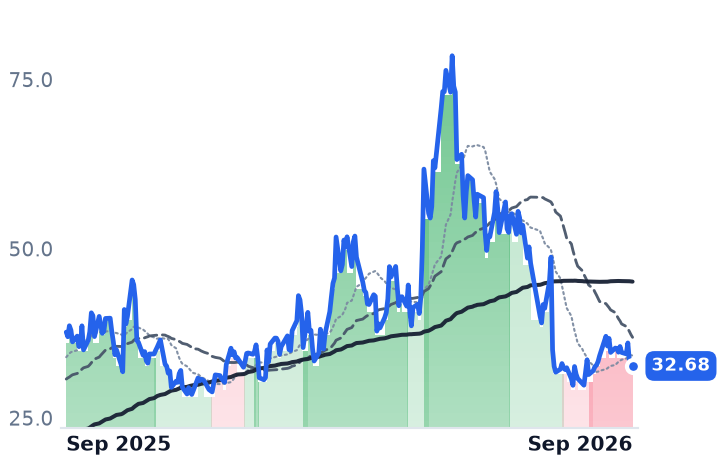
XIFR | XPLR Infrastructure | Renewable & Infrastructure Assets | 🟢 Cont. Bull | −10.0% | +2.4% |
| Compared against · context, not the story | |||||
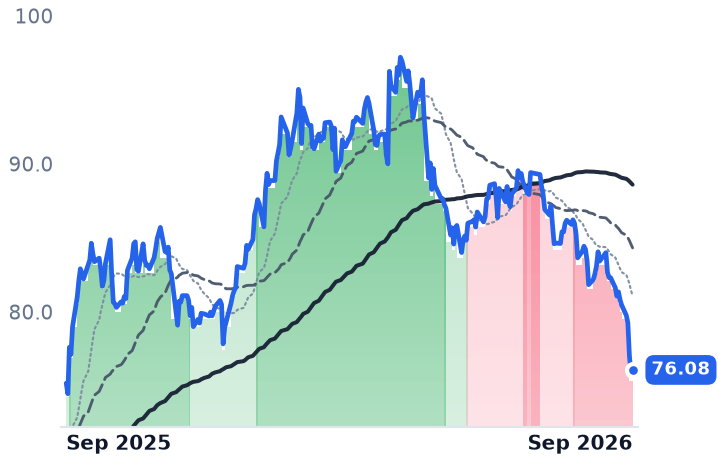
FSLR | First Solar | Solar Module Manufacturers | ⚠️ Emerging Bear | −13.1% | −20.5% |
CWEN | Clearway Energy | Wind & Solar Developers | ⚠️ Emerging Bear | −6.3% | +7.5% |
ENPH | Enphase Energy | Inverters & Power Electronics | 🔴 Cont. Bear | −13.0% | −10.2% |
SEDG | SolarEdge Technologies | Inverters & Power Electronics | ⚠️ Emerging Bear | +4.0% | −13.3% |
NEE | NextEra Energy | Vertically Integrated Utilities | 🔴 Cont. Bear | −7.0% | +1.2% |
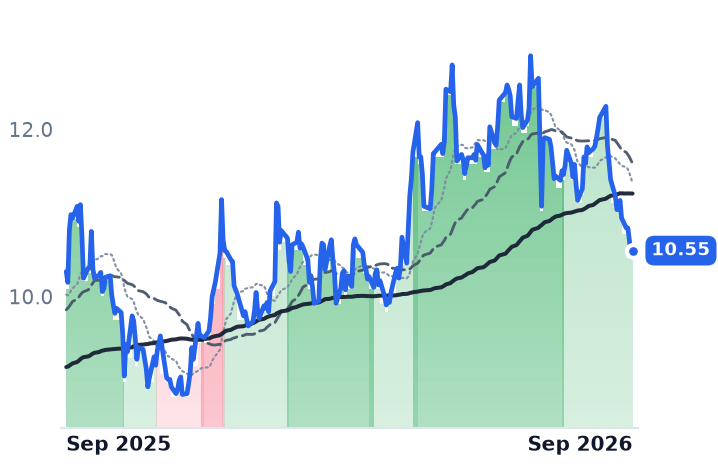
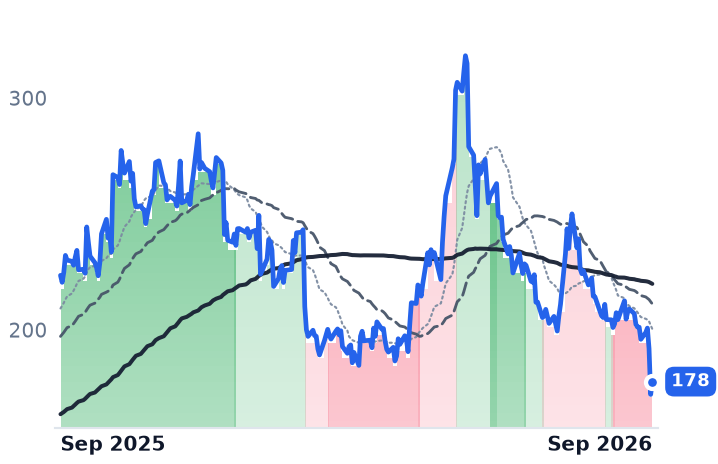
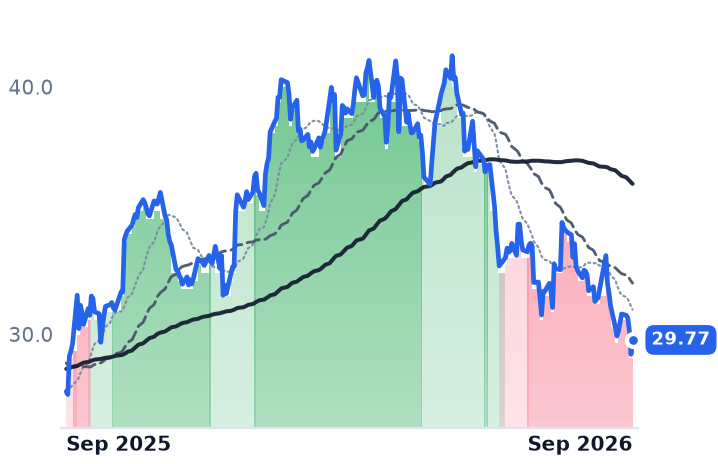
12-month price & trend
| Ticker | Mkt cap | P/E | P/E fwd | P/S | P/S fwd | P/GP | P/GP fwd | EV/EBITDA | FCF yld |
|---|---|---|---|---|---|---|---|---|---|
RUN | $1.9B | 4.7x | 6.4x | 0.6x | 0.6x | 1.6x | 1.8x | 23.1x | -70.4% |
XIFR | $994.6M | 15.7x | 9.3x | 0.8x | 0.7x | 4.8x | 4.3x | 8.8x | -63.7% |
FSLR | $19.1B | 10.9x | 10.1x | 3.6x | 3.8x | 8.1x | 8.6x | 7.2x | 7.9% |
| Ticker | Mkt cap | P/E | P/E fwd | P/S | P/S fwd | P/GP | P/GP fwd | EV/EBITDA | FCF yld |
|---|---|---|---|---|---|---|---|---|---|
CWEN | $6.3B | 40.3x | — | 4.0x | 3.8x | 7.6x | 7.2x | 14.3x | 10.7% |
ENPH | $4.9B | 36.1x | 18.4x | 3.7x | 4.1x | 7.8x | 8.7x | 27.9x | 3.1% |
SEDG | $2.2B | n/m | — | 1.7x | 1.7x | 7.6x | 7.6x | n/m | 4.0% |
| Ticker | Mkt cap | P/E | P/E fwd | P/S | P/S fwd | P/GP | P/GP fwd | EV/EBITDA | FCF yld |
|---|---|---|---|---|---|---|---|---|---|
NEE | $165.4B | 17.7x | 19.7x | 5.7x | 5.3x | 7.9x | 7.4x | 15.4x | -6.2% |
Consensus projections
| Ticker | FY2026E | FY2027E | FY2028E | |
|---|---|---|---|---|
RUN | Revenue | +29.7% | +3.5% | +12.9% |
| EPS | −8.2% | −65.9% | −38.3% | |
XIFR | Revenue | +0.8% | +4.7% | +1.3% |
| EPS | −849.6% | −44.0% | −144.3% | |
FSLR | Revenue | −1.7% | +17.1% | +11.7% |
| EPS | +20.3% | +33.1% | +26.2% | |
CWEN | Revenue | +14.5% | +11.5% | +12.2% |
| EPS | −116.0% | −318.9% | +60.4% | |
ENPH | Revenue | −19.1% | +6.2% | +10.8% |
| EPS | −28.8% | +14.0% | +18.9% | |
SEDG | Revenue | +12.0% | +11.1% | +11.4% |
| EPS | −86.2% | −370.0% | +91.7% | |
NEE | Revenue | +9.4% | +9.7% | +8.9% |
| EPS | +9.0% | +9.1% | +8.5% |
Forward fiscal years only. Blank means no analyst coverage for that year.
Sunrun sold a slice of its seasoned rooftop solar and battery leases to bond investors in August, and they charged it less than at any point in roughly a year and a half. The $267m securitization priced its publicly placed A- rated senior notes at a 6.33% yield — a 200 basis-point spread over the benchmark, 20 basis points tighter than the company's April deal and, per chief financial officer Danny Abajian, the tightest in about 18 months. Three weeks later the shares made a 52-week low.
That gap is the whole question in residential solar. Sunrun, the largest US installer and financier of home solar-and-battery systems, builds a system, keeps it, and collects a 20-to-25-year lease or power-purchase payment — funding the up-front cost with nonrecourse asset-level debt and by selling federal tax credits. It has raised roughly $1.5bn of such debt so far this year and booked a $98.4m tax benefit from investment-tax-credit transfer agreements in the first half. Credit investors are underwriting the cash flows of systems already on roofs, and they have grown more comfortable. Equity investors are underwriting the next system, and they have not.
The next customer got much more expensive
Sunrun's June quarter made the distinction plain. Revenue rose 53% to $870.0m, but net subscriber value — the company's own measure of value created per new customer, net of the cost to create it — fell to $9,444 from $17,004 a year earlier. Strip out assumed contract renewals and contracted net subscriber value fell 61% to $5,100, even as contracted subscriber value rose 10% to $55,033: the price held, the cost did not. Additions fell 31% to 19,793, and full-year cash generation guidance came down to $200–375m from $250–450m. Sunrun also stopped publishing aggregate creation costs and aggregate net value creation, replacing them with two new measures — a disclosure change that retires the most comparable unit-economics series just as it deteriorated.
The causes are dated and mostly external. Section 25D, the 30% federal credit for homeowner-owned systems, expired on 31 December 2025 with no phase-down; leases and power-purchase agreements kept a 30% credit under Section 48E. Customer-owned share of the market duly fell from 54% to 43% while third-party ownership rose to 52%, and SEIA and Wood Mackenzie expect US residential installations to fall around a fifth this year. Wood Mackenzie also expects customer-acquisition costs to spike about 40% in 2026 — the mechanism behind the creation-cost jump. Add the failure of Freedom Forever, the second-largest installer at roughly 6.1% share against Sunrun's 12.7%, whose Chapter 11 became a Chapter 7 liquidation this month; Sunrun financed its systems, so a rival's collapse cost Sunrun volume. "Customer demand for our offering remains strong, and as our expanded sales force reaches full productivity, we believe that we will exit the year at a robust growth rate and higher unit margins," Abajian told investors on the second-quarter call. Storage attachment, at a record 74%, is the one metric moving his way.
The last month was the discount rate
None of that explains September. The Federal Open Market Committee raised its target range to 3.75–4.00% on 16 September, a first increase in more than three years, with 16 of 18 participants penciling in another; the 30-year Treasury reached its highest since June 2007. On 24 September solar equities fell together on financing costs rather than demand: First Solar about 8%, SolarEdge about 5%.
First Solar sells cadmium-telluride modules to utility-scale developers and has no rooftop business. Its June quarter carried a 57.3% gross margin, consensus has 2027 earnings of $23.36 a share against $17.55 this year, and it trades near ten times forward earnings — yet it is down 28.5% in three months and only slipped into a downtrend on 1 September, the last of the group to break. XPLR Infrastructure, the externally managed owner of contracted wind, solar and Texas gas infrastructure, is the counter-example: up 8.65% over twelve months, the only name here whose trend is not falling. It reaffirmed 2026 free cash flow before growth of $600–700m after $257m in the quarter, bought out a $150m slice of a convertible-equity portfolio financing and repaid $500m of converts while paying no distribution at all. It trades at 8.8x trailing earnings before interest, tax, depreciation and amortization and 0.31x book, against 14.3x and 0.68x for Clearway Energy, which owns a similar contracted fleet and trimmed its distributable cash guide to $430–470m on weak wind and solar resource.
What each part earns
The twelve-month verdict belongs to Sunrun alone: returns across these four names span 60.7 percentage points, from Sunrun's 52% decline to XPLR's gain, so there is no single renewables judgment to read. Sunrun's de-rating is earned — halved unit economics, a cut cash guide, and a repealed credit are a business event, not a mood. The thirty-day leg is a rate event, and it fell hardest on the businesses least exposed to rooftops, which is the signature of a discount-rate move rather than a demand one. The awkward fact for the bear case is the bond: the market that actually prices Sunrun's contracted cash flows tightened while the market that prices its growth made a new low.
The clock is the thing to watch. The 30% credit that survives only for leased and third-party-owned systems runs through the end of 2027, and only for projects whose construction began by 4 July 2026. Sunrun's financing structure has a known expiry date; its customer acquisition costs do not.