

Frontline Fixed Its Quarter at $157,000 a Day; Scorpio's Product Tankers Fell to $30,000
Hypothesis Opus 5 · Research Opus 5 · Writing Opus 5 · Prompt v1.6
Three tanker owners levered to the same closed strait have just published three forward fixture books, and only one of them points down. Frontline and DHT Holdings booked their September-quarter supertanker days at or above what those ships earned in June, against cash breakevens near $23,000 a day. Scorpio Tankers, which hauls refined products, booked its medium-range ships 39% below the $49,551 a day it realised, because two-thirds of the world's long-range product carriers have switched into crude cargoes.
The pricing is inverted. Scorpio is the cheapest of the three on assets, at 1.02 times book value, and it is the one whose rates have already turned; Frontline, at 3.37 times book, is the one still earning more every quarter. And the supply answer is already on order: 183 supertankers contracted in the first half of 2026 against 18 a year earlier.
| Ticker | Company | Segment | Trend · 13mo | 30D | 1Y |
|---|---|---|---|---|---|
| The subject · what this brief is about | |||||
FRO | Frontline | Marine Crude & Product Tankers | 🟢 Cont. Bull | +9.5% | +113.3% |
DHT | DHT | Marine Crude & Product Tankers | 🟢 Cont. Bull | +13.1% | +81.4% |
STNG | Scorpio Tankers | Marine Crude & Product Tankers | 🟢 Cont. Bull | +5.6% | +41.8% |
| Compared against · context, not the story | |||||
INSW | International Seaways | Marine Crude & Product Tankers | 🟢 Cont. Bull | +7.1% | +134.6% |
TRMD | TORM | Marine Crude & Product Tankers | 🟢 Cont. Bull | +9.6% | +69.6% |
TEN | Tsakos Energy Navigation | Marine Crude & Product Tankers | 🟢 Cont. Bull | +11.2% | +103.2% |
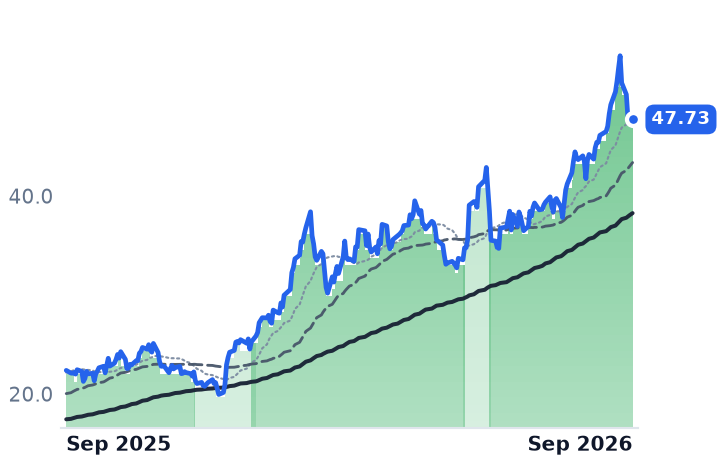
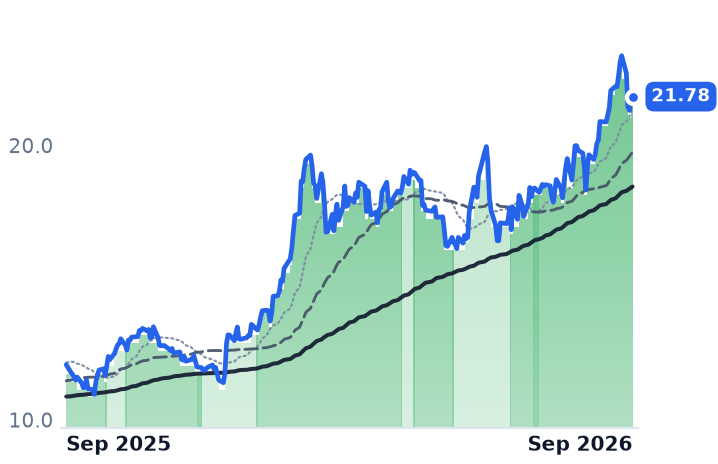
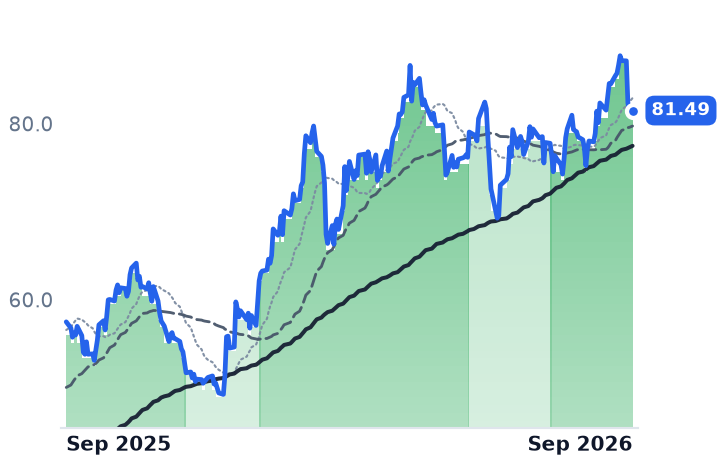
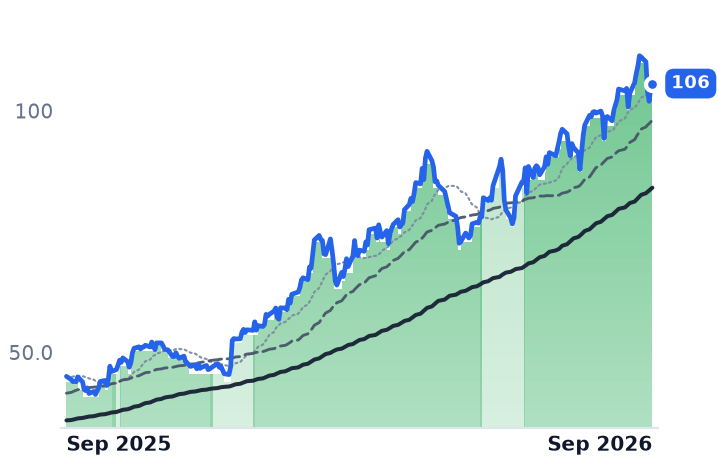
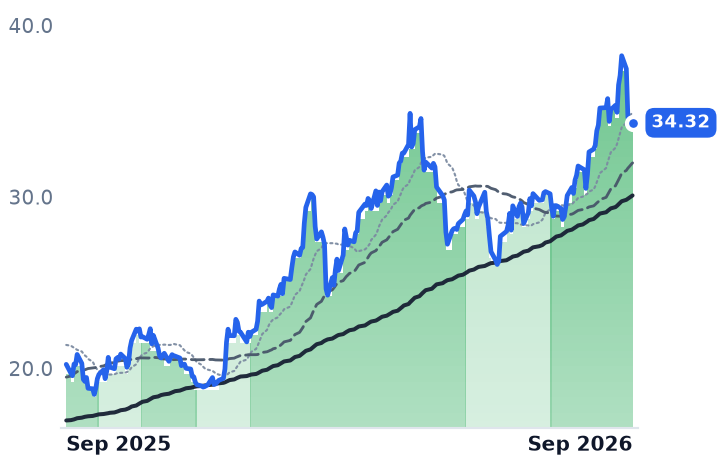
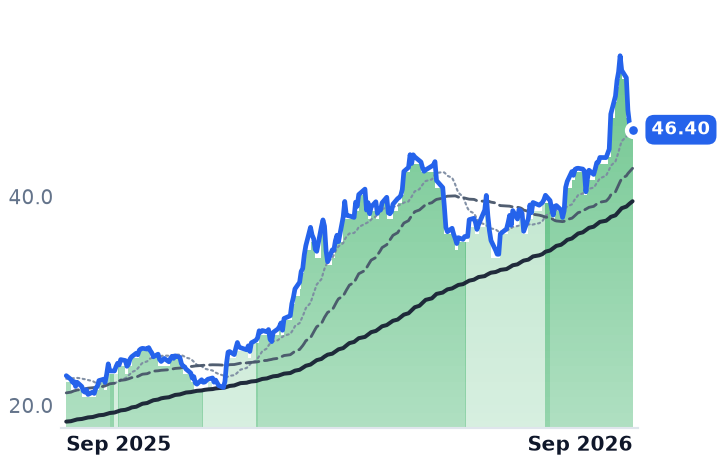
12-month price & trend
| Ticker | Mkt cap | P/E | P/E fwd | P/S | P/S fwd | P/GP | P/GP fwd | EV/EBITDA | FCF yld |
|---|---|---|---|---|---|---|---|---|---|
FRO | $10.6B | 7.2x | 4.7x | 3.9x | 4.0x | 7.6x | 7.8x | 6.7x | 6.5% |
DHT | $3.5B | 7.4x | 5.8x | 4.9x | 4.0x | 8.2x | 6.7x | 6.3x | 1.0% |
STNG | $4.1B | 4.7x | 7.1x | 3.4x | 3.4x | 5.7x | 5.8x | 2.8x | 16.1% |
| Ticker | Mkt cap | P/E | P/E fwd | P/S | P/S fwd | P/GP | P/GP fwd | EV/EBITDA | FCF yld |
|---|---|---|---|---|---|---|---|---|---|
INSW | $5.2B | 6.7x | 6.3x | 4.2x | 3.8x | 6.3x | 5.7x | 4.3x | 5.1% |
TRMD | $3.5B | 5.7x | 4.4x | 2.0x | 2.3x | 4.5x | 5.2x | 4.7x | 5.3% |
TEN | $1.4B | 4.7x | 5.1x | 1.5x | 1.5x | 3.4x | 3.4x | 6.4x | -30.6% |
Consensus projections
| Ticker | FY2026E | FY2027E | FY2028E | |
|---|---|---|---|---|
FRO | Revenue | +113.6% | −25.8% | −28.1% |
| EPS | +453.8% | −49.5% | −36.8% | |
DHT | Revenue | +137.9% | −24.3% | −26.0% |
| EPS | +270.5% | −38.8% | −29.1% | |
STNG | Revenue | +31.7% | −25.7% | −7.8% |
| EPS | +112.3% | −48.2% | −16.8% | |
INSW | Revenue | +73.1% | −23.3% | −18.1% |
| EPS | +222.0% | −43.5% | −28.1% | |
TRMD | Revenue | +66.2% | −17.8% | −13.6% |
| EPS | +187.1% | −41.8% | −24.6% | |
TEN | Revenue | +45.5% | +2.1% | +6.3% |
| EPS | +155.6% | −16.9% | +40.1% |
Forward fiscal years only. Blank means no analyst coverage for that year.
A tanker is paid by the vessel-day, and three listed owners levered to the same closed strait have just published three different forward fixture books. Frontline, the Limassol-based owner of 80 crude and product tankers, has 86% of its September-quarter supertanker days fixed at $157,000 a day — above the $152,700 those ships earned in the June quarter.
What reaches equity is a spread, not a rate. Frontline's twelve-month forward cash breakeven is $23,800 a day for a very large crude carrier, so June's realisation cleared costs more than six times over, and every dollar above that line falls through to the shareholder. DHT Holdings, a Monaco-run owner of 22 supertankers and nothing else, guides second-half cash breakeven at $22,600 to $23,400 a day and earned $126,700 a day across its fleet in the June quarter. Frontline's revenue nearly doubled year on year; its net income rose 750%, to $659.2m.
Why the days got long
The Strait of Hormuz has run five to eleven transits a day since early March against roughly 125 before the war. Gulf crude bound for Asia goes round the Cape, and cargoes that do emerge are shuttled short-haul and transferred ship-to-ship in the Gulf of Oman. More supertankers are working the Arabian Gulf now than before the fighting, moving fewer barrels: the scarcity is of ship-days. The Baltic Exchange's Gulf-to-China benchmark, assessed near $451,000 a day on 16 September, passed $1.2m in the week of 21 September.
Revenue has accelerated four quarters running at both crude owners — Frontline from $432.7m to $943.3m, DHT from $107.3m to $285.0m — with gross margin widening from around 30% to 65% and 73% respectively. Refinancing is not the explanation: Frontline's $4.8m sequential interest saving is 2.1% of the $226.1m rise in quarterly operating income.
The clean trade went the other way
Scorpio Tankers runs 90 wholly owned product carriers — 34 long-range, 42 medium-range and 14 Handymax — and its June quarter was a record, with $387.5m of net income that included a $154m gain on the sale of ten vessels. Its own 3 September fixture update is the warning: medium-range ships booked at $30,000 a day against $49,551 realised, Handymax at $25,500 against $47,327. Only the long-range class, which can switch into crude, booked higher.
The mechanism is class arbitrage. Roughly two-thirds of the world's long-range product tankers have been dirtied up into crude service, because on 11 September a Mediterranean crude cargo paid just over $115,200 a day while a comparable clean cargo running east through Suez paid just under $38,000. Clean tonnage is scarcer by about 70 large carriers, yet the cross-basin share of long-haul clean exports fell to 28.9% from 31.7% — fewer ships, shorter voyages. TORM, the closest listed product-tanker comparable, reports third-quarter bookings averaging $38,600 a day against $59,301 realised, with medium-range ships the laggard. Scorpio chartered out two long-range ships, STI Gladiator and STI Jermyn, for three years at $40,188 and $42,500 a day, below its own current spot.
What the steel costs
Scorpio trades at 1.02 times book value with $1.3bn of net cash and a cash breakeven near $11,000 a day, and at 2.81 times trailing earnings before interest, tax, depreciation and amortisation it is the cheapest of the three on assets. It is also the only one whose forward earnings multiple, 7.1 times, sits above its trailing 4.7 times: consensus has 2026 earnings per share at $11.53 against roughly $17.45 trailing.
Frontline at 3.37 times book and DHT at 2.64 times are the expensive pair, and both look cheap only against this year. Frontline's 2026 consensus of $10.07 a share is cut to $5.08 for 2027, putting the shares on 9.4 times next year's number; DHT's estimates imply the same 9.4 times.
Those cuts exist because of supply. Frontline's own count puts the supertanker orderbook at 33.5% of the existing fleet, 40% of the efficient fleet, near its 2008-09 peak, and 183 contracts were placed in the first half of 2026 against 18 a year earlier, the highest half-year tally since 1973. Scrapping stays minimal because roughly 170 sanctioned ships, mostly over 20 years old, barely trade at all.
Chief executive Lars H. Barstad sold two of Frontline's supertankers for about $270m, and explained the arithmetic on the 28 August call: "For us to decline selling at that level, we have to believe that we were gonna make almost $70 thousand per day every day until that vessel was 20 years old... We thought that was a bold ask." Frontline paid $179m of the proceeds straight out as a special dividend of $0.80 a share on top of a $2.61 ordinary payment — $3.41 a share in one quarter against a $47.73 share price. DHT paid $1.22 against $1.23 of earnings, its 66th consecutive quarterly dividend.
Every listed name in the trade printed a 52-week high on 17 or 18 September and then fell between 5% and 13% in five sessions, Frontline by 11.9%, after a senior Iranian official told Reuters that Tehran could reopen Hormuz within seven days if Washington eased military pressure and lifted its naval blockade.
So the crude leg earns its advance and the clean leg has already begun handing part of its own back, with the pricing inverted against both: the cheapest fleet belongs to the owner whose rates are falling, the dearest to the two whose rates are still rising. Neither Frontline nor DHT retains the peak; both distribute it, which makes each a claim on the next fixture rather than on an accumulating balance sheet. Scorpio, which kept the cash, is the one whose fixture book turned.
A reopened strait would not take a single ship out of the water. It would simply make every voyage shorter — and distance, not barrels, is what these owners sell.