

Digital Realty Repriced Its Biggest Leases 66.7% Higher and Added $750m to Capex
Hypothesis Opus 5 · Research Opus 5 · Writing Opus 5 · Prompt v1.6
The part of the artificial-intelligence buildout that owns the buildings is supposed to be the price-taker, squeezed by a handful of cloud tenants who can build their own halls. Digital Realty's June-quarter renewals say the opposite: cash rents on renewing leases rose 25.4%, and within that the wholesale blocks above one megawatt repriced 66.7% higher, against 5.2% in the small-footprint book.
Equinix's per-unit meter moved the same way — monthly recurring revenue per cabinet of $2,538, up 6%, with churn at 1.8% — and it raised 2026 guidance to revenue growth of 11-12%. NextDC's contracted capacity tripled to 740 megawatts against 175 billed.
What fell was the discount rate applied to those books, not the rents inside them. The one operator guiding pricing down is GDS in China, where it is moving into power-abundant provinces — which is the tell: scarcity of power, not enthusiasm for AI, sets the rent.
| Ticker | Company | Segment | Trend · 13mo | 30D | 1Y |
|---|---|---|---|---|---|
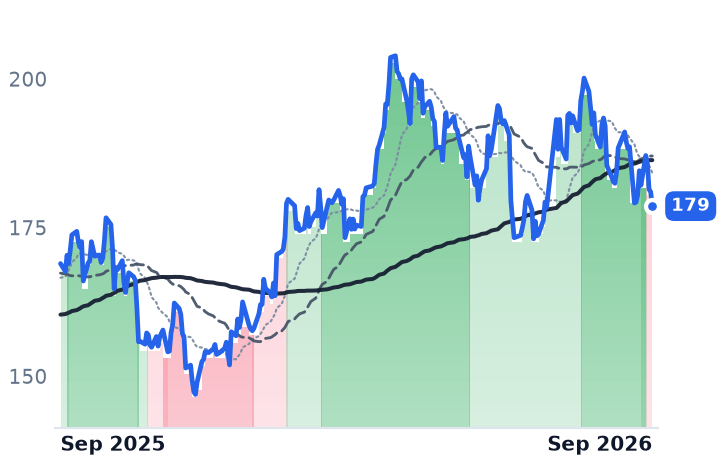
DLR | Digital Realty Trust | Data Center & Colocation | 🟢 Cont. Bull | −7.0% | +5.7% |
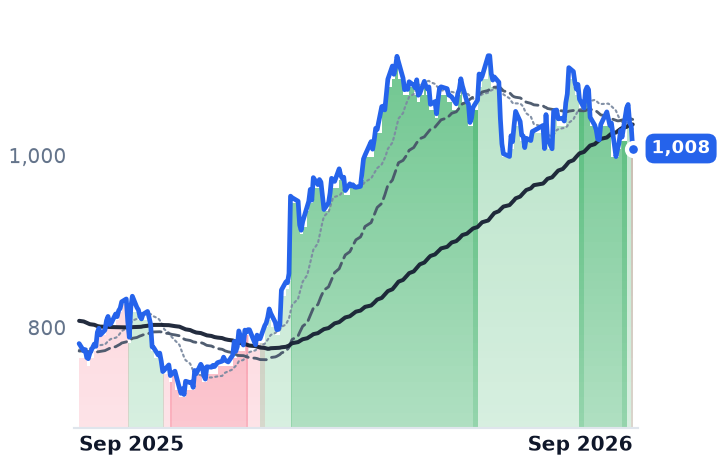
EQIX | Equinix | Data Center & Colocation | 🟢 Cont. Bull | −6.4% | +29.0% |
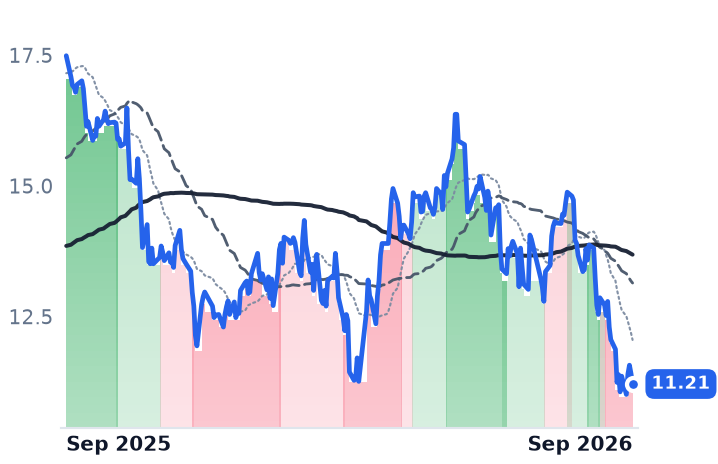
NXT.AX | NEXTDC | Information Technology Services | 🌱 Emerging Bull | −17.5% | −35.9% |
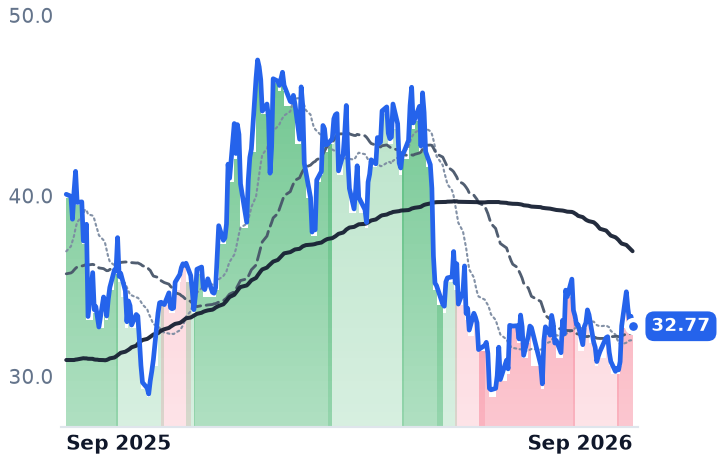
GDS | GDS | Data Center & Cloud Infrastructure | 🔴 Cont. Bear | −2.7% | −18.2% |
IRM | Iron Mountain Incorporated | Records & Information Management | 🟢 Cont. Bull | −9.3% | +12.4% |
VNET | VNET | Data Center & Cloud Infrastructure | 🔴 Cont. Bear | +0.1% | −38.5% |
SPY | State Street SPDR S&P 500 ETF Trust | Asset Management | 🟢 Cont. Bull | +0.1% | +17.2% |
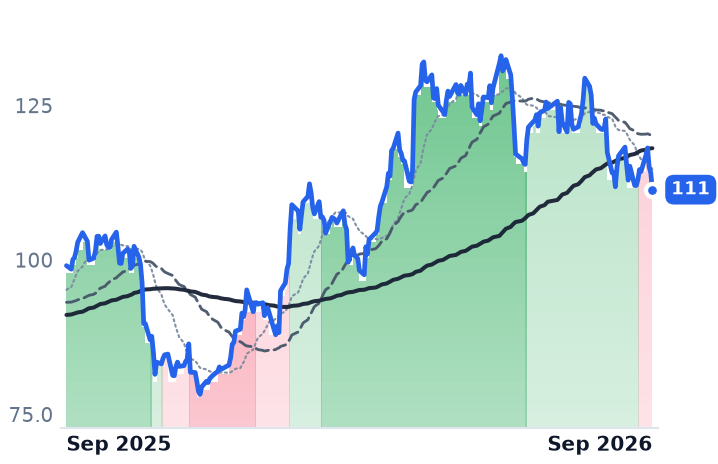
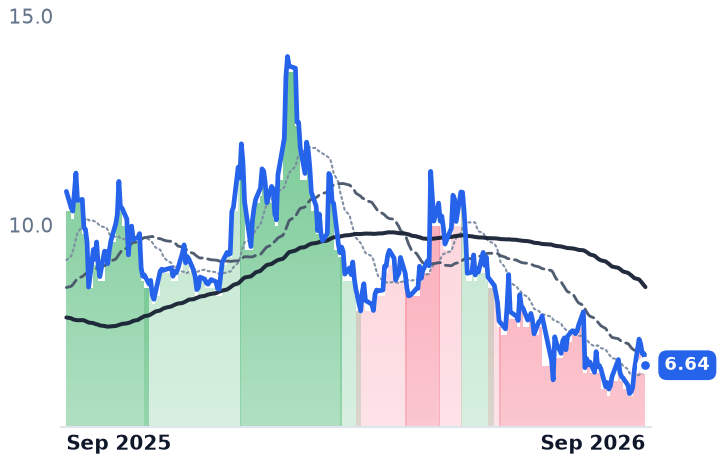
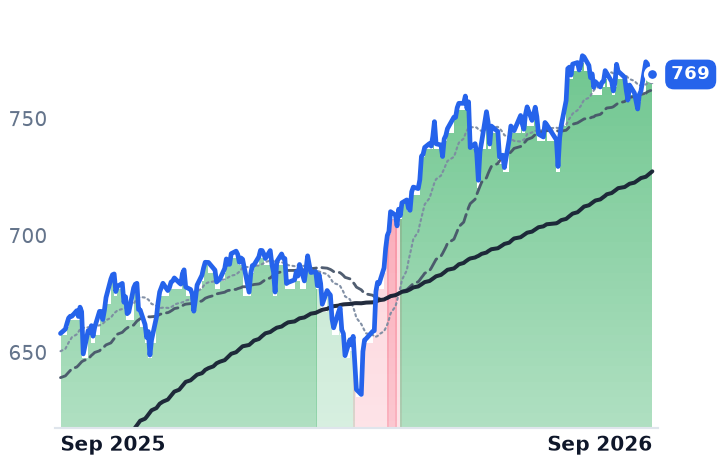
12-month price & trend
| Ticker | Mkt cap | P/E | P/E fwd | P/S | P/S fwd | P/GP | P/GP fwd | EV/EBITDA | FCF yld |
|---|---|---|---|---|---|---|---|---|---|
DLR | $66.1B | 82.3x | 65.7x | 9.6x | 9.3x | 70.1x | 67.6x | 24.2x | 2.1% |
EQIX | $99.5B | 64.6x | 58.5x | 10.1x | 9.7x | 19.6x | 18.7x | 27.1x | 1.4% |
NXT.AX | $8.5B | 87.2x | — | 17.1x | 10.7x | — | 744.1x | 48.6x | -23.2% |
| Ticker | Mkt cap | P/E | P/E fwd | P/S | P/S fwd | P/GP | P/GP fwd | EV/EBITDA | FCF yld |
|---|---|---|---|---|---|---|---|---|---|
GDS | $6.4B | 11.9x | — | 3.5x | — | 14.5x | — | 13.8x | -1.8% |
IRM | $33.1B | 79.6x | 44.8x | 4.4x | 4.1x | 8.1x | 7.6x | 20.9x | -1.5% |
VNET | $1.9B | n/m | — | 1.2x | — | 5.7x | — | 9.7x | -44.9% |
| Ticker | Mkt cap | P/E | P/E fwd | P/S | P/S fwd | P/GP | P/GP fwd | EV/EBITDA | FCF yld |
|---|---|---|---|---|---|---|---|---|---|
SPY | $773.0B | — | — | — | — | — | — | — | — |
Consensus projections
| Ticker | FY2026E | FY2027E | FY2028E | |
|---|---|---|---|---|
DLR | Revenue | +17.3% | +11.0% | +14.2% |
| EPS | −25.7% | −4.8% | +24.7% | |
EQIX | Revenue | +11.1% | +10.7% | +11.5% |
| EPS | +16.8% | +9.2% | +12.6% | |
NXT.AX | Revenue | +13.7% | +63.2% | +68.8% |
| EPS | +106.8% | +18.1% | −12.4% | |
GDS | Revenue | +11.8% | +9.6% | +23.6% |
| EPS | −36.2% | −95.7% | +488.5% | |
IRM | Revenue | +17.0% | +8.8% | +8.0% |
| EPS | +24.2% | +11.7% | +12.6% | |
VNET | Revenue | +19.1% | +22.1% | +22.5% |
| EPS | −31.7% | −244.2% | +27.6% |
Forward fiscal years only. Blank means no analyst coverage for that year.
Digital Realty's oldest wholesale leases are rolling over into a market where megawatts are scarcer than tenants, and the tenants are paying up. Rents on renewal leases the company signed in the June quarter rose 25.4% on a cash basis and 32.0% on a reported basis, and the markup was concentrated in exactly the place a landlord is supposed to be weakest: leases above one megawatt, the wholesale blocks bought by the few cloud operators who can build halls for themselves, were 44% of renewal volume and repriced 66.7% higher. The small-footprint book, under one megawatt, managed 5.2%.
That single split is the answer to the question hanging over data-center landlords: whether the lease books signed before the power shortage are capturing the shortage, or whether the buildings are just capital sinks whose rent is set by their customers. The stake is the conversion schedule — the dollars and megawatts already contracted that have yet to reach a bill — because that is what every valuation in this group is underwriting.
The backlog has a date on it
Digital Realty, which owns 309 data centers and about 3.0 gigawatts of operating capacity and leases wholesale and colocation space to cloud and enterprise customers, ended June with a record $1.9bn of signed-but-not-commenced annualized rent at full share — roughly 30% of in-place data-center revenue, on management's account. Of that, $208m began billing in the quarter and $635m is scheduled to commence in the second half. Its development pipeline is 1.4 gigawatts, 63% pre-leased, underwritten to an average stabilized yield of 11.5%.
The cost of that growth is visible on the per-share line. Revenue rose 28.9% in the quarter while core funds from operations per share excluding promote income rose 14%, to a record $2.13 — the gap being 4.6% more diluted shares plus a joint-venture structure that routes development into fee and promote income, including $188m of net promote from the Blackstone transaction. The company sold about 13.5m shares this year at an average $184.94 for roughly $2.5bn, above the $178.61 close on 25 September, and raised net capital-expenditure guidance by $750m to $4.25-4.75bn. At that price it trades near 21.9 times the midpoint of raised 2026 core FFO guidance of $8.15-8.20, just under the 22-25 times forward FFO it carried in May.
Equinix charges by the cabinet, and the cabinet got dearer
Equinix sells power, space and interconnection inside more than 273 exchange facilities, and its revenue is a meter read: monthly recurring revenue per cabinet reached $2,538, up 6% on higher power densities and firm pricing, with churn of 1.8%. Gross bookings of $424m were up 23% and produced a record backlog, alongside 9,700 net new interconnections and a 53% adjusted EBITDA margin. Adjusted FFO per share grew 18% against reported revenue growth of 16.4% — per-share growth outran the top line, with the diluted count up 1.1%.
"This is the largest single guidance raise in the history of our company," chief executive Adaire Fox-Martin told investors on the call for the quarter reported 29 July. The company lifted 2026 revenue growth to 11-12% and adjusted FFO per share to $42.69-43.29, and raised its through-2029 revenue growth range to 10-13% from 7-10%. It is funding the build at 4.400% on notes due 2031 and 4.700% on 2033s — several hundred basis points inside the double-digit stabilized yields the sector underwrites. At $1,008.08 the shares sit at about 23.4 times the midpoint of that raised per-share guide, below the 25-30 times forward FFO the name has commanded; the trailing earnings multiple of 64.6x, against 74.6x in May, says little for a REIT carrying this much depreciation.
NextDC is the conversion test
NextDC, the Brisbane-based operator building hyperscale capacity across Australia and Asia, has no earnings at all — operating income of minus A$36.1m on FY2026 revenue of A$496.5m — and is the purest read on whether contracted megawatts become billed ones. At its 27 August result, contracted utilization had tripled to 740 megawatts against 175 billed, leaving a 565-megawatt forward order book, of which 197 megawatts is scheduled to convert in the current year. "Every megawatt in that forward order book is a binding customer contract," chief executive Craig Scroggie said that day. FY27 revenue is guided to A$615-640m, growth above 50%, against capital expenditure of A$5.25-5.75bn — nine dollars of build for each dollar of revenue, which is why an A$1.1bn convertible priced on 10 September at a 1.25-1.75% cash coupon read to the market as dilution. The shares have fallen about 20% from the post-result level with no change to that guidance, and are the only one of the three whose uptrend has actually broken.
Where the pricing power actually comes from
One operator in this business is guiding rents down, and it is the one with power to spare: GDS, which runs data centers in mainland China, booked 470 megawatts in the first half and raised full-year bookings guidance to a gigawatt, yet expects monthly recurring rates about 3% lower by the fourth quarter as its mix shifts into power-abundant Inner Mongolian and southern markets. Set against Digital Realty's American renewal spread, that is the mechanism stated plainly: rent tracks local grid scarcity rather than AI demand in the abstract. It also explains the geography of the selloff — over thirty days Equinix fell 6.6%, Digital Realty 7.7% and NextDC 18.8% while GDS was flat, as the Federal Reserve raised its target range on 16 September for the first time in more than three years and the ten-year Treasury yield reached 5.17%, lifting the capitalization rate applied to an unchanged lease book. The same week brought token-price cuts of 40-50% from OpenAI, Anthropic and xAI and public slowdown talk; Digital Realty's Andrew Power went on CNBC on 15 September to say it does not mean "pencils down".
The verdict the meters support is narrow but real: the businesses earn none of this drawdown, and the discount rate earns most of it. What the rate move cannot touch is signed rent with a commencement date; what it can touch is anything still requiring equity — which is why the same headline cost NextDC nearly three times what it cost Equinix. The distinction to hold is between a landlord repricing a scarce asset and a developer pre-funding one.
By Christmas, Digital Realty expects $635m of annualized rent to have started billing. If it does, the argument moves from whether the demand is contractual to what discount rate a contract deserves.