

indie Semiconductor's $7.4bn Backlog Bills Only When Automakers Actually Build
Hypothesis Opus 5 · Research Opus 5 · Writing Opus 5 · Prompt v1.6
indie Semiconductor's automotive chip revenue is finally accelerating and its margins are moving the other way at the same time. June-quarter sales rose 24% to $64.0m, with a September-quarter guide of $67m-$73m, but gross margin fell to 36.1% from 40.6%, so gross profit grew only 10.2% — the opposite of the scale economics the company has framed 2026 as delivering. The GAAP operating loss was $35.1m, and $149m of cash sits behind $150m of 4.00% convertible notes sold in March.
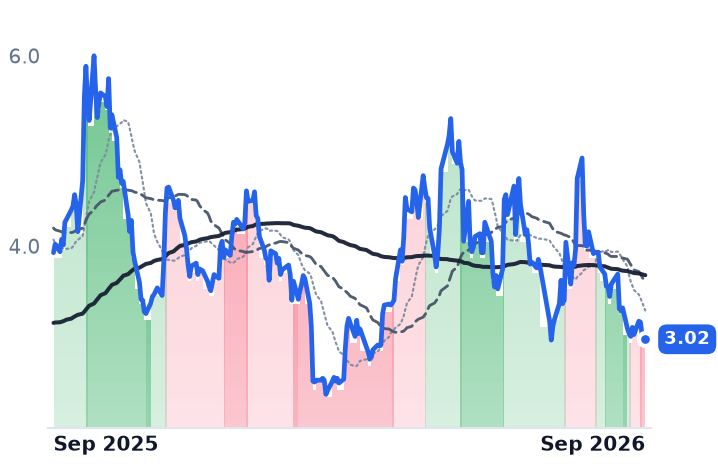
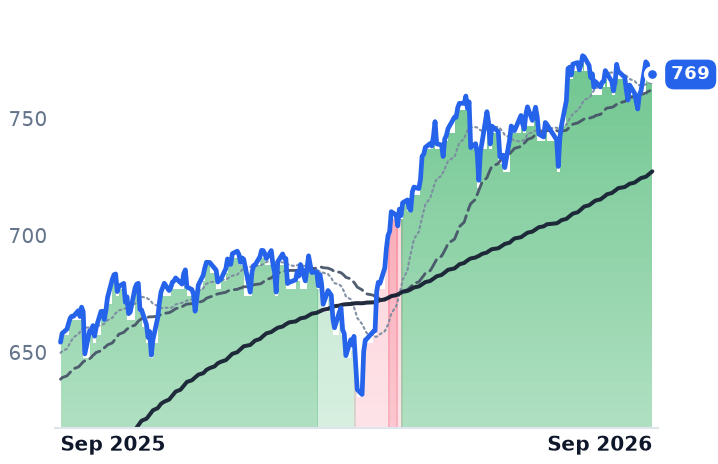
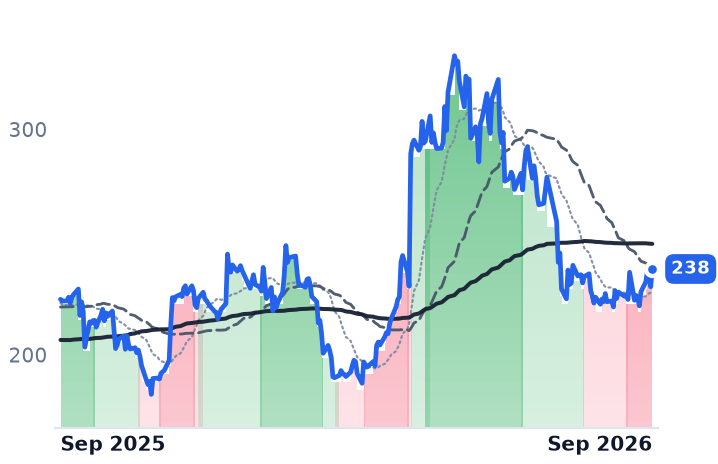
The shares have also split from their nearest comparables: over the thirty days to 25 September CEVA rose 34% while indie fell 23%. Measured against gross profit rather than sales, indie is no cheaper than Ambarella despite earning half the margin — the discount investors think they see in its 2.76x sales multiple is the margin gap.
| Ticker | Company | Segment | Trend · 13mo | 30D | 1Y |
|---|---|---|---|---|---|
| The subject · what this brief is about | |||||
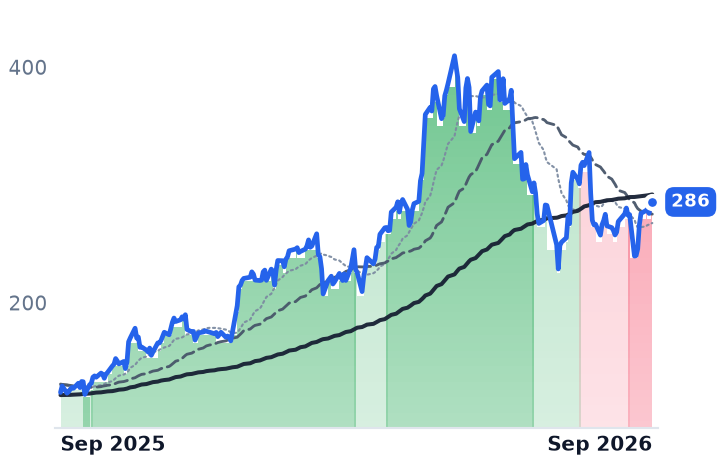
INDI | indie Semiconductor | RF & Wireless | 🔴 Cont. Bear | −23.2% | −23.2% |
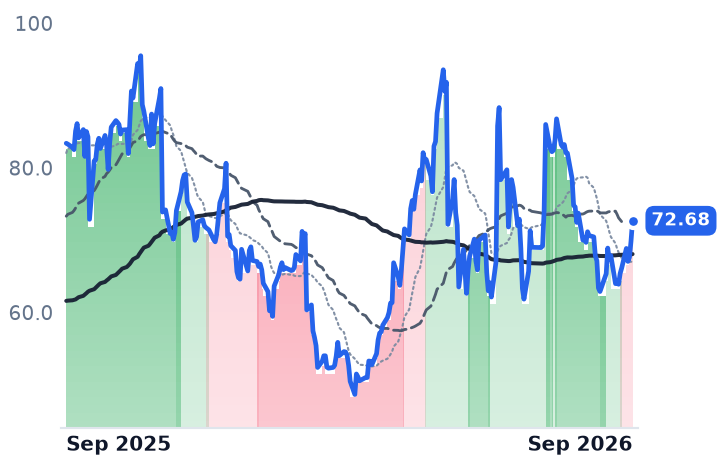
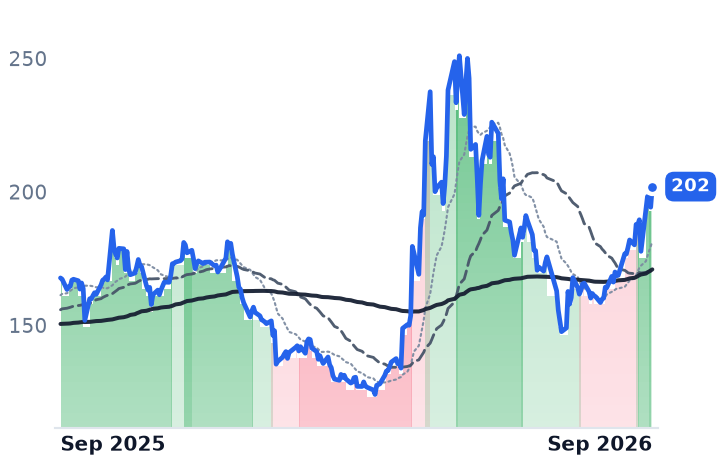
AMBA | Ambarella | Specialty Semiconductors | 🌱 Emerging Bull | +4.3% | −12.9% |
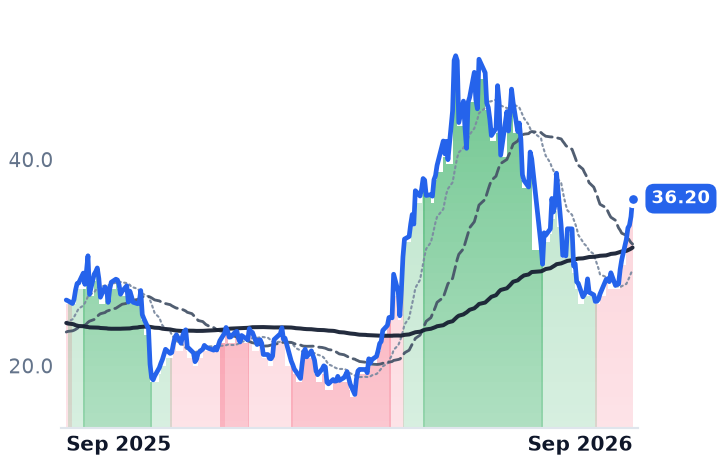
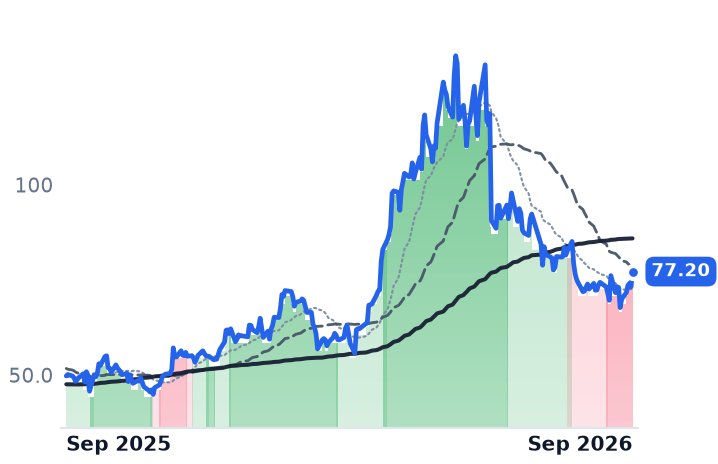
CEVA | CEVA | Specialty Semiconductors | 🌱 Emerging Bull | +32.9% | +37.3% |
| Compared against · context, not the story | |||||
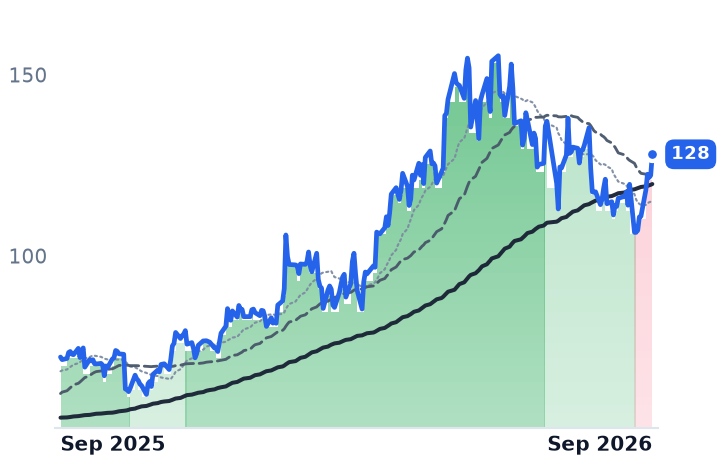
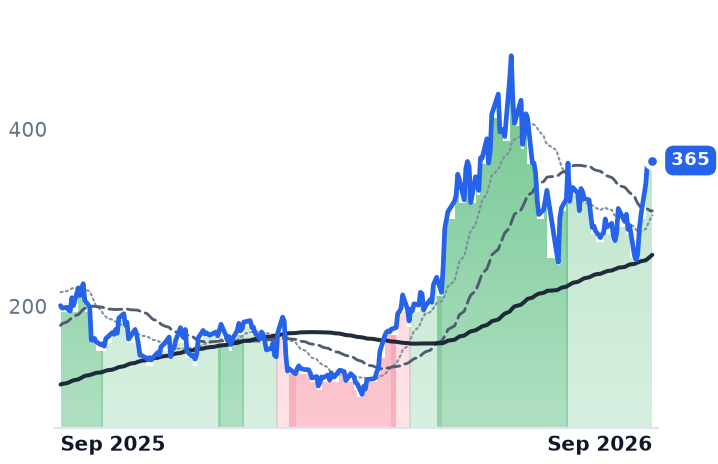
LSCC | Lattice Semiconductor | Specialty Semiconductors | 🟢 Cont. Bull | +7.8% | +77.7% |
MTSI | MACOM Technology Solutions | RF & Wireless | ⚠️ Emerging Bear | +5.8% | +130.5% |
QCOM | QUALCOMM Incorporated | RF & Wireless | 🟢 Cont. Bull | +26.1% | +20.4% |
ON | ON Semiconductor | Analog & Mixed-Signal | ⚠️ Emerging Bear | +5.6% | +55.1% |
ALAB | Astera Labs | Specialty Semiconductors | 🟢 Cont. Bull | +28.9% | +81.7% |
SPY | State Street SPDR S&P 500 ETF Trust | Asset Management | 🟢 Cont. Bull | +0.4% | +17.5% |
NXPI | NXP Semiconductors | Analog & Mixed-Signal | ⚠️ Emerging Bear | +6.5% | +6.0% |
12-month price & trend
| Ticker | Mkt cap | P/E | P/E fwd | P/S | P/S fwd | P/GP | P/GP fwd | EV/EBITDA | FCF yld |
|---|---|---|---|---|---|---|---|---|---|
INDI | $638.1M | n/m | — | 2.8x | 2.4x | 12.8x | 11.1x | n/m | -13.1% |
AMBA | $3.2B | n/m | 90.4x | 7.6x | 7.2x | 13.1x | 12.4x | n/m | 0.3% |
CEVA | $1.0B | n/m | 66.0x | 8.7x | 8.1x | 10.0x | 9.2x | n/m | -0.1% |
| Ticker | Mkt cap | P/E | P/E fwd | P/S | P/S fwd | P/GP | P/GP fwd | EV/EBITDA | FCF yld |
|---|---|---|---|---|---|---|---|---|---|
LSCC | $17.5B | 484.1x | 60.1x | 26.9x | 19.1x | 39.8x | 28.2x | 200.9x | 1.2% |
MTSI | $21.8B | 89.2x | 51.8x | 18.7x | 16.5x | 33.1x | 29.1x | 63.4x | 0.5% |
QCOM | $170.3B | 18.5x | 15.3x | 3.9x | 3.9x | 7.1x | 7.3x | 13.4x | 6.1% |
| Ticker | Mkt cap | P/E | P/E fwd | P/S | P/S fwd | P/GP | P/GP fwd | EV/EBITDA | FCF yld |
|---|---|---|---|---|---|---|---|---|---|
ON | $27.2B | 44.3x | 21.9x | 4.4x | 4.2x | 11.7x | 11.1x | 22.3x | 6.5% |
ALAB | $48.8B | 131.3x | 72.1x | 40.6x | 25.8x | 54.1x | 34.4x | 145.9x | 0.6% |
SPY | $773.0B | — | — | — | — | — | — | — | — |
| Ticker | Mkt cap | P/E | P/E fwd | P/S | P/S fwd | P/GP | P/GP fwd | EV/EBITDA | FCF yld |
|---|---|---|---|---|---|---|---|---|---|
NXPI | $57.5B | 19.4x | 15.1x | 4.4x | 4.0x | 7.8x | 7.2x | 13.3x | 5.1% |
Consensus projections
| Ticker | FY2026E | FY2027E | FY2028E | |
|---|---|---|---|---|
INDI | Revenue | +23.1% | +33.2% | +30.4% |
| EPS | −38.3% | −110.8% | +1093.0% | |
AMBA | Revenue | +39.8% | +12.9% | +11.6% |
| EPS | −311.1% | +34.9% | +31.8% | |
CEVA | Revenue | +14.3% | +13.3% | +13.0% |
| EPS | +31.8% | +46.4% | +36.5% | |
LSCC | Revenue | +2.3% | +76.6% | +45.1% |
| EPS | +11.9% | +103.0% | +50.7% | |
MTSI | Revenue | +37.0% | +35.9% | +16.3% |
| EPS | +58.9% | +54.0% | +18.4% | |
QCOM | Revenue | −1.3% | +4.2% | +15.1% |
| EPS | −10.8% | −2.6% | +26.8% | |
ON | Revenue | +9.2% | +13.1% | +13.9% |
| EPS | +37.1% | +40.6% | +30.5% | |
ALAB | Revenue | +127.6% | +60.7% | +29.5% |
| EPS | +122.0% | +61.8% | +27.1% | |
NXPI | Revenue | +16.7% | +11.5% | +8.3% |
| EPS | +28.0% | +20.5% | +15.3% |
Forward fiscal years only. Blank means no analyst coverage for that year.
indie Semiconductor sells chips into cars — ultrasonic sensors for parking assistance, in-cabin wireless charging, infotainment, LED lighting and telematics, plus photonic components for optical sensing — and the headline number it asks investors to value is not revenue. It is a "strategic backlog" of program awards, quoted at $7.4bn when the company reported its third quarter of 2025 and still cited at the same figure in materials around its latest results, which the August release did not restate. Against an annualized run-rate near $260m, that is roughly 29 years of current revenue.
The catch is in how an award converts. A design award bills only when an automaker builds the vehicle it was designed into, on the schedule the automaker chooses. indie's own fourth-quarter 2025 guidance was tempered by package-substrate shortages, and the company has framed 2026 as the transition year to scale economics. The June quarter is the first real test of that framing, and it went half right.
Volume arrived; the margin left
Revenue growth inflected hard: -0.5% year on year in the September 2025 quarter, flat in December, 2.6% in March, then 24.0% in the June quarter, to $64.0m. Gross margin over the same stretch fell to 36.1% from 40.6% a year earlier, so gross profit grew 10.2% against revenue up 24.0%. The GAAP operating loss was $35.1m, against $43.0m a year earlier; on the company's non-GAAP measure the loss narrowed to $8.9m from $14.5m. Third-quarter revenue is guided to $67m-$73m, about 30% growth.
That is volume arriving without the unit economics that were supposed to come with it. Trailing free cash flow runs at a negative 13.1% yield on the market value, and the balance sheet reflects it: $149m of total cash at quarter-end, after indie sold $150m of 4.00% convertible senior notes due 2031 in a placement that closed on 6 March, a deal that knocked the shares down about 17% pre-market on dilution and runway worries.
Part of the cost pressure is an industry mechanism rather than an indie failure. Memory makers have shifted wafer capacity toward high-bandwidth memory for AI accelerators under hyperscaler contracts, leaving automotive memory supply meeting under half of demand and device makers receiving a fraction of what they ordered. A car-chip supplier does not need to buy much memory to be hurt by that; its customers' build plans do the damage.
The company it no longer keeps
indie is grouped with two other loss-making edge-AI names, and the grouping stopped working. Over the thirty days to 25 September, CEVA — which ships no chips at all, licensing signal-processing and neural-network cores for fees plus per-unit royalties — rose 34.4% and Ambarella, which sells computer-vision chips for cameras and driver-assistance systems, rose 3.4%. indie fell 23.3%. Over the eight sessions to 25 September, CEVA gained 19.6% and Ambarella 9.9% against 0.9% for the S&P 500 tracker, with no new disclosure from either; the likelier reading is the small-cap rotation that followed the Federal Reserve's cut, which loosens conditions for floating-rate small borrowers. CEVA also has something indie does not: accelerating revenue with an 87.4% gross margin and raised guidance. "We are seeing increasing demand for our technologies across AI, connectivity, and sensing," chief executive Amir Panush said on 10 August.
Because all three lose money on a GAAP basis and their gross margins run from 36% to 87%, sales multiples cannot be compared across them. On price to gross profit, indie trades at 12.83x trailing and 11.13x forward — level with Ambarella's 13.09x and 12.42x, on half the margin and with no path yet to GAAP profit. Its 2.76x trailing sales multiple is not a discount; it is the margin gap, restated.
The silicon the market is willing to pay up for sits elsewhere. Lattice Semiconductor, whose programmable chips are levered to data-center systems, grew revenue 62.2% in the July quarter at a 70.3% gross margin and an 11.1% operating margin; MACOM grew 35.8% with a 22.5% operating margin. Both are profitable, and both carry roughly three times the edge trio's gross-profit multiple — Lattice at 39.8x trailing, MACOM at 33.1x.
What the fall earns
Most of indie's month is earned. A gross margin down 4.5 points on accelerating revenue, a $35.1m quarterly operating loss and a cash balance smaller than the converts behind it are a de-rating with reasons attached, and the backlog does nothing to offset them until it bills. What the evidence does not explain is the shape: the shares fell 9.9% on 9 September, a session in which Ambarella rose 5.4%, and no company disclosure for that day was discoverable.
The practical consequence is that revenue growth has stopped being the variable. Management has guided to roughly 30% again this quarter, and at 36% gross margin faster growth widens the loss rather than closing it. Whether the award pipeline ever matters depends on the line that went the other way.