

Thor Industries Withheld 2027 Guidance as Retail Fell Faster Than Wholesale Shipments
Hypothesis Opus 5 · Research Opus 5 · Writing Opus 5 · Prompt v1.6
Thor Industries told investors on 22 September it could not yet forecast the coming fiscal year — and the reason sits in a dealer's credit line rather than at a campground. Thor books revenue when a trailer ships to an independent dealer who has borrowed against it, so its sales line measures dealer appetite for financed inventory at a rate the Federal Reserve has just started raising again.
The destocking evidence is real: Thor's dealers ended July holding about 64,000 units against 73,300 a year earlier, while towable order backlog rose 74.6%. The demand evidence cuts the other way: US retail registrations have now fallen for nine-plus consecutive months, at least as fast as wholesale shipments. Polaris is the exception that complicates it — gross margin up five points to 23.6% and guidance raised twice — but it added roughly 7% to dealer inventory against 4% retail growth, and was sold on the news.
| Ticker | Company | Segment | Trend · 13mo | 30D | 1Y |
|---|---|---|---|---|---|
| The subject · what this brief is about | |||||
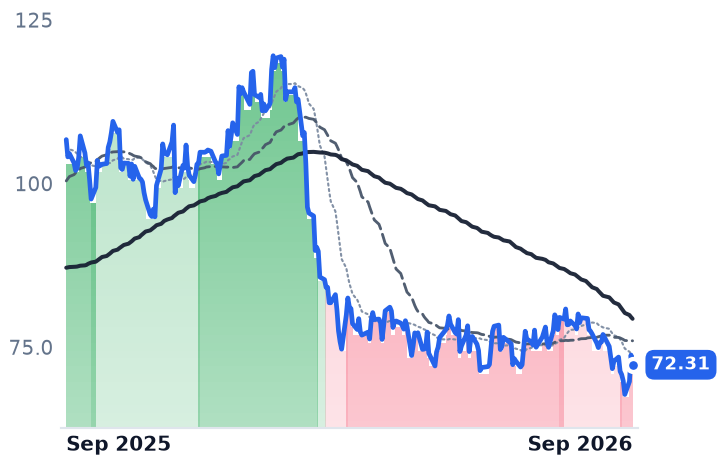
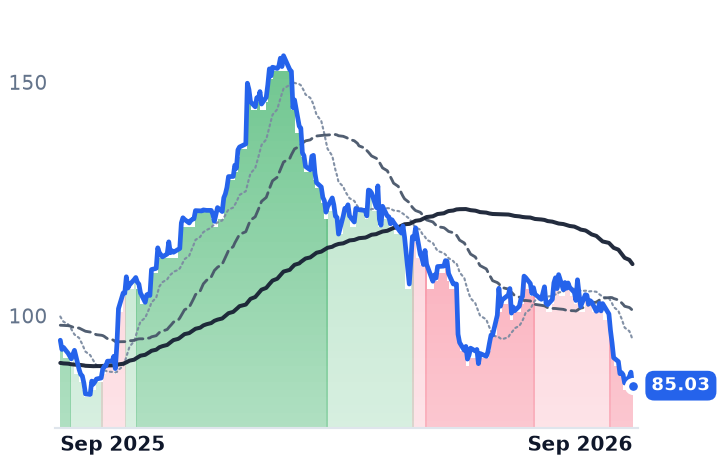
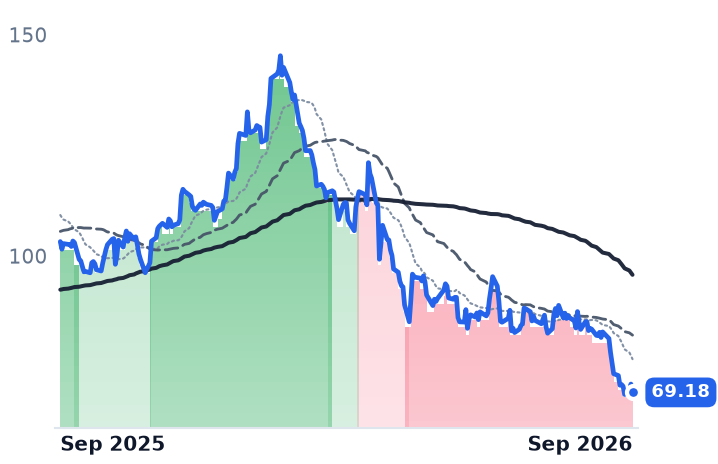
THO | Thor Industries | RV Manufacturers | 🔴 Cont. Bear | −8.9% | −32.2% |
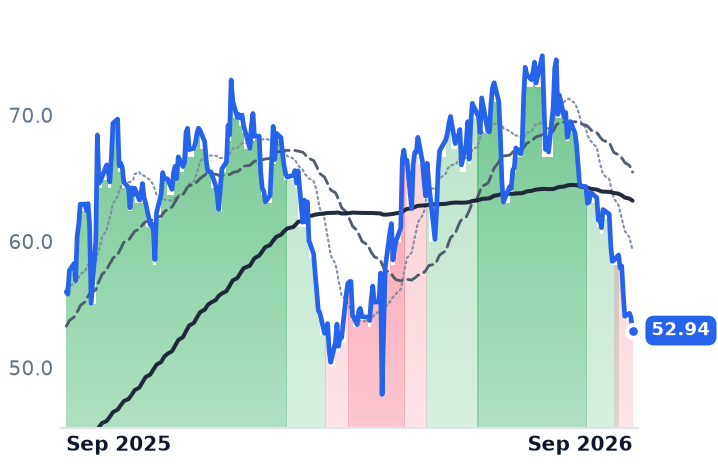
PII | Polaris | Powersports Vehicles | 🟢 Cont. Bull | −16.0% | −5.5% |
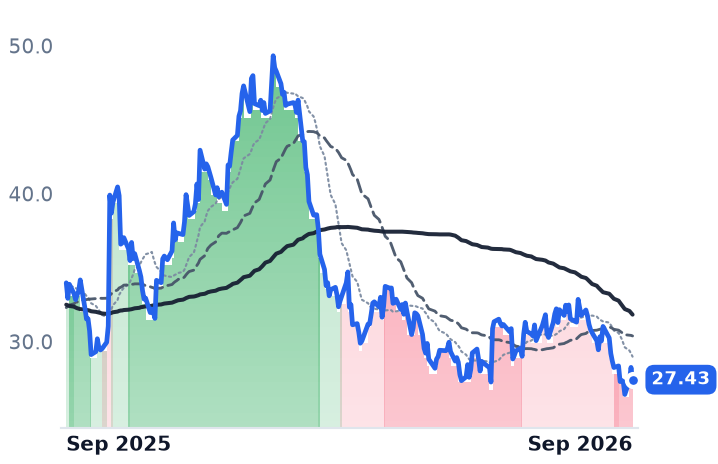
WGO | Winnebago Industries | RV Manufacturers | 🔴 Cont. Bear | −13.6% | −19.3% |
| Compared against · context, not the story | |||||
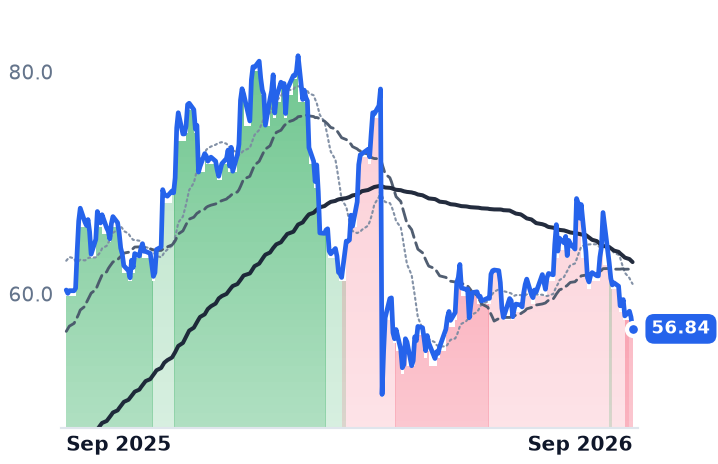
DOO | BRP | Powersports Vehicles | 🔴 Cont. Bear | −7.5% | −5.8% |
LCII | LCI Industries | RV Components & Suppliers | 🔴 Cont. Bear | −18.5% | −10.3% |
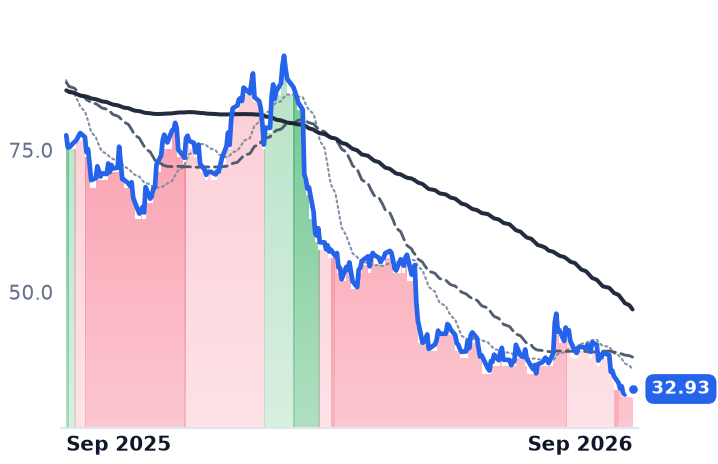
PATK | Patrick Industries | RV & Marine Furnishings | 🔴 Cont. Bear | −18.8% | −33.0% |
WHR | Whirlpool | Kitchen & Home Appliances | 🔴 Cont. Bear | −19.1% | −57.6% |
12-month price & trend
| Ticker | Mkt cap | P/E | P/E fwd | P/S | P/S fwd | P/GP | P/GP fwd | EV/EBITDA | FCF yld |
|---|---|---|---|---|---|---|---|---|---|
THO | $3.8B | 21.3x | 19.6x | 0.4x | 0.4x | 3.1x | 3.1x | 15.1x | 4.5% |
PII | $3.0B | n/m | 16.9x | 0.4x | 0.4x | 1.9x | 1.9x | 40.2x | 2.2% |
WGO | $775.4M | 20.2x | 11.7x | 0.3x | 0.3x | 2.1x | 2.1x | 9.3x | 23.3% |
| Ticker | Mkt cap | P/E | P/E fwd | P/S | P/S fwd | P/GP | P/GP fwd | EV/EBITDA | FCF yld |
|---|---|---|---|---|---|---|---|---|---|
DOO | $4.2B | 52.7x | 19.4x | 0.6x | 0.6x | 3.1x | 3.0x | 9.6x | 18.6% |
LCII | $2.5B | 11.8x | 12.0x | 0.6x | 0.6x | 2.4x | 2.4x | 7.7x | 11.5% |
PATK | $2.7B | 18.2x | 19.4x | 0.7x | 0.7x | 3.0x | 3.0x | 10.0x | 4.7% |
| Ticker | Mkt cap | P/E | P/E fwd | P/S | P/S fwd | P/GP | P/GP fwd | EV/EBITDA | FCF yld |
|---|---|---|---|---|---|---|---|---|---|
WHR | $2.1B | 11.2x | 18.0x | 0.1x | 0.1x | 1.1x | 1.1x | 9.2x | -7.5% |
Consensus projections
| Ticker | FY2026E | FY2027E | FY2028E | |
|---|---|---|---|---|
THO | Revenue | +0.9% | +2.6% | +4.9% |
| EPS | −7.3% | +5.7% | +29.8% | |
PII | Revenue | +5.6% | +3.3% | +4.0% |
| EPS | −7825.8% | +9.0% | +18.5% | |
WGO | Revenue | −0.9% | +4.1% | +6.1% |
| EPS | +21.5% | +29.4% | +24.5% | |
DOO | Revenue | +14.7% | +9.5% | +4.6% |
| EPS | +20.9% | −20.6% | +33.3% | |
LCII | Revenue | −2.0% | +5.4% | +1.5% |
| EPS | +17.7% | +11.7% | +24.8% | |
PATK | Revenue | +0.2% | +5.5% | +8.2% |
| EPS | −1.5% | +24.5% | +26.7% | |
WHR | Revenue | −5.0% | +3.5% | +3.9% |
| EPS | −72.6% | +93.2% | +45.8% |
Forward fiscal years only. Blank means no analyst coverage for that year.
Revenue is a dealer's decision
Thor Industries — the Elkhart, Indiana builder of travel trailers, fifth wheels, Class A, B and C motorhomes and European campervans, every one of them sold through an independent dealership — reported its fiscal fourth quarter on 22 September and then declined to tell investors what the coming year looks like. The company said insights from September industry events made it prudent to delay, and that it expects a relatively flat retail environment in fiscal 2027.
Withholding a forecast is the news, but the mechanism underneath it is the story. Thor is not paid for recreational-vehicle demand in any form its revenue line makes visible. It recognizes a sale when a unit ships to a dealer who has borrowed against that unit on a floorplan credit line, so the top line measures how much financed inventory the dealer network is willing to carry. Six days before the print, the Federal Reserve raised its benchmark rate a quarter point to 3.75%-4.00%, its first increase since 2023, with 16 of 18 officials penciling in another and the 10-year Treasury yield back at 5%. Because the hike answered an inflation impulse Chairman Kevin Warsh traced to spiraling oil prices, one decision repriced the dealer's floorplan rate, the retail buyer's loan and the fuel to run the vehicle at once.
The destocking case, and what breaks it
Thor's own disclosures make the channel-correction argument well. North American dealer inventories ended fiscal 2026 at roughly 64,000 units against roughly 73,300 a year earlier, a 12.7% reduction, with towable stock down 20.6% sequentially — while total North American backlog rose 7.5% to $1.645bn and the towable segment's backlog rose 74.6% to $916.6m. Orders piling up as shipments fall is a channel taking delivery late, not one cancelling.
The quarter itself was ugly regardless. Revenue fell 8.4% to $2.312bn and operating income halved, down 50.8% to $50.5m; gross margin narrowed 2.3 percentage points to 12.4% on lower volumes, unfavorable mix, increased promotional activity and higher material costs. North American towable sales fell 22.7% on a 19.7% decline in unit shipments — revenue falling faster than units, so mix and discounting deepened the hole rather than cushioning it.
What breaks the clean destocking read is the industry data. Statistical Surveys counted US retail registrations down every month of 2026 through June — 14.5% in January, 24.1% in February, 21.5% in June — with May marking the ninth consecutive year-over-year decline. Against that, wholesale shipments through April fell 13.5%, and the industry body cut its 2026 forecast to a 314,000-unit median from 349,000. Retail is contracting at least as fast as the factories are shipping. Supplier LCI Industries has marked down further still, to 280,000-300,000 wholesale units.
"Fiscal 2026 was a structurally important year for THOR," chief executive Bob Martin said in the 22 September release. "With numerous macro elements working against our industry, we took action to address our margin profile, our production footprint and the supply chain pressures weighing on the business." Martin told the trade press that the inflection point the industry expected never arrived, naming interest rates, fuel costs and inflation. The shares still rose 5.8% on the day, to $73.80, because revenue beat consensus even as earnings per share missed — from a level near a 52-week low. Thor trades at 0.89x book, below its own net asset value, and 19.6x forward earnings on a $3.70 consensus that has already been cut.
Winnebago, and the recovery in the price
Winnebago Industries, the smaller builder whose Grand Design and Winnebago towables sit alongside Newmar motorhomes and the Barletta and Chris-Craft boat lines, reported the same shape a quarter earlier: revenue down 9.9% to $698.7m and operating income down 23.8%, with production aligned to retail demand as dealer ordering stayed measured. "Consumers who are drawn to the outdoor lifestyle remain engaged, but continue to navigate affordability pressures," chief executive Michael Happe said on 25 June, citing cumulative inflation, elevated interest rates and geopolitical uncertainty in the timing of discretionary purchases. He cut the industry wholesale outlook to 290,000-310,000 units.
Winnebago is the cheapest asset in the group at 0.63x book and 9.3x trailing enterprise value to earnings before interest, taxes, depreciation and amortization. But its 11.7x forward earnings against 20.2x trailing is not cheapness; it is a forecast. Closing that gap requires earnings per share to rise from $0.91 to $2.34 — more than a doubling, embedded in today's price.
Polaris earned the opposite quarter and was sold anyway
Polaris, which builds side-by-sides, ATVs, snowmobiles, motorcycles and pontoon boats out of Medina, Minnesota, ran the other way: June-quarter revenue up 9.2% to $2.023bn, gross margin up five percentage points to 23.6%, operating income up nearly sixfold to $132.0m, North American retail up 4% with a fifth straight quarter of off-road share gain. Guidance was raised for the second time this year. The stock fell 9.9% the next session.
The reason is in the same filing: North American off-road dealer inventories were up about 7% in the quarter, faster than retail grew. Polaris is refilling the channel Thor is draining — and it owns a slice of the credit doing it, through Polaris Acceptance, its 50/50 floorplan venture with Wells Fargo Commercial Distribution Finance, which carried $1,788.9m of net dealer receivables at 30 June and obliges Polaris to repurchase repossessed product up to roughly $89.5m this year. Chief executive Mike Speetzen said in July that promotional activity from rivals had been surgical rather than broad; on 18 September UBS cut its target to $61 citing promotional headwinds. At 3.63x book and 16.9x forward earnings — with 2025's $465.5m net loss leaving no usable trailing figure — Polaris is the most expensive asset here against the weakest cash conversion.
BRP, the Can-Am and Sea-Doo maker taking side-by-side share from Polaris, grew revenue 19.8% last quarter and raised full-year guidance, and its shares fell 10.9% over the following month anyway. Its free cash flow yield, near 19%, is among the highest in the complex. Chief financial officer Sébastien Martel quantified the tariff carried into fixed model-year prices on the 3 September call: "We are talking about a net exposure this year of CAD 200 million and next year of CAD 225 on an annualized basis." He also described signing up 90% of BRP's US dealers to a new in-house retail financing program in two weeks — building the credit layer Polaris already owns.
The verdict
Thor's de-rating is earned by its income statement and only half-explained by its channel: the backlog and the emptied lots are genuine destocking, but registrations falling faster than shipments means the restock, when it comes, restocks into a shrinking retail market. Polaris's is not earned by its profit and loss at all — it is earned by the 7% inventory build sitting on dealer floorplans that just got more expensive, and by a promotional cycle its own guidance assumes away. Winnebago sits between them, priced for a doubling of earnings it has not begun to deliver.
A dealer who financed a trailer in March is carrying it at a rate that has since gone up, against a buyer whose loan costs more and whose fuel costs more for the same reason. That last variable is not settled: crude freight futures dropped roughly a quarter intraday on 22 September only because an Iranian official floated reopening the Strait of Hormuz within a week if Washington lifted its blockade.