

Cognex Is Buying the Depth Cameras Inside 80% of Humanoid Robots for $500m in Cash
Hypothesis Opus 5 · Research Opus 5 · Writing Opus 5 · Prompt v1.6
Cognex just paid cash for robot exposure its own revenue line does not contain — and the market took more market value off the company than the deal costs. On 22 September it agreed to buy RealSense, the Intel spin-out whose depth cameras sit in roughly 80% of humanoid robots, for about $500m, or 5.2% of its market value; the shares fell over the next two sessions while Teradyne, Symbotic and Rockwell rose or held.
The business underneath is strong: June-quarter revenue rose 16.9% to $291m, gross margin reached 70.6% against 67.4% a year earlier, and logistics posted its tenth straight double-digit quarter. But automotive — the factory floor everyone means by physical AI — fell, while semiconductor and electronics customers carried the growth. Teradyne's robotics arm hit a record quarter for the same reason: its new buyers are building AI data centers.
| Ticker | Company | Segment | Trend · 13mo | 30D | 1Y |
|---|---|---|---|---|---|
| The subject · what this brief is about | |||||
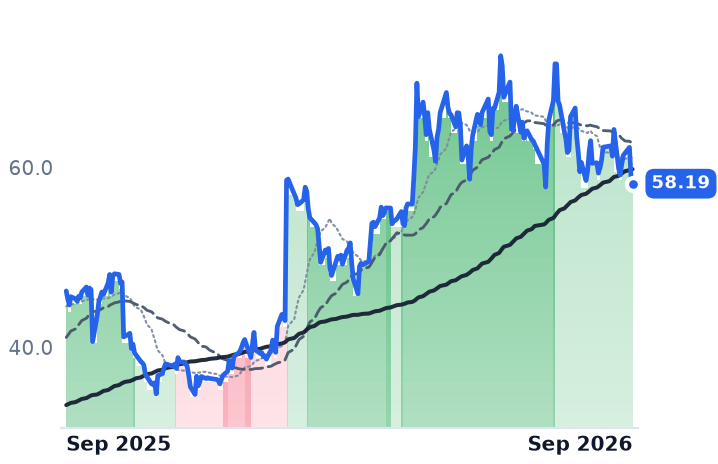
CGNX | Cognex | Precision Motion & Sensors | 🟢 Cont. Bull | −0.6% | +25.8% |
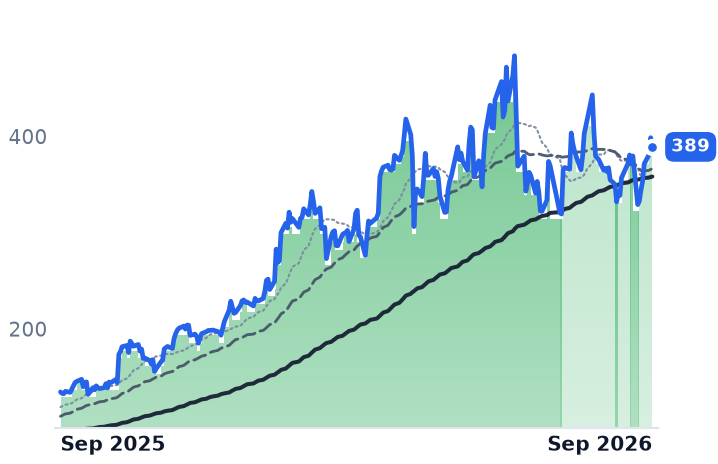
TER | Teradyne | Semiconduct Equipment | 🟢 Cont. Bull | +6.6% | +189.3% |
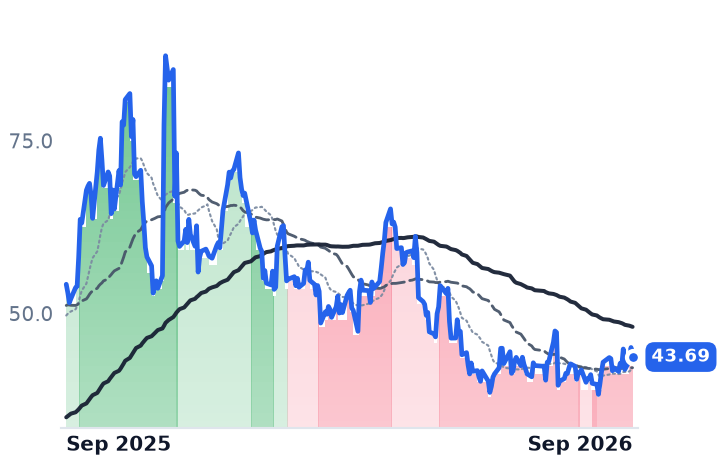
SYM | Symbotic | Industrial Automation & Controls | 🔴 Cont. Bear | +9.1% | −19.4% |
| Compared against · context, not the story | |||||
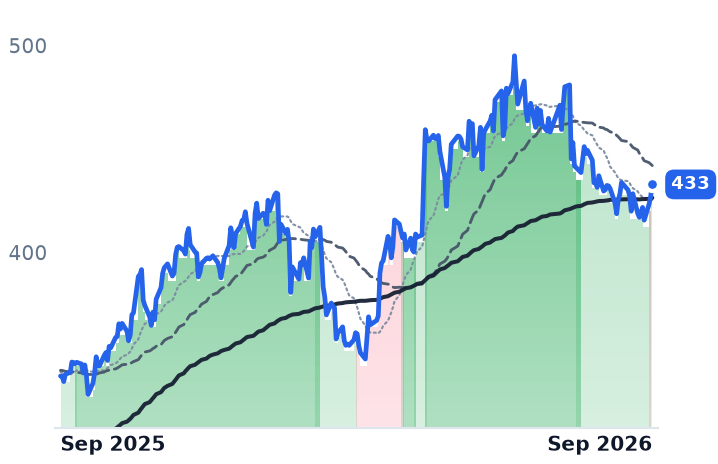
ROK | Rockwell Automation | Industrial Automation & Controls | 🟢 Cont. Bull | +0.7% | +27.2% |
12-month price & trend
| Ticker | Mkt cap | P/E | P/E fwd | P/S | P/S fwd | P/GP | P/GP fwd | EV/EBITDA | FCF yld |
|---|---|---|---|---|---|---|---|---|---|
CGNX | $9.7B | 55.4x | 34.6x | 8.9x | 8.5x | 12.9x | 12.3x | 33.9x | 2.8% |
TER | $60.8B | 53.1x | 42.2x | 13.6x | 11.8x | 23.0x | 19.9x | 41.7x | 1.3% |
SYM | $28.0B | 456.1x | 213.1x | 10.6x | 10.0x | 49.1x | 46.3x | 434.2x | 2.6% |
| Ticker | Mkt cap | P/E | P/E fwd | P/S | P/S fwd | P/GP | P/GP fwd | EV/EBITDA | FCF yld |
|---|---|---|---|---|---|---|---|---|---|
ROK | $48.6B | 40.9x | 33.1x | 5.4x | 5.4x | 9.9x | 9.9x | 29.2x | 3.1% |
Consensus projections
| Ticker | FY2026E | FY2027E | FY2028E | |
|---|---|---|---|---|
CGNX | Revenue | +16.7% | +9.3% | +9.4% |
| EPS | +74.7% | +19.4% | +15.3% | |
TER | Revenue | +67.1% | +21.2% | +24.5% |
| EPS | +159.3% | +27.3% | +31.7% | |
SYM | Revenue | +25.7% | +29.2% | +24.5% |
| EPS | −15.6% | +82.3% | +121.2% | |
ROK | Revenue | +10.0% | +5.5% | +6.4% |
| EPS | +31.5% | +12.1% | +12.1% |
Forward fiscal years only. Blank means no analyst coverage for that year.
On 22 September, Cognex — which sells the barcode readers, smart cameras and vision software that inspect parts and sort parcels without a person looking — agreed to acquire RealSense for approximately $500m in cash, funded entirely from cash on hand and expected to close in the fourth quarter. Over the two sessions that followed, Cognex shed roughly $670m of market value, more than the purchase price, on 2.4m shares against 0.6m the prior day.
That reaction is the news, because the deal is Cognex buying with cash the thing its revenue line does not yet contain. RealSense, spun out of Intel in July 2025 with $50m from Intel Capital and the MediaTek Innovation Fund, makes stereo depth cameras embedded in about 60% of the world's autonomous mobile robots and 80% of humanoid robots. "RealSense represents a compelling strategic expansion for Cognex into robotic perception, one of the most attractive adjacent markets in machine vision," president and chief executive Matt Moschner said in announcing the deal.
The price and the pipeline
Cognex sizes robotic perception at roughly $600m today, growing more than 25% a year to about $1.6bn by 2030, with RealSense expected to turn over $80m to $90m this year. That puts the price near six times forward revenue, below Cognex's own 8.9x trailing sales. What is not in the headline number: a three-year retention pool of $56.5m in cash at target plus restricted stock valued around $50m, and RealSense's facial-authentication line spinning out before closing. D.A. Davidson kept a neutral rating after the announcement.
What Cognex actually sells today
The operating business is in its best stretch in years. June-quarter revenue rose 17% to a record $291m, with adjusted EBITDA margin of 32.2% and an eighth consecutive quarter of margin expansion; reported gross margin reached 70.6% against 67.4% a year earlier. Logistics, a quarter of 2025 revenue, grew double digits for a tenth straight quarter, and packaging, consumer electronics and semiconductor did the same. Full-year guidance is $1.13bn to $1.15bn.
The exception is the one that matters to this story. Automotive revenue fell high single digits in the quarter, with Asian and American growth offset by continued European weakness — the German manufacturing index slipped to 50.1 in May, its lowest in four months, with new orders falling for the first time this year. The marginal Cognex dollar is now a chip-and-electronics dollar. That is also why the shares fell 6.7% on 14 September alongside Teradyne's 13.3% drop and Cohu's 12.5%, when the wider market fell less than half a percent.
The multiple has come in as the earnings arrived: 55.4x trailing against 78.7x in early May, with 34.6x forward on consensus 2026 earnings of $1.68 a share versus $0.68 reported for 2025. The trend has been mild rather than strong since early August, 37 sessions of grinding rather than a break.
The mirror and the control
Teradyne, which builds semiconductor test systems and owns the Universal Robots and Mobile Industrial Robots arms, makes the mechanism explicit. Semiconductor Test was $1,122m of its $1,329m June quarter, up 128%, and group operating margin reached 32.9% against 13.9%. Its robotics arm did hit a first $100m quarter, up 33%, as electronics manufacturers and semiconductor firms building AI data centers displaced automotive as its largest end market — the robots are selling because of the data center, not the car plant. After a 2025 consolidation that cut about 10% of staff, the segment's operating loss narrowed to $1.0m in the March quarter from $37.2m. Teradyne trades at 53.1x trailing earnings, down from 109.9x in May.
Symbotic is the counter-case. Its June-quarter revenue grew 21.7% to $720.8m, gross margin improved to 22.3% from 18.2%, and it swung to a $32.9m operating profit — and the shares are down 19.4% over a year, priced at 49.1x gross profit against 72.8x in May. The discount sits outside the income statement: backlog is flat at $22.5bn and roughly $11.6bn of it is orders from GreenBox, a venture Symbotic owns 35% of, with Walmart 85% of fiscal 2025 revenue. Rockwell Automation, the plain read on factory capital spending, grew 10% organically with warehouse and e-commerce orders up 30% — but its services arm shrank and book-to-bill was 0.97. Its twelve-month share gain is a shade ahead of Cognex's.
The verdict
Cognex earns its advance on the numbers — the margin expansion and the logistics streak are real, and the de-rating since May means the price has lagged the profit. What the business has not earned is the robot story attached to it. The physical-AI dollars being spent today are being spent by chip and electronics manufacturers building capacity for data centers, and Cognex is capturing them as a vision-inspection vendor, not as a robotics one. Paying half a billion dollars for the camera inside someone else's humanoid is an admission that the second leg has to be bought.
The deal closes in the fourth quarter. Until then the only test that matters is whether automotive stops falling, because everything else Cognex sells is already growing.