

FMC Agreed to Sell a Fifth of Itself at $13.30 to Pay Down $4.1bn of Net Debt
Hypothesis Opus 5 · Research Opus 5 · Writing Opus 5 · Prompt v1.6
FMC's income statement and its cash statement have stopped agreeing. Second-quarter revenue fell 17.5% as Chinese generics of the insecticide molecule that built the company ate into low-margin partner orders — yet free cash flow came in at $357m, and a Belgian industrial buyer agreed to take roughly a fifth of the equity at a 29% premium to where the shares now trade.
Not all of that reads as recovery. With $4.1bn of net debt, the whole enterprise is valued near 8.3 times FMC's own full-year earnings guide, so an equity priced below book value is a function of borrowings rather than a cheap business. Corteva, facing the same Latin American price war, grew first-half crop-protection segment earnings; FMC's are guided sharply lower.
| Ticker | Company | Segment | Trend · 13mo | 30D | 1Y |
|---|---|---|---|---|---|
| The subject · what this brief is about | |||||
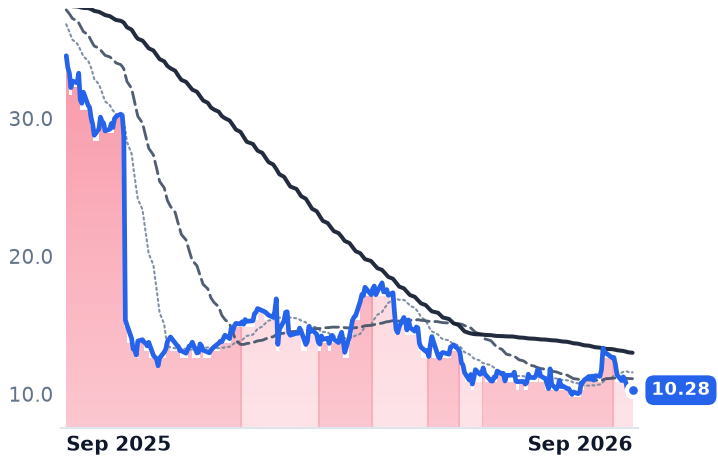
FMC | FMC | Crop Protection Chemicals | 🔴 Cont. Bear | −8.9% | −70.2% |
| Compared against · context, not the story | |||||
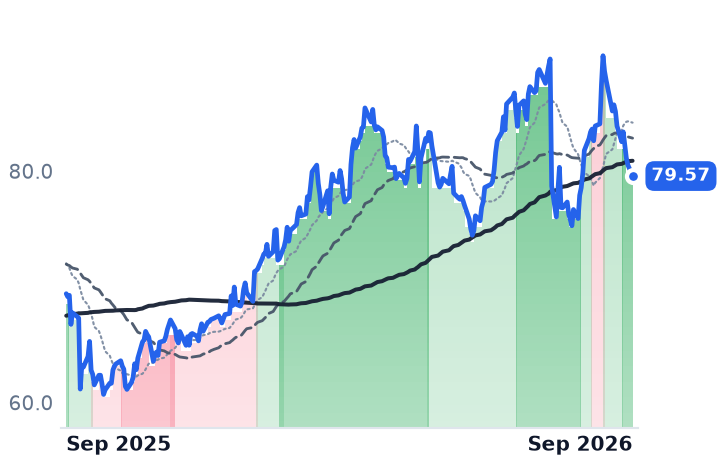
CTVA | Corteva | Integrated Seeds & Crop Protection | 🟢 Cont. Bull | −3.9% | +14.6% |
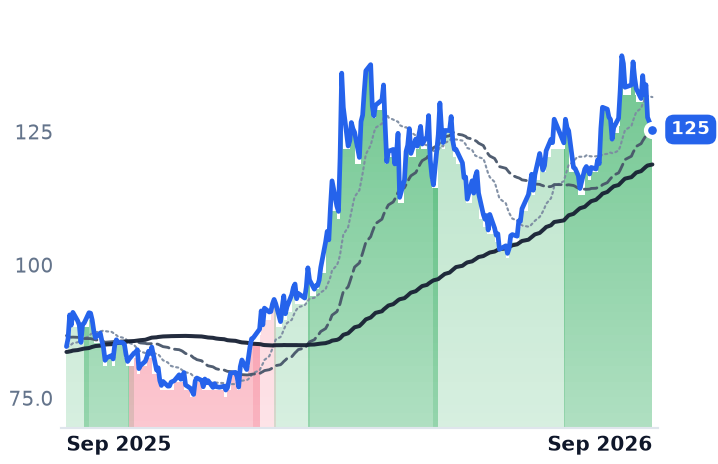
CF | CF Industries | Nitrogen Fertilizers | 🟢 Cont. Bull | −3.0% | +48.1% |
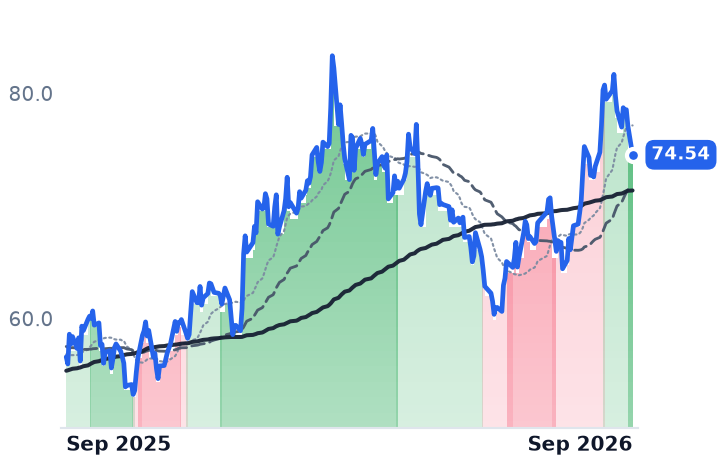
NTR | Nutrien | Fertilizer Distribution & Retail | ⚠️ Emerging Bear | +0.3% | +31.7% |
MOS | The Mosaic | Phosphate & Potash | 🔴 Cont. Bear | +0.6% | −26.5% |
SMG | The Scotts Miracle-Gro | Specialty Crop & Garden Products | ⚠️ Emerging Bear | −14.7% | −9.4% |
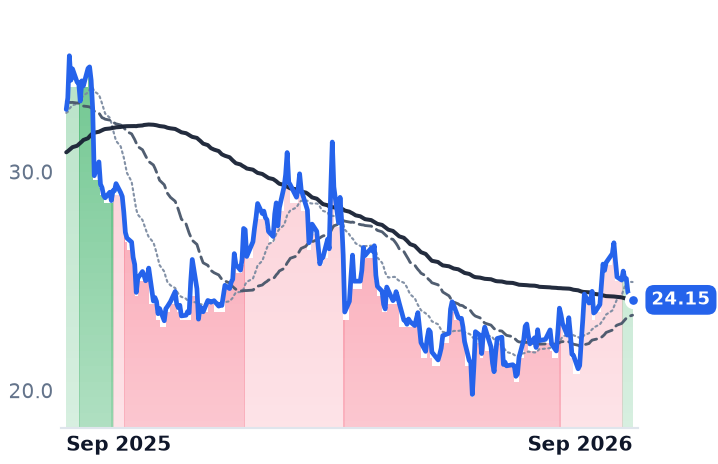
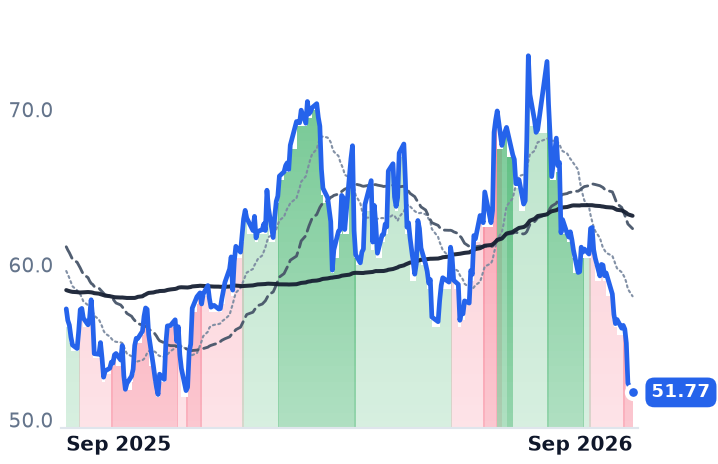
12-month price & trend
| Ticker | Mkt cap | P/E | P/E fwd | P/S | P/S fwd | P/GP | P/GP fwd | EV/EBITDA | FCF yld |
|---|---|---|---|---|---|---|---|---|---|
FMC | $1.3B | n/m | 7.7x | 0.4x | 0.4x | 1.1x | 1.0x | n/m | 12.8% |
CTVA | $55.0B | 47.6x | 22.0x | 3.1x | 3.0x | 6.6x | 6.4x | 16.5x | 3.7% |
CF | $19.6B | 9.4x | 8.5x | 2.5x | 2.4x | 6.0x | 5.7x | 5.3x | 9.7% |
| Ticker | Mkt cap | P/E | P/E fwd | P/S | P/S fwd | P/GP | P/GP fwd | EV/EBITDA | FCF yld |
|---|---|---|---|---|---|---|---|---|---|
NTR | $37.0B | 15.6x | 15.6x | 1.3x | 1.3x | 4.2x | 4.3x | 7.7x | 5.7% |
MOS | $6.9B | 9.5x | 18.4x | 0.6x | 0.5x | 4.1x | 3.9x | 4.0x | -7.1% |
SMG | $3.3B | 29.7x | 12.9x | 1.0x | 1.0x | 3.0x | 3.0x | 10.8x | 11.5% |
Consensus projections
| Ticker | FY2026E | FY2027E | FY2028E | |
|---|---|---|---|---|
FMC | Revenue | −8.7% | +4.3% | +4.2% |
| EPS | −55.0% | +24.4% | +22.1% | |
CTVA | Revenue | +3.3% | +3.4% | +2.7% |
| EPS | +11.9% | +10.2% | +11.5% | |
CF | Revenue | +16.5% | −10.6% | −5.0% |
| EPS | +68.3% | −27.7% | −20.0% | |
NTR | Revenue | +5.2% | −1.3% | −1.1% |
| EPS | +6.8% | −0.3% | −8.0% | |
MOS | Revenue | +7.5% | −0.7% | −1.2% |
| EPS | −53.0% | +65.0% | +1.6% | |
SMG | Revenue | −2.7% | +2.8% | +3.1% |
| EPS | +18.3% | +10.5% | +9.3% |
Forward fiscal years only. Blank means no analyst coverage for that year.
FMC agreed in June to sell roughly a fifth of itself at $13.30 a share to Tessenderlo Group, a Belgian industrial company. The stock purchase agreement covers 30,319,166 new shares for $403.2m, and the money is not for growth: it goes to lenders. Tessenderlo's price sits 29% above FMC's September 21 close of $10.28.
That gap is the story. FMC ended the June quarter with $4.1bn of net debt, equal to 5.2 times earnings before interest, taxes, depreciation and amortization. Room under its loan terms exists because the terms were rewritten: an April 16 credit amendment leaves the maximum leverage ratio untested for the first three quarters of 2026, sets it at 6.75x through the end of 2027, and pledges collateral. S&P Global Ratings has since cut FMC to 'BB+', below investment grade.
One molecule family, repriced
FMC sells branded insecticides, herbicides and fungicides through distributors and alliance partners, and its earnings base has for a decade rested on the diamide actives — chlorantraniliprole, sold as Rynaxypyr, and cyantraniliprole. Chlorantraniliprole's Chinese compound patent expired on August 13, 2022, after which Chinese producers scaled capacity on cost advantage and turned a premium active into a fragmented multi-supplier commodity. FMC has guided 2026 price down mid-single digits, mainly on Rynaxypyr.
The second quarter shows where the damage lands. Revenue fell 17.5% to $867.1m, volumes fell 10% on lower diamide partner orders and weak legacy-product demand, and North American sales dropped 22.4%. But sales of FMC's own differentiated post-patent diamide formulations grew more than 35% year on year. The commodity active-ingredient socket is being taken; the branded formulation business is growing. Generic economics are not a one-way street either — technical-grade chlorantraniliprole rose to $40.50 a kilogram by late March from $26.98 in January as Chinese regulators pushed compliant intermediate production.
The control that isn't falling
Corteva, FMC's closest branded competitor and now also its licensee, reported crop-protection price down 4% and volume down 2% in the June quarter, blaming Latin American competition — and still grew first-half segment operating EBITDA 9%, to $776m. The price war is industry-wide; the 10% volume drop and the 23% decline in full-year adjusted EBITDA that FMC guides to are FMC's own. Corteva's shares are up 14.1% over twelve months and its separation into two public companies targets October 1, which will hand the market a pure-play crop-protection comparable within days.
Underneath the loss line, cash turned first. Free cash flow reached $357m in the quarter, an improvement of $318m, and full-year free-cash-flow guidance was raised to $75–225m. Roughly $1bn has been assembled for debt paydown from four actions: the Tessenderlo placement, a $252m sale of the India commercial business, a $114m Newark sale-leaseback, and a $200m upfront payment from Corteva under a rimisoxafen supply and license agreement — a herbicide FMC still owns outright, not a diamide. "During the quarter, we completed several important actions that strengthened FMC's financial foundation," chairman and chief executive Pierre Brondeau said on July 29. A manufacturing restructuring approved in December targets $175m or more of annual savings by the end of 2027, at a cost of $560–635m in charges.
What the shares have done
The stock is down 71% over twelve months and 83% over two years, against a 52-week range of $9.71 to $36.18. It is not a smooth grind: it rose 13.9% on the July 30 earnings session, 13.4% on September 2 with no discoverable company news, and made a fresh 52-week low on September 18.
At 7.7 times consensus 2026 earnings of $1.33 a share and 0.79 times book, the equity screens cheap. On the whole enterprise it does not: $1.29bn of market value plus $4.1bn of net debt is about 8.3 times the midpoint of FMC's own $620–680m EBITDA guide, and the share count has 24% of dilution still to come. The business has stopped burning cash and is growing the part of the diamide franchise it can defend; the equity is a thin slice on top of a balance sheet that has to shrink before any of that reaches shareholders.
Tessenderlo's regulatory clearances were expected by the end of September or October, its finance chief said. Until that $403.2m lands, the cheapest thing about FMC is the debt the buyer is paying off.