

The Infrastructure Act Funding Martin Marietta and Vulcan Expires September 30
Hypothesis Opus 5 · Research Opus 5 · Writing Opus 5 · Prompt v1.6
Aggregates pricing power is not breaking, and the two largest US rock producers are being priced as though it were. Vulcan raised freight-adjusted selling prices 3.9% in the June quarter and shipped 1% more tons; Martin Marietta's mix-adjusted price rose too, with its reported decline traceable to cheap acquired quarries.
What broke is the conversion of price into profit. Diesel alone cost Vulcan nearly $40m in the quarter, and cash gross profit per ton crawled from $11.88 to $12.02. Operating income fell at both companies on revenue that grew at both.
The repricing, though, is aimed past this year. Consensus puts all of the growth in 2027 — the first year with no federal highway authorization behind it. Martin Marietta raised revenue guidance in July and closed a $13.5bn lime acquisition in August, then made a 52-week low.
| Ticker | Company | Segment | Trend · 13mo | 30D | 1Y |
|---|---|---|---|---|---|
| The subject · what this brief is about | |||||
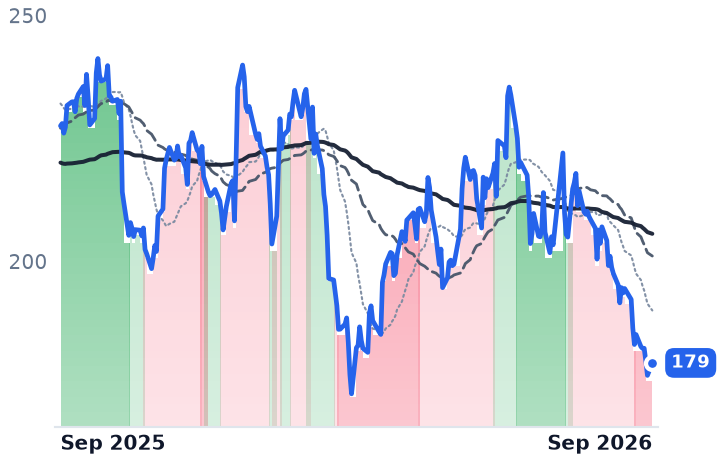
MLM | Martin Marietta Materials | Aggregates & Concrete | 🔴 Cont. Bear | −6.3% | −19.2% |
VMC | Vulcan Materials | Aggregates & Concrete | ⚠️ Emerging Bear | −10.8% | −17.3% |
KNF | Knife River | Aggregates & Concrete | 🔴 Cont. Bear | −13.0% | −26.8% |
| Compared against · context, not the story | |||||
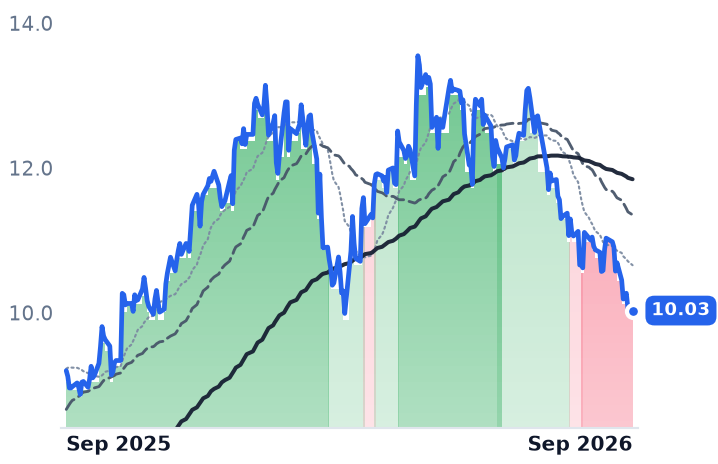
CRH | CRH | Integrated Cement & Materials | 🔴 Cont. Bear | −9.3% | −24.0% |
EXP | Eagle Materials | Specialty Building Products | 🔴 Cont. Bear | −12.2% | −21.2% |
CX | CEMEX, S.A.B. de C.V | Integrated Cement & Materials | ⚠️ Emerging Bear | −9.1% | +9.0% |
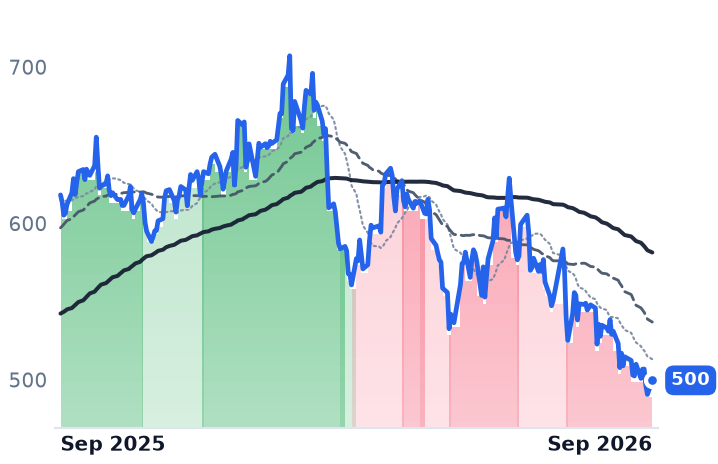
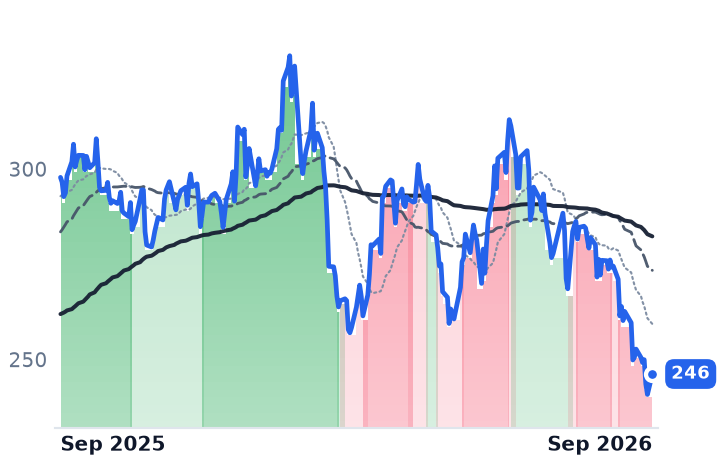
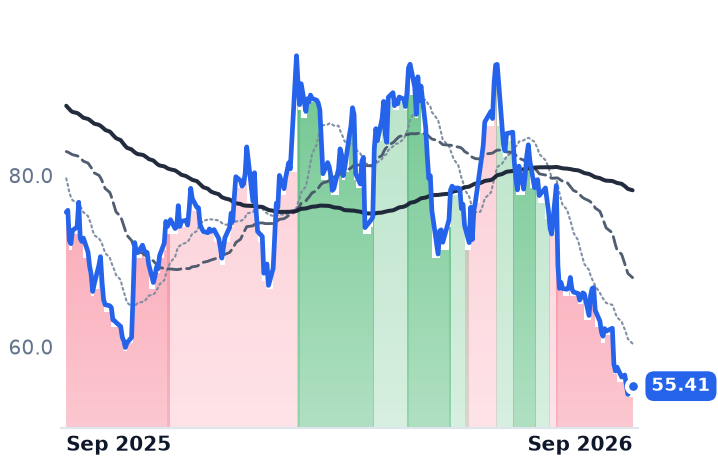
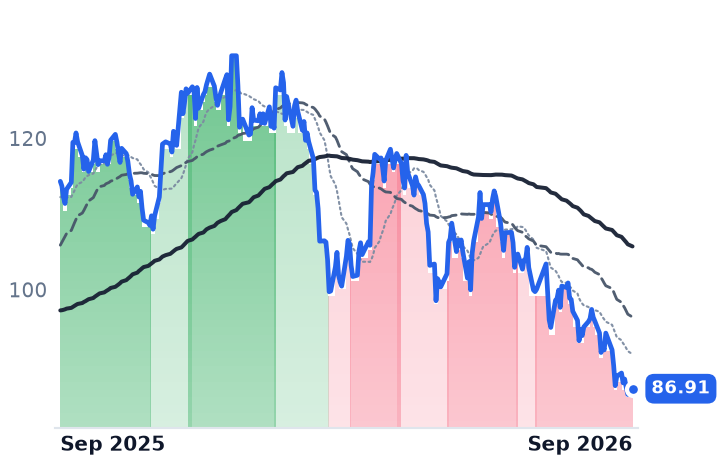
12-month price & trend
| Ticker | Mkt cap | P/E | P/E fwd | P/S | P/S fwd | P/GP | P/GP fwd | EV/EBITDA | FCF yld |
|---|---|---|---|---|---|---|---|---|---|
MLM | $30.0B | 12.3x | 27.6x | 4.5x | 4.2x | 15.9x | 14.7x | 17.2x | 2.7% |
VMC | $31.9B | 29.0x | 27.0x | 3.9x | 3.9x | 14.3x | 14.3x | 14.3x | 3.2% |
KNF | $3.1B | 22.5x | 19.1x | 1.0x | 0.9x | 5.3x | 5.1x | 10.9x | 1.4% |
| Ticker | Mkt cap | P/E | P/E fwd | P/S | P/S fwd | P/GP | P/GP fwd | EV/EBITDA | FCF yld |
|---|---|---|---|---|---|---|---|---|---|
CRH | $69.0B | 13.7x | 17.3x | 1.2x | 1.7x | 3.5x | 4.9x | 7.9x | 4.2% |
EXP | $6.1B | 14.6x | 15.1x | 2.7x | 2.6x | 9.4x | 9.3x | 9.6x | 3.8% |
CX | $18.2B | 40.6x | 15.6x | 1.1x | 1.1x | 3.4x | 3.2x | 9.5x | 4.1% |
Consensus projections
| Ticker | FY2026E | FY2027E | FY2028E | |
|---|---|---|---|---|
MLM | Revenue | +8.9% | +7.1% | +10.3% |
| EPS | −0.4% | +18.3% | +16.6% | |
VMC | Revenue | +2.3% | +5.6% | +6.4% |
| EPS | +8.7% | +16.1% | +15.1% | |
KNF | Revenue | +11.2% | +4.6% | +3.4% |
| EPS | +11.3% | +18.0% | +6.3% | |
CRH | Revenue | +5.9% | +5.1% | +6.8% |
| EPS | +6.8% | +12.7% | +12.0% | |
EXP | Revenue | +0.5% | +1.9% | +5.8% |
| EPS | −9.4% | −0.1% | +13.5% | |
CX | Revenue | +7.1% | +4.2% | +2.8% |
| EPS | −12.0% | +13.6% | +17.0% |
Forward fiscal years only. Blank means no analyst coverage for that year.
The Infrastructure Investment and Jobs Act, the 2021 law that has paid for American highway, bridge and transit work for five years, loses its program authority on September 30, and no successor surface transportation bill has been introduced in either chamber. More than 100 industry organizations warn that formula funding would revert to pre-IIJA levels and discretionary grant programs would stop making new awards — a $36.8bn annual shortfall beginning October 1.
For Vulcan Materials, the largest US producer of construction aggregates, and Martin Marietta Materials, which sells the same crushed stone and gravel alongside asphalt, paving and a fast-growing lime and magnesia business, that is not a 2026 problem. It is a 2027 one, and 2027 is where the entire growth case now sits. Consensus has Vulcan's EBITDA falling 3.5% this year to $2.58bn and Martin Marietta's falling 1.3% to $2.20bn, then rebounding 9.4% and 20.6% respectively — in the first year with no authorization behind it.
The market has been taking that year apart in public. Wells Fargo's Timna Tanners cut Vulcan to Underweight on September 9, target $254 from $305, citing an "increasingly cautious" 2027 of leaner government spending, constrained state budgets and "limited benefit from data-center related demand"; the same firm trimmed Martin Marietta's target to $585 on September 21, four days after the shares set a 52-week low of $491.41, 31% below their high. Both have traded with the 50-day average below the 200-day every session this month.
The rent is intact
Crushed stone is too heavy to ship far, so a quarry is effectively the only supplier inside a haul radius of roughly thirty miles and raises its price on a schedule rather than in response to a bid. That machinery is working. Vulcan's June quarter carried freight-adjusted prices up 3.9%, 4.7% adjusted for mix, on shipments up 1% to 59.9m tons. Martin Marietta's reported average selling price fell 2.0% to $22.74 — but that is arithmetic, not a price cut: the New Frontier quarries it bought sell rock at roughly $12 a ton, and mix-adjusted pricing rose 3.7%.
What is failing is the conversion. Vulcan's cash gross profit per ton went from $11.88 a year ago to $12.02, a gain of just over 1% on a price increase four times that size, because diesel created a headwind of nearly $40m in the quarter alone. US on-highway diesel hit a record $6.31 a gallon on September 16, more than 70% above a year earlier, the downstream result of Brent going from $61 to $118 in the first quarter after the Strait of Hormuz closure. Anirban Basu, chief economist of Associated Builders and Contractors, said the crude spike put upward pressure on "virtually every construction material". Operating income fell 9.7% at Vulcan and 17.2% at Martin Marietta on revenue that grew at both.
The company that did everything right
Martin Marietta raised full-year revenue guidance to $7.2bn-$7.4bn on July 30, shipped 17% more tons, and on August 21 closed a $13.5bn combination with Lhoist North America that adds $786m of adjusted EBITDA and makes it the leading US lime franchise. Its specialties segment set a record $152m quarter. Its aggregates gross profit per ton still fell 17%, to $6.78, of which $0.84 is the accounting cost of selling acquired inventory written up to fair value. The 52-week low came after all of it.
Demand itself has not rolled over. Single-family starts rose to 918,000 in August, up 5.2% year on year though still down year to date, and data-center construction spending is running 45.8% above last year. Knife River, the upper-Midwest contractor, holds a record $1.2bn backlog. But ARTBA's 2026 outlook has public highway and street work growing just under 1% this year, plateauing at record levels in the authorization's final year.
What the de-rating buys
Martin Marietta's price against trailing gross profit has fallen to 15.9x from 19.5x in early May, its market value from $36.96bn to $30.01bn; Vulcan's has gone to 14.3x from 17.7x. (Martin Marietta's 12x trailing earnings is an artifact of the $1.4bn after-tax gain on the cement assets it swapped to QUIKRETE in February and should be ignored.) Yet both still carry roughly 27x forward earnings, and Vulcan's forward multiple sits only 7% below its trailing one — the market is paying a premium for a business it expects to earn no more next year than this one.
So the de-rating is half-earned. The quarries kept their rent; an oil shock took the increment, and that part of the fall is honest and reversible with crude. The other half is a bet on a vote. Consensus has moved every dollar of growth into a year whose federal funding does not yet legally exist, which means an extension at current levels turns these into cheap cyclicals and a lapse turns 2027 into the air pocket the price already assumes.
Rock stays where it is; the money that buys it does not. Eight days from now, the country finds out which.