

Viasat Finished the ViaSat-3 Constellation September 17 as Its Home Broadband Shrank 27%
Hypothesis Opus 5 · Research Opus 5 · Writing Opus 5 · Prompt v1.6
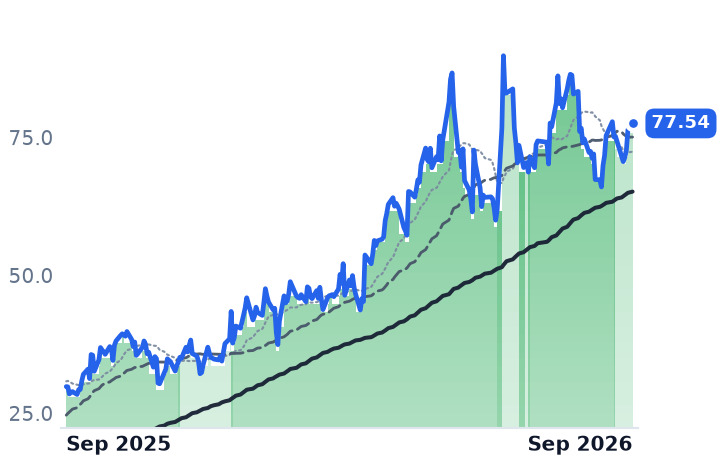
The satellite fleet Viasat spent a decade and several billion dollars building is finally complete — and the consumer business it was designed to serve is disappearing. Fixed broadband revenue is falling at a double-digit rate; defence and airline connectivity are carrying the company instead, with backlog up 19% to $4.2bn and 4,530 commercial aircraft in service.
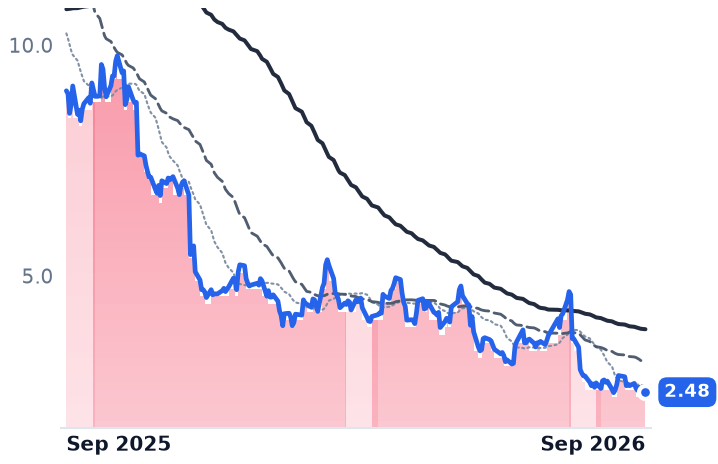
The reported income statement is still negative: a $51.7m net loss on revenue of $1.157bn last quarter. What has improved is cash and leverage, down to 3.2 times adjusted earnings from 3.6. Shares now fetch 2.17x forward sales against roughly 1.4x in May, so the cheapness argument has largely been spent.
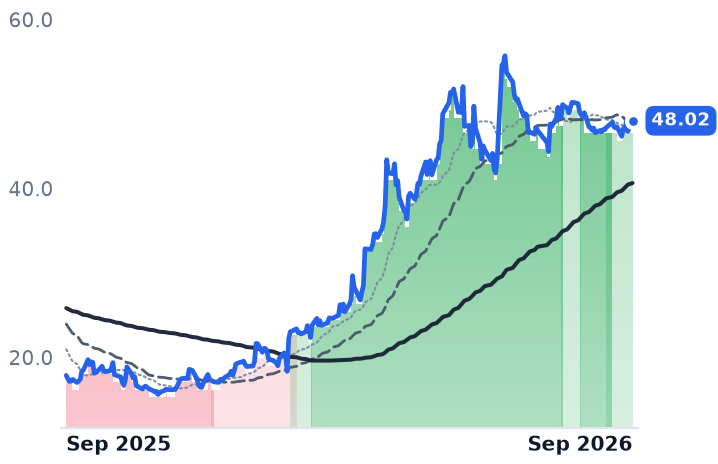
Iridium, the other big twelve-month gainer in satellite, is no longer an operating story at all: it is a claim on Rocket Lab's $54-a-share offer, and Rocket Lab is trading near the floor of the collar that protects it.
| Ticker | Company | Segment | Trend · 13mo | 30D | 1Y |
|---|---|---|---|---|---|
| The subject · what this brief is about | |||||
VSAT | Viasat | Satellite & Broadband Services | 🟢 Cont. Bull | +7.3% | +159.9% |
IRDM | Iridium Communications | Specialty & Small Carriers | 🟢 Cont. Bull | +1.5% | +168.6% |
SATS | EchoStar | Satellite & Broadband Services | ⚠️ Emerging Bear | — | +25.8% |
| Compared against · context, not the story | |||||
RKLB | Rocket Lab USA | Unmanned Systems & ISR | ⚠️ Emerging Bear | +2.0% | +39.9% |
TSAT | Telesat | Satellite & Broadband Services | 🟢 Cont. Bull | +22.6% | +109.1% |
GOGO | Gogo | Niche Connectivity | 🔴 Cont. Bear | −3.1% | −72.5% |
SIRI | Sirius XM | Music & Audio | 🟢 Cont. Bull | −3.3% | +22.6% |
12-month price & trend
| Ticker | Mkt cap | P/E | P/E fwd | P/S | P/S fwd | P/GP | P/GP fwd | EV/EBITDA | FCF yld |
|---|---|---|---|---|---|---|---|---|---|
VSAT | $10.5B | n/m | — | 2.3x | 2.2x | 7.5x | 7.1x | 8.8x | 5.5% |
IRDM | $5.1B | 54.8x | 50.7x | 5.8x | 5.5x | 8.2x | 7.9x | 15.8x | 5.6% |
RKLB | $72.2B | n/m | — | 106.3x | 79.7x | 290.7x | 218.0x | n/m | -0.4% |
| Ticker | Mkt cap | P/E | P/E fwd | P/S | P/S fwd | P/GP | P/GP fwd | EV/EBITDA | FCF yld |
|---|---|---|---|---|---|---|---|---|---|
TSAT | $699.7M | n/m | — | 2.7x | 2.2x | 5.9x | 4.8x | n/m | -76.0% |
GOGO | $524.7M | 37.7x | 11.4x | 0.6x | 0.6x | 1.1x | 1.1x | 8.4x | -0.1% |
SIRI | $8.7B | 10.3x | 8.3x | 1.0x | 1.0x | 2.2x | 2.2x | 8.4x | 15.6% |
| Ticker | Mkt cap | P/E | P/E fwd | P/S | P/S fwd | P/GP | P/GP fwd | EV/EBITDA | FCF yld |
|---|---|---|---|---|---|---|---|---|---|
SATS | $25.1B | n/m | 4.6x | 1.7x | 1.7x | 5.8x | 5.9x | n/m | -1.1% |
Consensus projections
| Ticker | FY2026E | FY2027E | FY2028E | |
|---|---|---|---|---|
VSAT | Revenue | +3.6% | +3.9% | +4.6% |
| EPS | −66.9% | +40.3% | +1.4% | |
IRDM | Revenue | +5.0% | +5.2% | +5.2% |
| EPS | −11.2% | +41.7% | +7.3% | |
RKLB | Revenue | +51.0% | +39.0% | +27.0% |
| EPS | −41.8% | −100.1% | +68844.3% | |
TSAT | Revenue | −22.5% | −14.0% | +101.1% |
| EPS | +52.5% | +7.6% | −25.1% | |
GOGO | Revenue | +1.4% | +3.2% | — |
| EPS | +75.8% | +50.0% | — | |
SIRI | Revenue | +0.3% | +1.4% | +1.4% |
| EPS | +12.2% | +9.1% | +5.2% | |
SATS | Revenue | −4.0% | −5.7% | −7.6% |
| EPS | −141.8% | −86.6% | +31.6% |
Forward fiscal years only. Blank means no analyst coverage for that year.
Viasat switched on the second of its three ViaSat-3 satellites over the Americas on September 17, and with it declared the constellation complete — more than a terabit per second of throughput, with steerable beams pointed at shipping lanes and flight routes, and global fleet bandwidth tripled. The first of the three satellites suffered an antenna failure after launch in 2023. The program it completes was conceived to sell satellite internet to houses.
That business is going away. Fixed broadband revenue fell 27% year on year in the June quarter, leaving roughly 115,000 subscribers, which is what happens when Starlink sells the same product from lower orbit. So the interesting question about Viasat is not whether it lost the home; it is what the tripled capacity now gets sold into, and whether the cash it throws off arrives before the debt taken on to buy Inmarsat comes due.
Tails and appropriations
What pays Viasat today is not subscribers. It is aircraft and governments. Aviation revenue rose 11% on a 10% increase to 4,530 commercial aircraft in service, billed per installed tail to airlines that own the passenger. Government satcom grew 10%. Total awards in the quarter were $1.3bn and backlog reached $4.2bn, up 19%, led by the Defense and Advanced Technologies unit. "It is going to be the fastest-growing part of our business," chairman and chief executive Mark Dankberg told investors on the August 4 call, where he also framed the strategic review of that unit around growing it rapidly. Activist Carronade Capital has pressed for separating the defence business outright, and two of its nominees sat on a new Strategic Review Committee formed in May.
The income statement has not caught up. Revenue of $1.157bn was down 1.2% and the quarter carried a $51.7m net loss. Free cash flow rose 19% to $72m, net debt of $4.8bn equals 3.2 times trailing adjusted earnings against 3.6 a year earlier, and Inmarsat's $568m settlement with Ligado Networks begins arriving in roughly $16m quarterly instalments from September 30. Management guides fiscal 2027 to mid-single-digit revenue growth, capital expenditure of $950m to $1bn and about $180m of free cash flow.
The other satellite winner is not a satellite story
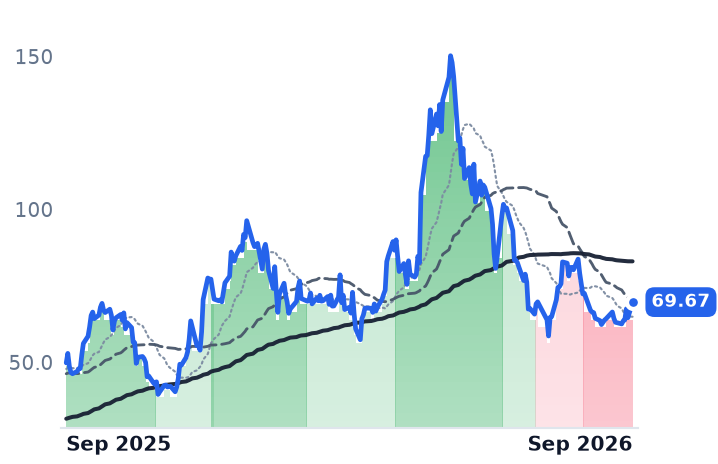
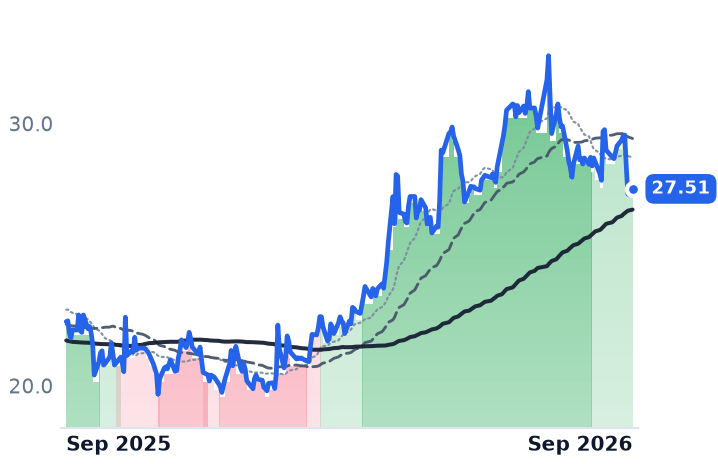
Iridium, which runs 66 crosslinked low-orbit satellites and sells airtime per billable subscriber, matched Viasat's twelve-month gain for an entirely different reason. On June 29 Rocket Lab agreed to buy it for $54.00 a share, about $8bn including debt, and the stock gapped 25% in a session. The buyback was terminated the day before signing; earnings calls and guidance are suspended until a mid-2027 close. Holders get $27.00 in cash plus Rocket Lab shares inside a collar that stops protecting them if Rocket Lab's average price falls below $67.50. Rocket Lab closed at $69.67 on September 21. Iridium closed at $48.02, an 11% discount to the offer.
The underlying business is fine and unexciting: 2.63m billable subscribers, up 6%, revenue up 4%, operating income down 32%. Peter Beck, Rocket Lab's chief executive, was explicit about what he bought: "L-band is important because if you want to do safety-critical comms, you need that band to penetrate through weather and harsh conditions." Spectrum, not subscribers.
What the business earns
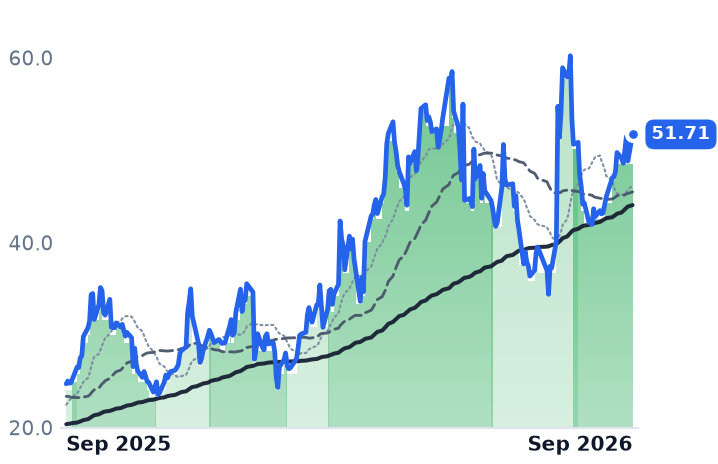
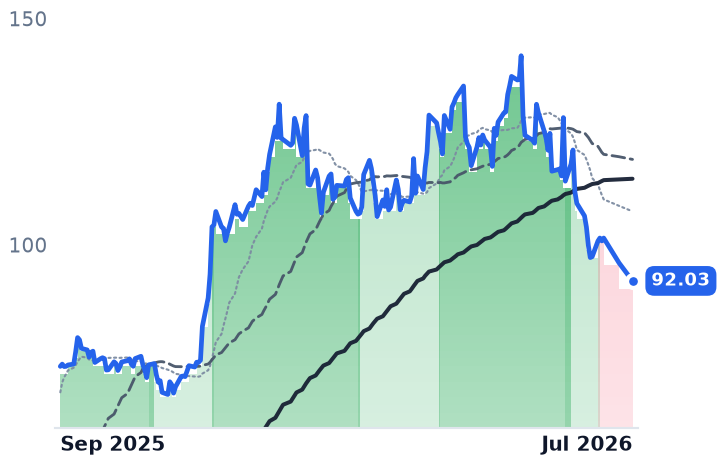
Viasat's re-rating from roughly 1.4x forward sales in May to 2.17x now is paid for by the measurable half: backlog, tails, four-tenths of a turn of deleveraging. It is not paid for by earnings, which consensus does not expect to turn positive before fiscal 2028, and the 27% decline in fixed broadband is a real hole that defence growth is covering rather than filling. Iridium's move is not a judgement on satellite economics at all — price it against Rocket Lab's shares, not its own subscriber base. And in the same neighbourhood, Gogo, which sells connectivity to business jets, is down 72% over twelve months. There is no satellite trade here, only three separate ones.
The capacity is finally in orbit. The customer it was built for has left, and the airlines and defence ministries that must absorb it were never the plan.