

CrowdStrike's Net New Recurring Revenue Rose 51% While Palo Alto Guided Its Growth Down
Hypothesis Opus 5 · Research Opus 5 · Writing Opus 5 · Prompt v1.6
Three cybersecurity companies that earn a security dollar in three incompatible ways have been repriced almost identically, and only one of them is accelerating.
CrowdStrike's July quarter brought record net new annual recurring revenue and a second consecutive raise to its full-year target. Six days later Palo Alto Networks reported 34% revenue growth and then guided next-generation security growth down to roughly 22-23% for fiscal 2027; the shares fell about 10%. Fortinet's quarter was an appliance refresh, with product revenue up 52%.
Yet measured against trailing gross profit, all three multiples expanded between 78% and 86% since early May. The business explains the direction of CrowdStrike's move. Nothing in the three sets of meters explains why three different billing models re-rated together.
| Ticker | Company | Segment | Trend · 13mo | 30D | 1Y |
|---|---|---|---|---|---|
CRWD | CrowdStrike | Cybersecurity & Threat Protection | ⚠️ Emerging Bear | +23.8% | −51.8% |
PANW | Palo Alto Networks | Cybersecurity & Threat Protection | 🟢 Cont. Bull | +1.6% | +74.6% |
FTNT | Fortinet | Network Security Appliances | 🟢 Cont. Bull | +10.6% | +99.8% |
ZS | Zscaler | AI & Data Intelligence | 🌱 Emerging Bull | +8.6% | −32.3% |
OKTA | Okta | Identity & Access Management | 🟢 Cont. Bull | +34.9% | +97.4% |
NET | Cloudflare | Network & Application Delivery | 🟢 Cont. Bull | +10.4% | +41.8% |
RBRK | Rubrik | Other | 🟢 Cont. Bull | +6.6% | +32.6% |
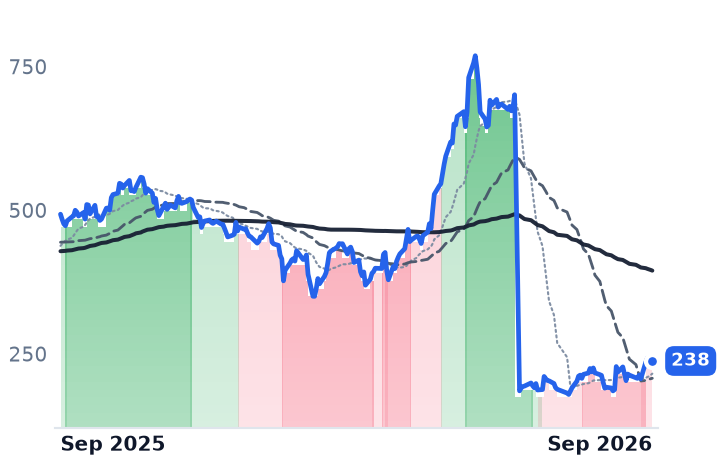
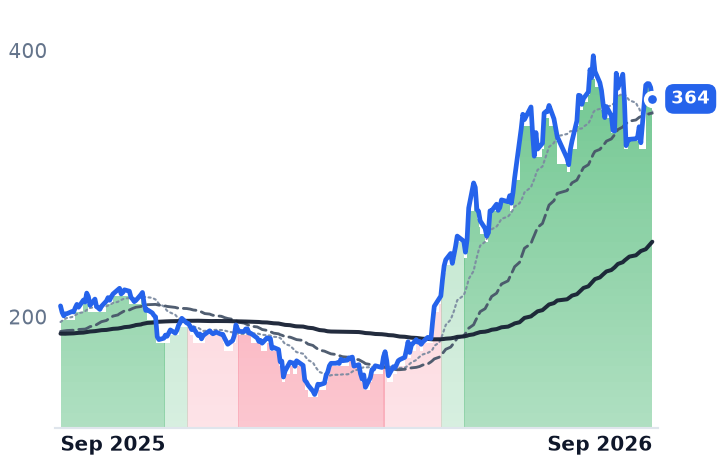
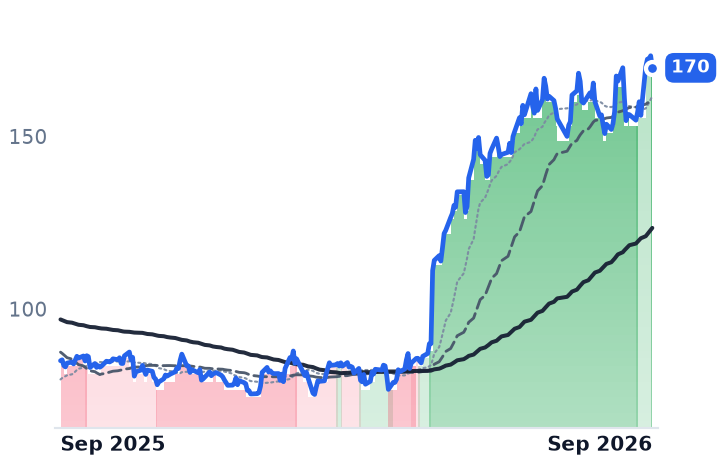
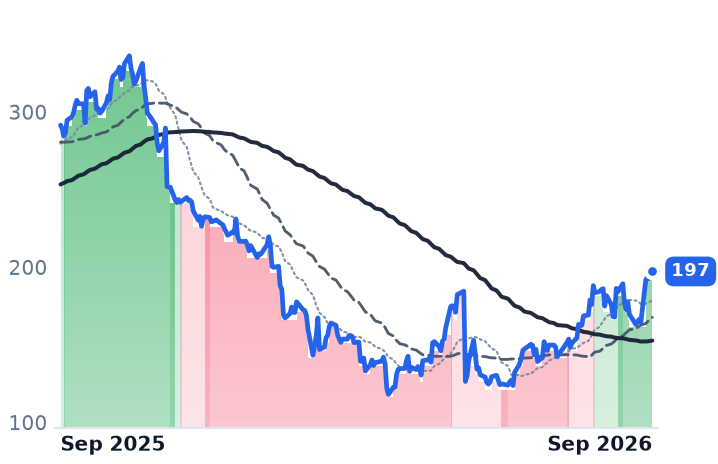
12-month price & trend
| Ticker | Mkt cap | P/E | P/E fwd | P/S | P/S fwd | P/GP | P/GP fwd | EV/EBITDA | FCF yld |
|---|---|---|---|---|---|---|---|---|---|
CRWD | $242.0B | — | 189.5x | 44.8x | 40.3x | 59.6x | 53.5x | 544.3x | 0.7% |
PANW | $296.3B | 790.4x | 86.8x | 25.8x | 20.9x | 36.7x | 29.7x | 552.8x | 1.5% |
FTNT | $124.6B | 59.4x | 49.2x | 16.6x | 15.4x | 20.6x | 19.1x | 42.2x | 2.5% |
| Ticker | Mkt cap | P/E | P/E fwd | P/S | P/S fwd | P/GP | P/GP fwd | EV/EBITDA | FCF yld |
|---|---|---|---|---|---|---|---|---|---|
ZS | $31.9B | n/m | 40.4x | 9.5x | 8.1x | 12.4x | 10.6x | 176.0x | 2.7% |
OKTA | $30.3B | 107.9x | 46.4x | 9.9x | 9.4x | 12.6x | 12.0x | 75.1x | 3.2% |
NET | $115.0B | n/m | 256.8x | 45.8x | 40.1x | 63.1x | 55.2x | — | 0.3% |
| Ticker | Mkt cap | P/E | P/E fwd | P/S | P/S fwd | P/GP | P/GP fwd | EV/EBITDA | FCF yld |
|---|---|---|---|---|---|---|---|---|---|
RBRK | $22.0B | n/m | 212.0x | 14.2x | 13.0x | 17.8x | 16.2x | n/m | 1.5% |
Consensus projections
| Ticker | FY2026E | FY2027E | FY2028E | |
|---|---|---|---|---|
CRWD | Revenue | +22.2% | +25.0% | +22.7% |
| EPS | −1.2% | +35.1% | +27.5% | |
PANW | Revenue | +24.3% | +24.1% | +14.4% |
| EPS | +15.5% | +10.8% | +16.3% | |
FTNT | Revenue | +20.2% | +11.3% | +11.1% |
| EPS | +28.0% | +9.4% | +13.1% | |
ZS | Revenue | +25.2% | +17.9% | +16.3% |
| EPS | +29.2% | +18.3% | +14.7% | |
OKTA | Revenue | +12.0% | +10.9% | +9.9% |
| EPS | +24.3% | +14.1% | +10.6% | |
NET | Revenue | +33.7% | +28.4% | +27.1% |
| EPS | +38.1% | +32.6% | +35.1% | |
RBRK | Revenue | +48.7% | +32.0% | +21.5% |
| EPS | −90.5% | −389.4% | +52.5% |
Forward fiscal years only. Blank means no analyst coverage for that year.
CrowdStrike booked more new recurring revenue in its July quarter than in any quarter of its history — $332.8m, up 51% from a year earlier — and raised a full-year target it had already raised once. Six days later, Palo Alto Networks told investors that its own subscription book would grow roughly a third as fast in the coming year as it had in the one just finished, and the shares fell about 10%.
These two companies, plus Fortinet, are the three largest listed pure-play security vendors, and they bill for the same threat in three incompatible ways. CrowdStrike, run by George Kurtz out of Austin, sells Falcon modules priced per endpoint per year, so its meter is recurring revenue added. Palo Alto sells firewalls and attached subscriptions and is deliberately bundling product to convert customers onto a contracted book that leads its income statement by years. Fortinet sells FortiGate appliances through distributors and recognizes product revenue on a hardware cycle. Since early May, all three have re-rated by within eight percentage points of one another.
Three meters, three directions
CrowdStrike's ending recurring revenue reached $5.84bn, up 25%, and reported revenue grew 25.8% in a fifth consecutive quarter of acceleration. Falcon Flex — the pooled commitment that lets a customer reallocate spend across modules — ended the quarter above $2.29bn of recurring revenue, growing 101%, with 935 new Flex accounts signed. The worry about Flex was that it pulls revenue forward; instead, new-logo Flex business hit a record 34% of all net new recurring revenue. "Our top 10 deals by deal value were each Flexes," Kurtz said on the August 26 call. Free cash flow of $377m was 25.6% of revenue. Management said both gross and net retention rose but did not put numbers to either.
Palo Alto's fiscal fourth quarter, reported September 1, grew revenue 34% to $3.41bn and next-generation security recurring revenue 63% to $9.10bn, with contracted obligations of $21.2bn. Then came the guide: $11.075bn to $11.175bn for fiscal 2027, or 22-23% growth, as the $21.1bn CyberArk acquisition closed in February and the Chronosphere deal enter both sides of the comparison. Jefferies put organic net new growth at about 45%, stripping those out. "Platformization is the only viable strategy for real-time defense, fighting AI with AI," chief executive Nikesh Arora told investors. In the reported accounts it shows as damage: gross margin fell to 67.6% from 73.2% as purchase-accounting amortization landed in cost of revenue, producing a GAAP net loss of $282m.
Fortinet's June quarter was the odd one: product revenue up 52% to $773m on FortiGate unit growth and higher selling prices, with billings up 33% and operating margin at 33.7%. It is the only one of the three with a substantial GAAP earnings base — and consensus models the refresh as a pull-forward with an end date, with revenue growth stepping from 20% this year to 11% next.
One re-rating
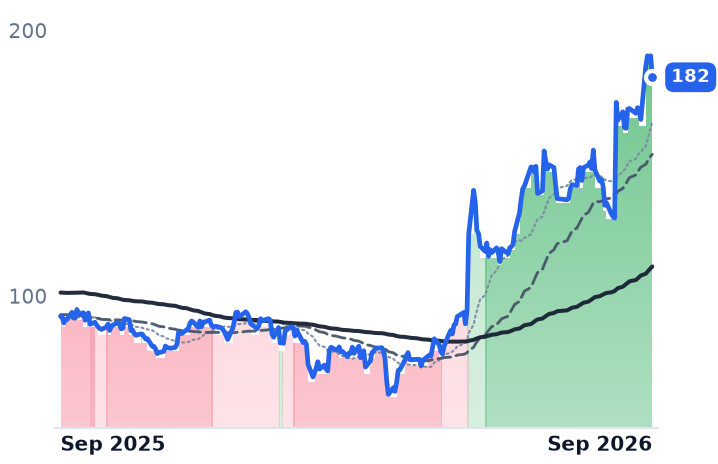
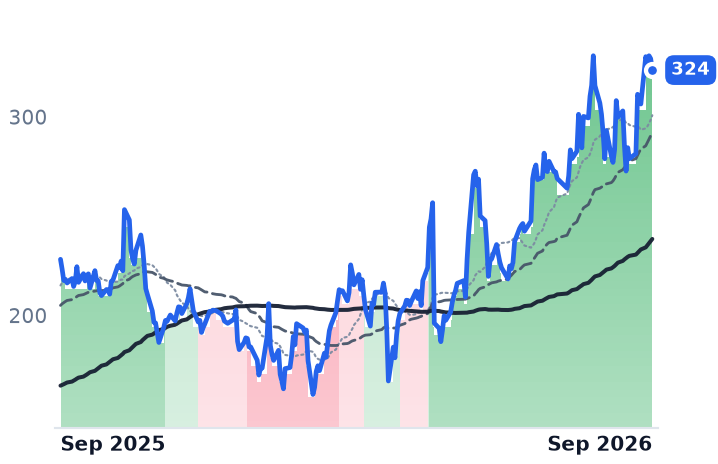
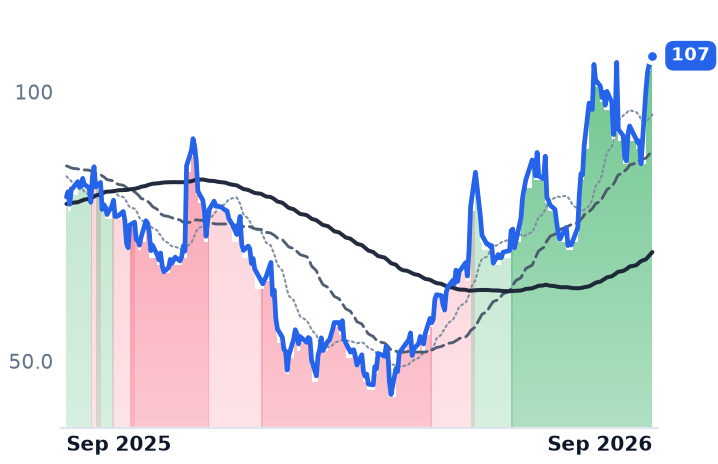
CrowdStrike's price against trailing gross profit went from 32x in early May to 60x now; Palo Alto's and Fortinet's expanded 82% and 78% over the same stretch. Fortinet remains the cheapest of the three by that measure and CrowdStrike the most expensive, at 53.5x forward gross profit and a 0.65% free-cash-flow yield against Fortinet's 2.50%. CrowdStrike's forward earnings multiple of 189x compares with roughly 80-90x in early May — while consensus still models $6.01bn of revenue this fiscal year, unchanged. The single largest session in the group's recent advance produced no earnings at all: on September 14 CrowdStrike rose 15.4% and Palo Alto 13.8% after Anthropic's Dario Amodei published an essay on pacing AI risk.
One technical note matters for anyone reading the chart: CrowdStrike split its stock four-for-one, trading adjusted from July 2. Adjusted, it is up 118% over six months — the strongest of the three, not the laggard its unadjusted price history suggests.
The verdict divides cleanly. CrowdStrike's business earns the direction of its move: accelerating revenue, accelerating recurring revenue, a raised outlook. It does not earn the level, because the estimates underwriting that multiple have not moved while the multiple roughly doubled. Palo Alto's meters are pointing the other way into a comparable expansion, and Fortinet's cycle has a modeled end. Three businesses that agree on almost nothing operationally were marked up together, which means the November and December prints are the first real test of whether the market was paying for security economics or for the word.
Kurtz, for his part, publicly rejected the premise of the essay that added tens of billions to his own market value in a single session, arguing that securing AI's progress matters more than slowing it down.