

ServiceNow's Gross Margin Fell to 70.7% While Revenue Growth Accelerated to 24.0%
Hypothesis Opus 5 · Research Opus 5 · Writing Opus 5 · Prompt v1.6
Enterprise software has been repriced on the belief that AI agents will replace per-seat licences; roughly $2 trillion of market value has gone since early 2026. Three companies billed three different ways show no demand break: ServiceNow's contracted revenue due within a year rose 21%, PTC raised full-year recurring-revenue guidance after 9.1% constant-currency growth, and PAR lifted its outlook in August.
What did break is the cost line. ServiceNow has bundled its Now Assist AI into every service-management tier and meters agent work by consumption; PAR's hardware margin fell to 20% from 27% on tariffs and chip prices. PAR is the one name whose business partly earns its de-rating — trailing gross profit grew 3.0% against revenue near 19%.
| Ticker | Company | Segment | Trend · 13mo | 30D | 1Y |
|---|---|---|---|---|---|
NOW | ServiceNow | Specialized Enterprise Solutions | 🌱 Emerging Bull | +5.4% | −28.5% |
PTC | PTC | Specialized Enterprise Solutions | 🌱 Emerging Bull | −12.1% | −34.0% |
PAR | PAR Technology | Specialized Enterprise Solutions | 🌱 Emerging Bull | −21.9% | −63.7% |
PCOR | Procore Technologies | Specialized Enterprise Solutions | 🌱 Emerging Bull | −19.2% | −27.2% |
ROP | Roper Technologies | Specialized Enterprise Solutions | 🌱 Emerging Bull | −9.5% | −26.2% |
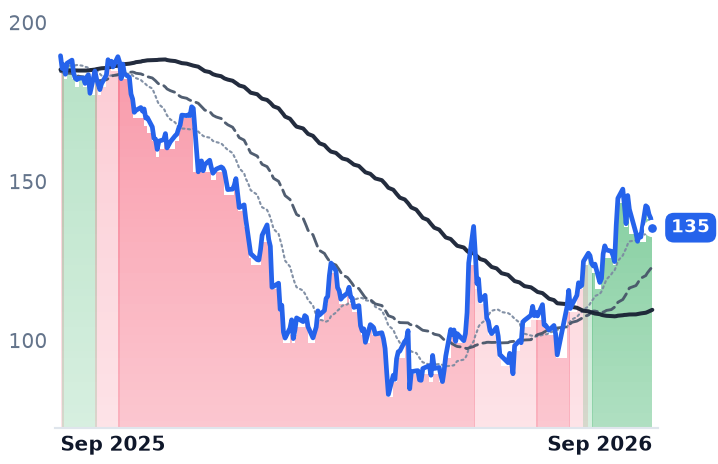
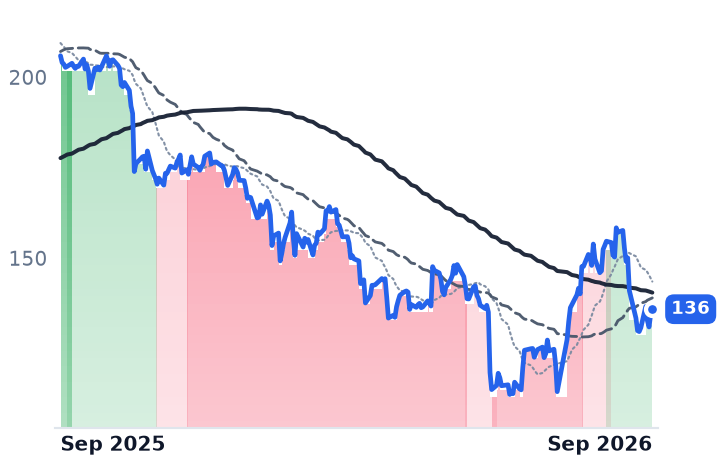
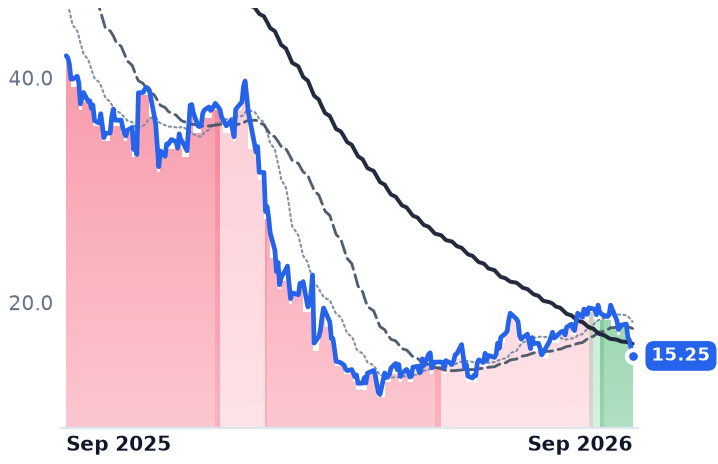
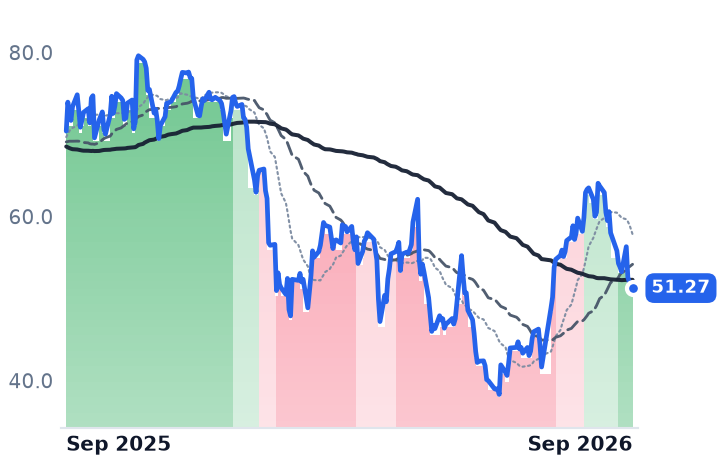
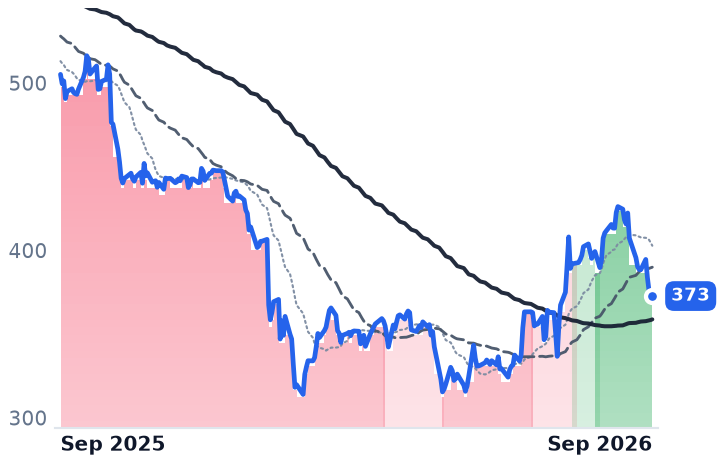
12-month price & trend
| Ticker | Mkt cap | P/E | P/E fwd | P/S | P/S fwd | P/GP | P/GP fwd | EV/EBITDA | FCF yld |
|---|---|---|---|---|---|---|---|---|---|
NOW | $140.1B | 84.1x | 33.3x | 9.5x | 8.6x | 12.7x | 11.6x | 41.8x | 3.3% |
PTC | $15.7B | 13.1x | 16.6x | 5.3x | 5.8x | 6.3x | 6.9x | 10.1x | 6.0% |
PAR | $629.0M | n/m | 19.9x | 1.3x | 1.2x | 3.3x | 3.1x | n/m | -3.0% |
| Ticker | Mkt cap | P/E | P/E fwd | P/S | P/S fwd | P/GP | P/GP fwd | EV/EBITDA | FCF yld |
|---|---|---|---|---|---|---|---|---|---|
PCOR | $7.7B | n/m | 30.5x | 5.4x | 5.1x | 6.8x | 6.4x | 120.8x | 3.8% |
ROP | $37.6B | 15.5x | 16.8x | 4.5x | 4.4x | 6.5x | 6.3x | 10.8x | 7.0% |
Consensus projections
| Ticker | FY2026E | FY2027E | FY2028E | |
|---|---|---|---|---|
NOW | Revenue | +22.4% | +18.7% | +18.6% |
| EPS | +17.1% | +23.2% | +21.4% | |
PTC | Revenue | +4.9% | +6.4% | +7.5% |
| EPS | +20.4% | +8.8% | +10.2% | |
PAR | Revenue | +15.1% | +9.9% | +10.2% |
| EPS | +505.2% | +86.3% | +84.9% | |
PCOR | Revenue | +15.3% | +13.9% | +14.4% |
| EPS | +24.1% | +46.2% | +20.2% | |
ROP | Revenue | +8.1% | +5.9% | +5.6% |
| EPS | +11.5% | +9.5% | +9.2% |
Forward fiscal years only. Blank means no analyst coverage for that year.
ServiceNow's revenue growth accelerated again in the June quarter, and its gross margin fell 6.8 points while that happened. The company, which sells information-technology service, operations and human-resources workflow software to large enterprises and governments, has stopped selling its generative AI as a standalone product: since April it has been bundled into every tier of the service-management line, with agent work metered afterward out of consumption pools and charged on overage.
The past year's de-rating was not built on that. Roughly $2 trillion of software market value has been erased since early 2026 on the argument that autonomous agents will replace per-seat licences. But these companies are paid in three incompatible ways — by contracted seat and workflow, by annual recurring revenue on engineering licences, and by the restaurant — and not one of the three order books has broken. What has bent is cost of goods.
ServiceNow: the AI bill lands below the revenue line
Current remaining performance obligations — contracted revenue due within twelve months, and the leading meter for a multi-year subscription book — reached $13.20bn at 30 June, up 21%, two percentage points above the company's own guidance. Subscription revenue of $3.877bn grew 24.5%, and full-year subscription guidance was raised to $15.760–15.780bn. "Once again, we beat the high end of our guidance range across every topline and profitability metric," chief financial officer Gina Mastantuono said on 22 July. Annual contract value tied to AI products passed $1bn in the quarter, against a $1.5bn target for year-end.
Selling that AI costs real money. Gross margin fell to 70.7% from 77.5% a year earlier, so gross profit grew 13.1% against 24.0% revenue growth, and operating income dropped 54.7% to $162m. The honest caution sits in the same release: third-quarter growth in that twelve-month contracted backlog is guided to 20%, a step down from the 21% just reported. Against a year ago the shares cost far less per dollar of gross profit — 12.7x trailing versus roughly 20.9x, on trailing gross profit that grew 16.4% to $11.02bn — though the 90-day rally has already carried the forward earnings multiple to 33x from about 24x in May.
PTC: two meters pointing opposite ways
PTC, which sells Creo computer-aided design and Windchill product-lifecycle software to discrete manufacturers, reported June-quarter revenue down 6.8% to $600.0m — in the same quarter constant-currency recurring revenue excluding divested units grew 9.1% to $2.448bn and full-year growth guidance was raised to 9–9.5% from 7.5–9.5%. Reported growth swung from +21.4% to +21.7% to -6.8% across three quarters; the sale of the Kepware and ThingWorx units and lumpy licence recognition, not lost customers, produce that. Chief executive Neil Barua told investors on the third-quarter call that competitive Windchill displacements had doubled year over year by count and value. Fourth-quarter free cash flow is guided to about $15m after $249m in the third, on capital-gains tax from the divestiture. The stock fetches 6.3x trailing gross profit, half the roughly 12.3x of a year ago, on gross profit up 22.3%.
PAR: the sites were bought, not won
PAR Technology sells restaurant point-of-sale hardware alongside Brink cloud software and Punchh loyalty to large chains. Revenue grew 18.7% to $133.4m last quarter, but gross margin fell to 42.4% and hardware margin to 20% from 27%, which management attributed to tariffs and processor and memory costs. Recurring revenue near $338m grew 17% but only 12.3% organically. Active sites reached 174,300, of which 28,400 came from the Bridg acquisition — meaning the organic base finished below the roughly 149,700 sites of a year earlier, and revenue per site was flat near $1,940. "What's especially notable is that 3 of those wins came from customers migrating off the market's largest legacy ordering provider," chief executive Savneet Singh said on 6 August, and guidance went up. Free cash flow was $3m; JPMorgan has flagged leverage near seven times this year's EBITDA.
What actually moved them in September
All five names in this corner of software, Procore and Roper included, peaked between 27 August and 4 September and fell together; none of them reported in that window. Oracle's September disclosure of fiscal-2026 capital spending near $55.7bn and negative free cash flow re-lit anxiety about where AI money goes, and the main software exchange-traded fund has fallen 17% since 1 June. No company-specific catalyst was discoverable for PAR's slide, so the likelier reading is sector repricing.
The verdict divides cleanly. At ServiceNow and PTC the twelve-month de-rating is a multiple event: both meters grew, both raised guidance, and the price per dollar of gross profit roughly halved against a bigger denominator. At PAR the business earns part of it — trailing gross profit grew 3.0% while revenue grew nearly 19%, because component inflation passes straight through a hardware line no software multiple can absorb, and the site count grew by purchase.
If agents were eating seats, the damage would appear first in contracted backlog and recurring revenue, and it has not. It is appearing instead in what it costs to answer the prompt.