

PayPal's Branded Checkout Grew 2% While Braintree Grew 13%; Margin Dollars Rose 1%
Hypothesis Opus 5 · Research Opus 5 · Writing Opus 5 · Prompt v1.6
Payment volume is the most quoted number in digital payments and the least informative. PayPal moved 9% more money in the June quarter on a currency-neutral basis and kept 1% more gross profit from it, because the growth came from unbranded Braintree processing — a near-commodity gateway at a take rate analysts put near 1.85% — rather than from the checkout button it owns.
A second engine sits outside volume entirely: interest on customer balances, guided down to about $1,003m in 2026 from $1,225m in 2025, which the Federal Reserve's September hike now starts to reverse.
The verdict splits the two acceptance businesses in this corner of financial services. PayPal's de-rating is mostly earned; Global Payments, paid a spread per merchant per transaction, grew adjusted earnings 12% and has been re-rated upward. The same twelve months marked down the button and marked up the rail.
| Ticker | Company | Segment | Trend · 13mo | 30D | 1Y |
|---|---|---|---|---|---|
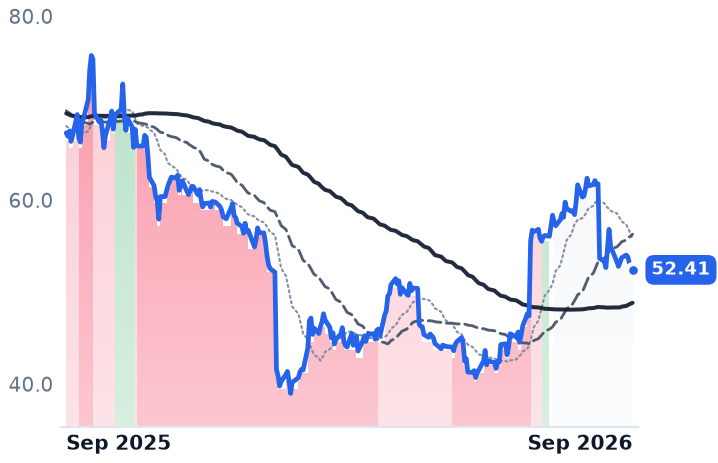
PYPL | PayPal | Digital Payments & Fintech Platforms | 🔴 Cont. Bear | −14.8% | −22.1% |
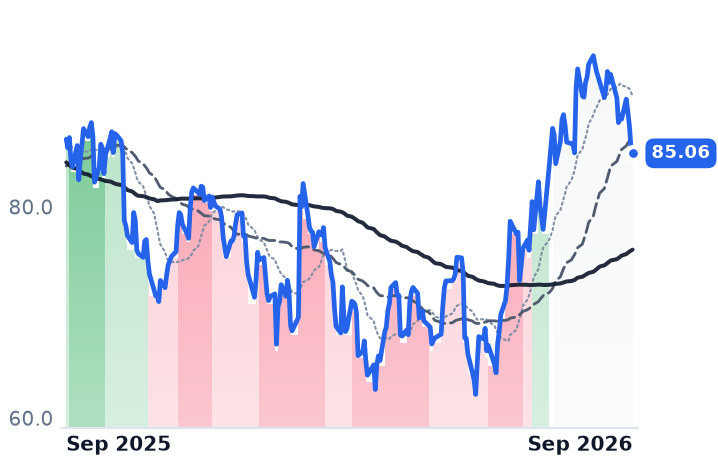
GPN | Global Payments | Digital Payments & Fintech Platforms | 🔴 Cont. Bear | −9.0% | −1.6% |
12-month price & trend
| Ticker | Mkt cap | P/E | P/E fwd | P/S | P/S fwd | P/GP | P/GP fwd | EV/EBITDA | FCF yld |
|---|---|---|---|---|---|---|---|---|---|
PYPL | $44.8B | 9.8x | 9.7x | 1.3x | 1.3x | 2.9x | 2.8x | 6.8x | 14.7% |
GPN | $21.1B | n/m | 6.2x | 2.1x | 1.7x | 3.2x | 2.7x | 12.5x | 3.9% |
Consensus projections
| Ticker | FY2026E | FY2027E | FY2028E | |
|---|---|---|---|---|
PYPL | Revenue | +4.5% | +4.3% | +4.6% |
| EPS | +0.5% | +7.5% | +8.5% | |
GPN | Revenue | +33.1% | +5.2% | +4.8% |
| EPS | +11.9% | +17.5% | +16.4% |
Forward fiscal years only. Blank means no analyst coverage for that year.
PayPal moved $486.4bn of payment volume in the June quarter and kept almost none of the increase. Total volume grew 9% on a currency-neutral basis; transaction margin dollars — the spread PayPal actually retains after paying the card networks and banks — rose 1%, to $3.9bn.
That gap is the whole business explained in two lines. A payments company is not paid for volume; it is paid a take rate, and PayPal's differs by a large factor depending on where the transaction enters. Branded checkout — the yellow button on a merchant's page, where PayPal owns the consumer relationship — carries a high spread and grew 2% currency-neutral. Unbranded processing through Braintree, where PayPal is a gateway routing other companies' card transactions, grew 13%, at a take rate analysts put near 1.85%. Every point of mix shift toward the cheap channel dilutes what the volume headline implies.
The meter that volume hides
Gross profit tells the same story on a longer clock: growth of 5.9%, 2.5%, 2.5% and 1.5% across the last four quarters, with gross margin down to 44.9% from 46.4%. Active accounts were flat at 439m, though transactions per account excluding the gateway business grew 7% for a second straight quarter. Operating income rose 25.6% on cost cuts while GAAP net income fell 12.5% — the swing sits below the operating line.
What sits there is float. PayPal earns interest on customer balances and on its buy-now-pay-later receivables, a second engine no volume statistic captures, and it is forecast to fall to about $1,003m in 2026 from $1,225m in 2025 on a roughly 75 basis-point lower effective rate. Strip it out and margin dollars grew 3%. The direction is changing: the Federal Reserve raised its target to 3.75%-4.00% on September 16, the first increase since 2023.
The competitive reading is harsher. Apple Pay, Shopify, Affirm, Klarna, Cash App and Zelle have all taken checkout territory, and PayPal is spending $400m this year to defend it. "PayPal has had a lot of trouble evolving from being just a way to pay on your desktop computer," Sanjay Sakhrani of Keefe, Bruyette & Woods told the Associated Press. "I'm encouraged by the progress we made this quarter," Enrique Lores, chief executive since March, said on the July 28 call. "We moved with urgency to sharpen our transformation plan."
The shares are down 23.5% over twelve months in three discrete events, not a grind: a 20.3% fall on February 3 when a fourth-quarter miss coincided with the board's ouster of Alex Chriss, a 17.2% jump on July 15 when Stripe and Advent International bid $60.50 a share, and a 13.1% drop on August 28 when that consortium walked. Trailing earnings multiple: 9.83x, against roughly 13.7x a year ago, on four-quarter GAAP earnings per share that rose to $5.29 from $4.99. Forward is 9.73x — the market underwrites no growth — and the trailing free-cash-flow yield is 14.7%.
The other way to earn a payments dollar
Global Payments is the mirror. It is a merchant acquirer, paid a spread per merchant per transaction on physical terminals and embedded software, and in January it swapped its issuer-processing arm to FIS for Worldpay. Second-quarter adjusted net revenue grew 4% normalised with adjusted earnings per share of $3.46, up 12%, and operating margin of 42.0%. Enterprise and Platforms each grew 7%, small-business 4%. Full-year revenue growth guidance was cut to 4-5% on Middle East travel exposure while the $13.60-$13.80 earnings range held. Leverage sits just under 3.5x; chief executive Cameron Bready said the company feels "very good about getting back to that 3x leverage point" by end-2027, with $1.2bn returned this year. Trailing earnings are unusable — a $1.8bn first-quarter loss on non-deductible goodwill tax from the disposal — so the anchor is 6.23x forward against $13.65 consensus, below Fiserv's roughly 7.5x, and 0.955x book. The shares are roughly flat over twelve months and 27% above their June low.
What the market actually repriced
So the card rail was not marked down wholesale. The spread-per-merchant model was re-rated upward on delivered synergies and falling leverage; the consumer-checkout franchise was marked down a quarter while its earnings rose. PayPal's de-rating is largely earned — a 2% branded meter and flat accounts are what a nine-times multiple describes — and the unexplained residue is narrow: cost discipline and buybacks are producing earnings the market will not capitalize, on the view that mix and float erosion continue.
Both of those assumptions face a date. PayPal reports on October 27, Global Payments on November 3. And the board that called $60.50 inadequate now has shares 15% below it, with the bidder gone and the burden of proof entirely on the button.