

Cognizant Earns $60,673 Per Employee, Less Than Infosys, and Fell a Third as Far
Hypothesis Opus 5 · Research Opus 5 · Writing Opus 5 · Prompt v1.6
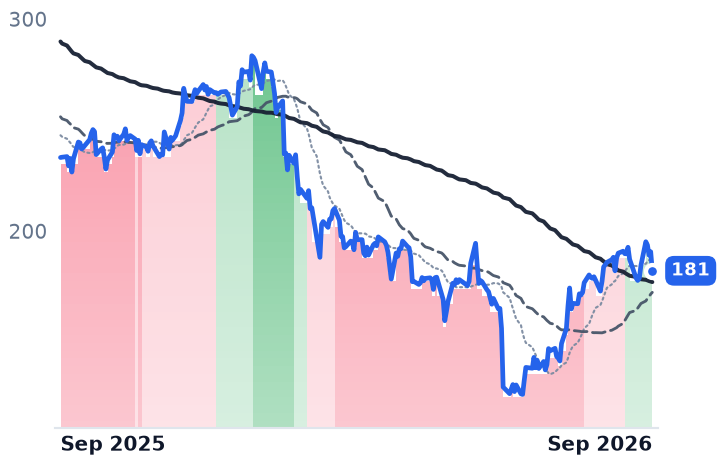
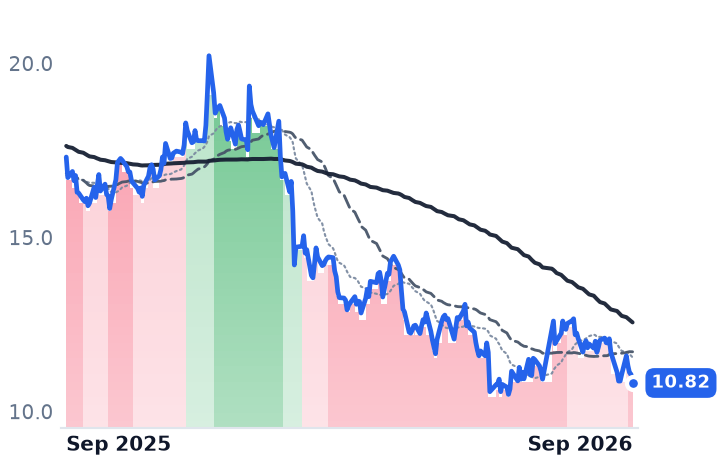
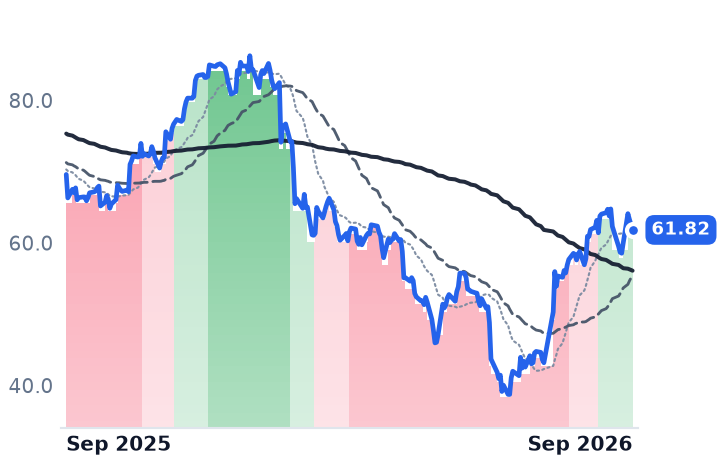
If generative artificial intelligence were repricing the billable seat, the most labor-leveraged information-technology firms would be marked down hardest. They were not. Cognizant generates $60,673 of revenue per employee, fractionally below Infosys's $61,869 and a third below Accenture's $91,490 — and Cognizant is down 12% over twelve months against Infosys's 38.4%, having recovered off the June low alongside Accenture rather than with its fellow offshore outsourcer.
Infosys expanded operating margin to 21.09% last quarter and won $3.6bn of large deals, 61% of it net new work, and broke to a fresh low anyway. What separates the three is not how they deliver: it is the direction of consensus estimates, the currency of the listing, and price. Accenture's rebound is multiple repair on flat-to-falling estimates — the trade Guggenheim closed on 18 September, thirteen days before the fiscal-year results land.
| Ticker | Company | Segment | Trend · 13mo | 30D | 1Y |
|---|---|---|---|---|---|
| The subject · what this brief is about | |||||
ACN | Accenture | Enterprise Consulting & Systems Integration | 🔴 Cont. Bear | −1.0% | −22.8% |
INFY | Infosys | Enterprise Consulting & Systems Integration | 🔴 Cont. Bear | −10.1% | −37.5% |
| Compared against · context, not the story | |||||
CTSH | Cognizant Technology Solutions | Enterprise Consulting & Systems Integration | 🔴 Cont. Bear | +1.5% | −11.2% |
EPAM | EPAM Systems | Enterprise Consulting & Systems Integration | 🔴 Cont. Bear | +10.6% | −23.8% |
GLOB | Globant | Enterprise Consulting & Systems Integration | 🔴 Cont. Bear | −3.9% | −33.7% |
GIB | CGI | Enterprise Consulting & Systems Integration | 🔴 Cont. Bear | −5.1% | −22.8% |
GDYN | Grid Dynamics | Enterprise Consulting & Systems Integration | 🔴 Cont. Bear | +2.3% | +5.0% |
WIT | Wipro | Enterprise Consulting & Systems Integration | 🔴 Cont. Bear | −13.1% | −40.7% |
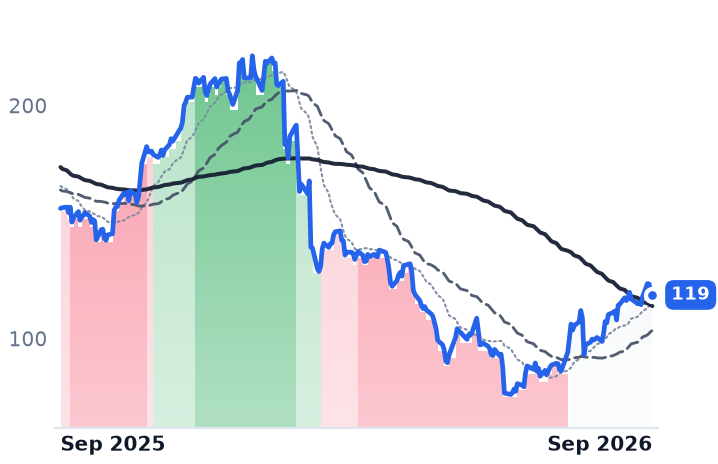
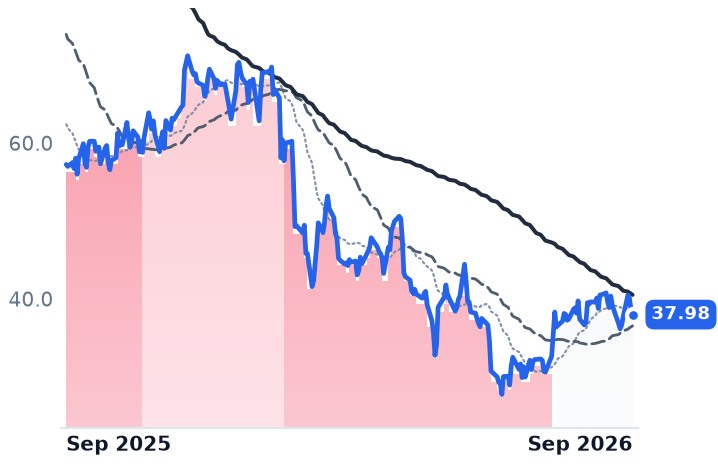
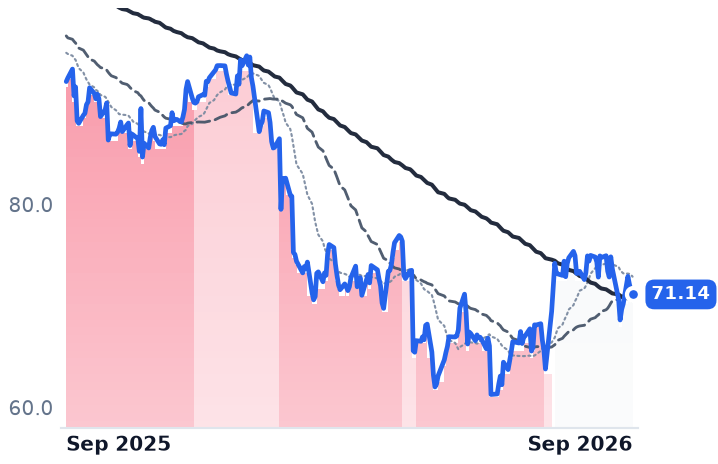
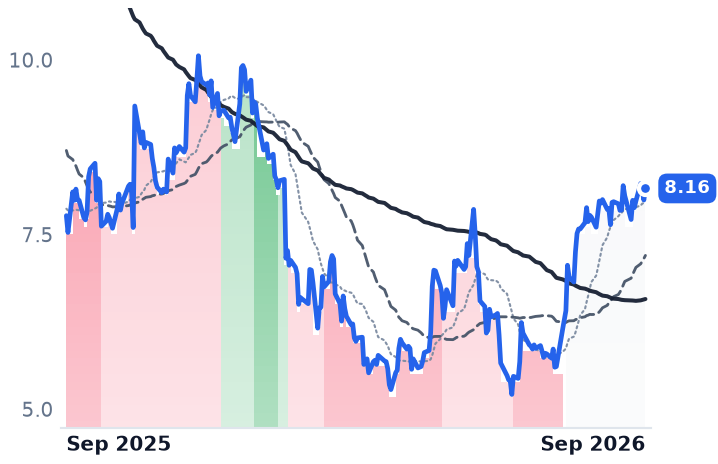
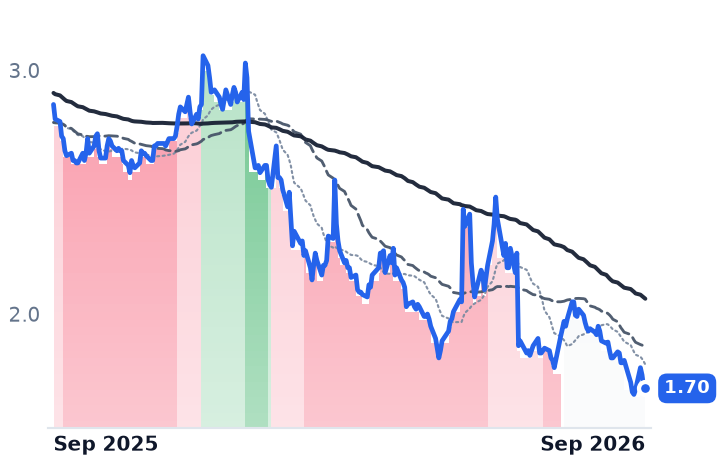
12-month price & trend
| Ticker | Mkt cap | P/E | P/E fwd | P/S | P/S fwd | P/GP | P/GP fwd | EV/EBITDA | FCF yld |
|---|---|---|---|---|---|---|---|---|---|
ACN | $110.9B | 14.4x | 12.4x | 1.5x | 1.4x | 4.7x | 4.5x | 8.6x | 11.3% |
INFY | $43.9B | 13.4x | 13.6x | 2.2x | 2.2x | 7.2x | 7.1x | 8.5x | 8.6% |
CTSH | $27.9B | 13.3x | 10.8x | 1.3x | 1.3x | 4.0x | 3.9x | 7.3x | 9.3% |
| Ticker | Mkt cap | P/E | P/E fwd | P/S | P/S fwd | P/GP | P/GP fwd | EV/EBITDA | FCF yld |
|---|---|---|---|---|---|---|---|---|---|
EPAM | $6.1B | 15.8x | 8.9x | 1.1x | 1.1x | 3.8x | 3.8x | 8.0x | 7.9% |
GLOB | $1.7B | 15.6x | 6.7x | 0.7x | 0.7x | 2.2x | 2.2x | 6.8x | 18.4% |
GIB | $15.5B | 12.4x | 8.0x | 1.3x | 0.9x | 6.4x | 4.5x | 8.4x | 11.3% |
| Ticker | Mkt cap | P/E | P/E fwd | P/S | P/S fwd | P/GP | P/GP fwd | EV/EBITDA | FCF yld |
|---|---|---|---|---|---|---|---|---|---|
GDYN | $608.5M | 272.7x | 17.0x | 1.4x | 1.4x | 4.1x | 4.0x | 13.6x | 2.6% |
WIT | $16.6B | 13.2x | — | 1.7x | — | 6.0x | — | 8.8x | 8.6% |
Consensus projections
| Ticker | FY2026E | FY2027E | FY2028E | |
|---|---|---|---|---|
ACN | Revenue | +6.0% | +4.0% | +5.1% |
| EPS | +7.6% | +5.8% | +7.3% | |
INFY | Revenue | +1.6% | +4.3% | +3.6% |
| EPS | +2.3% | +4.5% | +4.5% | |
CTSH | Revenue | +5.2% | +4.7% | +5.2% |
| EPS | +10.8% | +9.8% | +10.5% | |
EPAM | Revenue | +3.9% | +3.5% | +4.9% |
| EPS | +15.1% | +7.3% | +7.6% | |
GLOB | Revenue | −0.1% | +2.5% | +3.6% |
| EPS | −2.4% | +4.9% | +4.8% | |
GIB | Revenue | +5.0% | +2.6% | +2.6% |
| EPS | +9.3% | +9.2% | +8.0% | |
GDYN | Revenue | +6.5% | +9.2% | +10.6% |
| EPS | +11.3% | +17.7% | +9.6% | |
WIT | Revenue | +5.4% | +4.5% | +2.6% |
| EPS | +4.6% | +3.1% | +3.7% |
Forward fiscal years only. Blank means no analyst coverage for that year.
A Guggenheim analyst withdrew his price target on Accenture on 18 September, thirteen days before the company closes its fiscal year and reports, arguing the shares had come back without the demand. Applied across the three largest listed systems integrators, that test breaks the story the market has been telling about this industry all year.
The accusation hanging over the sector is substitution: that code assistants replace the billable offshore seat, which is why the Nifty IT index has fallen nearly 40% from its peak. If that were what was being priced, the businesses most levered to headcount would be marked hardest. The numbers say something else, and with Accenture's full-year print due on 1 October the difference matters to what the market thinks it is buying.
The per-employee test fails
Over the trailing four quarters, Accenture — the Dublin-based professional services firm that both advises clients and runs their applications and infrastructure under multi-year contracts, with 799,000 staff — generated $91,490 of revenue per employee. Infosys, the Bengaluru outsourcer behind the Topaz artificial-intelligence suite and the Finacle banking platform, generated $61,869 across 328,062 people. Cognizant, the Teaneck, New Jersey services firm with 356,700 employees, generated $60,673 — marginally less leverage on headcount than Infosys, off the same offshore delivery pyramid.
Cognizant recovered 41.5% from its 18 June low, within a fifth of a point of Accenture's 41.7%, and is down 12.0% over twelve months — the shallowest decline in the group. Infosys recovered 2.4% and is down 38.4%. Delivery model does not separate them.
What Infosys's quarter actually did
The June quarter took Infosys's operating margin to 21.09% from 20.81%, with gross margin up as well, on revenue of $5.082bn. Large-deal total contract value was $3.6bn, of which 61% was net new work rather than renewal — the opposite of a franchise living on vendor consolidation — with artificial-intelligence work at 8.2% of revenue and headcount down 532 sequentially. Management narrowed fiscal 2027 constant-currency guidance to 1.5%–3.0% from 1.5%–3.5%, leaving the margin range untouched. Its American depositary receipts broke to a new low in their twelve-month downtrend on 17 September regardless.
Two things outside the quarter explain the marks. The rupee is down 8.7% against the dollar over twelve months, roughly 6 points of the receipt's 38.4% fall; the same quarter grew earnings per share 14.9% in rupees while dollar net income rose 1.3%. And Infosys carries a higher revenue multiple than either peer, at 2.19x trailing sales against Accenture's 1.52x and Cognizant's 1.29x, with a forward price-to-earnings of 13.60x sitting above its 13.37x trailing — consensus modeling no earnings growth at all.
What Accenture's rally is made of
Accenture lost 4.73% on 18 September on 11.5m shares, roughly four times the prior session's volume, after Guggenheim's Jonathan Lee cut the stock from Buy to Neutral and withdrew his price target, his argument being that the shares had rebounded more than 52% from the June low against a 2% gain in the S&P 500 with channel checks showing "no corresponding improvement in demand."
He had material. June-quarter new bookings were $19.32bn, down 2% on a book-to-bill of exactly 1.0, with consulting filling more of the order book than the managed-services half growing twice as fast. The restructuring the company calls business optimisation still cost $0.40 of nine-month adjusted earnings per share. In August staff were told they could carry unused vacation into the new fiscal year to keep selling through the 31 August close; "our shareholders are counting on us to deliver a strong quarter," chief executive Julie Sweet wrote in the memo. The stock trades at 12.35x forward earnings against 21x to 37x at each of its last five fiscal year-ends — cheap against its own history, and cheaper still in late July at 10.1x, the repair since coming on flat-to-falling estimates.
The verdict
Accenture's advance is multiple repair rather than order-book recovery, which is precisely the trade Guggenheim closed. Infosys's break to new lows is earned by its price rather than its quarter — margins rose, deal wins skewed net new — and a sixth of the twelve-month decline in the receipts is currency the business never touched. What is sorting these three is the direction of estimates and the currency of the listing; the one company whose operating income actually grew, Cognizant, is also the cheapest and the best held. Labor substitution is a good story. It is not what these charts are measuring.
On 1 October Accenture closes the argument with a full year of bookings and its first fiscal 2027 guidance. In June a book-to-bill of exactly 1.0 was survivable because the shares had already been marked down for it. Nothing has been marked down since.