

CF Industries Sold 15% Fewer Tons and Widened Its Margin to 51.5% on $3.37 Gas
Hypothesis Opus 5 · Research Opus 5 · Writing Opus 5 · Prompt v1.6
Two producers of gas-derived molecules rose within a point of each other over the past twelve months, and the market has priced what they earn on opposite terms. CF Industries shipped 15% fewer tons in the June quarter and still grew revenue 17.6%, because ammonia sold for $677 a ton while the natural gas in its cost of sales held at $3.37 per MMBtu. The spread, rather than the price, is what widened.
Methanex buys much of its feedstock on contracts indexed to the methanol price, which should dampen the swing — and its margin still moved further than CF's did. Yet measured against the last nitrogen peak of April 2022, CF now costs more relative to its best earnings than it did then, and Methanex costs less. Both forward readings rest on a single year: consensus has CF's earnings falling 28% in 2027, Methanex's 39%.
| Ticker | Company | Segment | Trend · 13mo | 30D | 1Y |
|---|---|---|---|---|---|
| The subject · what this brief is about | |||||
CF | CF Industries | Nitrogen Fertilizers | 🟢 Cont. Bull | +10.2% | +58.6% |
MEOH | Methanex | Basic Chemicals & Intermediates | 🟢 Cont. Bull | +6.9% | +58.3% |
| Compared against · context, not the story | |||||
LXU | LSB Industries | Basic Chemicals & Intermediates | ⚠️ Emerging Bear | +10.4% | +38.7% |
NTR | Nutrien | Fertilizer Distribution & Retail | ⚠️ Emerging Bear | +13.0% | +39.9% |
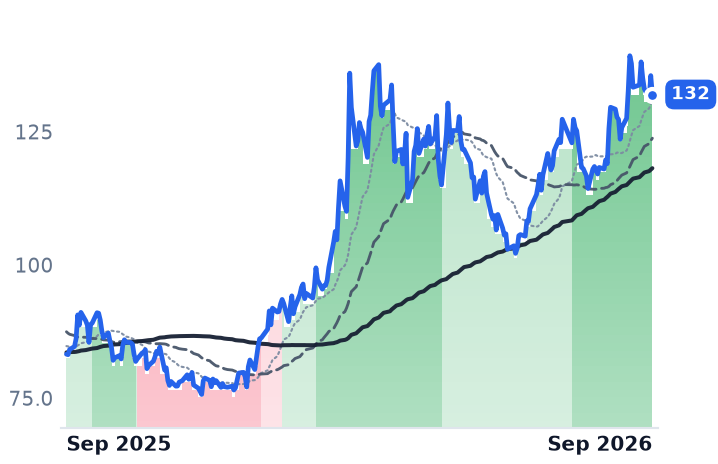
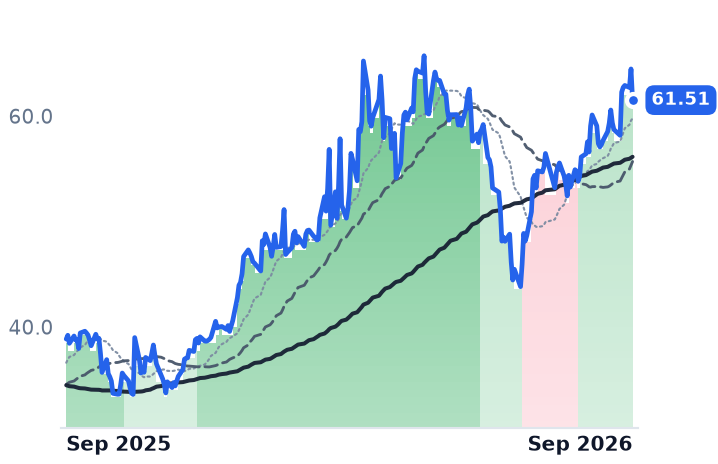
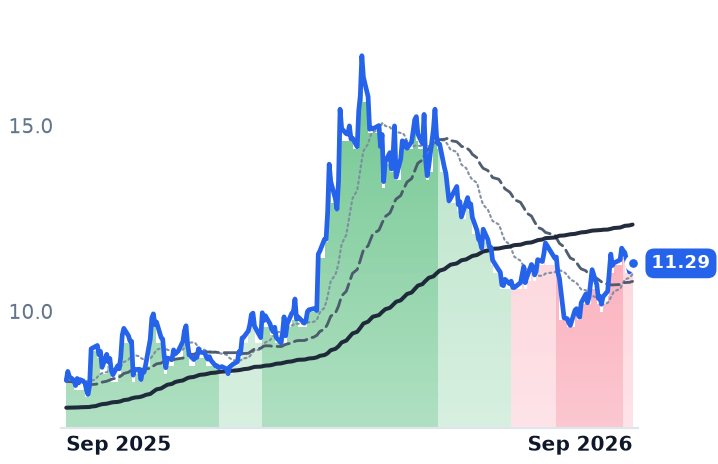
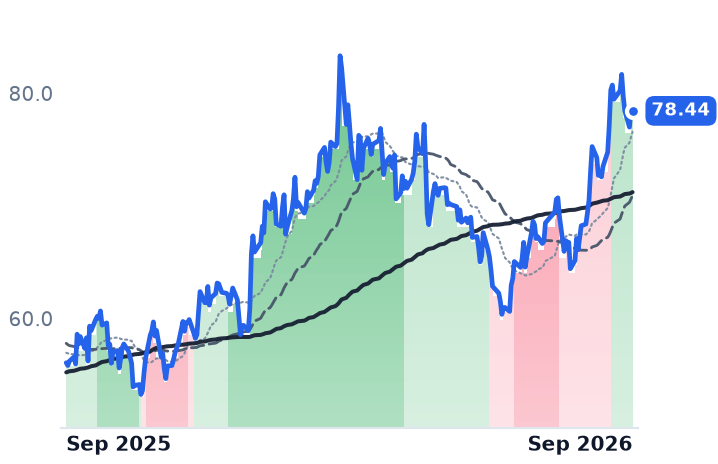
12-month price & trend
| Ticker | Mkt cap | P/E | P/E fwd | P/S | P/S fwd | P/GP | P/GP fwd | EV/EBITDA | FCF yld |
|---|---|---|---|---|---|---|---|---|---|
CF | $20.3B | 9.8x | 8.8x | 2.6x | 2.5x | 6.2x | 5.9x | 5.4x | 9.4% |
MEOH | $4.8B | 54.9x | 6.8x | 1.1x | 1.0x | 3.9x | 3.4x | 7.4x | 15.5% |
LXU | $795.6M | 22.2x | 18.5x | 1.2x | 1.2x | 7.0x | 7.0x | 8.3x | 20.6% |
| Ticker | Mkt cap | P/E | P/E fwd | P/S | P/S fwd | P/GP | P/GP fwd | EV/EBITDA | FCF yld |
|---|---|---|---|---|---|---|---|---|---|
NTR | $38.7B | 16.3x | 16.0x | 1.4x | 1.4x | 4.4x | 4.4x | 8.0x | 5.4% |
Consensus projections
| Ticker | FY2026E | FY2027E | FY2028E | |
|---|---|---|---|---|
CF | Revenue | +16.5% | −10.6% | −5.0% |
| EPS | +68.3% | −27.7% | −20.0% | |
MEOH | Revenue | +32.6% | −18.6% | −3.4% |
| EPS | +202.6% | −39.3% | −24.3% | |
LXU | Revenue | +9.8% | −3.3% | −0.5% |
| EPS | +73.2% | +23.0% | +7.4% | |
NTR | Revenue | +6.9% | −1.3% | −0.8% |
| EPS | +9.1% | −2.1% | −8.0% |
Forward fiscal years only. Blank means no analyst coverage for that year.
CF Industries, North America's largest maker of nitrogen fertilizer, moved fewer tons in the June quarter than a year earlier and grew revenue 17.6% doing it. Ammonia averaged $677 a ton, half again the year-earlier price; granular urea rose 29% and urea ammonium nitrate 37%, according to the quarterly filing. The natural gas burned to make all of it, including realized derivatives, cost $3.37 per MMBtu against $3.36. Total sales volumes fell 15%. Every incremental dollar was price.
A nitrogen producer is paid the gap between two commodities it does not set: the molecule, priced abroad by Europe's gas bill and China's export quota, and the gas it buys at home. CF's gross margin went to 51.5% from 44.8%, and that widening — not the headline price of urea — is the whole earnings story. It is also a position, because the company does not hedge. Three months earlier the same meter ran backwards: gas in cost of sales jumped 24% to $4.57 per MMBtu in the March quarter, gross margin fell to 37.6% from 40.7% despite revenue up 19.4%, and CF described itself as "open and receiving prices represented in NYMEX."
What CF can control it has been working. Ammonia plants ran at 98% of capacity in the first half, and the production mix was tilted toward urea and diesel exhaust fluid and away from UAN to capture more margin per ton. Management says the urea price needed to incentivize new global capacity has risen $30 a ton to $385 at New Orleans, roughly $10 of it structural, as Gulf-to-Asia freight doubled. "Higher global capital costs have structurally raised the incentive price required for new global nitrogen capacity, lifting CF Industries' baseline mid-cycle earnings power while reinforcing the value of our existing manufacturing and distribution network," chief executive Christopher Bohn told investors on the August 6 call. About a tenth of first-half volumes sold as low-carbon ammonia at a premium above $20 a ton, and roughly 1m tons is contracted to JERA and Mitsui — the same partners who own 35% and 25% of the Blue Point joint venture in Louisiana, which broke ground in August, starts up in 2029 and expects the federal 45Q sequestration credit on about 2.3m tonnes of carbon dioxide a year.
The indexed producer swung harder
Methanex, the world's largest methanol supplier, is supposed to be insulated from exactly this. Its own annual information form says gas contracts in Trinidad, Egypt, New Zealand and some Chilean volumes carry a variable component "adjusted by a formula linked to methanol prices"; only Geismar in Louisiana buys American gas at fixed price and spot. Of the 2.213m tonnes produced in the June quarter, over 1m came from Geismar, a North American record. Realized price reached $529 a tonne from $351 in the March quarter.
The dampener did not dampen. Methanex's gross margin moved 18.7 percentage points year over year, to 45.7% from 27.1% — nearly three times CF's 6.8-point improvement — because the product price moved further than an indexed cost line could absorb. Nor did indexation save the marginal plant: the 860,000-tonne Titan works in Trinidad was idled indefinitely on June 29 against a $115m impairment. "Not all tonnes are created equal when it comes to earnings," chief executive Richard Sumner said on the July 29 call. Third-quarter realized price is already guided to $460–485.
Cheap gas alone settles nothing. LSB Industries, an Oklahoma City producer of ammonia and industrial nitrogen chemicals, buys the same Henry Hub feedstock and posted a 6.8% gross margin against 15.3% a year earlier, with operating income slightly negative — and carries the group's most expensive forward earnings multiple at 18.5 times, against CF's 8.8.
What the shares are paying for
CF and Methanex each rose about 56% over the twelve months to September 16; CF's 50-day average has sat above its 200-day since late July, and it has given back 4.4% from $138.11 on September 9 with no company news to explain it. The discriminating measure is not the return but the anchor. CF's shares are 20% above their April 2022 close on 2026 consensus earnings 8.5% below what it actually earned in 2022 — its peak-earnings multiple has widened from roughly 6.7 times to 8.8. Methanex is 10% above its 2022 close on earnings expected to run 87% above that year's — its peak multiple has compressed to 6.8 times from about 11.5.
So the market is paying a structural premium for the American gas position and still discounting the indexed one, even though the indexed producer delivered the bigger margin swing. The arbitrage is visible in the multiple, not in the margin. The business earns most of the year's move at both names; what nothing in the filings explains is why the company whose earnings have not regained their last peak is the one priced more richly against it. And the cycle's leading edge is already turning: urea has fallen to $443 a tonne from April's $935 emergency print as China's export quota expanded, while European gas at €81.69 per megawatt-hour keeps the cost side of the arbitrage wide.
The Energy Information Administration expects Henry Hub to average $3.28 per MMBtu next year, which is the assumption underneath both companies' American plants and CF's incentive-price math alike. CF goes into the heating season with none of it hedged, and its own March quarter is the reminder of what a cold winter does to an unhedged gas line.