

Cencora, McKesson and Cardinal Have Spent $16bn Buying Physician Practices
Hypothesis Opus 5 · Research Opus 5 · Writing Opus 5 · Prompt v1.6
The three US drug wholesalers are no longer mainly paid to move boxes, and the evidence is in the gap between their two top lines: Cencora's revenue grew 5.1% in the June quarter while its gross profit grew 35.7%. The difference is bought margin — more than $16bn spent across the three on management services organizations that own the oncology, urology and retina practices where expensive drugs are administered.
The old lever is gone: McKesson says over 95% of its branded drugs now sit on fee-for-service terms, so 2026's list-price cuts deflate revenue without touching margin. The new lever is working at all three — Cardinal's pharmaceutical segment profit rose 23% for its fiscal year, McKesson's oncology unit 41%.
What differs is the price. Cencora's 12-month gain is fully covered by a 12.2% step-up in consensus earnings; Cardinal's 57% gain is not.
| Ticker | Company | Segment | Trend · 13mo | 30D | 1Y |
|---|---|---|---|---|---|
| The subject · what this brief is about | |||||
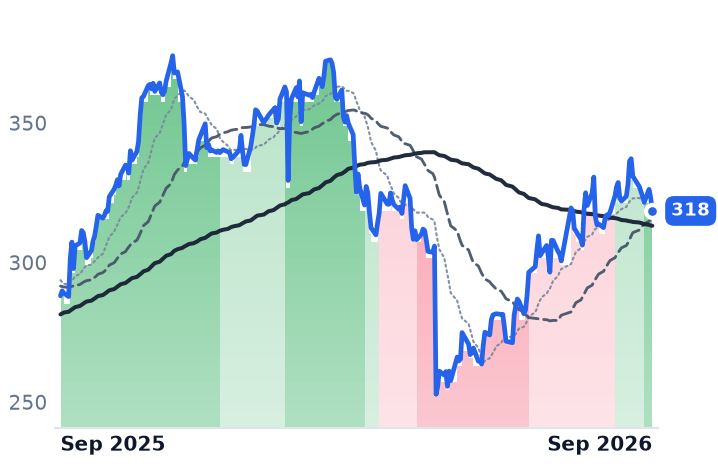
COR | Cencora | Pharmaceutical Distribution | 🟢 Cont. Bull | +0.7% | +10.5% |
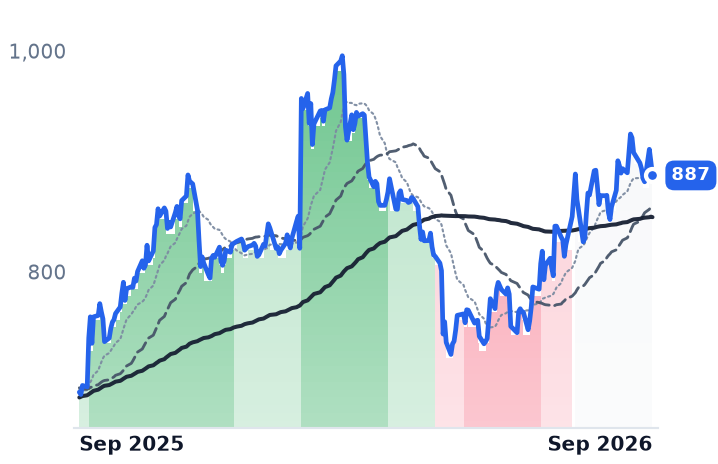
MCK | McKesson | Pharmaceutical Distribution | ⚠️ Emerging Bear | +2.1% | +28.4% |
| Compared against · context, not the story | |||||
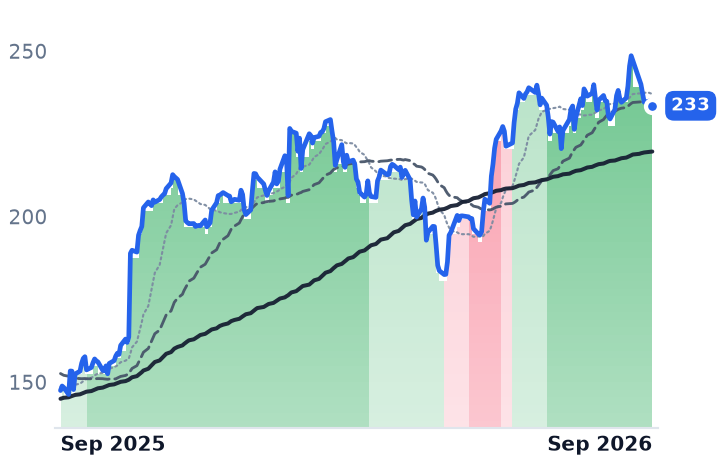
CAH | Cardinal Health | Pharmaceutical Distribution | 🟢 Cont. Bull | −0.6% | +58.3% |
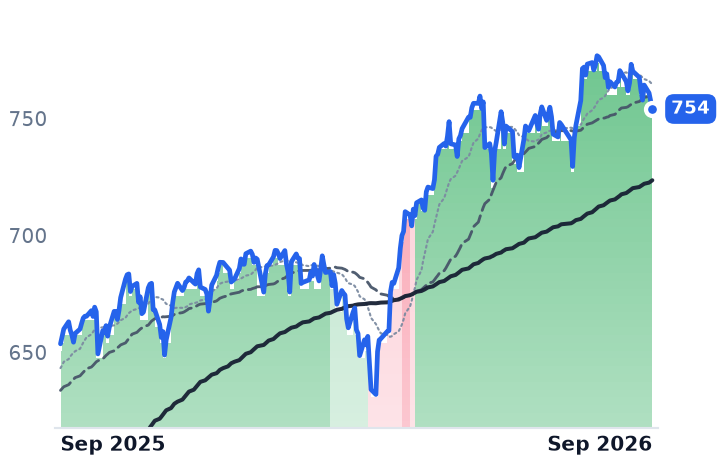
SPY | State Street SPDR S&P 500 ETF Trust | Asset Management | 🟢 Cont. Bull | −1.7% | +15.4% |
12-month price & trend
| Ticker | Mkt cap | P/E | P/E fwd | P/S | P/S fwd | P/GP | P/GP fwd | EV/EBITDA | FCF yld |
|---|---|---|---|---|---|---|---|---|---|
COR | $62.0B | 23.6x | 17.8x | 0.2x | 0.2x | 5.0x | 5.0x | 13.8x | 6.6% |
MCK | $103.9B | 23.6x | 19.9x | 0.3x | 0.2x | 6.9x | 6.6x | 15.5x | 6.0% |
CAH | $54.5B | 32.0x | 18.5x | 0.2x | 0.2x | 5.6x | 5.3x | 17.1x | 8.3% |
| Ticker | Mkt cap | P/E | P/E fwd | P/S | P/S fwd | P/GP | P/GP fwd | EV/EBITDA | FCF yld |
|---|---|---|---|---|---|---|---|---|---|
SPY | $773.0B | — | — | — | — | — | — | — | — |
Consensus projections
| Ticker | FY2026E | FY2027E | FY2028E | |
|---|---|---|---|---|
COR | Revenue | +5.1% | +4.5% | +4.9% |
| EPS | +12.2% | +10.8% | +10.7% | |
MCK | Revenue | +12.7% | +5.8% | +7.0% |
| EPS | +19.0% | +14.4% | +13.3% | |
CAH | Revenue | +14.6% | +3.9% | +6.3% |
| EPS | +31.5% | +16.4% | +12.3% |
Forward fiscal years only. Blank means no analyst coverage for that year.
Cencora moved 5% more drug revenue in the quarter ended June 30 and collected 36% more gross profit for doing it. That gap — $84.75bn of sales producing $3.607bn of gross profit, up from $2.66bn a year earlier — is the whole argument about what a pharmaceutical distributor now is.
Revenue at these companies says almost nothing. Cencora, which sources and ships branded, generic and specialty drugs to hospitals, pharmacies and physician offices, turned $321.3bn of fiscal 2025 revenue into $3.65bn of operating income — a 1.14% margin on pass-through volume. What earns money is the margin captured where the drug is administered, and the three big wholesalers have spent more than $16bn acquiring management services organizations that run practices in oncology, gastroenterology, ophthalmology and urology. In the buy-and-bill world, the practice pockets the spread between what it pays for a drug and what the payer reimburses — and owning the practice also redirects its purchasing to the new parent.
The old meter broke
The conventional account has distributors riding manufacturer list-price inflation through percentage-of-price fees. McKesson said on August 5 that over 95% of its branded drugs are now on fee-for-service terms, so January's list-price reductions hit revenue with negligible margin impact. That matters because 2026 is a year of branded deflation: manufacturers are cutting prices on at least 15 more drugs, between -25% and -85%, stripping $35-40bn of gross brand revenue. Generic oral solids are deflating at -13.4% year on year, yet both Cencora and Cardinal cited positive generics performance — the scale sourcing ventures are absorbing it.
GLP-1 weight-loss drugs cut the other way: enormous revenue at thin margin. Cencora's GLP-1 sales rose $2.3bn, up 25%; McKesson's ran $15bn in its June quarter. Cencora's adjusted gross margin still expanded 61 basis points to 4.16%, with OneOncology the named driver. "Overall OneOncology operating income is modestly better than our initial expectations," chief financial officer Eva Boratto told investors on August 5.
Three companies, one mechanism
McKesson, the largest of the three at a $103.9bn market value, grew Oncology & Multispecialty operating profit 41% to $405m, roughly 15% of that organic; its US Oncology Network reaches about 3,400 providers. Chief executive Brian Tyler pointed to a moat distribution alone cannot build: "SCRI participated in research that contributed to 43 of the 52 adult oncology drugs approved by the FDA in 2025." Cardinal Health bought Solaris Health, the largest US urology MSO, for about $1.9bn and lifted pharmaceutical segment profit 23% to $2.8bn for its fiscal year. Its medical products arm, a manufacturing business on different economics, contributed $258m and is guided lower still — too small to explain anything here.
What the market paid for it
All three peaked in March and fell into May — Cencora by 32%, McKesson 27%, Cardinal 23% — before recovering. Over twelve months Cardinal gained 57.4%, McKesson 28.0% and Cencora 9.8%, against 14.3% for the S&P 500.
Only one of those is paid for by earnings. Cencora's forward-year consensus rose 12.2%, more than covering its share gain, and it trades at 16.1x the fiscal 2027 consensus of $19.81. McKesson's estimates rose 16.3% against a 28% gain and it sits at 19.9x fiscal 2027's $44.63; Cardinal's rose 16.4% against 57%, leaving it at 18.5x. Because reported sales are pass-through, price against gross profit is the comparable measure: Cencora is cheapest at 5.02x trailing, McKesson dearest at 6.95x, a 38% premium only partly earned by converting more gross profit into operating income.
The verdict is that the operating story confirms at all three and the payment does not. The specialty capture is real and simultaneous; the re-rating was granted mostly to the two names whose earnings revisions were the smallest relative to their share gains.
The threats are dated, not vague. Section 232 tariffs of up to 100% on patented drugs reach all remaining importers on September 29; most-favored-nation deals now cover an estimated 86% of the US branded market and push manufacturers toward selling direct. So far those direct channels use other fulfilment partners — Eversana, Truepill, CenterWell — which is the point: the volume leaves the wholesaler without a fight. Owning the doctor is the one position that cannot be routed around, which is why it cost $16bn.