

Vicor Licensed Its Power Patents to an AI Customer That Can Buy the Modules Elsewhere
Hypothesis Opus 5 · Research Opus 5 · Writing Opus 5 · Prompt v1.6
Vicor's newest artificial-intelligence customer paid for permission rather than parts. The non-exclusive licence granted on 16 September covers the company's vertical power delivery patents and carries the right to source those modules from unlicensed suppliers — an earnings stream set by a legal calendar rather than by rack volumes.
Behind it the shipped business is compounding: one-year backlog up 145% year on year to $379.7m, gross margin recovered to 58.0%. But recognition of the newest licence drops from $15m in the June quarter to $5m in September before stepping to $10m a quarter, a sequential decline that owes nothing to demand.
Navitas, the other half of the same 800-volt trade, has produced no cumulative gross profit across four quarters and has pushed the date its silicon goes inside the compute tray to early 2028. One of these de-ratings is earned on the reported numbers; the other is harder to source.
| Ticker | Company | Segment | Trend · 13mo | 30D | 1Y |
|---|---|---|---|---|---|
| The subject · what this brief is about | |||||
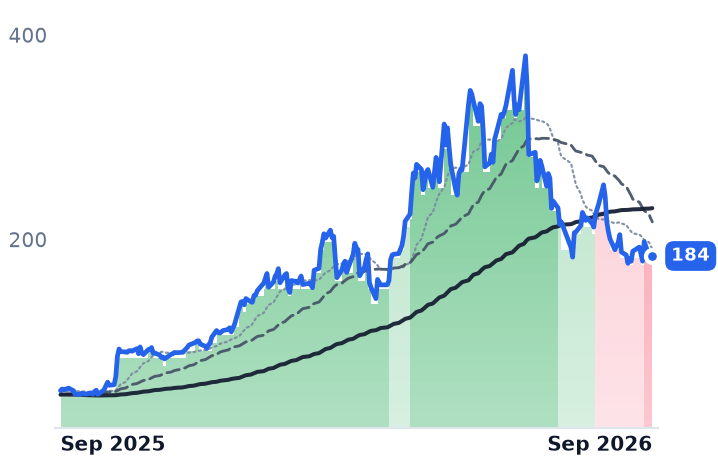
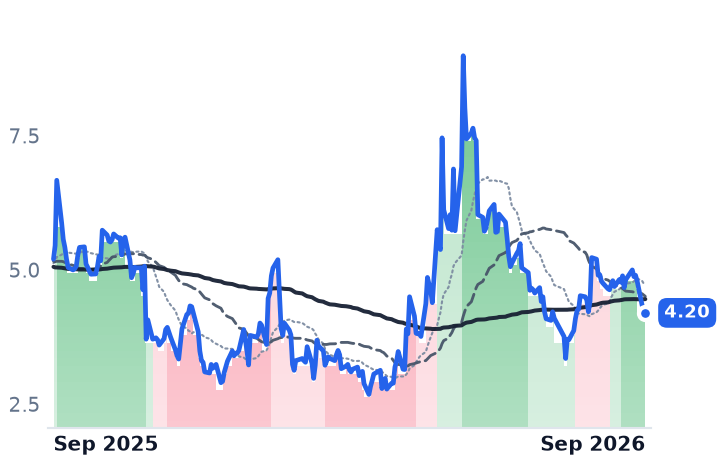
VICR | Vicor | Other | ⚠️ Emerging Bear | −24.1% | +252.3% |
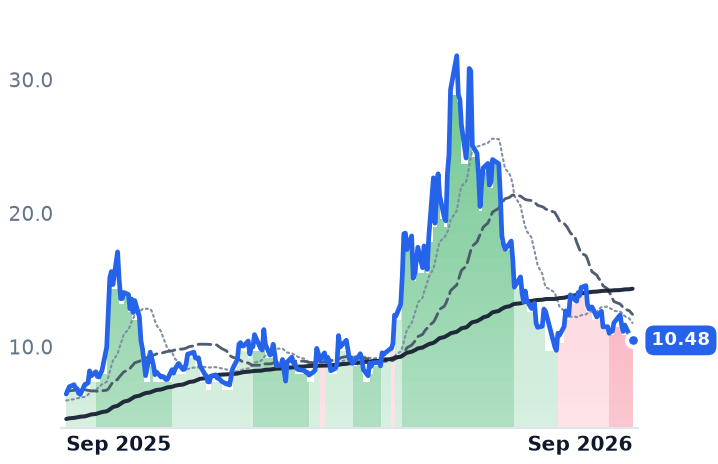
NVTS | Navitas Semiconductor | Other | ⚠️ Emerging Bear | −20.4% | +62.2% |
| Compared against · context, not the story | |||||
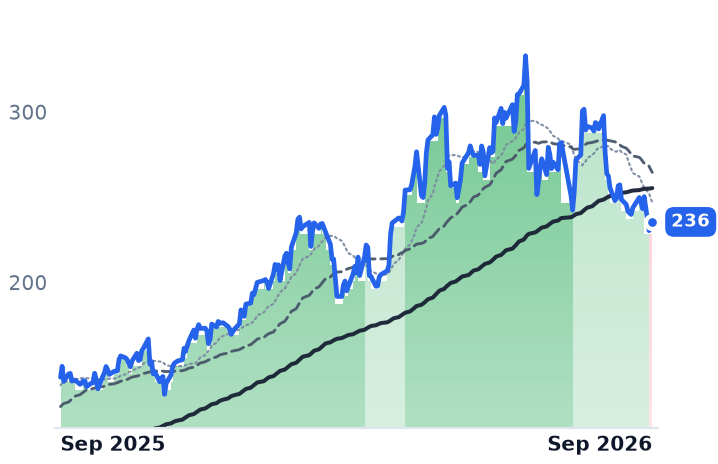
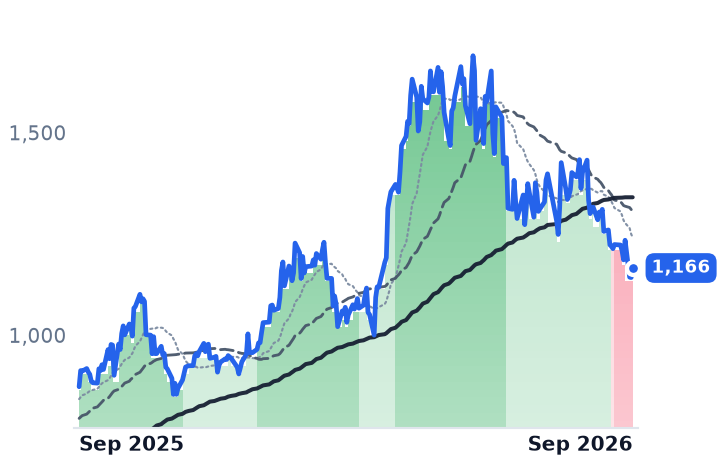
BELFB | Bel Fuse | Connectors & Interconnect Systems | 🟢 Cont. Bull | −14.7% | +63.1% |
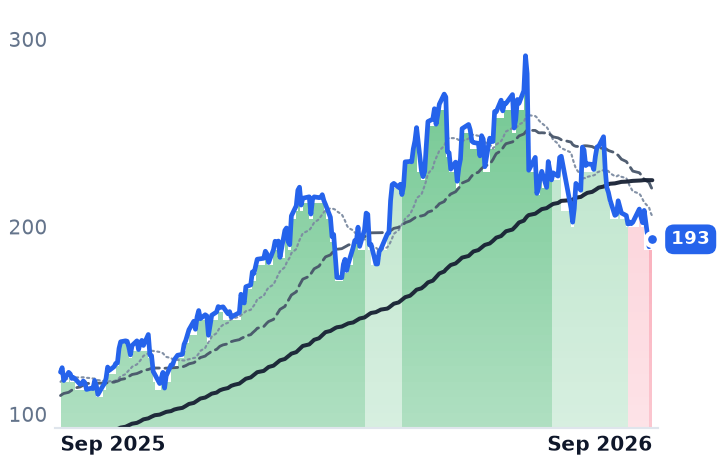
BELFA | Bel Fuse | Hardware, Equipment & Parts | ⚠️ Emerging Bear | −16.3% | +57.8% |
IPWR | Ideal Power | Semiconductors | 🌱 Emerging Bull | −14.3% | −19.2% |
MPWR | Monolithic Power Systems | Analog & Mixed-Signal | ⚠️ Emerging Bear | −12.5% | +33.6% |
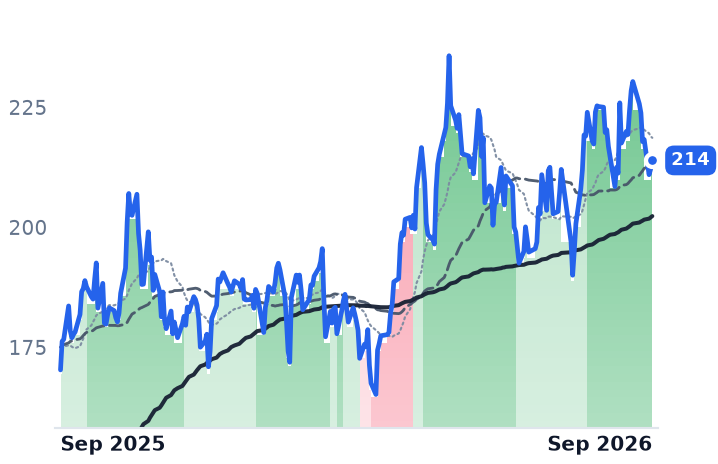
NVDA | NVIDIA | AI & Data Center GPUs | 🟢 Cont. Bull | −2.6% | +25.6% |
12-month price & trend
| Ticker | Mkt cap | P/E | P/E fwd | P/S | P/S fwd | P/GP | P/GP fwd | EV/EBITDA | FCF yld |
|---|---|---|---|---|---|---|---|---|---|
VICR | $8.3B | 57.7x | 53.5x | 17.6x | 13.8x | 31.1x | 24.4x | 61.8x | 0.6% |
NVTS | $2.7B | n/m | — | 74.9x | 57.4x | — | — | n/m | -2.5% |
BELFB | $2.8B | 58.6x | 23.9x | 3.8x | 3.5x | 9.7x | 8.9x | 19.8x | 2.6% |
| Ticker | Mkt cap | P/E | P/E fwd | P/S | P/S fwd | P/GP | P/GP fwd | EV/EBITDA | FCF yld |
|---|---|---|---|---|---|---|---|---|---|
BELFA | $3.4B | 69.0x | 24.6x | 4.5x | 4.2x | 11.4x | 10.7x | 23.6x | 2.2% |
IPWR | $63.9M | n/m | — | — | 79.8x | — | — | n/m | -14.8% |
MPWR | $56.1B | 69.7x | 41.7x | 17.1x | 13.5x | 31.1x | 24.5x | 54.5x | 1.0% |
| Ticker | Mkt cap | P/E | P/E fwd | P/S | P/S fwd | P/GP | P/GP fwd | EV/EBITDA | FCF yld |
|---|---|---|---|---|---|---|---|---|---|
NVDA | $5.5T | 34.3x | 25.0x | 21.5x | 13.9x | 29.0x | 18.7x | 28.3x | 2.2% |
Consensus projections
| Ticker | FY2026E | FY2027E | FY2028E | |
|---|---|---|---|---|
VICR | Revenue | +33.1% | +55.6% | +22.2% |
| EPS | +58.9% | +73.2% | +33.0% | |
NVTS | Revenue | +4.7% | +52.5% | +59.8% |
| EPS | −21.9% | −17.9% | −44.8% | |
BELFB | Revenue | +20.7% | +8.2% | +12.9% |
| EPS | +45.5% | +13.6% | +26.3% | |
BELFA | Revenue | +20.3% | +7.6% | +12.6% |
| EPS | +39.7% | +13.2% | +34.5% | |
IPWR | Revenue | +1500.0% | +0.0% | +975.0% |
| EPS | −31.5% | −18.8% | −20.3% | |
MPWR | Revenue | +49.2% | +28.7% | +20.2% |
| EPS | +54.8% | +31.0% | +20.2% | |
NVDA | Revenue | +65.1% | +84.2% | +43.2% |
| EPS | +59.0% | +91.7% | +42.0% |
Forward fiscal years only. Blank means no analyst coverage for that year.
Vicor's newest artificial-intelligence customer bought a permission slip. On 16 September the Andover, Massachusetts maker of modular power converters granted a non-exclusive licence over its vertical power delivery patents to what it described only as a leading AI original-equipment manufacturer. The licence lets that customer procure the covered modules from suppliers Vicor has not licensed — and eight days earlier Vicor had sued Monolithic Power Systems, the rival that took the Nvidia H100 power socket from it, in the US District Court for the Western District of Texas.
That is how this company is now paid. Vicor pioneered the topology that steps 800 volts down to the roughly six volts an accelerator wants in a single stage, and as rack currents climb past what the old twelve-volt chain can serve, the industry is migrating onto terrain Vicor patented. It collected $30.4m of royalty income in the June quarter, close to a fifth of core revenue, under a licensing wave forced by a February 2025 US International Trade Commission exclusion order that upheld two of its patents and barred importation of unlicensed computing systems containing infringing power modules. A second enforcement case is expected to reach final determination in 2027.
The shipped half is compounding
Strip out a one-time $45m patent settlement booked a year ago and core product-plus-royalty revenue grew 49.3% year on year to $143.4m in the June quarter. One-year backlog rose 26% sequentially to $379.7m, up 145% from a year earlier, with book-to-bill above one. Gross margin recovered 280 basis points sequentially to 58.0%, though management attributed that step to high-margin royalties rather than to product mix. On 11 September the company bought two New Hampshire sites — a 334,000 square foot building in Merrimack and 54 acres in Hooksett — for a pair of new fabs totaling nearly a million square feet. "Essentially sold out in terms of capacity for the foreseeable future," founder-chief executive Patrizio Vinciarelli told investors on the first-quarter call.
The September quarter will not show it. The newest licence pays $5m a quarter in year one and $10m in year two, but accounting recognition front-loaded $15m into June and leaves $5m for September before the $10m cadence begins — a roughly $10m sequential drop in the highest-margin line the company has, caused by termination clauses rather than by anything a customer did.
The option that has not shipped
Navitas Semiconductor, which sells gallium-nitride and silicon-carbide power devices into chargers, solar, industrial and increasingly data-center sockets, is the other name in this trade and the harder one to defend. Its reported line is actually inflecting — June revenue of $10.5m rose 22.5% sequentially, high-power revenue grew more than 50% year on year, and third-quarter guidance of $13.0m to $14.0m implies another 28% step. But four quarters to June produced roughly minus $0.6m of cumulative gross profit on a reported basis, so no earnings or gross-profit multiple exists; the stock changes hands at 74.9x trailing sales. And the one date the equity is priced against moved the wrong way: gallium-nitride conversion inside the compute tray, dated mid-to-late 2027 on the 27 July call, was dated to early 2028 at Citi's Global TMT conference on 8 September. "It would have happened without NVIDIA, it's happening much sooner due to their influence," chief executive Chris Allexandre said there of the 800-volt shift. In August Navitas committed up to roughly $232.8m to acquire Claros, a vertical-power-delivery developer — better than half the $373m it raised in July, spent on the socket rather than the runway.
What actually knocked them down
Nothing about rack timing. Three market-wide sessions did most of the damage: 28 July, when the Philadelphia Semiconductor Index fell for a fourth straight day and the Nasdaq 100 dropped 1.8% into correction on fears AI spending is peaking; 18–19 August, when the 30-year Treasury yield reached a 19-year high of 5.33%; and 14 September, when the semiconductor index fell 5.86% and Monolithic Power dropped about 7% on a note questioning its slot on Nvidia's next platform. The sorting was by valuation, not by end market. Bel Fuse, whose power and circuit-protection components grew 25.2% year on year at a 39.9% gross margin and which trades at 9.7x trailing gross profit, fell 8.0% on 14 September alongside the expensive names.
So the group's rollover is one mechanism with two very different bills. Navitas has de-rated from above 100x sales in May toward 75x, and that is earned: consensus does not see $200m of revenue before 2029, the gross profit is not there yet, and the date is drifting. Vicor's 42.6% three-month fall took it to 31.1x trailing gross profit and 24.4x forward, against 61.8x in mid-May — a multiple that was priced for perfection and no longer is, while backlog compounds and consensus models revenue up 55.6% next year. What the market appears to be marking down at Vicor is the September royalty hole and the AI-capex mood, not the order book.
The second enforcement case reaches final determination in 2027 — a year before Navitas now expects its silicon inside the tray. In the corner of semiconductors built on an architecture that has not shipped, the lawyers are running ahead of the racks.