

Vistra and NRG Are Paid by a Capped Auction and a Battery Glut, Not by Data-Center Load
Hypothesis Opus 5 · Research Opus 5 · Writing Opus 5 · Prompt v1.6
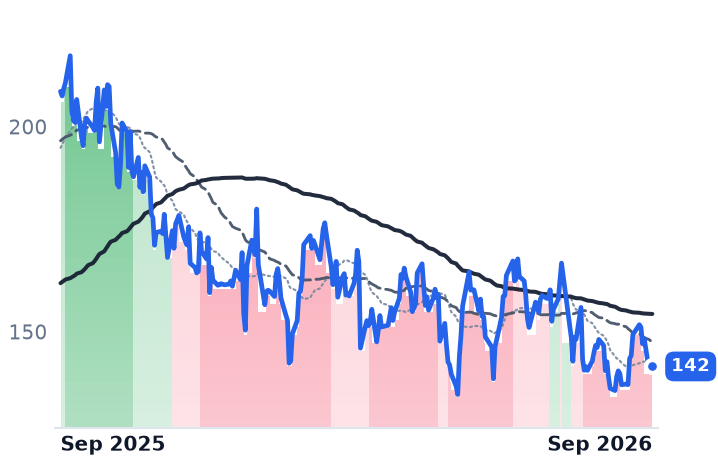
Two of the market's most direct listed bets on data-center electricity have lost about a third of their value in twelve months while their own forecasts never moved. Vistra's 2027 adjusted EBITDA range of $7.4bn-$7.8bn has been unchanged since November 2025, and both companies reaffirmed 2026 guidance.
The mechanism explains more of the gap than demand does. In Texas, battery saturation cut the intraday spreads merchant gas plants monetize roughly in half year on year; in PJM, the capacity auction cleared at its $325 per megawatt-day administrative cap for a third consecutive year. On 14 September both stocks gapped down with Oracle and Nvidia rather than with any power price.
The two are not the same claim: Vistra's data-center contracts carry dated delivery starts, while NRG's flagship plant has no final investment decision and no power before late 2029.
| Ticker | Company | Segment | Trend · 13mo | 30D | 1Y |
|---|---|---|---|---|---|
| The subject · what this brief is about | |||||
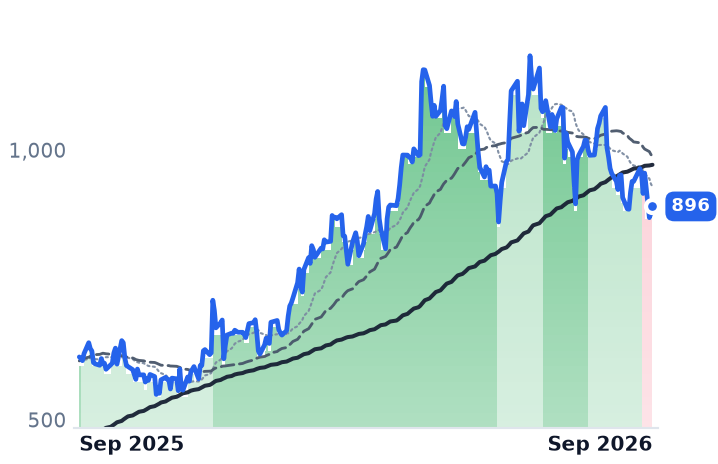
VST | Vistra | Integrated Retail & Generation | 🔴 Cont. Bear | −3.5% | −32.2% |
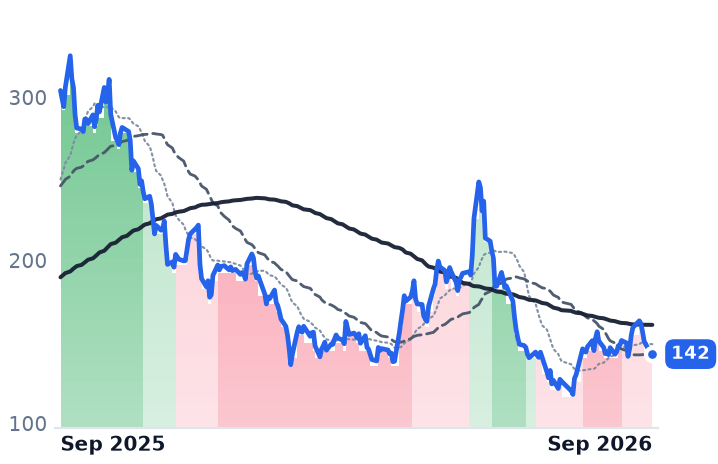
NRG | NRG Energy | Integrated Retail & Generation | 🔴 Cont. Bear | −12.2% | −34.0% |
| Compared against · context, not the story | |||||
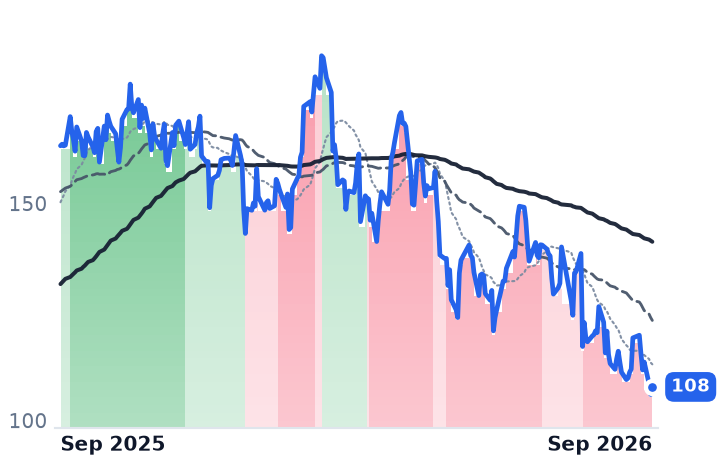
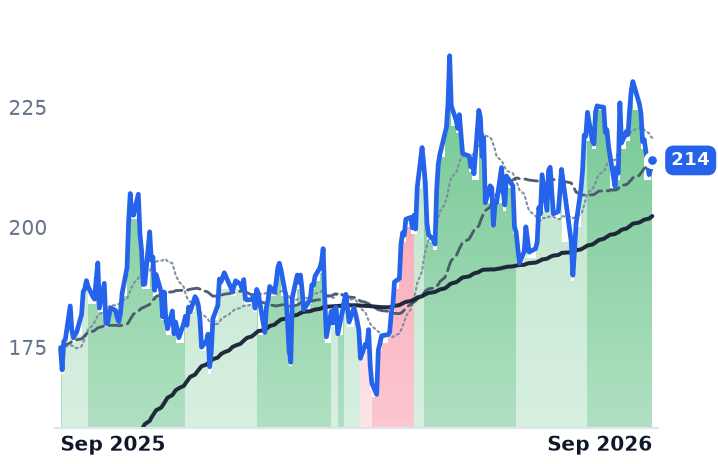
CEG | Constellation Energy | Diversified Renewable Generators | ⚠️ Emerging Bear | −6.2% | −19.0% |
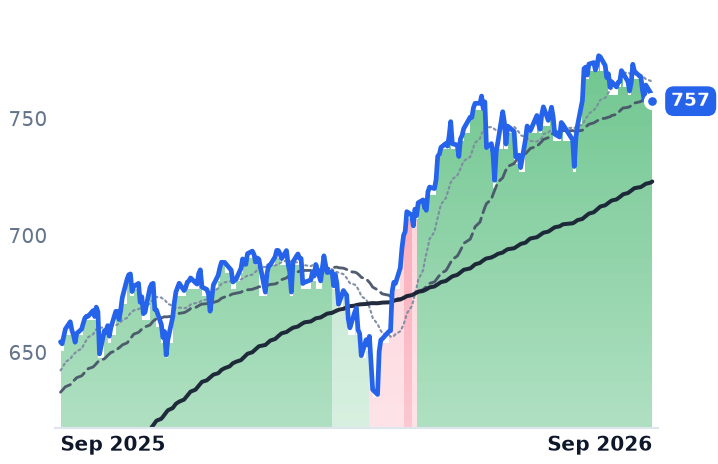
TLN | Talen Energy | Wholesale Power Producers | ⚠️ Emerging Bear | −20.1% | −30.0% |
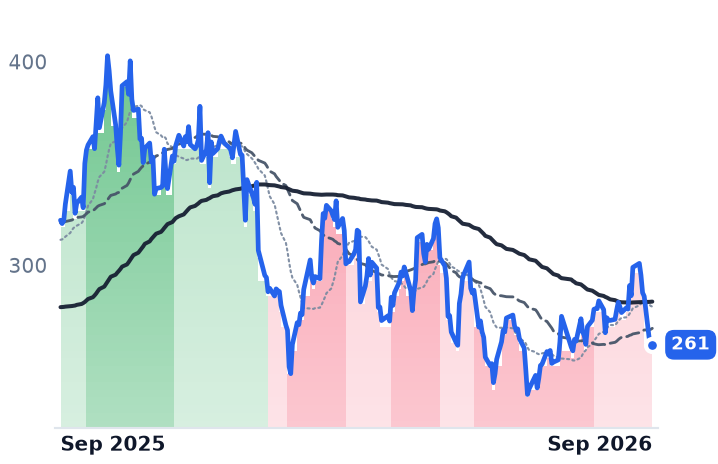
GEV | GE Vernova | GE Vernova Integrated | 🟢 Cont. Bull | −17.0% | +45.3% |
ORCL | Oracle | Cloud Infrastructure & Platforms | 🔴 Cont. Bear | −2.8% | −53.2% |
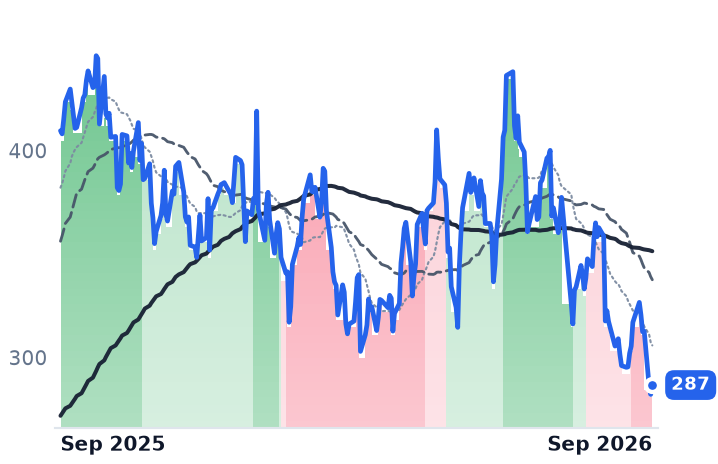
NVDA | NVIDIA | AI & Data Center GPUs | 🟢 Cont. Bull | −4.9% | +22.3% |
SPY | State Street SPDR S&P 500 ETF Trust | Asset Management | 🟢 Cont. Bull | −2.0% | +15.7% |
12-month price & trend
| Ticker | Mkt cap | P/E | P/E fwd | P/S | P/S fwd | P/GP | P/GP fwd | EV/EBITDA | FCF yld |
|---|---|---|---|---|---|---|---|---|---|
VST | $47.8B | 23.7x | 16.5x | 3.0x | 2.1x | 23.1x | 16.4x | 10.4x | 2.9% |
NRG | $22.8B | 28.2x | 12.1x | 0.6x | 0.6x | 3.8x | 4.0x | 10.9x | 1.5% |
CEG | $102.3B | 27.7x | 23.6x | 3.3x | 3.1x | 3.4x | 3.2x | 14.8x | 0.3% |
| Ticker | Mkt cap | P/E | P/E fwd | P/S | P/S fwd | P/GP | P/GP fwd | EV/EBITDA | FCF yld |
|---|---|---|---|---|---|---|---|---|---|
TLN | $14.2B | n/m | 15.2x | 4.0x | 3.2x | 9.0x | 7.2x | 29.6x | 3.6% |
GEV | $242.9B | 25.9x | 29.7x | 5.9x | 5.2x | 29.0x | 26.0x | 27.0x | 5.1% |
ORCL | $433.0B | 25.3x | 18.7x | 6.4x | 4.8x | 9.8x | 7.3x | 17.4x | -5.5% |
| Ticker | Mkt cap | P/E | P/E fwd | P/S | P/S fwd | P/GP | P/GP fwd | EV/EBITDA | FCF yld |
|---|---|---|---|---|---|---|---|---|---|
NVDA | $5.5T | 34.3x | 25.0x | 21.5x | 13.9x | 29.0x | 18.7x | 28.3x | 2.2% |
SPY | $773.0B | — | — | — | — | — | — | — | — |
Consensus projections
| Ticker | FY2026E | FY2027E | FY2028E | |
|---|---|---|---|---|
VST | Revenue | +16.7% | +9.3% | +4.7% |
| EPS | +80.0% | +18.7% | +18.0% | |
NRG | Revenue | +17.7% | +0.8% | +3.7% |
| EPS | +14.0% | +24.6% | +15.4% | |
CEG | Revenue | +36.6% | +2.6% | +5.5% |
| EPS | +28.7% | +10.1% | +26.3% | |
TLN | Revenue | +84.0% | +15.8% | +4.6% |
| EPS | +247.6% | +48.4% | +17.8% | |
GEV | Revenue | +23.9% | +14.8% | +15.0% |
| EPS | +321.7% | −19.5% | +40.7% | |
ORCL | Revenue | +17.8% | +33.2% | +45.5% |
| EPS | +25.3% | +7.6% | +35.6% | |
NVDA | Revenue | +65.1% | +84.2% | +43.2% |
| EPS | +59.0% | +91.7% | +42.0% |
Forward fiscal years only. Blank means no analyst coverage for that year.
No power-market datapoint landed on 14 September. Vistra's shares fell 5.16% that session and NRG's 4.40%, against less than half a percent for the S&P 500, while Constellation Energy, the largest US nuclear operator, dropped 7.09% and Talen Energy 8.38% — the same day chip shares sold off on worries about the pace of artificial-intelligence spending. Over the preceding week Oracle lost 13.9% from its 8 September close and Nvidia 6.0%. What moved the electricity companies was sentiment about their customer, not a price in any power market.
That is the problem with owning them as an artificial-intelligence trade. Vistra runs roughly 38,700 megawatts of nuclear, gas, coal, solar and battery capacity and sells power to about 4.3 million retail customers across 20 states; NRG serves some six million retail customers under the Reliant, Direct Energy and Green Mountain brands alongside its own fleet. Neither is paid for load growth. Each is paid by an auction clearing at an administrative cap, by a Texas spot market flooded with batteries, and by hedges struck years before delivery. Both reaffirmed guidance this year. Both have lost about a third of their value over twelve months.
The price is capped at one end and compressed at the other
On 22 July, with Texas supply tight, power cleared at $57 a megawatt-hour; Vistra's management said it could have cleared $400 to $500 had batteries not been competing into the same hours. Across the Electric Reliability Council of Texas grid, the intraday spreads merchant gas plants monetize fell about 50% year on year by June and ancillary-service prices 45%, with federal projections putting Texas battery capacity at 37 GW by the end of 2027.
At the other end sits PJM Interconnection, the mid-Atlantic grid operator, whose capacity auction for the 2028/29 delivery year cleared at the $325 per megawatt-day price cap for a third consecutive auction — 2.5% below the prior year's $333.44 — while PJM's own simulation put the uncapped clearing price at $555 and the auction still left the system roughly 6.8 GW short of its reserve-margin target. Scarcity is being rationed by rule rather than paid to generators. NRG says less than half of about 2 GW of upgrades it could make to its PJM plants would be economic even at $555.
Vistra sold the recovery already
Vistra had sold forward about 94% of expected 2027 generation and 72% of 2028. Second-quarter adjusted EBITDA rose about 30% to $1.77bn with the generation segment up 68%, and the 2027 opportunity range of $7.4bn-$7.8bn first set in November 2025 still stands, now trending to its lower end as the Texas forward curve fell. Downside is bounded: the section 45U nuclear production tax credit phases out only above $25 a megawatt-hour and disappears at $43.75, converting weak prices into a federal transfer.
Its data-center business is contracted rather than announced: 2,609 MW to Meta from PJM nuclear plants with deliveries starting in late 2026, and 1,200 MW to Amazon Web Services from Comanche Peak beginning late 2027. After Governor Greg Abbott ordered an audit of every data center in the Texas interconnection queue on 3 August — some 474 GW of requests, about 90% of them data centers — chief executive Jim Burke said that "baseload projects, because they've been studied, you'd expect those to be moving forward," and that "2026 wholesale power prices being soft is not that big of a surprise" to the company.
NRG earns more when power is cheap
NRG's second-quarter adjusted EBITDA rose 34% to $1.2bn, but $370m of that was the first full quarter of the acquired LS Power fleet; adjusted earnings per share fell to $1.49 from $1.73 and gross margin to 14.5% from 16.5%. Texas EBITDA dropped $131m as round-the-clock Houston power averaged $33 a megawatt-hour against a $52 planning assumption. The offset is subscription income — Smart Home customers grew 8% to 2.45 million — and the fact that roughly half of the Texas margin base is a retail spread that widens as wholesale prices fall. 2026 guidance of $5.325bn-$5.825bn was reaffirmed.
The growth story is later and less certain. Its 1.2 GW, $3.2bn hyperscaler plant has aligned commercial terms but no final investment decision, with commercial operation targeted for late 2029; more than 95% of its free cash flow would come from fixed capacity payments, and the company's leverage target has slipped to 2029 to fund it. "This is the model for how large load growth should work," said Robert Gaudette, its chief executive. "The customer supports the investment, with reliability and affordability protected for all." NRG closed at $105.99 on 15 September, a fresh 52-week low.
What the de-rating actually removed
Vistra trades near 10x trailing enterprise value to EBITDA and NRG marginally above it, against nearly 15x for Constellation. Vistra's reported earnings are distorted by hedge marks — 2025 diluted earnings were $2.21 a share against $7.00 in 2024 — which is why 16.5x forward earnings sits against 23.7x trailing; NRG is the cheapest of the three on forward earnings at 12.1x.
So the businesses did not deteriorate; the premium did. Both guidance sets held through the twelve months in which the shares lost a third, and the 14 September session shows the pair moving with Oracle and Nvidia rather than with any megawatt-hour. But the two are not one claim. Vistra has already sold 2027, so a firmer power curve cannot reach its margin before 2028, while contracted nuclear deliveries and the tax-credit floor limit how far the downside goes. NRG has been marked down for a price move that helps half its Texas book, and its compensation for the other half does not begin until late 2029. Meanwhile GE Vernova, which sells the turbines this same demand requires, is up 44.9% over twelve months: investors are paying for the equipment and marking down the electrons.
The first Meta megawatt-hours are due to leave Perry and Davis-Besse before this year is out. That delivery, not an interconnection queue, is the test.