

Ambarella Guided Growth Down to 10% as Memory Makers Shorted Its Customers' Orders
Hypothesis Opus 5 · Research Opus 5 · Writing Opus 5 · Prompt v1.6
The shortage that has made DRAM the most profitable product in semiconductors is reaching Ambarella from the wrong side: its customers cannot get the memory that sits beside its chips. Device makers are receiving half to two-thirds of the memory volumes they ordered, and automotive memory supply is meeting under half of demand.
Ambarella guided the October quarter to a $119.5m midpoint, about 10% growth and a sixth consecutive deceleration from 31.2% a year ago, missed its own gross-margin range at 59.3%, and flagged explicit fourth-quarter volume risk. The shares have given back the entire NXP takeover premium and more.
The de-rating is real but it is not a verdict on edge inference: CEVA raised full-year guidance and fell 39% in three months, and Lattice, whose revenue grew 62%, fell harder still.
| Ticker | Company | Segment | Trend · 13mo | 30D | 1Y |
|---|---|---|---|---|---|
| The subject · what this brief is about | |||||
AMBA | Ambarella | Specialty Semiconductors | 🟢 Cont. Bull | −18.6% | −19.3% |
CEVA | CEVA | Specialty Semiconductors | 🌱 Emerging Bull | −16.1% | +14.6% |
| Compared against · context, not the story | |||||
LSCC | Lattice Semiconductor | Specialty Semiconductors | 🟢 Cont. Bull | −21.0% | +61.8% |
INDI | indie Semiconductor | RF & Wireless | 🔴 Cont. Bear | −38.1% | −19.7% |
NXPI | NXP Semiconductors | Analog & Mixed-Signal | ⚠️ Emerging Bear | −4.6% | +3.3% |
12-month price & trend
| Ticker | Mkt cap | P/E | P/E fwd | P/S | P/S fwd | P/GP | P/GP fwd | EV/EBITDA | FCF yld |
|---|---|---|---|---|---|---|---|---|---|
AMBA | $2.8B | n/m | 78.0x | 6.6x | 6.2x | 11.3x | 10.7x | n/m | 0.3% |
CEVA | $774.8M | n/m | 50.7x | 6.7x | 6.2x | 7.7x | 7.1x | n/m | -0.1% |
LSCC | $14.6B | 402.0x | 49.9x | 22.4x | 15.8x | 33.1x | 23.4x | 166.5x | 1.5% |
| Ticker | Mkt cap | P/E | P/E fwd | P/S | P/S fwd | P/GP | P/GP fwd | EV/EBITDA | FCF yld |
|---|---|---|---|---|---|---|---|---|---|
INDI | $638.1M | n/m | — | 2.8x | 2.4x | 12.8x | 11.1x | n/m | -13.1% |
NXPI | $56.9B | 19.1x | 15.0x | 4.3x | 4.0x | 7.7x | 7.1x | 13.2x | 5.2% |
Consensus projections
| Ticker | FY2026E | FY2027E | FY2028E | |
|---|---|---|---|---|
AMBA | Revenue | +39.8% | +13.1% | +12.0% |
| EPS | −311.1% | +35.0% | +31.2% | |
CEVA | Revenue | +14.3% | +13.0% | +12.8% |
| EPS | +31.8% | +45.2% | +36.4% | |
LSCC | Revenue | +2.3% | +76.6% | +45.1% |
| EPS | +11.9% | +103.0% | +50.7% | |
INDI | Revenue | +23.1% | +33.2% | +30.4% |
| EPS | −38.3% | −110.8% | +1093.0% | |
NXPI | Revenue | +16.7% | +11.5% | +8.3% |
| EPS | +28.0% | +20.5% | +15.3% |
Forward fiscal years only. Blank means no analyst coverage for that year.
A rationing notice, not a demand signal
Ambarella designs low-power processors that fold video compression, image processing and computer vision onto one chip, sold to the makers of internet-protocol security cameras, dashcams, driver-assistance modules and robots. It neither buys nor resells a byte of memory. Its customers do, and they are being told they cannot have as much as they asked for: with suppliers shifting wafers toward high-bandwidth memory for artificial-intelligence accelerators under long-term hyperscaler agreements, major device makers are receiving only half to two-thirds of the volumes they ordered, and automotive memory supply is meeting under half of global demand.
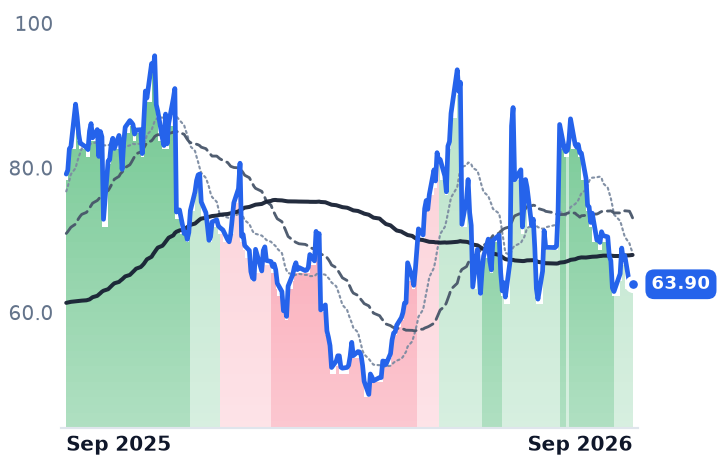
That matters because of how an edge-inference dollar is actually earned. Ambarella is paid content per device multiplied by devices its channel partners ship — and it controls only the first term. However much artificial-intelligence silicon it wins per camera, a customer that can build two-thirds of its planned units buys two-thirds of the chips. Management named memory-driven customer ordering behavior as an explicit revenue risk for the January quarter, and guided October revenue to $115.0m–$124.0m. The $119.5m midpoint implies about 10% growth — the sixth consecutive step down from 31.2% a year earlier.
The quarter underneath
July-quarter revenue of $108.1m grew 13.2%, automotive set a record on commercial vehicles, and the operating loss narrowed to $8.1m from $22.0m: the cost line is behaving. The damage is above it. Non-GAAP gross margin of 59.3% landed below Ambarella's own guided 59%–60.5% range and below 60.5% a year earlier, on supply costs management tied to memory scarcity, and inventory days rose to 157 from 145 — a deliberate pre-build ahead of memory price increases, against 99 days a year ago. A cancelled automotive autonomy development program cost a further $9m.
The offsets bill later. Chief executive Fermi Wang, sizing two new seven-year channel partnerships on the September 3 call, said: "When we talk to both CapGemini and Macnica, the range of revenue we are expecting from this collaboration is $0.5 billion with each one of them" — with meaningful revenue two to three years out. The X7 accelerator is sampling; the 2nm CV8 expects first production revenue in fiscal 2028.
The premium is gone
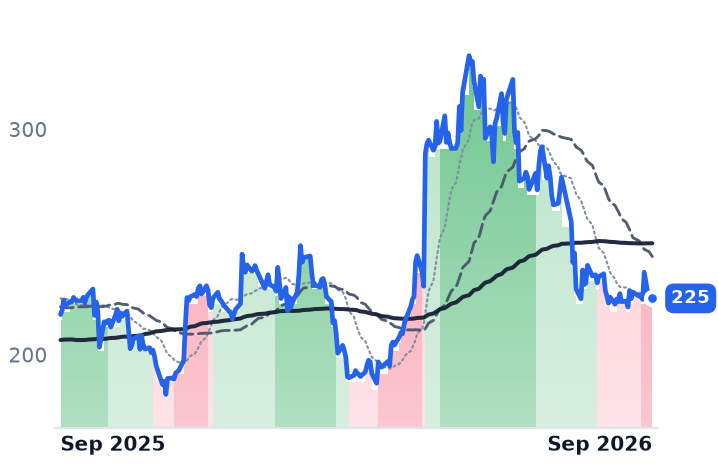
Ambarella jumped 16.1% on July 31, to $86.00 from $74.09, after the Financial Times reported NXP Semiconductors was in talks to buy it for more than $3bn; no update confirming or ending those talks has surfaced. At $63.90 on September 16 the shares sit 13.8% below the pre-report price. Four brokers cut after the print, including Craig-Hallum's downgrade to Hold with a $70 target and Bank of America's move to $70 from $96.
Both Ambarella and its comparators lose money on a reported basis and their gross margins differ by nearly thirty points, so price against gross profit is the measure that travels. Ambarella now trades at 11.31x trailing and 10.71x forward gross profit, against roughly 13.7x a year ago and 14.8x at its August 7 peak — the first genuine compression in a year. It still carries 78x forward earnings on consensus of $0.80, a multiple priced for acceleration.
What did not hold up
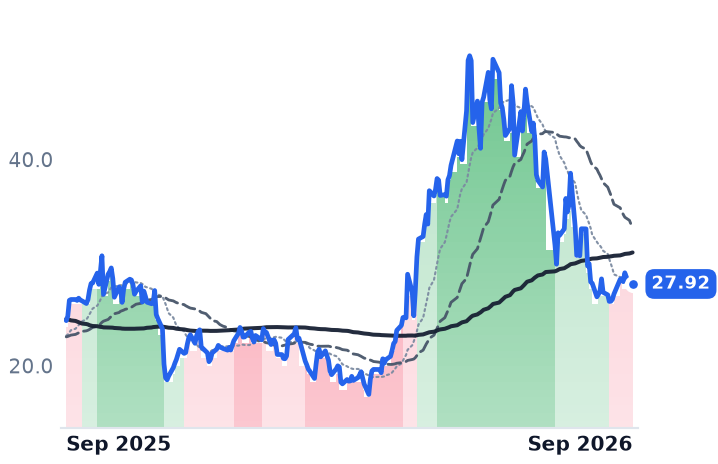
CEVA, which sells no silicon and licenses digital-signal-processor and neural-accelerator designs for an upfront fee plus a per-chip royalty, is the unit meter. Its licensees shipped 567m chips in the June quarter, up 16% — and produced royalty revenue of $10.8m, up 1%, as mix shifted to low-rate Wi-Fi while higher-earning Bluetooth fell. Licensing rose 21% to a three-year-high $18.2m and full-year growth guidance went up to 13%–15% from 12%. "We are seeing increasing demand for our technologies across AI, connectivity, and sensing," chief executive Amir Panush said on August 10. The shares are down 39% in three months, at 7.10x forward gross profit — still above the roughly 5.9x of a year ago, so the fall is unwinding a June re-rating the royalty line never earned.
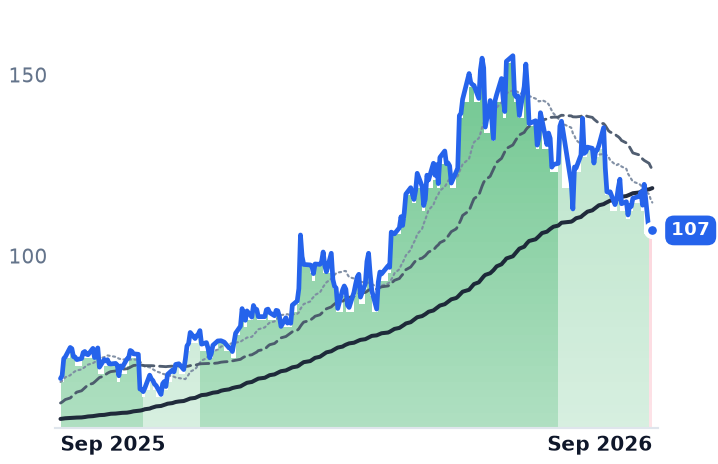
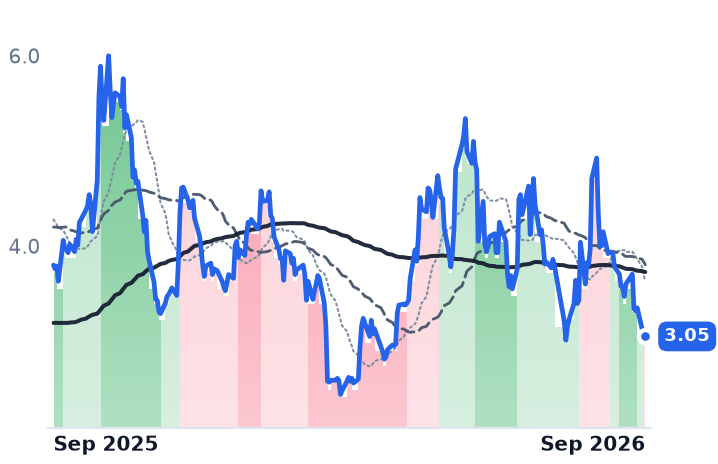
The breadth argues against reading any of this as a verdict on edge inference. Lattice Semiconductor, whose June quarter grew 62% on artificial-intelligence data-center demand and whose backlog management called "pretty much booked" into 2027, fell 25.4% over three months — harder than either edge name, from the richest starting multiple at 23.42x forward gross profit. indie Semiconductor fell 38.1% in thirty days on 24% revenue growth and no disclosed order deterioration; its memory-less vision chips are winning designs because of the shortage. All four dropped together in the September 14 chip-stock selloff that followed public calls from leading AI executives to slow frontier model development, with no company news at any of them.
The verdict
Ambarella's decline is the most earned of the four: a sixth guided deceleration, a self-inflicted margin miss, rising inventory and the evaporation of a takeover bid that may never have had a price. What nothing in the business explains is why a company raising guidance trades 39% lower in a quarter, or why the fastest grower fell hardest — the likelier reading there is a small- and mid-cap semiconductor de-rating that did not discriminate. The useful reframing is that edge inference and data-center inference now compete for the same wafers, and the edge is losing: the binding constraint on Ambarella and CEVA over the next four quarters is not how much intelligence a camera contains but how many cameras get built.
Wang told investors the X7 needs only four megabytes of memory to run a large language model. The problem was never what Ambarella's chip requires. It is what the chip beside it now costs, and whether it arrives at all.