

J.B. Hunt Guided Third-Quarter Earnings Down 5% to 10% as Fuel Surcharges Lagged Diesel
Hypothesis Opus 5 · Research Opus 5 · Writing Opus 5 · Prompt v1.6
Record diesel is being paid twice on the same container, and only one of the two carriers gets to charge for it straight away. At Morgan Stanley's Laguna Conference on 15 September, J.B. Hunt's finance chief told investors third-quarter earnings would fall sequentially on $25m of driver-related costs and a surcharge formula that resets slower than fuel; the shares closed 11.9% lower the next day.
Nothing in the reported numbers foreshadowed it. Second-quarter revenue rose 19.4% and intermodal loads set a company record. The same $6.285-a-gallon diesel is pushing boxes onto rail, where CSX lifted volumes 6% and cut its operating ratio to 61.7%. Yet measured against trailing operating income, J.B. Hunt still fetches 23.3x versus CSX's 17.9x — the market pays a premium for the spread over the track.
| Ticker | Company | Segment | Trend · 13mo | 30D | 1Y |
|---|---|---|---|---|---|
| The subject · what this brief is about | |||||
CSX | CSX | Class I Railroads | 🟢 Cont. Bull | −5.3% | +48.6% |
JBHT | J.B. Hunt Transport Services | Truckload & LTL | 🟢 Cont. Bull | −15.1% | +75.3% |
| Compared against · context, not the story | |||||
UNP | Union Pacific | Class I Railroads | 🟢 Cont. Bull | −5.8% | +32.3% |
NSC | Norfolk Southern | Class I Railroads | 🟢 Cont. Bull | −6.3% | +16.0% |
ODFL | Old Dominion Freight Line | Less-Than-Truckload (LTL) | 🟢 Cont. Bull | −16.7% | +20.5% |
SAIA | Saia | Less-Than-Truckload (LTL) | ⚠️ Emerging Bear | −9.9% | +5.6% |
XPO | XPO Logistics | Truckload & LTL | ⚠️ Emerging Bear | −16.7% | +29.7% |
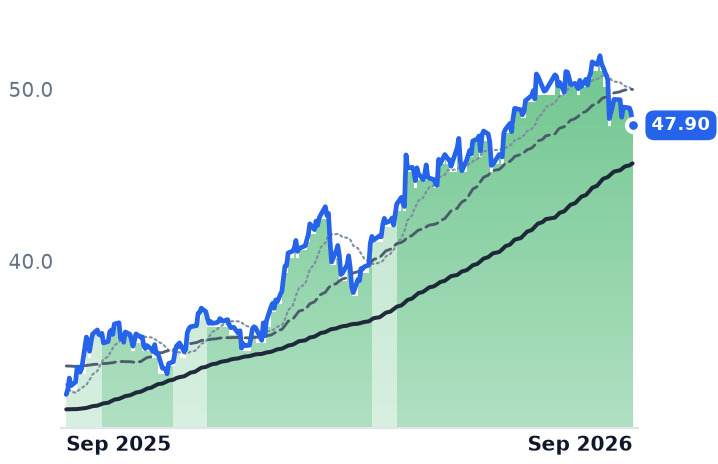
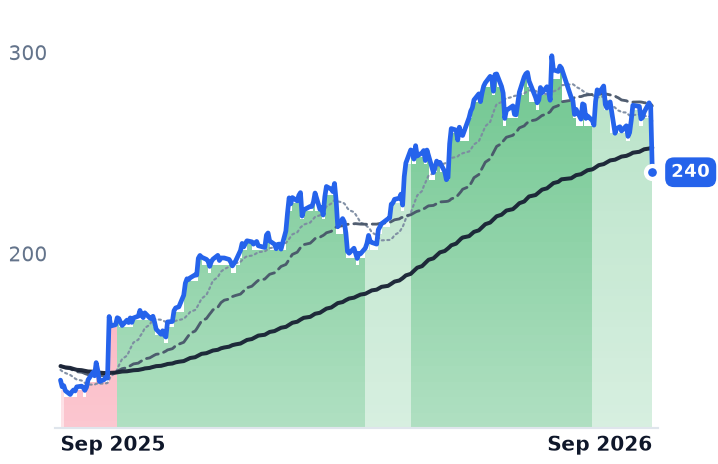
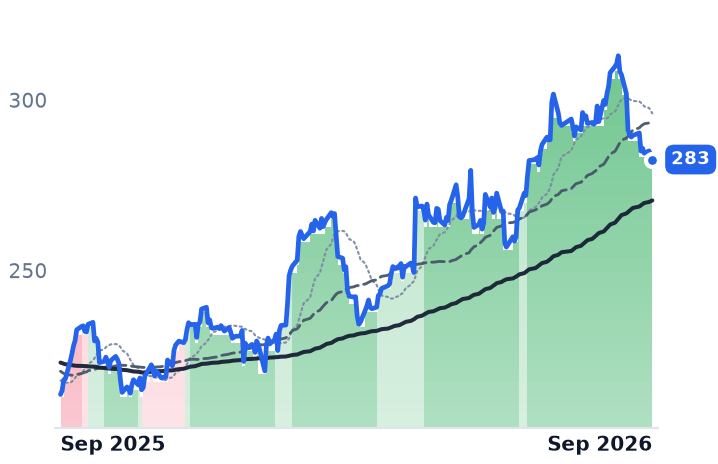
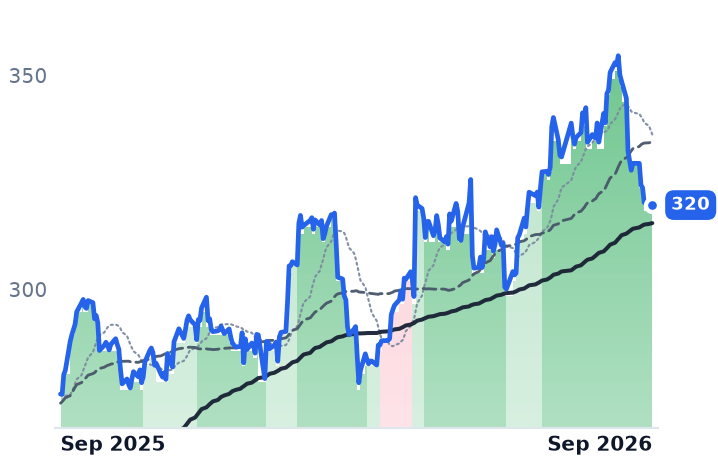
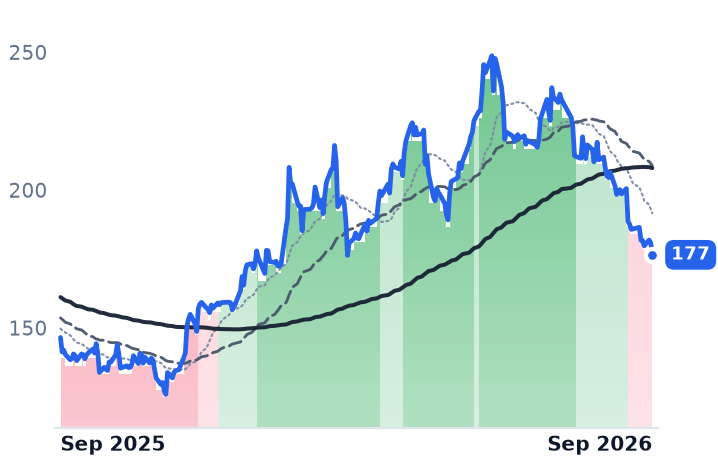
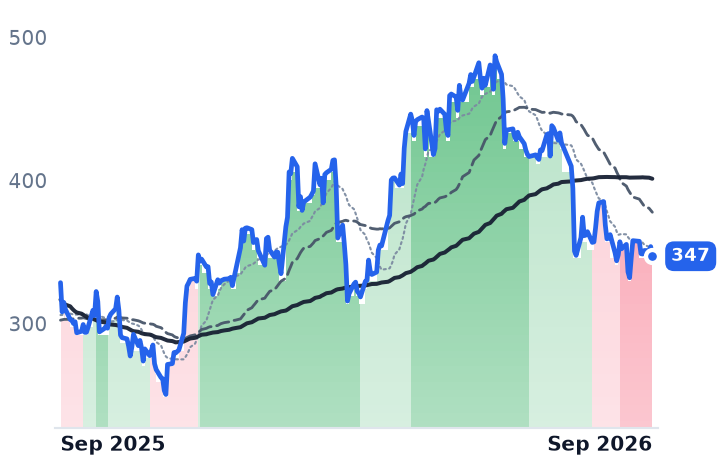
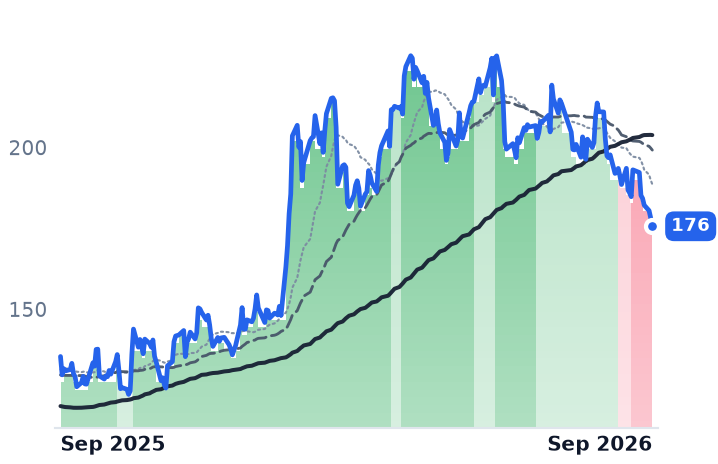
12-month price & trend
| Ticker | Mkt cap | P/E | P/E fwd | P/S | P/S fwd | P/GP | P/GP fwd | EV/EBITDA | FCF yld |
|---|---|---|---|---|---|---|---|---|---|
CSX | $88.7B | 27.7x | 23.9x | 6.1x | 5.8x | 11.1x | 10.6x | 16.0x | 5.7% |
JBHT | $22.2B | 33.6x | 30.2x | 1.8x | 1.6x | 10.8x | 10.0x | 14.3x | 4.9% |
UNP | $174.5B | 23.7x | 22.5x | 6.9x | 6.5x | 15.1x | 14.3x | 15.3x | 3.7% |
| Ticker | Mkt cap | P/E | P/E fwd | P/S | P/S fwd | P/GP | P/GP fwd | EV/EBITDA | FCF yld |
|---|---|---|---|---|---|---|---|---|---|
NSC | $75.1B | 28.5x | 26.0x | 6.0x | 5.7x | 11.2x | 10.6x | 16.7x | 5.1% |
ODFL | $43.9B | 40.6x | 36.3x | 7.8x | 7.4x | 24.7x | 23.5x | 24.0x | 2.5% |
SAIA | $10.3B | 37.0x | 33.8x | 3.0x | 2.8x | 18.8x | 17.6x | 16.5x | 2.5% |
| Ticker | Mkt cap | P/E | P/E fwd | P/S | P/S fwd | P/GP | P/GP fwd | EV/EBITDA | FCF yld |
|---|---|---|---|---|---|---|---|---|---|
XPO | $24.7B | 61.5x | 39.3x | 2.9x | 2.7x | 22.6x | 21.5x | 22.1x | 2.4% |
Consensus projections
| Ticker | FY2026E | FY2027E | FY2028E | |
|---|---|---|---|---|
CSX | Revenue | +7.6% | +5.0% | +3.7% |
| EPS | +22.6% | +13.3% | +10.4% | |
JBHT | Revenue | +13.9% | +9.2% | +7.8% |
| EPS | +29.6% | +29.7% | +19.2% | |
UNP | Revenue | +9.0% | +4.4% | +9.3% |
| EPS | +11.6% | +8.5% | +10.8% | |
NSC | Revenue | +8.0% | +4.3% | +4.5% |
| EPS | +7.1% | +11.0% | +9.7% | |
ODFL | Revenue | +7.5% | +7.8% | +8.7% |
| EPS | +21.0% | +14.2% | +15.3% | |
SAIA | Revenue | +12.1% | +7.7% | +8.1% |
| EPS | +22.0% | +25.4% | +20.2% | |
XPO | Revenue | +11.3% | +5.2% | +6.8% |
| EPS | +48.8% | +19.1% | +21.1% |
Forward fiscal years only. Blank means no analyst coverage for that year.
On Tuesday 15 September, at Morgan Stanley's 14th Annual Laguna Conference, J.B. Hunt Transport Services' chief financial officer told investors that third-quarter earnings would come in 5% to 10% below the second quarter, weighed down by roughly $25m of incremental driver recruiting and bonus costs and at least $10m of sequential fuel headwind. The shares closed at $240.50 the next day, down 11.9%.
What broke was a formula, not a freight market. J.B. Hunt — which runs intermodal, dedicated trucking, brokerage, final-mile and truckload operations, owning about 105,000 containers and trailers but moving them over other companies' rail track — bills customers a fuel surcharge that resets on a lag. Diesel has been rising faster than the resets, so the company pays the bill first and collects later. "Some of the most radical and abnormal swings in fuel prices…we have ever seen," is how Brad Delco, chief financial officer and executive vice president of finance, described the quarter at Laguna.
The same gallon, two different meters
On-highway diesel reached a record $6.285 a gallon in the weekly Department of Energy series this month, passing the June 2022 peak. That input is a cost at the intermediary and a demand pull at the railroad: rail burns far less fuel per ton-mile, so expensive diesel moves freight out of trucks and into containers on flatcars.
CSX, the Class I railroad operating roughly 19,500 route miles east of the Mississippi, is on the receiving end. Second-quarter revenue was a record $3.94bn, up 10%, with the operating ratio improving to 61.7% from 64.1%; operating income rose 17.4% on that 10.1% revenue gain, and the operating margin reached 38.3%. Volume did the work — 1.68 million units, 6% more than a year earlier, with intermodal up 9%. "Our railroaders successfully managed substantial volume growth while maintaining a consistent focus on safety and productivity," chief executive Stephen Angel said on 22 July. Price did less: revenue per unit rose 4%, but excluding fuel it fell 1%, because cheap intermodal boxes grew fastest. Terminal dwell worsened 6% to 11.0 hours on the extra volume.
J.B. Hunt's own reported quarter gave no warning. Revenue rose 19.4% to $3.495bn and operating income 31.5%; intermodal set a record 578,072 loads with gross revenue per load up 11%, and the dedicated fleet earned $5,635 per truck per week, 9.1% more than a year earlier. The asset-light legs were gaining rate, not losing it. The guidance implies about $1.77 of third-quarter earnings per share against a $2.10 consensus — a gap in the forecast rather than in the results.
What each side is paid for
The valuations split the same way. CSX trades at 27.7x trailing earnings, essentially the 27.4x of May, so a 47.5% twelve-month share gain is earnings rather than re-rating; the 23.9x forward multiple embeds a further 22.6% step-up. J.B. Hunt has de-rated from 42.0x in May to 33.6x. Yet on price against trailing operating income — the margins are too far apart for a sales comparison — CSX sits near 17.9x and J.B. Hunt near 23.3x even after the fall.
The merger that supposedly underwrites CSX is slower than the tape. The Surface Transportation Board set its schedule on 18 August for the Union Pacific–Norfolk Southern application: comments due 18 November, final briefs 28 May 2027, hearing unscheduled. CSX and BNSF each moved for summary denial on 6 August. CSX's shares barely registered the schedule, dipping 0.7% and recovering within two sessions.
So the verdict is narrower than a freight-cycle call. CSX's advance is bought with margin and volume, and the merger is optionality dated to 2027, not a driver of this year's move. J.B. Hunt's markdown is a timing cost — surcharges catch up by construction — but the second-quarter book that justified 42x has not returned, and consensus still models $7.836 of earnings per share for the year, a number set before Laguna. The contagion went sideways, not down the track: Old Dominion, Saia and XPO had already rolled into downtrends in late August and early September, while CSX fell 1.6% on the day of the warning.
If diesel retreats, J.B. Hunt gets its surcharge lag back as a tailwind and CSX loses the fuel component that lifted its intermodal revenue per unit 16%. The two are short the same barrel on opposite sides.