

dLocal Grew Payment Volume 92% and Its Gross Margin Fell to 31.8%
Hypothesis Opus 5 · Research Opus 5 · Writing Opus 5 · Prompt v1.6
Two payment companies are paid in spreads rather than in transaction counts, and their spreads are moving in opposite directions. dLocal, which moves money for global platforms across emerging markets, reported record gross profit in the June quarter — but its take fell to 0.72 cents on each dollar moved, from 1.07 cents a year earlier.
Shift4's blended spread went the other way, widening to 65 basis points, and its shares are still down 48% over twelve months because $4.5bn of acquisition debt doubled interest expense and forced a cut to its own profit guidance. The business explains Shift4's de-rating better than it explains dLocal's recovery: the market pays roughly 3.5 times as much for a dollar of dLocal's gross profit as for Shift4's.
| Ticker | Company | Segment | Trend · 13mo | 30D | 1Y |
|---|---|---|---|---|---|
| The subject · what this brief is about | |||||
FOUR | Shift4 Payments | Payment Processing & Fintech | 🔴 Cont. Bear | +2.5% | −47.6% |
DLO | Dlocal | Payment Processing & Fintech | ⚠️ Emerging Bear | +6.4% | +4.8% |
| Compared against · context, not the story | |||||
MQ | Marqeta | Payment Processing & Fintech | 🌱 Emerging Bull | +4.1% | +181.6% |
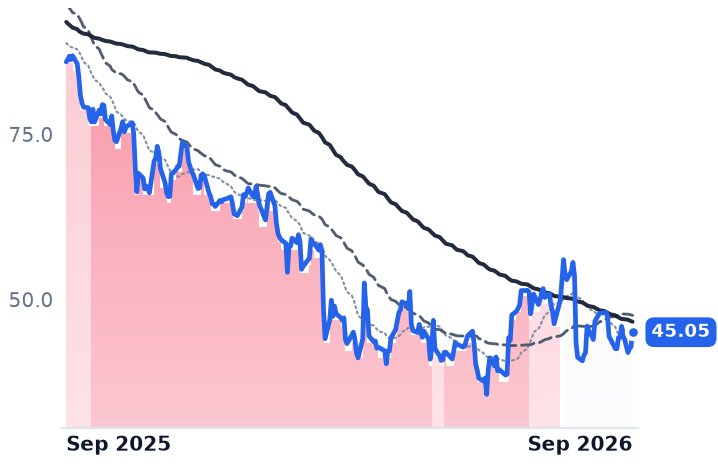
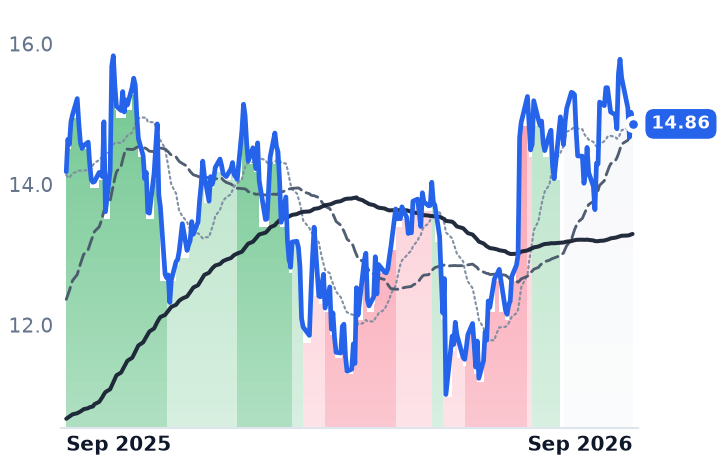
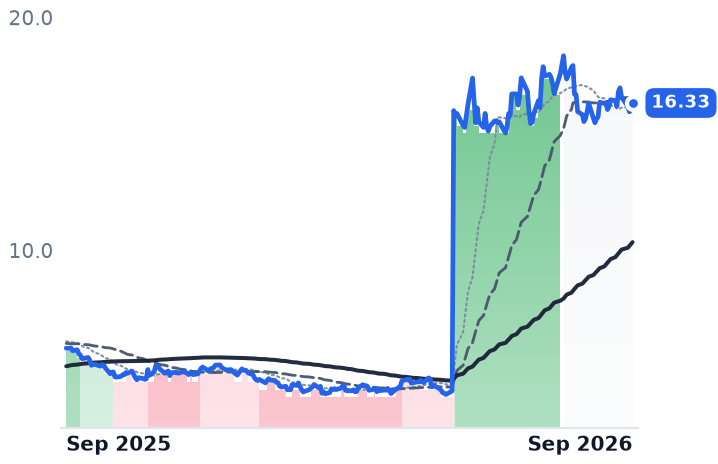
12-month price & trend
| Ticker | Mkt cap | P/E | P/E fwd | P/S | P/S fwd | P/GP | P/GP fwd | EV/EBITDA | FCF yld |
|---|---|---|---|---|---|---|---|---|---|
FOUR | $4.1B | 71.0x | 7.1x | 0.9x | 0.8x | 2.4x | 2.3x | 9.1x | 12.5% |
DLO | $4.4B | 21.5x | 17.9x | 3.2x | 2.8x | 9.4x | 8.1x | 13.8x | 9.7% |
MQ | $1.6B | 166.6x | 73.5x | 2.4x | 2.3x | 4.1x | 4.0x | 34.9x | 10.7% |
Consensus projections
| Ticker | FY2026E | FY2027E | FY2028E | |
|---|---|---|---|---|
FOUR | Revenue | +23.7% | +11.0% | +24.4% |
| EPS | +22.5% | +24.8% | +2.7% | |
DLO | Revenue | +49.2% | +29.6% | +23.3% |
| EPS | +22.8% | +31.2% | +22.2% | |
MQ | Revenue | +13.5% | +14.5% | +14.3% |
| EPS | −261.8% | +127.0% | +52.7% |
Forward fiscal years only. Blank means no analyst coverage for that year.
dLocal moved $17.7bn through its emerging-market payment rails in the June quarter, nearly double a year earlier, and earned less on each of those dollars than at any point in its public life. The Montevideo-based company, which collects and disburses money in Brazil, Argentina, Mexico, Nigeria and dozens of other markets for ride-hailing, streaming, e-commerce and remittance platforms, reported record gross profit of $127m. It also reported a gross margin of 31.8%, down 6.7 percentage points from a year earlier.
That gap is the whole story of what a payments company actually sells. Neither dLocal nor Shift4 is paid for transactions; both are paid a spread on the value that passes through them, and the spread is the only line that tells you whether winning more volume makes the owner richer. On that meter the two are diverging — and the divergence, not the volume growth, is what the market has been repricing.
The take that keeps shrinking
dLocal's gross profit per dollar of total payment volume has fallen from 1.16% in the June quarter of 2024 to 1.07% in 2025 to 0.718% now — a one-third decline in a single year. The annual pattern is older and unbroken: gross margin was 53.4% in 2021 and 36.8% last year. The mechanism is mix. Local-to-local flows, where dLocal never converts currency, reached 61% of volume, up six points; the cross-border business it is displacing carries the foreign-exchange spread on converting a merchant's collections out of reais or pesos, which is where much of the old margin lived. Volume is also concentrating in a handful of enormous customers who price accordingly.
"Were you to back out that one very large ride-hailing merchants mix gains at a lower take rate, take rate would have been relatively flat sequentially," chief executive Pedro Arnt told investors on the August 13 call. Revenue rose 55.8% to $400m; operating income rose 12.2%. Management raised full-year volume growth guidance to 60–70% and gross profit growth to 25–30%, but left operating profit growth at 27.5–32.5%. At the Goldman Sachs technology conference on September 10, Arnt said take rates are falling across the payments industry and faster in emerging markets, which started higher — a deceleration, not a reversal.
The spread that widened, and the debt that ate it
Shift4, the Allentown acquirer that sells card acceptance and its SkyTab point-of-sale system to restaurants, hotels and stadiums, has the opposite problem. Its reported revenue of $1.295bn is not what it earns — strip the interchange and network fees it passes to the card networks and $624m remains. On $61bn of end-to-end volume it earned a blended 65 basis points, or 65 cents per $100 processed, against 63 cents on $50bn a year earlier, with a mix shift toward smaller merchants offsetting enterprise pricing pressure.
What broke was below the spread. Gross profit rose 52.5%; operating income rose 14.3%; net income fell 35.3% to $22m. Organic growth in revenue less network fees was 11%, meaning most of the headline came from acquisitions — chiefly Global Blue, the $2.5bn tax-free-shopping refund business that takes a commission and a currency conversion on tourist spending, a demand curve with nothing in common with an American restaurant. Interest expense more than doubled to $65m on $4.52bn of debt, with net leverage at 3.7x against a self-imposed 3.75x cap. Guidance came down roughly $40m at the midpoint on that interest and $20m more on currency, to non-GAAP earnings of $5.15–5.35 a share.
"We can grow meaningfully without adding a single new customer," chief executive David Lauber said on the August 6 call, describing the conversion of merchants already running Shift4 software onto its own processing rails. The market's answer came the same week: the shares fell 22.9% in two sessions. They are down 48% over twelve months, and the recent 7% bounce starts from that floor. dLocal, by contrast, sits 6% below its 52-week high.
What each spread is worth
Shift4 trades at 2.3x forward gross profit and 9.1x trailing earnings before interest, taxes, depreciation and amortization, with a trailing free-cash-flow yield of 12.5%; dLocal at 8.1x forward gross profit and 13.8x EBITDA. For the same unit of economics — a dollar kept after the cost of moving money — dLocal costs three and a half times more. Shift4's 7.1x forward earnings rests on a consensus estimate of $6.36, above management's own guidance; against the company's midpoint it is nearer 8.6x. Analysts still average a $60.86 target while cutting it, Truist to $46 and Goldman Sachs to $49.
The verdict splits cleanly. Shift4's de-rating is earned, but by the balance sheet rather than the business: the spread widened, the volume grew 22%, and leverage taken on to buy a tourist-refund business converted all of it into interest. dLocal's re-rating is the harder one to defend — the dollars are real and rising, the guidance was raised twice, but every incremental dollar arrives thinner, and the market is paying a premium multiple for a company whose unit economics have halved since 2021.
dLocal's fastest volume growth since 2022 bought it 28.6% more gross profit. Whatever the next doubling buys is the number that settles this.