

Affirm Borrows at 5.8% to Hold $9.56bn of Loans; Klarna Funds 90% of Its Book With Deposits
Hypothesis Opus 5 · Research Opus 5 · Writing Opus 5 · Prompt v1.6
Two lenders sell the same instalment plan at the same checkout and pay for it in opposite ways — and in the past month that, rather than anything happening to borrowers, decided which one the bond market could reach.
Affirm kept $9.56bn of loans on its own balance sheet against $3.3bn of funding debt at an average 5.8% cost of money, so a one-year-high ten-year Treasury yield lands directly in its earnings. Klarna, a licensed Swedish bank, funds roughly 90% of its book with about $13bn of consumer deposits, and the curve never touches it.
Both businesses improved. Affirm's June-quarter gross-profit line grew 39% to $589m, or 4.2% of volume, with 30-day delinquencies down to 2.5%. Klarna's transaction-margin dollars rose 42% to $446m and provisions fell a third straight quarter — yet its shares sit near an all-time low at 2.04x forward gross profit against Affirm's 6.40x. Deposit funding wins on cost; the American checkout wins on price.
| Ticker | Company | Segment | Trend · 13mo | 30D | 1Y |
|---|---|---|---|---|---|
| The subject · what this brief is about | |||||
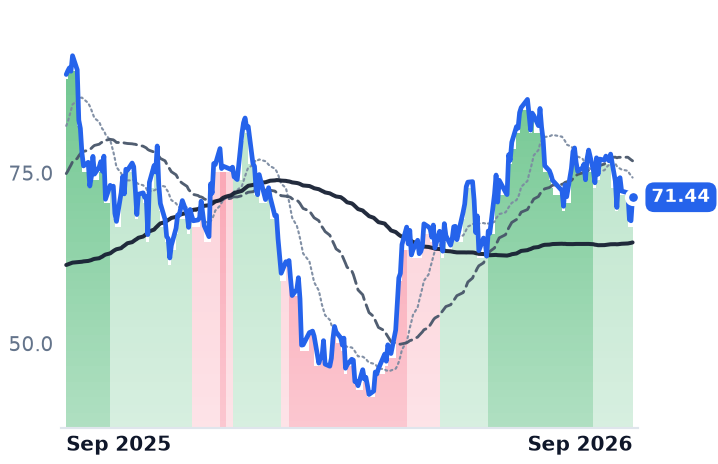
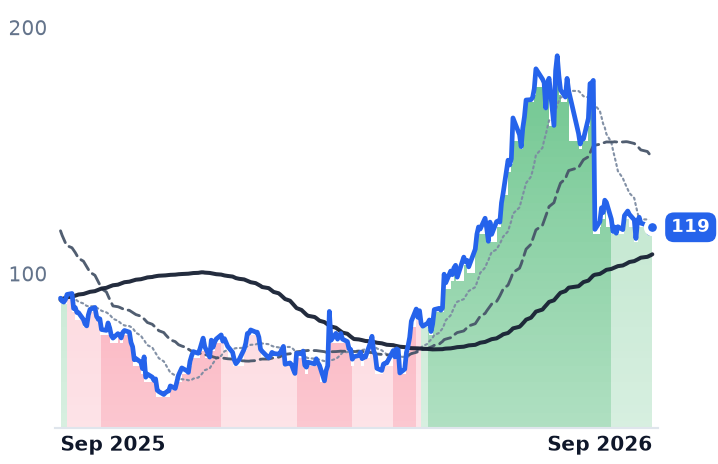
AFRM | Affirm | Consumer Fintech & Lending | 🌱 Emerging Bull | −8.8% | −20.1% |
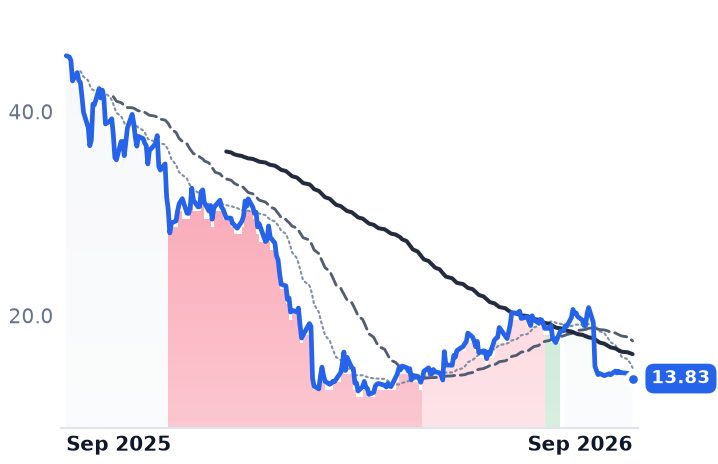
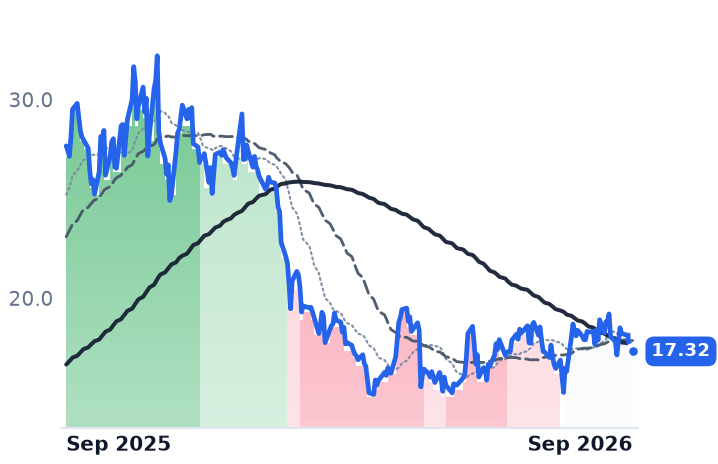
KLAR | Klarna | Consumer Fintech & Lending | 🔴 Cont. Bear | −33.5% | −69.6% |
| Compared against · context, not the story | |||||
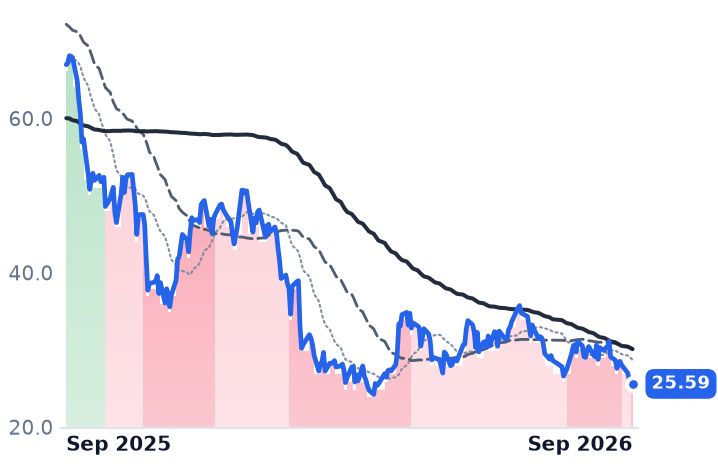
UPST | Upstart | Digital Payments & Fintech Platforms | 🔴 Cont. Bear | −15.9% | −61.8% |
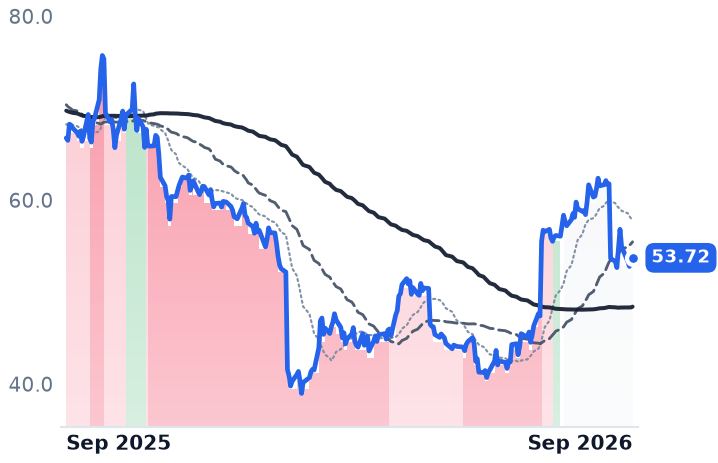
PYPL | PayPal | Digital Payments & Fintech Platforms | 🔴 Cont. Bear | −12.9% | −19.5% |
SEZL | Sezzle | Digital Payments & Fintech Platforms | 🌱 Emerging Bull | −7.8% | +32.0% |
SOFI | SoFi Technologies | Digital Payments & Fintech Platforms | 🔴 Cont. Bear | −5.3% | −37.4% |
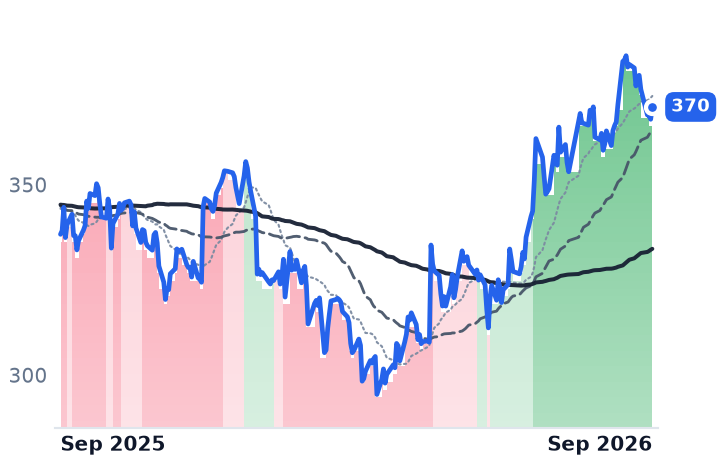
V | Visa | Payment Networks | 🌱 Emerging Bull | +1.7% | +9.9% |
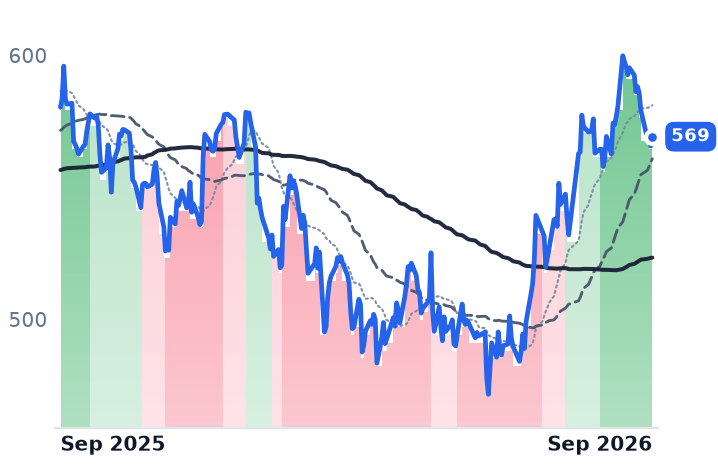
MA | Mastercard Incorporated | Payment Networks | 🌱 Emerging Bull | −0.0% | −1.9% |
12-month price & trend
| Ticker | Mkt cap | P/E | P/E fwd | P/S | P/S fwd | P/GP | P/GP fwd | EV/EBITDA | FCF yld |
|---|---|---|---|---|---|---|---|---|---|
AFRM | $23.9B | 12.5x | 36.2x | 5.7x | 4.4x | 8.4x | 6.4x | 25.0x | 4.2% |
KLAR | $5.2B | n/m | — | 1.3x | 1.3x | 2.1x | 2.0x | 18.9x | -72.7% |
UPST | $2.7B | 45.1x | 40.2x | 2.1x | 1.9x | 2.2x | 2.0x | 48.8x | -11.1% |
| Ticker | Mkt cap | P/E | P/E fwd | P/S | P/S fwd | P/GP | P/GP fwd | EV/EBITDA | FCF yld |
|---|---|---|---|---|---|---|---|---|---|
PYPL | $39.2B | 8.0x | 8.4x | 1.2x | 1.1x | 2.5x | 2.5x | 5.8x | 14.1% |
SEZL | $3.3B | 22.5x | 19.4x | 6.9x | 5.6x | 7.8x | 6.3x | 17.3x | 7.2% |
SOFI | $20.0B | 34.5x | 26.0x | 3.9x | 4.3x | 5.1x | 5.6x | 20.4x | -12.6% |
| Ticker | Mkt cap | P/E | P/E fwd | P/S | P/S fwd | P/GP | P/GP fwd | EV/EBITDA | FCF yld |
|---|---|---|---|---|---|---|---|---|---|
V | $624.4B | 28.0x | 24.8x | 14.5x | 13.7x | 17.9x | 16.9x | 22.5x | 3.4% |
MA | $436.7B | 28.3x | 25.1x | 12.9x | 11.8x | 15.5x | 14.2x | 21.1x | 4.1% |
Consensus projections
| Ticker | FY2026E | FY2027E | FY2028E | |
|---|---|---|---|---|
AFRM | Revenue | +32.0% | +30.5% | +24.5% |
| EPS | +2220.4% | +59.1% | +45.1% | |
KLAR | Revenue | +18.4% | +14.1% | +15.5% |
| EPS | −101.4% | +5132.8% | +79.5% | |
UPST | Revenue | +37.1% | +30.9% | +28.7% |
| EPS | −58.2% | +163.5% | +60.1% | |
PYPL | Revenue | +3.2% | +4.1% | +4.4% |
| EPS | −1.0% | +8.6% | +9.0% | |
SEZL | Revenue | +32.4% | +27.0% | — |
| EPS | +51.5% | +27.4% | — | |
SOFI | Revenue | +31.3% | +22.3% | +23.6% |
| EPS | +64.3% | +34.3% | +26.0% | |
V | Revenue | +14.1% | +10.6% | +10.3% |
| EPS | +14.9% | +13.3% | +13.0% | |
MA | Revenue | +13.2% | +12.6% | +12.2% |
| EPS | +19.3% | +15.9% | +16.0% |
Forward fiscal years only. Blank means no analyst coverage for that year.
Two companies sell the same thing at the same checkout — an instalment plan on a several-hundred-dollar purchase — and pay for the money in opposite ways. Affirm borrows it in the capital markets. Klarna, a licensed Swedish bank headquartered in London, takes it from depositors. Over the past month that one structural difference, rather than anything happening to borrowers, decided which of the two the bond market could reach.
Affirm has spent the year keeping more of what it originates. Loans held for investment reached $9.56bn gross at 30 June against $7.03bn a year earlier, while funding debt doubled to $3.3bn, according to its fiscal-2026 annual report. Its average annualised cost of funds was 5.8% in the March quarter, down about 1.3 percentage points year over year as it repriced warehouse lines and upsized a securitisation to $750m from $500m, the company told shareholders. Hold a book that size and the long end of the curve becomes an operating input. When the ten-year Treasury yield touched a one-year high of 4.79%, Affirm fell about 5% alongside SoFi on 1 September, while Robinhood, which carries no loans, sat still. Across the thirty days to 11 September the balance-sheet lenders all fell — Upstart 12.2%, PayPal 8.7%, Affirm 6.3% — while Visa and Mastercard, which lend nothing, rose.
The borrower data did not move
Nothing in Affirm's June quarter explains a de-rating. Gross merchandise volume rose 36% to $14.1bn and revenue less transaction costs — the company's own gross-profit line, capturing gain-on-sale and servicing — grew 39% to $589m, or 4.2% of volume, so the take rate widened as the volume grew. Thirty-day delinquencies on monthly instalment loans improved to 2.5% from the 2.7%–2.8% of the prior three quarters. Amazon, at 22% of volume, signed a five-year renewal, and top-five partner concentration eased to 44% from 47%.
The exposed seam is the merchant-subsidised 0% offer, where a retailer pays the discount and the lender eats the funding. Underwriting those loans is "really, really hard science," chief executive Max Levchin said on the fiscal fourth-quarter call, where small errors produce "a lot of unprofitable transactions." That 0% volume grew 30% in the March quarter against 52% for pay-in-four. Chief financial officer Rob O'Hare guided fiscal-2027 take rates to roughly this year's level — explicitly on the assumption that funding costs and funding mix hold.
The bank that the curve cannot touch
Klarna funds about 90% of its book with roughly $13bn of consumer deposits, alongside a debit and banking franchise Affirm does not have. Its June-quarter transaction-margin dollars grew 42% to $446m on revenue up 27% and volume up 18%; provisions fell to 0.52% of volume, a third consecutive quarterly decline; the company posted a $9m profit, its first as a listed firm. "Three years ago, our transaction margin did not cover our adjusted operating cost," chief financial officer Niclas Neglen said on the 18 August call. "Today, roughly $0.56 of every additional transaction margin dollar reaches the operating line."
The shares fell 22% the next session and have ground lower since, to $13.83 — within $1.56 of their all-time closing low and some 65% below the September 2025 offer price. The cause was the top line, not the credit line: full-year volume guidance was cut to $149–151bn from more than $155bn on weak German discretionary retail and about $600m of adverse currency, as the company disclosed. UBS moved to Neutral with a $16 target and Morgan Stanley cut to $17. Consensus now has 2026 revenue growth at 18.4% against 31.6% delivered in 2025, and both the finance and marketing chiefs leave in early 2027.
Price-to-earnings is unusable for either — Affirm's fiscal-2026 net income was inflated by a one-off deferred-tax release, and Klarna's 2026 consensus earnings round to a cent. Against gross profit, Affirm trades at 8.39x trailing and 6.40x forward, down from roughly 9.6x trailing in mid-August because the profit base stepped up faster than the price. Klarna trades at 2.04x forward gross profit and 1.26x forward sales.
What each side earns
The pair answers its own test unevenly. Deposit funding plainly wins on cost, and Klarna's improving loss rates prove the product is not the problem — yet it is the capital-markets-funded lender that carries a threefold premium, because Affirm's volume is compounding in America at 36% while Klarna's largest market is shrinking in dollars. Affirm's 41% advance from March is earned by the take rate and the delinquency line; the last three weeks' give-back is not, and tracked the ten-year with no company news behind it. Its 5% rebound on 11 September came on 4.5m shares against the 29.0m traded after earnings, which is an unwind rather than a re-rating.
Klarna has now said substantially all new US and German Fair Financing originations from the second half of 2026 will be fair-valued and sold — the forward-flow model Affirm built, adopted by the one lender that did not need it. The bank is learning to sell its loans just as the borrower is learning what it costs to keep them.