

Bill Ackman Wants Howard Hughes 'Disproportionately an Insurance Holding Company'
Hypothesis Opus 5 · Research Opus 5 · Writing Opus 5 · Prompt v1.6
A master-planned community developer is being converted into a reinsurer, and the market is marking the conversion down rather than the land. Howard Hughes closed a $2.1bn all-cash purchase of Bermuda specialty re/insurer Vantage Group in June, funded partly with $1bn of preferred stock issued to Pershing Square, and management says every incremental dollar of real-estate cash flow goes to Vantage next.
The property meters did not break. Second-quarter land sales ran at $1.309m per residential acre, operating-asset net operating income rose 2% to $70.5m, and 527 condominium units closed in Hawaii for $130.9m of gross profit. The shares still sit at their lowest close in twelve months.
At 0.73x book against St. Joe's 4.9x, the discount reads as a verdict on the structure: a levered land bank exporting its cash into underwriting risk shareholders did not pick.
| Ticker | Company | Segment | Trend · 13mo | 30D | 1Y |
|---|---|---|---|---|---|
| The subject · what this brief is about | |||||
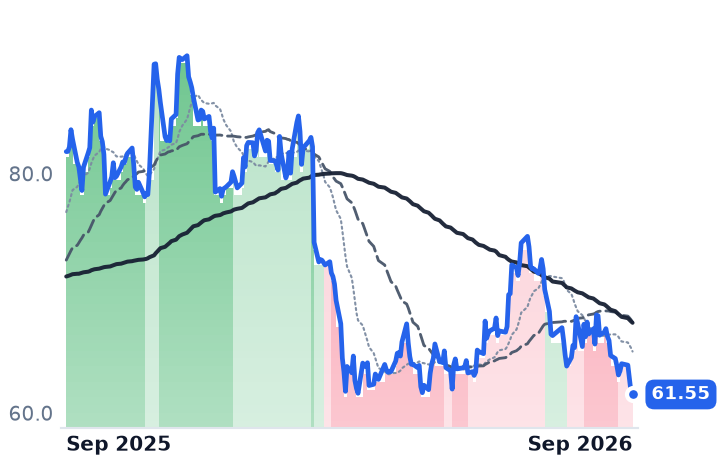
HHH | Howard Hughes | Real Estate - Development | ⚠️ Emerging Bear | −7.6% | −24.8% |
| Compared against · context, not the story | |||||
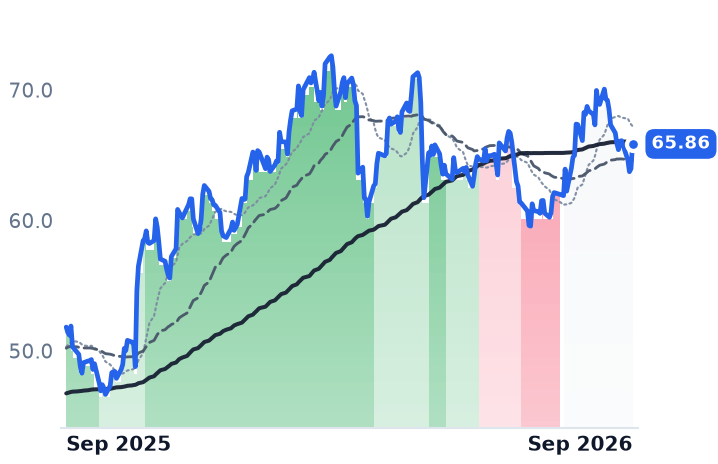
JOE | The St. Joe | Real Estate - Development | ⚠️ Emerging Bear | −3.7% | +27.1% |
12-month price & trend
| Ticker | Mkt cap | P/E | P/E fwd | P/S | P/S fwd | P/GP | P/GP fwd | EV/EBITDA | FCF yld |
|---|---|---|---|---|---|---|---|---|---|
HHH | $3.7B | 12.4x | 24.9x | 1.5x | 2.2x | 8.9x | 12.5x | 8.6x | 21.1% |
JOE | $3.7B | 30.8x | 263.4x | 6.8x | 43.5x | 8.4x | 53.3x | 17.3x | 5.7% |
Consensus projections
| Ticker | FY2026E | FY2027E | FY2028E | |
|---|---|---|---|---|
HHH | Revenue | +16.9% | −13.1% | +84.2% |
| EPS | +0.3% | +8.3% | +158.9% | |
JOE | Revenue | −16.1% | +6.2% | +12.3% |
| EPS | −171.4% | −68.0% | −100.0% |
Forward fiscal years only. Blank means no analyst coverage for that year.
Howard Hughes Holdings spent $2.1bn of cash in June on a Bermuda specialty re/insurer, and its master-planned communities now largely exist to pay for what comes next. The company completed the acquisition of Vantage Group Holdings on June 4 at roughly 1.5x year-end 2025 book value, funded from cash plus $1bn of non-voting exchangeable perpetual preferred stock issued to Pershing Square, with a further $200m of capital put into Vantage at closing. Pershing Square manages Vantage's $3.4bn investment portfolio without charging a fee.
Executive Chairman Bill Ackman was explicit about the destination. The goal, he told the August 6 earnings call, is to make Howard Hughes "disproportionately an insurance holding company as opposed to a real estate company with an insurance operation." On the same call: "The priority for every incremental dollar of free cash flow is to put it into Vantage." That is the stake. Shareholders own a land bank carried at decades-old cost whose monetization — management expects roughly $2.5bn to $3bn of excess real-estate cash over five years — is earmarked for underwriting risk. The market capitalization, about $3.67bn, is below the $5.6bn of "projected margin effective residual value" chief executive David O'Reilly attributed to the remaining wholly owned land bank on that call, before Teravalis and Floreo.
The land is still selling
Nothing in the operating record explains a stock at its lowest close in a year. Howard Hughes sold 119.7 residential acres in the second quarter at an average $1.309m per acre for $156.7m, per its earnings release, above the $1.2m average of the first half. Pre-tax earnings from the communities segment rose 32% to $134.7m and net new home sales across the portfolio rose 12%. In Hawaii, 527 units closed at The Park Ward Village, delivering $226.6m of net proceeds and $130.9m of gross profit; the pipeline behind it is 1,293 units, 78% pre-sold, better than $4bn of future revenue — though the company expects only about 40% of that to be recognized across 2026 and 2027.
Three things do argue for a lower price, and all are compositional. Growth is concentrated in Texas: Bridgeland's net new home sales rose 17% and The Woodlands Hills' 34%, while Summerlin managed 2%. That maps onto its market — Las Vegas net new-home sales fell 15% in the first half to 4,284 with permits down 25% as mortgage rates near 6.8% cut absorption per community. Second, this year's segment guidance of $343m to $391m is, by management's own account, essentially flat against 2025 excluding one large Summerlin superpad sale, so the 32% is a comparison effect. Third, Teravalis — 37,000 acres in Buckeye, Arizona, planned for 100,000 homes — needs water: Arizona will no longer issue new certificates of assured water supply on Phoenix-area groundwater.
The recurring stub is small and steady. Operating-asset net operating income was $70.5m in the quarter, up 2%, guided to $279m–$290m for the year. Against that sit near-term maturities of $230m for the rest of 2026 and $596m in 2027, with $1.2bn of liquidity including $698m of cash, per the 10-Q.
What the insurance arm actually looks like
Vantage is not a shell. It wrote $473m of gross premium in the quarter, up 29%, and carries $1.8bn of book value. It also ran a 101.6% combined ratio against 94% a year earlier, hit by $18m of Iran-conflict catastrophe losses and $19m of adverse prior-year development, even as the accident-year ratio excluding catastrophes improved to 91.4% from 96.2%. Marc Grandisson, formerly chief executive of Arch Capital, is executive chair; David Gansberg, Arch's former co-president, is chief executive designate, targeting mid-teens returns on equity. The holding structure already cost something: S&P cut Vantage's core subsidiaries to BBB from A− and then withdrew the ratings, citing the credit quality of the new leveraged parent rather than underwriting, while AM Best affirmed A− with a positive outlook.
The external management economics are modest for now: a $3.75m quarterly base fee, $15m a year, plus 0.375% a quarter of market-cap appreciation above a reference of about $3.93bn. The stock is below that line, so the incentive fee pays nothing. Pershing Square paid $100 a share for nine million shares in May 2025; that tranche is down roughly 38%.
The control that re-rated
The same mechanism elsewhere is being paid handsomely. St. Joe, which owns 170,000 acres in Northwest Florida and sells lots to builders, has spent a decade converting acreage into a membership club, hotels, marinas and leased commercial space. Its second-quarter revenue rose 23% to $158.8m with net income up 37% to $40.5m — "the highest in the second quarter in the company's history," chairman and chief executive Jorge Gonzalez told investors on July 31 — with residential, hospitality and commercial margins all up. It bought back $32.7m of stock in the quarter and trades at 4.9x book and 17.3x trailing EV/EBITDA. Howard Hughes trades at 0.73x book and 8.6x, and its 12.4x trailing earnings is flattered by condo closings and land gains that do not repeat on schedule. Shares of the two have moved almost symmetrically over twelve months in opposite directions.
So the de-rating is not the land repricing. Price per acre rose, Houston volumes rose, and the condo backlog is contracted. What is being repriced is the destination of the cash: a self-liquidating property portfolio whose proceeds leave real estate for a Bermudian balance sheet with one quarter of loss-affected results, a withdrawn S&P rating, and $1bn of preferred sitting ahead of the common. Investors who bought a land bank at a discount to appraised residual value are being asked to keep owning it while the discount funds something else. The Las Vegas slowdown and the Arizona water problem are real and quantifiable; neither is worth a quarter of the equity in a year.
On September 30, Ackman, chief investment officer Ryan Israel, O'Reilly and Grandisson will present strategy at the annual shareholder meeting. The land has been answering for itself all year; the question on that stage is what the insurer is worth to the people who still own the acreage.