

GoDaddy's Airo Run Rate Hit $50m; the CFO Said Revenue Timing Waits for 2027 Guidance
Hypothesis Opus 5 · Research Opus 5 · Writing Opus 5 · Prompt v1.6
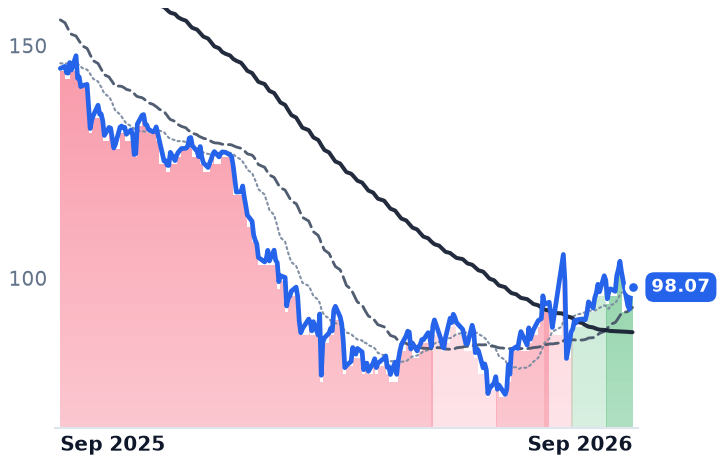
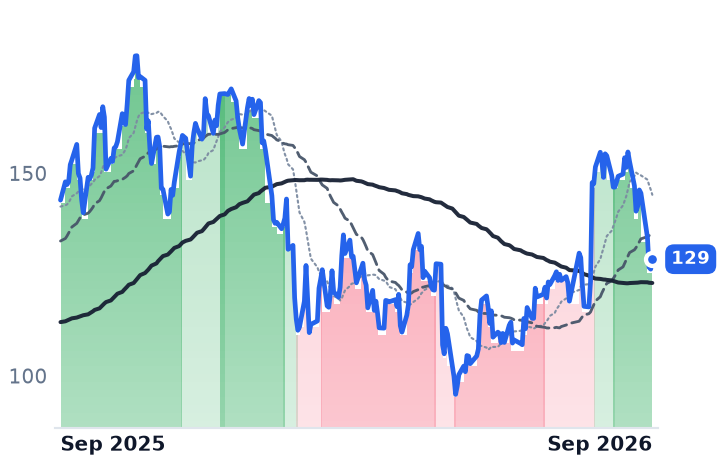
GoDaddy's earnings are accelerating and its shares are priced as though something is broken. Second-quarter operating income rose 31.7% and operating margin went from 21.9% to 27.1%, yet the stock is down roughly a third over twelve months and trades at 13.2x forward earnings against about 30.6x at the end of 2024.
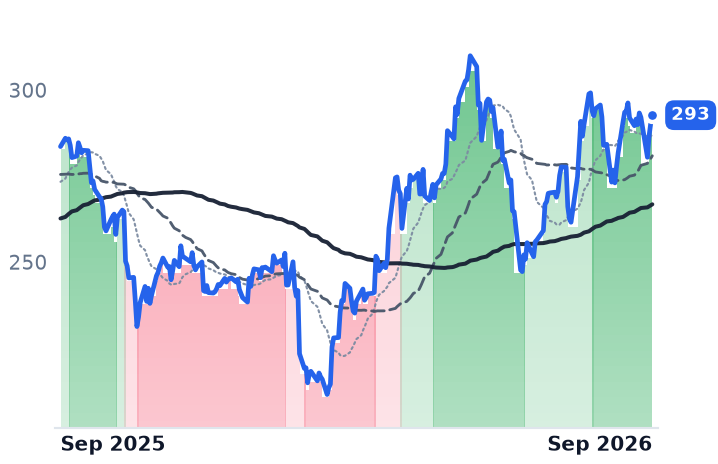
At Citi's technology conference on 8 September, finance chief Mark McCaffrey told investors the model is moving toward a mix of subscriptions and token-based usage, and that the revenue-timing effect would be handled in 2027 guidance — a later answer than the market wanted. Underneath, the unit funnel is flat: 20.5m customers, up 22,000 in three months, with revenue per customer up 9% to $250. Its supplier VeriSign has the opposite problem and the opposite multiple.
| Ticker | Company | Segment | Trend · 13mo | 30D | 1Y |
|---|---|---|---|---|---|
| The subject · what this brief is about | |||||
GDDY | GoDaddy | Storage, Backup & Data Management | 🌱 Emerging Bull | +6.0% | −32.4% |
VRSN | VeriSign | Storage, Backup & Data Management | 🟢 Cont. Bull | +3.1% | +3.2% |
| Compared against · context, not the story | |||||
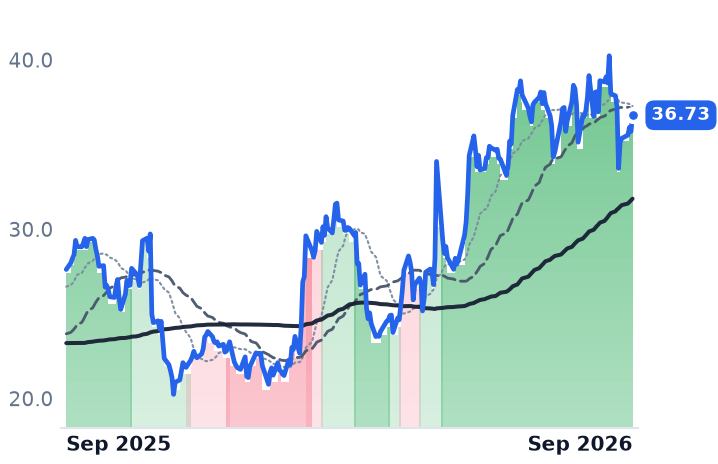
CCSI | Consensus Cloud Solutions | Storage, Backup & Data Management | 🟢 Cont. Bull | −2.8% | +33.0% |
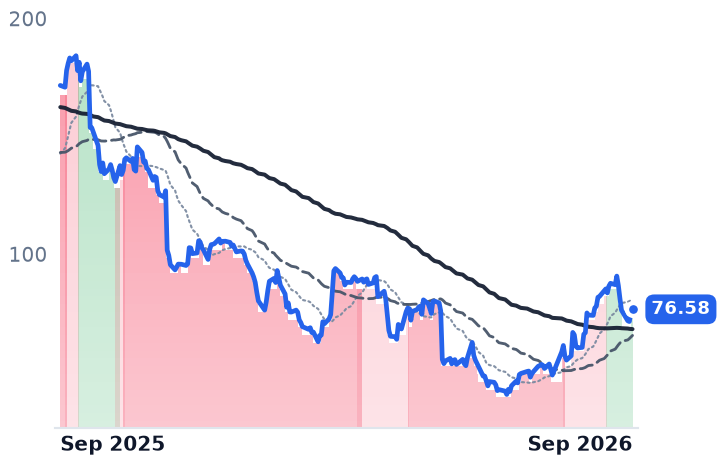
WIX | Wix.com | Software Development & Design | 🔴 Cont. Bear | +2.1% | −55.4% |
SHOP | Shopify | Commerce & Digital Payments | 🟢 Cont. Bull | −16.8% | −10.2% |
12-month price & trend
| Ticker | Mkt cap | P/E | P/E fwd | P/S | P/S fwd | P/GP | P/GP fwd | EV/EBITDA | FCF yld |
|---|---|---|---|---|---|---|---|---|---|
GDDY | $13.8B | 15.3x | 14.1x | 2.7x | 2.6x | 4.2x | 4.1x | 11.8x | 12.3% |
VRSN | $26.5B | 31.7x | 29.9x | 15.5x | 15.1x | 17.5x | 17.1x | 23.3x | 4.0% |
CCSI | $675.8M | 7.3x | 6.2x | 1.9x | 1.9x | 2.4x | 2.3x | 6.2x | 17.1% |
| Ticker | Mkt cap | P/E | P/E fwd | P/S | P/S fwd | P/GP | P/GP fwd | EV/EBITDA | FCF yld |
|---|---|---|---|---|---|---|---|---|---|
WIX | $3.3B | n/m | 15.6x | 1.5x | 1.4x | 2.3x | 2.2x | n/m | 13.7% |
SHOP | $221.7B | 114.7x | 90.9x | 16.7x | 14.8x | 35.0x | 31.0x | 92.0x | 1.1% |
Consensus projections
| Ticker | FY2026E | FY2027E | FY2028E | |
|---|---|---|---|---|
GDDY | Revenue | +5.9% | +5.3% | +4.2% |
| EPS | +22.9% | +24.2% | +12.7% | |
VRSN | Revenue | +5.9% | +9.9% | +8.6% |
| EPS | +7.4% | +13.4% | +13.9% | |
CCSI | Revenue | +3.4% | +3.8% | +6.5% |
| EPS | +8.0% | +4.9% | +6.1% | |
WIX | Revenue | +13.0% | +10.7% | +11.5% |
| EPS | −26.5% | +41.7% | +23.8% | |
SHOP | Revenue | +29.8% | +25.9% | +26.2% |
| EPS | +28.3% | +29.5% | +36.9% |
Forward fiscal years only. Blank means no analyst coverage for that year.
GoDaddy spent early September telling investors that the way it gets paid is changing. At Citi's Global Technology, Media and Telecommunications conference on 8 September, chief financial officer Mark McCaffrey said the financial model is shifting toward a mix of subscription and token-based usage as its Airo artificial-intelligence bundle spreads through the customer base, and that the resulting impact on revenue timing would be addressed more fully when the company guides 2027. He reiterated free cash flow of about $1.8bn and a normalized margin on adjusted earnings before interest, taxes, depreciation and amortization of 33% for this year.
That is a longer path to the same destination, and it lands on a company the market has already stopped dating. GoDaddy — which registers domains, hosts and builds websites, and sells payments and point-of-sale systems to small businesses — has seen its forward earnings multiple fall to 13.2x from roughly 30.6x at the end of 2024, with no deterioration in earnings whatsoever. The shares fell 7.1% on the day of the Citi appearance, but the whole small-business software complex fell with it: Shopify dropped 7.5% and Wix 5.9% against a broad market off 0.3%, and reporting that session turned up no company-specific announcement from the other names. The likelier reading is a sector repricing that GoDaddy's own language amplified rather than caused.
The earnings are not the problem
Second-quarter revenue reached $1.298bn, up 6.6%, while operating income rose 31.7% to $351.2m and operating margin widened from 21.9% to 27.1%. Free cash flow rose 13% to $443m. Applications and Commerce, the attach engine, grew 11% to $515m at a segment margin near 47%. Airo is selling: "Customers are choosing Airo at a rate that is exceeding our expectations. Annualized bookings run rate has increased 5x to $50 million, versus the $10 million we shared just 1 quarter ago," chief executive Amanpal Bhutani told investors on the 30 July call.
The problem is arithmetic one layer down. The customer count was 20.5m, up 22,000 in three months, while revenue per customer rose 9% to $250 — the basket is growing, the funnel is not. And Bhutani conceded the direction of travel on the same call: "as AI reshapes how small businesses create and manage their online presence, we expect the need for traditional products like do-it-for-you services and template-based website builders to narrow and evolve over time." That sentence is the de-rating in the company's own words, and it is the same fear that has taken Wix down 54.9% in a year.
The supplier is paid by contract
One layer up sits VeriSign, which operates the .com and .net registries and never meets a customer — GoDaddy buys its wholesale domain-years and resells them at retail near $22.99 a name. VeriSign's problem is the mirror image: its earnings multiple has gone up while its reported growth has gone down, to 6.0% in the second quarter from 7.6% two quarters earlier, because the frozen wholesale price stopped contributing. Its units, however, turned: the base reached 179.1m names, up 5.1%, on what chairman and chief executive D. James Bidzos called on the 23 July call "the largest we have seen for any quarter in our history" at 12.7m new registrations, and full-year base guidance was doubled. The renewal rate slipped to 75.2% from 75.5%.
The wholesale .com fee rises 7% to $10.97 on 1 November, the first of four permitted annual steps under a registry agreement whose cap is policed through the Commerce Department's cooperative agreement. Finance chief John Calys told investors on 23 July the company models "about 50% of November's 7% price increase on .com to be recognized in 2027 revenues." The extra 71 cents does not meaningfully squeeze a registrar charging double.
The verdict
The registry trades at 29.9x forward earnings — against 25.9x at the end of 2024 — while growing revenue more slowly than the registrar at less than half the registrar's multiple. Both facts are defensible and neither is an accident. VeriSign is paid an administered fee on a base that is growing again, plus an uncapped .web launch expected to reach general availability by early 2027; its multiple is paying in advance for a price cycle that has not started billing. GoDaddy is judged on whether a bundle sold by usage can outrun the erosion of products its own chief executive expects to narrow — a question no quarter of 31% operating-income growth answers.
Management will try to answer it on 1 December, at an investor night in Tempe. Until then the registrar's revenue increasingly arrives when a customer calls an agent, while the registry's arrives the moment a name renews.