

Avnet's Record Sales Year Consumed $281m of Cash While ScanSource's Generated $114m
Hypothesis Opus 5 · Research Opus 5 · Writing Opus 5 · Prompt v1.6
Two companies filed under the same technology-distribution heading just reported accelerating growth for opposite reasons, and only one of them paid for it out of earnings. Avnet's fiscal 2026 revenue rose 24.5% to $27.63bn, but consolidated gross margin fell to 10.43% from 10.74% — roughly a third of the growth is memory-chip price inflation the company passes straight through without marking it up. The inventory carrying that growth is financed: operating cash flow was a use of $281m, the accounts-receivable securitization is drawn to its $500m limit, and $550m of 5.65% notes were priced in September.
ScanSource, one seventh Avnet's size, expanded gross margin 82 basis points in its June quarter with its gross-recognized hardware book growing 18% — faster than its high-margin agency arm — and turned $114m of free cash flow into $98m of buybacks. The demand at both is real; the question is what happens to Avnet's balance sheet if memory prices stop rising.
| Ticker | Company | Segment | Trend · 13mo | 30D | 1Y |
|---|---|---|---|---|---|
| The subject · what this brief is about | |||||
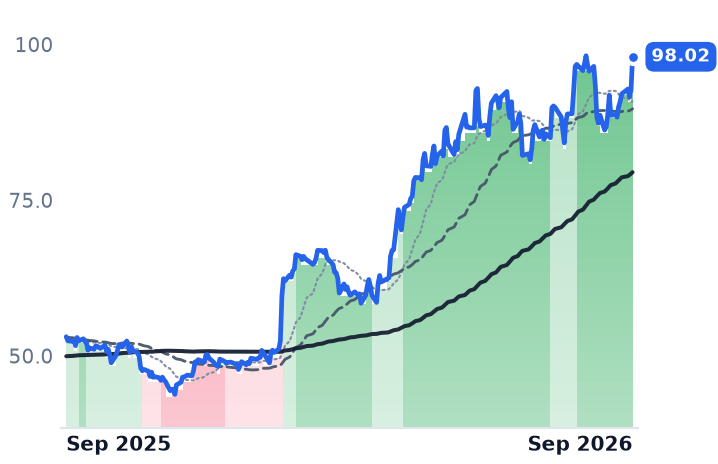
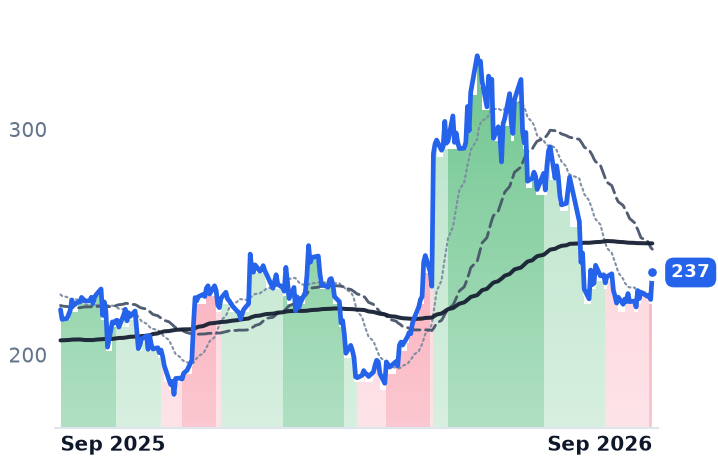
AVT | Avnet | Component & Specialty Distribution | 🟢 Cont. Bull | −0.2% | +84.7% |
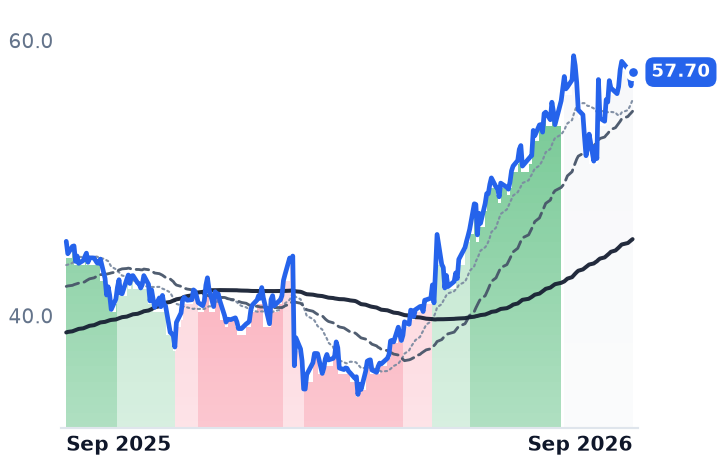
SCSC | ScanSource | Component & Specialty Distribution | 🌱 Emerging Bull | +11.8% | +27.1% |
| Compared against · context, not the story | |||||
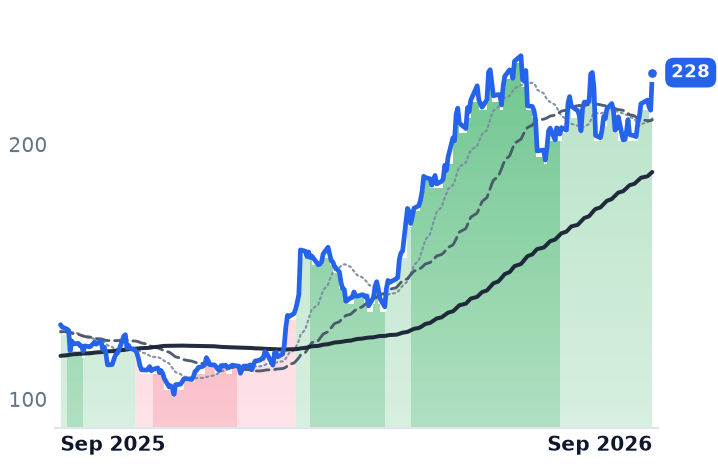
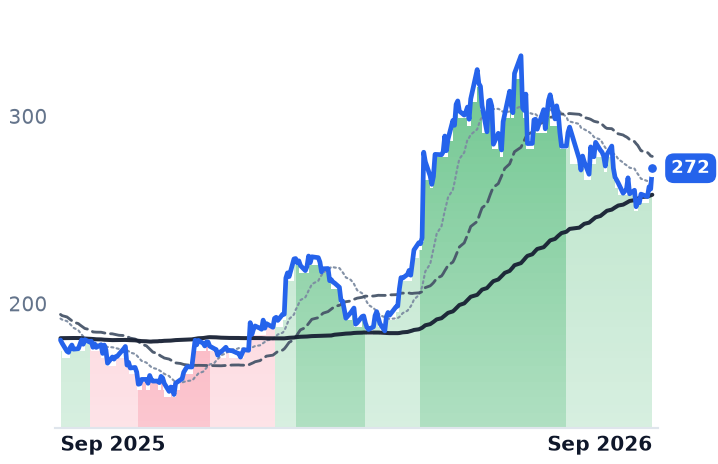
ARW | Arrow Electronics | Enterprise IT Solutions | 🟢 Cont. Bull | +8.2% | +76.5% |
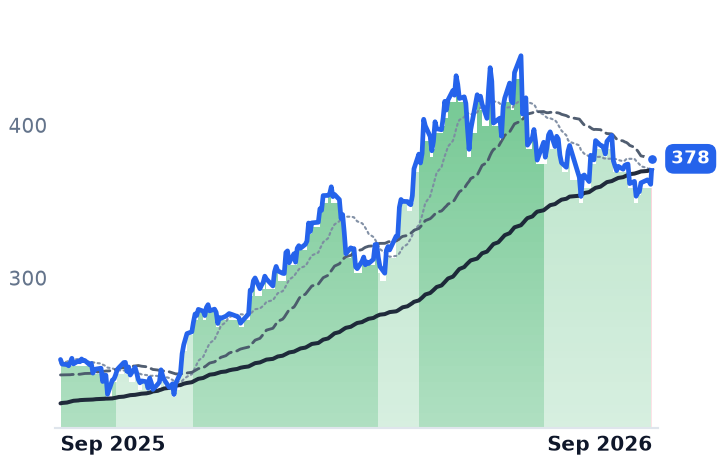
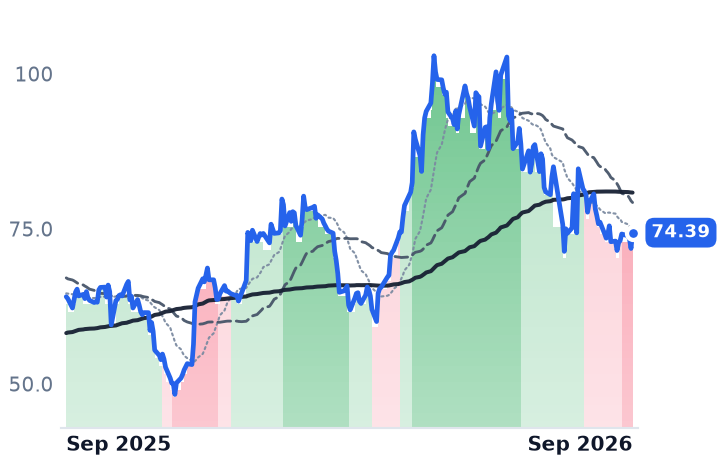
ADI | Analog Devices | Analog & Mixed-Signal | 🟢 Cont. Bull | −1.8% | +53.3% |
NXPI | NXP Semiconductors | Analog & Mixed-Signal | ⚠️ Emerging Bear | +0.4% | +7.5% |
TXN | Texas Instruments Incorporated | Analog & Mixed-Signal | 🟢 Cont. Bull | −2.3% | +50.7% |
MCHP | Microchip Technology Incorporated | Analog & Mixed-Signal | ⚠️ Emerging Bear | −7.6% | +16.1% |
12-month price & trend
| Ticker | Mkt cap | P/E | P/E fwd | P/S | P/S fwd | P/GP | P/GP fwd | EV/EBITDA | FCF yld |
|---|---|---|---|---|---|---|---|---|---|
AVT | $8.2B | 24.5x | 8.6x | 0.3x | 0.2x | 2.8x | 2.1x | 13.4x | -4.3% |
SCSC | $1.2B | 15.8x | 12.0x | 0.4x | 0.3x | 2.7x | 2.4x | 9.4x | 9.6% |
ARW | $11.1B | 13.8x | 10.0x | 0.3x | 0.3x | 2.8x | 2.5x | 10.2x | 8.1% |
| Ticker | Mkt cap | P/E | P/E fwd | P/S | P/S fwd | P/GP | P/GP fwd | EV/EBITDA | FCF yld |
|---|---|---|---|---|---|---|---|---|---|
ADI | $181.1B | 43.9x | 28.9x | 13.0x | 12.0x | 19.8x | 18.2x | 28.8x | 2.7% |
NXPI | $56.9B | 19.1x | 15.0x | 4.3x | 4.0x | 7.7x | 7.1x | 13.2x | 5.2% |
TXN | $258.4B | 42.8x | 33.4x | 13.3x | 11.8x | 22.8x | 20.2x | 29.5x | 2.1% |
| Ticker | Mkt cap | P/E | P/E fwd | P/S | P/S fwd | P/GP | P/GP fwd | EV/EBITDA | FCF yld |
|---|---|---|---|---|---|---|---|---|---|
MCHP | $40.2B | 102.6x | 20.3x | 7.8x | 6.3x | 13.0x | 10.4x | 26.9x | 2.8% |
Consensus projections
| Ticker | FY2026E | FY2027E | FY2028E | |
|---|---|---|---|---|
AVT | Revenue | +22.5% | +38.3% | +6.2% |
| EPS | +53.0% | +125.1% | +11.6% | |
SCSC | Revenue | +2.6% | +16.6% | +5.7% |
| EPS | +13.3% | +22.7% | +17.7% | |
ARW | Revenue | +32.1% | +7.6% | +7.9% |
| EPS | +109.8% | +12.5% | +10.8% | |
ADI | Revenue | +37.7% | +21.9% | +11.1% |
| EPS | +65.6% | +29.0% | +17.0% | |
NXPI | Revenue | +16.7% | +11.5% | +8.3% |
| EPS | +28.0% | +20.5% | +15.3% | |
TXN | Revenue | +23.8% | +14.0% | +10.8% |
| EPS | +55.0% | +20.5% | +18.4% | |
MCHP | Revenue | +6.2% | +37.1% | +16.4% |
| EPS | +20.7% | +132.2% | +25.6% |
Forward fiscal years only. Blank means no analyst coverage for that year.
Avnet finished the best year in its history with less cash than it started. The broadline distributor of semiconductors, connectors and passive components booked record June-quarter sales of $8.30bn, up 47.7% year on year, and fiscal 2026 operating cash flow was a use of $281m against $725m generated the year before.
That reversal is the story the headline growth rate hides. Distribution is a spread business: Avnet buys parts onto its own balance sheet and resells them, and the spread, not the volume, is what it keeps. Revenue accelerated every quarter of fiscal 2026 — up 5.3%, 11.6%, 33.9% and finally 47.7% — while full-year gross margin fell to 10.43% from 10.74% in fiscal 2025 and 11.64% the year before that. Gross profit dollars still grew 20.8%, to $2.88bn. The percentage narrowed because a large slice of the new revenue arrives pre-priced.
A third of the growth is a price, not a part
On the August 5 call, management said memory pricing accounted for about one third of both the year-over-year and sequential revenue growth, and roughly a third of the growth in gross profit dollars, with broadening non-memory supplier price increases generally passed through without extra markup. The upstream arithmetic is brutal: TrendForce forecast server DRAM contract prices rising 13–18% quarter on quarter in the third quarter of 2026 and PC DRAM 15–20%, with supplier inventories at historic lows as memory makers steer output to artificial-intelligence servers. Arrow Electronics, the direct rival for the same component revenue, described the identical mechanic — about a third of its growth from price inflation, on a June quarter of $9.99bn at an 11.26% gross margin.
Underneath the pricing, unit demand does appear to be turning. Avnet's regional book-to-bill ratios are solidly above 1 with backlog extending well into fiscal 2027. "Based on backlog, bookings and customer conversations, it feels like customers are in the third or fourth inning... for sure, not the eighth inning," chief executive Philip Gallagher told investors on August 5. The chipmakers corroborate the channel is lean rather than bloated: Analog Devices exited its August quarter with distributor channel weeks below its own six-to-seven-week target.
Who is paying for the inventory
Avnet closed June with $6.07bn of inventory, up $607m sequentially, more than half of that increase from pricing rather than units. Efficiency actually improved — inventory days fell to 71 from 77, return on working capital reached 19% against a 16% target — but the absolute book grew faster than earnings could fund it. "As things get tighter, we want to make sure we've got inventory on the shelves to take advantage of that opportunity as lead times extend," chief financial officer Ken Jacobson said on the same call. The funding shows up in the filings: $500m drawn under the accounts-receivable securitization, its full capacity, alongside $2.3bn of unsecured debt, and in September Avnet priced $550m of 5.650% notes due 2031. The board still raised the quarterly dividend 5.7% to $0.37. Arrow, running the same cycle, cut debt $650m year on year to $2.2bn.
ScanSource — barcode, point-of-sale, payments and physical-security hardware, plus a telecom and cloud agency arm whose commissions are booked net — did the opposite. Its June-quarter gross margin rose to 13.75% from 12.93%, and it rose while the hardware segment grew 18% with gross profit up 16% to $94m, outpacing the near-100%-margin agency business at 7.2%. That agency arm wrote roughly $2.88bn of end-customer billings in fiscal 2026 but books about $101m as revenue. The company generated $114m of free cash flow, 124% of adjusted net income, and bought back $98m of stock. "We've got a different mindset right now about winning instead of defending," chief executive Mike Baur said on August 20, days before agreeing to buy MicroAge for $220.5m, about a fifth of ScanSource's market value.
What the shares have done, and what they price
Avnet closed at $98.02 on September 11, up 81% over twelve months; ScanSource at $57.70, up 27%. Both moves came in jumps around results — Avnet 8.6% across three sessions in early August, ScanSource 11.2% in one session on August 20 — plus a September 11 lift in which the whole components complex rose together, Arrow 6.9% and Analog Devices 4.6%, with no Avnet announcement discoverable, so rotation is the likelier reading.
Avnet trades at 24.5x trailing earnings and 8.6x forward, the gap entirely a bet on consensus fiscal 2027 earnings of $11.61 against $4.01 delivered — a bar its own guide of $9.0–9.3bn in first-quarter sales starts to address. ScanSource is 15.8x trailing and 12.0x forward on a consensus of $4.84. But on enterprise value to earnings before interest, taxes, depreciation and amortization, which counts the debt, Avnet at 13.4x is the most expensive of the three: Arrow trades at 10.2x and ScanSource at 9.4x.
So the advance is earned, but unevenly. The demand recovery is genuine at both, and the upstream channel data supports it. What Avnet's share price has not yet been asked to absorb is that a third of its revenue growth is a price it does not mark up, sitting in inventory it borrowed to hold. ScanSource's smaller advance rests on cash the business produced, and its risk is now an acquisition rather than a balance sheet.
Memory pricing is a tailwind on the way up and a write-down on the way down. Avnet is carrying $6.07bn of stock into whichever it turns out to be.