

Brookfield Corporation Bought Back Stock at $41 and Values Itself at $66.37 a Share
Hypothesis Opus 5 · Research Opus 5 · Writing Opus 5 · Prompt v1.6
The parent of the Brookfield complex is being sold as if its fee engine were breaking, and the fee engine just had its best quarter on record. Brookfield Corporation raised $77bn in the second quarter, lifted fee-bearing capital 19% to $672bn and grew distributable earnings before realizations 15% — then made a new 52-week low in early September.
The correction matters because the sell-off has been read as a verdict on payouts, and Brookfield Corporation pays a dividend of $0.07 a quarter. Of the four listed Brookfield vehicles, only Brookfield Renewable shows a fundamental crack: roughly $175m of its record $421m quarter was gains on asset sales, leaving coverage of the declared distribution just under one times without them. Brookfield Infrastructure's revenue growth is accelerating.
| Ticker | Company | Segment | Trend · 13mo | 30D | 1Y |
|---|---|---|---|---|---|
| The subject · what this brief is about | |||||
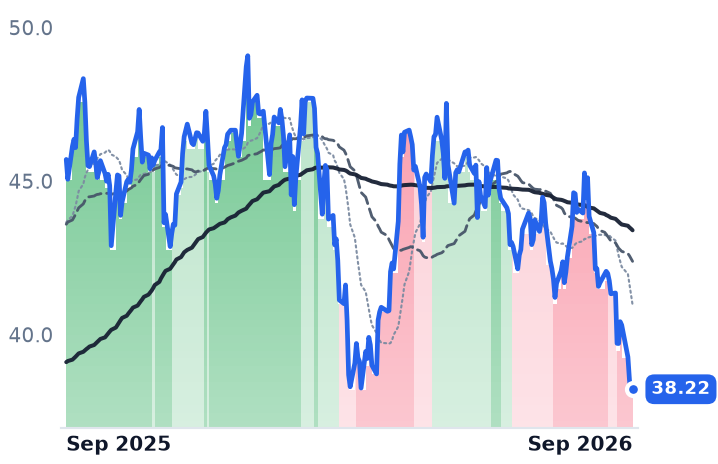
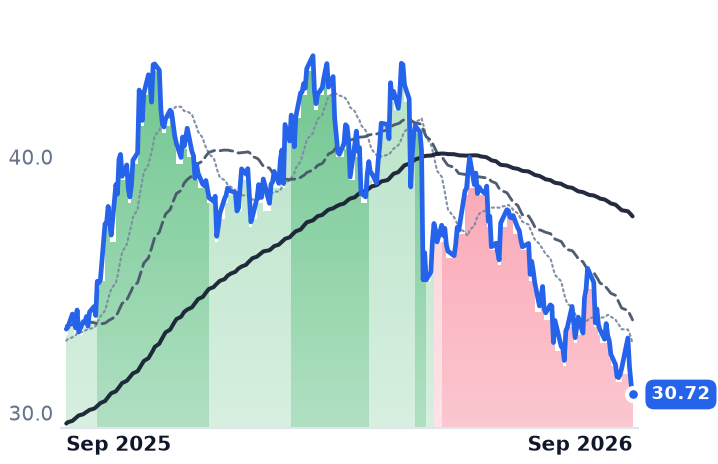
BN | Brookfield | Real Estate & Infrastructure | ⚠️ Emerging Bear | −14.1% | −16.4% |
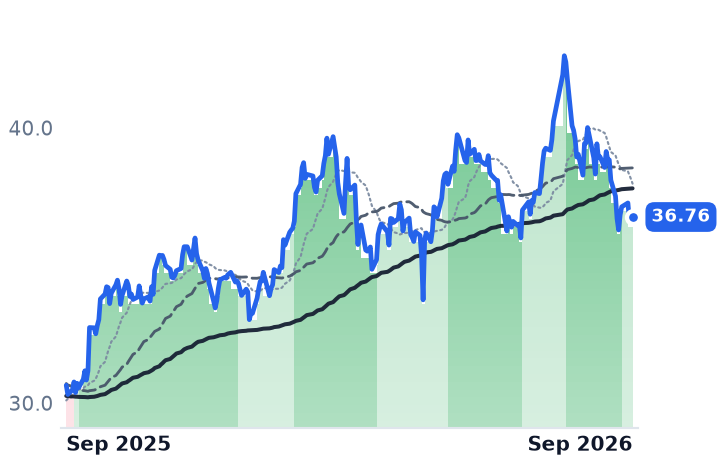
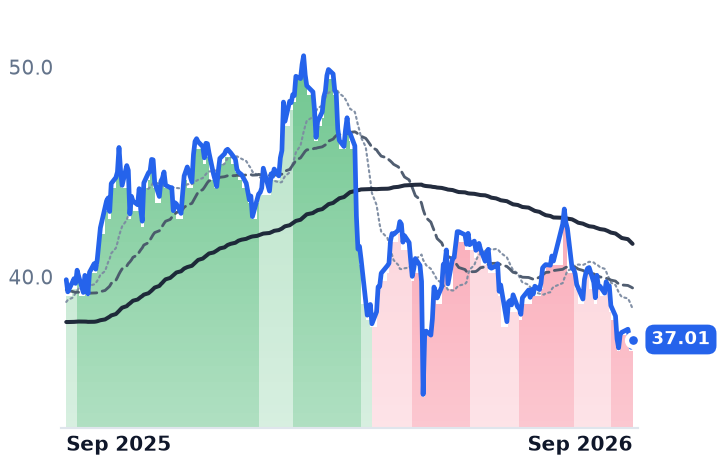
BIP | Brookfield Infrastructure Partners | Infrastructure & Transport Conglomerates | 🟢 Cont. Bull | −6.8% | +19.9% |
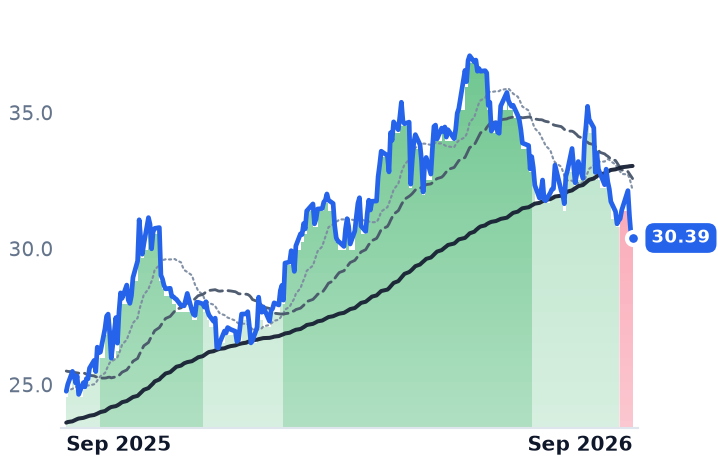
BEP | Brookfield Renewable Partners | Diversified Renewable Generators | ⚠️ Emerging Bear | −12.0% | +22.8% |
| Compared against · context, not the story | |||||
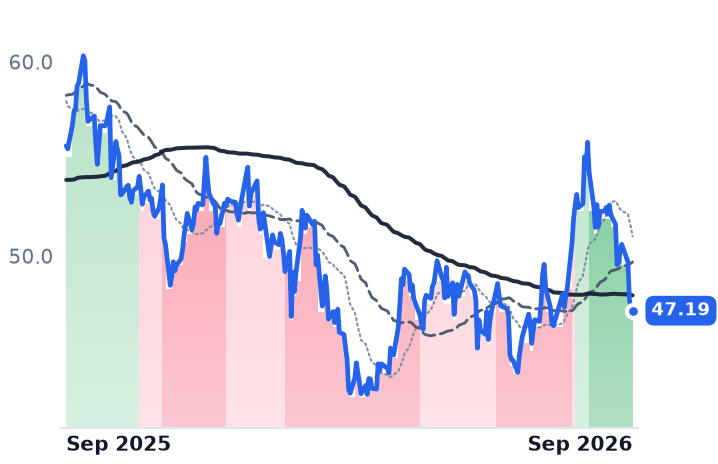
BAM | Brookfield Asset Management | Real Estate & Infrastructure | 🌱 Emerging Bull | −13.4% | −15.2% |
BEPC | Brookfield Renewable | Diversified Renewable Generators | ⚠️ Emerging Bear | −11.8% | −7.7% |
BIPC | Brookfield Infrastructure | International Gas Infrastructure | ⚠️ Emerging Bear | −8.0% | −7.2% |
12-month price & trend
| Ticker | Mkt cap | P/E | P/E fwd | P/S | P/S fwd | P/GP | P/GP fwd | EV/EBITDA | FCF yld |
|---|---|---|---|---|---|---|---|---|---|
BN | $85.4B | 68.1x | 13.8x | 1.1x | 11.3x | 3.8x | 39.1x | 10.0x | -9.7% |
BAM | $75.5B | 27.2x | 25.3x | 14.0x | 12.2x | 17.4x | 15.2x | 87.0x | 2.9% |
BIP | $17.0B | 51.4x | 61.0x | 0.7x | 1.0x | 2.6x | 3.7x | 7.1x | -3.4% |
| Ticker | Mkt cap | P/E | P/E fwd | P/S | P/S fwd | P/GP | P/GP fwd | EV/EBITDA | FCF yld |
|---|---|---|---|---|---|---|---|---|---|
BEP | $9.3B | 66.1x | — | 1.5x | 1.4x | 6.0x | 5.7x | 9.7x | -50.8% |
BEPC | $4.7B | n/m | — | 1.1x | 0.8x | 2.4x | 1.7x | n/m | -11.8% |
BIPC | $4.6B | n/m | — | 1.2x | 1.2x | 2.0x | 1.9x | 4.3x | -4.6% |
Consensus projections
| Ticker | FY2026E | FY2027E | FY2028E | |
|---|---|---|---|---|
BN | Revenue | −7.3% | +23.6% | +22.3% |
| EPS | +14.3% | +23.1% | +12.0% | |
BAM | Revenue | +14.2% | +17.1% | +11.7% |
| EPS | +14.6% | +18.2% | +16.8% | |
BIP | Revenue | +112.0% | −44.9% | +8.3% |
| EPS | −43.1% | +9.6% | +13.0% | |
BEP | Revenue | +3.8% | +9.0% | −3.4% |
| EPS | +14.0% | −11.7% | +9.4% | |
BEPC | Revenue | +4.6% | +16.3% | +5.7% |
| EPS | +280.9% | −93.3% | +455.5% | |
BIPC | Revenue | +3.7% | +6.4% | +6.3% |
| EPS | −120.4% | −553.3% | +14.2% |
Forward fiscal years only. Blank means no analyst coverage for that year.
Brookfield Corporation touched a 52-week low of $37.87 in early September, closing at $38.22 on 11 September — down about 17% over twelve months. The business underneath it reported its largest fundraising quarter ever six weeks earlier. Its shorter-dated leg down is new: the shares flipped into a downtrend on 1 September, after the listed affiliates had already done so, and short interest rose 51.6% during September to 20.34m shares.
What makes this worth untangling is that the whole complex has been sold as one payout story, and only one member of it is actually a payout story in trouble. Brookfield Corporation is the parent — an alternative asset manager that runs client money across real estate, renewable power, infrastructure, private equity and credit while investing its own balance sheet alongside it. It pays a dividend of $0.07 a quarter. Whatever repriced it, a distribution yield measured against a 10-year Treasury that reached 4.818% in early September is not the mechanism.
What the parent actually earns
Second-quarter distributable earnings before realizations came to $1.4bn, up 15% year on year, or $0.61 a share; the last twelve months produced $5.7bn, $2.39 a share. Fee-related earnings rose 20%. Fee-bearing capital reached $672bn, up 19%, on a record $77bn raised in the quarter. The wealth arm's distributable earnings grew 23%, with insurance assets of $190bn following the Just Group acquisition.
None of that reaches reported earnings in a usable form. Under international accounting rules, depreciation on consolidated assets and the share of profit owned by minority partners crush the bottom line — full-year 2025 diluted earnings were $0.50 a share against $2.39 of distributable earnings over the trailing year. The trailing price-to-earnings ratio of 68x measures the accounting, not the business. At $38.22 the shares are near 16 times last-twelve-month distributable earnings and 1.94 times book value.
Management publishes its own estimate of what the company is worth — a "plan value" of $66.37 a share at 31 March 2026, trimmed from $68 at year-end — and has repurchased stock this year at an average $41, which it described as roughly a 40% discount to that figure. The estimate is the company's own, produced by an interested party. The buyback is the one place it is being tested with cash.
The one vehicle with a real problem
Brookfield Renewable, which owns hydro, wind, solar and storage plants across the Americas and sells power under long contracts, reported a record quarter that was partly a sales event. "We delivered another record quarter, generating FFO of $421 million, or $0.62 per unit, up 13% or 11% per unit year-over-year," chief executive Connor Teskey told investors on 31 July. About $175m of that sat in the hydro segment as other income from developed-asset and non-core sales. Strip it and per-unit funds from operations fall near $0.36 against a declared distribution of $0.392 — coverage of roughly 0.92 times. Accounting revenue fell 1.8% in the quarter. The units yield 5.17%, barely clear of the risk-free curve, and trade at 9.69 times trailing enterprise value to earnings before interest, taxes, depreciation and amortization.
Brookfield Infrastructure is the opposite case and gets measured differently. Its regulated utilities, rail and motorways, gas pipelines and roughly 148,000 telecom towers produced second-quarter funds from operations of $0.89 a unit, up 10%, with the distribution raised 6% to $0.455 — a 66% payout, inside the 60-70% target. Crucially, its definition of funds from operations excludes gains on disposals, so that payout is struck on operating cash alone. Revenue growth accelerated to 19.4%, and at 7.05 times enterprise value to EBITDA it is the cheapest of the listed vehicles. Its units were still in an uptrend as of 10 September.
Brookfield Asset Management, the fee collector, earned $808m of fee-related earnings in the quarter, up 20%, and has bought back $575m of its own shares this year. It has held an uptrend since mid-August despite falling 9.5% in a fortnight. It also showed what has changed: it issued $1bn of notes in the second quarter at 4.832% for five years and 5.298% for ten.
The verdict
Brookfield Renewable's de-rating is earned — a distribution that needs asset sales to clear one times coverage deserves a lower multiple when money costs more. Nothing in the reported results of the parent, the manager or the infrastructure partnership does the same work. Their cost of capital rose, their duration lengthened, and holders of long-dated cash flows repriced them together; the likelier reading of the parent's September leg is rate duration plus positioning rather than franchise damage. The Westinghouse stake the company holds alongside Cameco is the clearest example of what the market is declining to pay for: a reactor order cycle whose units would not run before the 2030s.
On 14 October, holders vote on folding the paired corporations into their partnerships one-for-one, ending the last structural quirk in the stack. After that there is nothing left to simplify, and the discount to management's own number will have to be argued on the earnings — or closed by the buyback that is currently the only visible buyer at these prices.