

Planet Pulled $30m of Satellite Delivery Into Its Record Quarter as Backlog Grew 11%
Hypothesis Opus 5 · Research Opus 5 · Writing Opus 5 · Prompt v1.6
Planet Labs just posted the best quarter in its history — revenue of $116.1m, up 58%, and its first adjusted profit — and then guided the next one down to $101–105m. The reason is composition: one-time satellite handovers, led by the first Pelican delivered to the Swedish Armed Forces, were 12% of revenue against 1% a year earlier.
The recurring meters went the other way. Backlog of roughly $815m grew 11% year over year, and existing customers expanded spend by 9%. BlackSky is the same machine in miniature: revenue up 50%, but its subscription book up only 36%, with the milestone remainder roughly doubling. Neither top line is a demand series for pictures; both are delivery schedules with a subscription business attached.
| Ticker | Company | Segment | Trend · 13mo | 30D | 1Y |
|---|---|---|---|---|---|
| The subject · what this brief is about | |||||
PL | Planet Labs PBC | Unmanned Systems & ISR | ⚠️ Emerging Bear | −32.3% | +72.6% |
BKSY | BlackSky Technology | Specialty Manufacturing & Components | ⚠️ Emerging Bear | −35.0% | +19.3% |
| Compared against · context, not the story | |||||
SATL | Satellogic | Specialty Manufacturing & Components | 🔴 Cont. Bear | −14.6% | +34.4% |
SPIR | Spire Global | Specialized Services | 🔴 Cont. Bear | −23.6% | +15.9% |
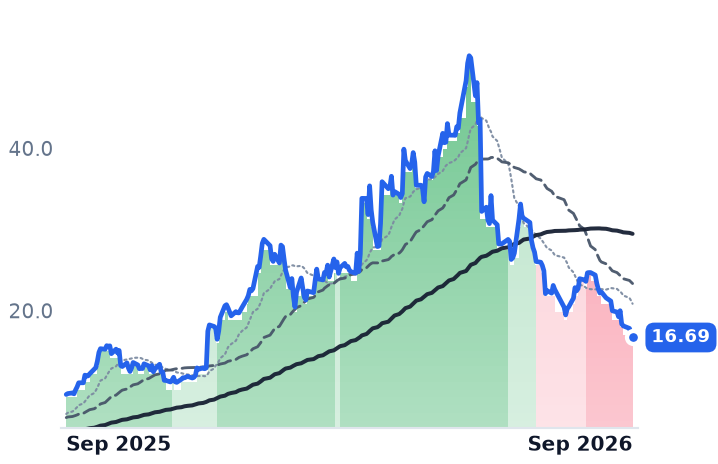
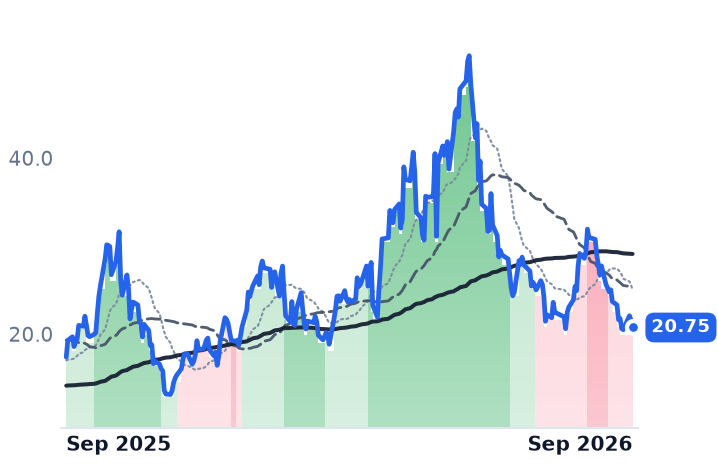
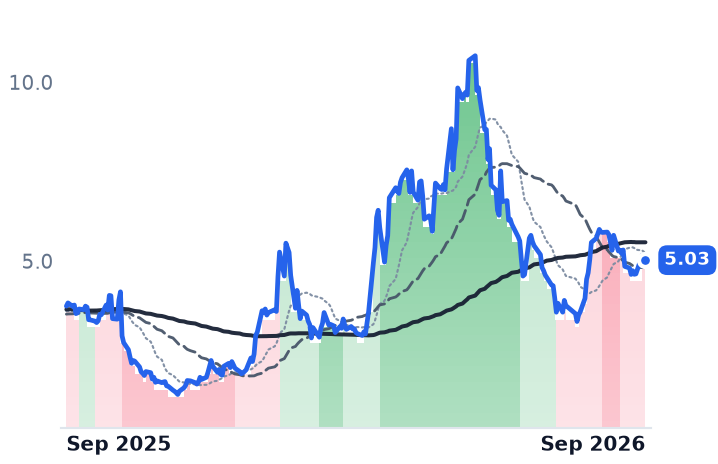
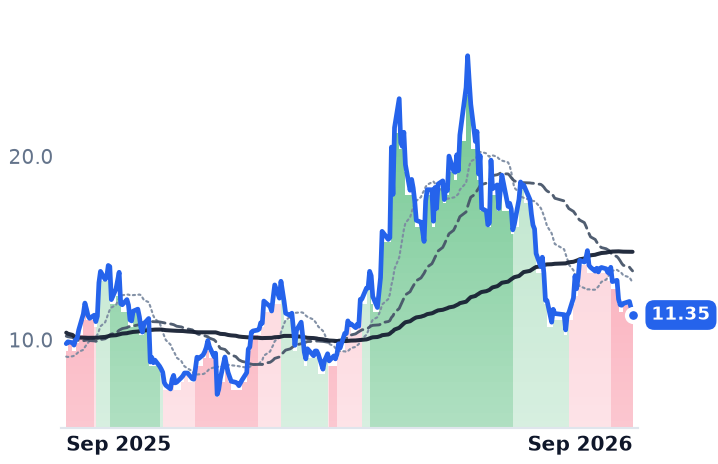
12-month price & trend
| Ticker | Mkt cap | P/E | P/E fwd | P/S | P/S fwd | P/GP | P/GP fwd | EV/EBITDA | FCF yld |
|---|---|---|---|---|---|---|---|---|---|
PL | $5.6B | n/m | — | 14.7x | 12.7x | 26.5x | 22.9x | n/m | 0.4% |
BKSY | $849.1M | n/m | — | 7.8x | 6.0x | 19.3x | 14.9x | n/m | -8.3% |
SATL | $647.0M | n/m | — | 20.3x | 14.1x | 25.7x | 17.9x | n/m | -6.5% |
| Ticker | Mkt cap | P/E | P/E fwd | P/S | P/S fwd | P/GP | P/GP fwd | EV/EBITDA | FCF yld |
|---|---|---|---|---|---|---|---|---|---|
SPIR | $367.0M | n/m | — | 5.9x | 4.6x | 15.6x | 12.2x | n/m | -29.6% |
Consensus projections
| Ticker | FY2026E | FY2027E | FY2028E | |
|---|---|---|---|---|
PL | Revenue | +21.9% | +46.5% | +30.4% |
| EPS | −55.9% | −32.3% | −125.5% | |
BKSY | Revenue | +30.1% | +36.6% | +32.8% |
| EPS | −32.8% | −69.4% | −155.8% | |
SATL | Revenue | +198.5% | +36.3% | +51.7% |
| EPS | +200.8% | −95.5% | −226.9% | |
SPIR | Revenue | +12.4% | +24.6% | — |
| EPS | −48.5% | −61.6% | — |
Forward fiscal years only. Blank means no analyst coverage for that year.
Planet Labs' best quarter came out of a delivery bay. The company, which flies roughly 150 small Earth-imaging satellites and sells the resulting daily picture of the planet as data subscriptions to governments, farmers, insurers and mapmakers, handed the first of its new Pelican satellites to the Swedish Armed Forces in the quarter ended 31 July. That handover pulled about $30m of one-time revenue into the period from the quarter where it had been expected. Revenue of $116.1m, up 58%, was a record; one-time delivery revenue was 12% of it, against 1% a year earlier.
Composition is the whole story in an industry the market still prices as though it were paid per picture. Planet's subscription revenue is annual contract value recognized evenly across multi-year terms, so any quarter's imagery line is a backlog-conversion schedule rather than a reading on demand. Growth has to arrive from new agreements — or, increasingly, from selling the satellite itself. Planet has guided the October quarter to $101–105m, a sequential decline and about 27% year-on-year growth, because a delivery cannot be made twice.
The meters that sit outside the revenue line
Backlog ended the quarter at roughly $815m, up about 11%, with remaining performance obligations of $753m, up 9%. Two quarters earlier the backlog figure was near $900m and growing 79%. Existing customers are expanding spend slowly: net dollar retention on annual contract value was 109%, 110% including winbacks. And the growth sits where the deliveries are — defense and intelligence revenue rose 90% while civil government grew 5%, and Europe, the Middle East and Africa grew 130% on Swedish and German satellite-services work.
The franchise underneath is not in question. "No one has a sufficient number of Earth imaging satellites in the right kind of plane and all that to do a daily scan," chief executive Will Marshall told investors on the September 3 call. "And so if you want to monitor for new threats and monitor things consistently, we're the only game in town." That uniqueness won a sole-source $8m National Geospatial-Intelligence Agency monitoring contract in the quarter, alongside a five-year German government satellite-services deal and a first national program with the Rwanda Space Agency.
What it does not do is make the margin a pricing story. Non-GAAP gross margin fell from 61% to 59% on satellite-services mix, and the full-year guide is 55–57%. Capital spending was raised to $100–115m against guided revenue of $430–441m, roughly a quarter of the top line, spent rebuilding a fleet with a short useful life. Trailing free-cash-flow yield is 0.42%. The $865m of cash is real; $120m of it came from an at-the-market offering priced at $31.96 a share, 92% above the 10 September close.
The same machine, one-sixth the size
BlackSky Technology, which sells minutes-from-tasking imagery and analytics and separately builds, integrates and operates satellite and ground systems, reported June-quarter revenue of $33.3m, up 50%. Its space-based intelligence and analytics subscriptions were $24.5m, up 36%, leaving a program remainder that roughly doubled to about $8.8m. The quarter before, revenue fell 29.7%. Full-year 2025 revenue grew 4.4% and gross profit shrank. International contracts are now over 80% of funded backlog, US government subscription revenue was flat, and the company said visibility into the 2027 US budget is unclear. Adjusted earnings before interest, taxes, depreciation and amortization were positive at $4.7m.
The share prices moved as a group, not as verdicts on either business. Planet, BlackSky, Spire Global and Satellogic all peaked within three days of each other in late May and are down 67.5%, 59.8%, 55.5% and 53.2% since, as the 30-year Treasury yield hit a 19-year high above 5.33% — the kind of move that lands hardest on long-duration, cash-burning small caps. Planet now trades at 12.7x forward sales against a trailing 39.4x in early May, and is still the most expensive of the four on forward price-to-gross-profit at 22.9x, against BlackSky's 14.9x.
So the reported income statements do not justify the fall: Planet's operating margin improved from −24.5% to −11.6% while the stock halved. The forward meters partly do. Backlog growth in the teens, retention under 110% and a guided sequential decline are what a business looks like when a handover, rather than demand, made the quarter. BlackSky's headline is evidence for neither case until its subscription line, not its program line, carries the growth.
Behind both sits one budget. The National Reconnaissance Office spends about $400m a year on commercial imagery, and the White House budget office has already proposed cutting it; BlackSky's last disclosed extension of that vehicle covered Gen-2 services only into mid-2026. Selling satellites to Stockholm and Berlin has become the growth story precisely because Washington stopped being one.