

Doximity Raised Its Year by $6m and Gave Up Three Points of Gross Margin to AI Compute
Hypothesis Opus 5 · Research Opus 5 · Writing Opus 5 · Prompt v1.6
Doximity's bookings held and its profit did not. The physician network raised full-year revenue guidance on August 6 and lifted the number of customers paying it more than $500,000 a year to 127, up 7% — while gross profit rose just 2.2% on 7.3% more revenue, because roughly 90% of its artificial-intelligence compute spending is booked in cost of revenue. Consensus now has earnings per share falling 13% this fiscal year.
Eight sessions earlier, Teladoc — filed under the same industry label — cut 2026 revenue guidance about 5%, entirely on its BetterHelp therapy subscription, where paying users fell 11% to 346,000. Its constraint is therapist supply rather than demand: about 70% of prospective users now want insurance-billed therapy.
One classification, two unrelated mechanisms — a cost line at Doximity, a capacity line at Teladoc.
| Ticker | Company | Segment | Trend · 13mo | 30D | 1Y |
|---|---|---|---|---|---|
| The subject · what this brief is about | |||||
DOCS | Doximity | Virtual Care & Telehealth | 🔴 Cont. Bear | −4.7% | −64.9% |
TDOC | Teladoc Health | Virtual Care & Telehealth | 🌱 Emerging Bull | −12.0% | −19.7% |
| Compared against · context, not the story | |||||
OMDA | Omada Health | Virtual Care & Telehealth | 🌱 Emerging Bull | −9.2% | −4.6% |
HIMS | Hims & Hers Health | Medical - Equipment & Services | 🌱 Emerging Bull | −12.8% | −41.5% |
GDRX | GoodRx | Patient Engagement & Benefits | 🌱 Emerging Bull | −7.8% | −15.6% |
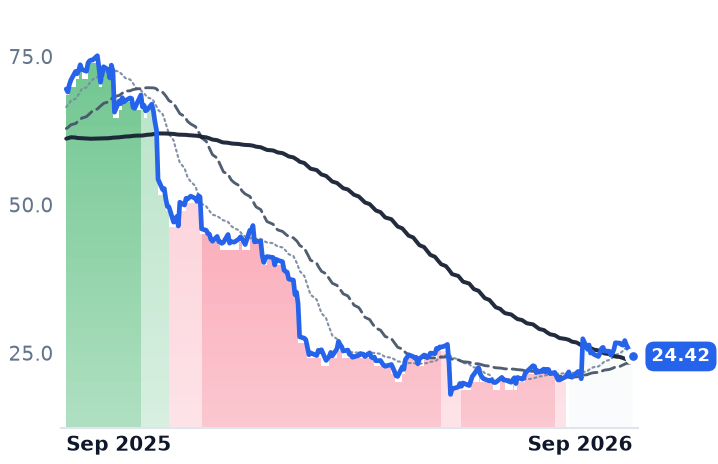
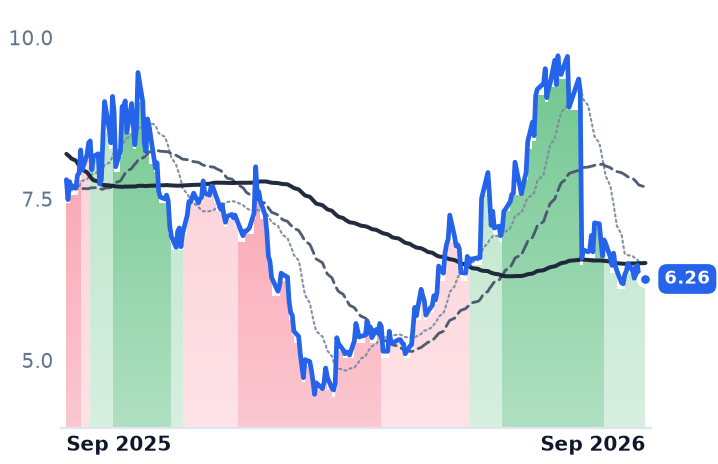
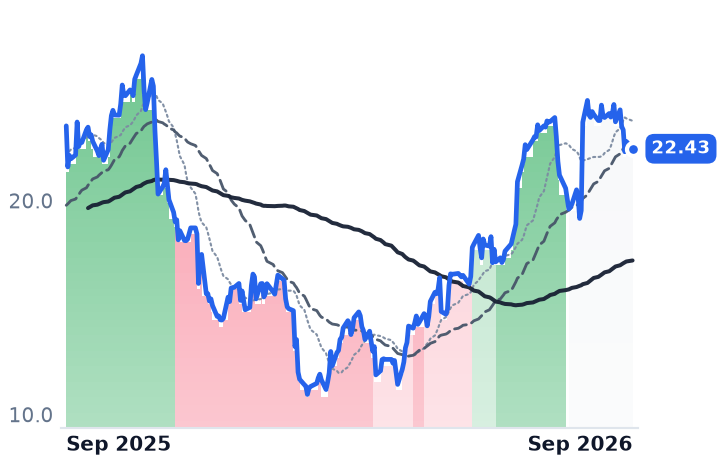
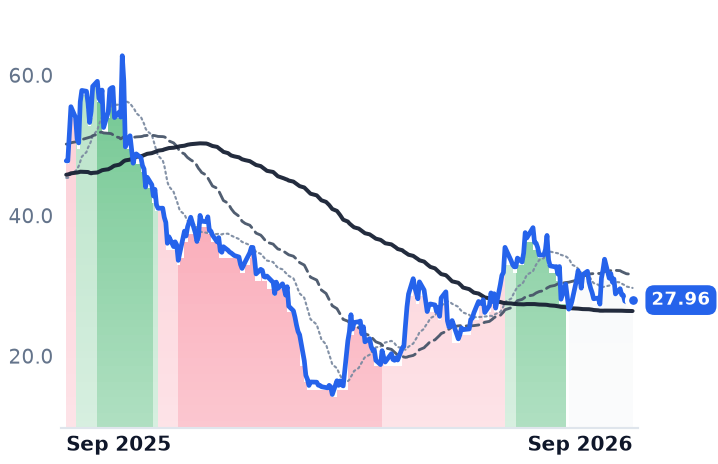
12-month price & trend
| Ticker | Mkt cap | P/E | P/E fwd | P/S | P/S fwd | P/GP | P/GP fwd | EV/EBITDA | FCF yld |
|---|---|---|---|---|---|---|---|---|---|
DOCS | $4.6B | 27.4x | 18.1x | 7.0x | 6.8x | 7.9x | 7.7x | 17.7x | 6.6% |
TDOC | $1.1B | n/m | — | 0.5x | 0.5x | 0.6x | 0.6x | n/m | 19.8% |
OMDA | $1.3B | 326.7x | 61.3x | 4.3x | 3.9x | 6.2x | 5.7x | 93.3x | 1.7% |
| Ticker | Mkt cap | P/E | P/E fwd | P/S | P/S fwd | P/GP | P/GP fwd | EV/EBITDA | FCF yld |
|---|---|---|---|---|---|---|---|---|---|
HIMS | $5.5B | n/m | — | 2.3x | 1.9x | 3.4x | 2.8x | 64.2x | 1.4% |
GDRX | $1.2B | 66.2x | 11.4x | 1.5x | 1.5x | 1.7x | 1.7x | 9.8x | 12.1% |
Consensus projections
| Ticker | FY2026E | FY2027E | FY2028E | |
|---|---|---|---|---|
DOCS | Revenue | +13.8% | +5.1% | +6.6% |
| EPS | +18.1% | −13.0% | +15.5% | |
TDOC | Revenue | −4.6% | −1.1% | +1.5% |
| EPS | −27.0% | −28.1% | −13.6% | |
OMDA | Revenue | +33.4% | +20.4% | +20.3% |
| EPS | −1434.8% | +27.4% | +59.5% | |
HIMS | Revenue | +22.5% | +19.6% | +15.1% |
| EPS | −99.7% | +38762.4% | +60.2% | |
GDRX | Revenue | +0.6% | +5.0% | +6.7% |
| EPS | −15.6% | +17.1% | +15.5% |
Forward fiscal years only. Blank means no analyst coverage for that year.
Doximity, which sells branded drug-marketing modules to pharmaceutical companies across a network of US physicians, grew revenue 7.3% in the June quarter and gross profit 2.2%. The difference sits in one cost line: roughly 90% of the company's artificial-intelligence compute spending is booked in cost of revenue rather than overhead, and non-GAAP gross margin fell to 88% from 91% a year earlier.
Bookings are not the problem. On the August 6 call Doximity raised full-year revenue guidance by $6m, to $671–681m, and reported 127 pharmaceutical and hospital customers paying more than $500,000 a year — up 7%, and 83% of total revenue. Net revenue retention among its twenty largest customers was 112%. What the compute bill broke is the operating leverage that justified the price: operating income fell 38% year over year on that 7.3% of growth, and consensus now has earnings per share declining 13% this fiscal year while revenue rises about 5%.
The re-rating arrived in gaps
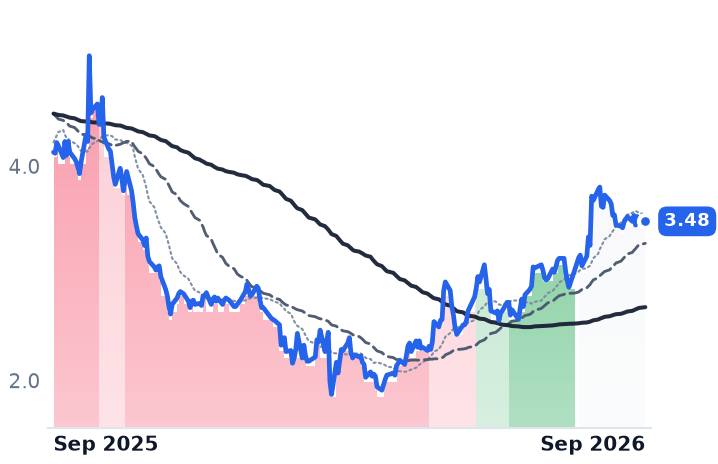
The market has spent a year repricing this. Doximity fell about 25% on May 14 after guiding fiscal 2027 revenue below consensus, then gained 32.6% on August 7 on the June-quarter beat. On September 8 Freedom Capital Markets cut the stock to Hold while raising its price target to $27, analyst Gene Mannheimer trimming his profit forecast because a further step-up in compute and product investment squeezes margins for years; the shares fell 7%. Over twelve months they are down about 65%. Trailing price-to-gross-profit is 7.9x, against roughly 26x a year ago, with 18.1x forward earnings.
Chief executive Jeff Tangney's answer on August 6 was unit economics: "I can tell you, we're earning more than 10x per search in revenue than it cost us to run that today." Doximity has 165 signed enterprise health-system clients for its AI tools and is in litigation both ways with its main rival for physician AI search, Open Evidence. The budget pool underneath all of it is moving: the Food and Drug Administration has proposed scrapping the "adequate provision" allowance that has made broadcast drug advertising practical for three decades, with a proposed rule expected in December 2026.
Teladoc ran out of therapists
Eight sessions before Doximity's beat, Teladoc — the virtual-care company filed under the same industry classification — fell 28.3% in a single day. It cut 2026 revenue guidance to $2.36–2.45bn, about 5% at the midpoint, entirely on BetterHelp, its direct-to-consumer therapy subscription. That segment's revenue fell 11.6% to $213m and its cash-paying users fell 11% to 346,000; it is now guided to shrink 12.7% to 19% this year, against a prior outlook of a 1% to 6.5% decline.
The cause is a composition shift rather than a demand collapse: roughly 70% of prospective users, and 80% in some markets, now want therapy billed through insurance, and provider capacity did not scale with them. "With over 20 thousand sessions completed last week alone, representing an estimated annualized revenue run rate on that basis of over $110 million up from over $75 million at the time of our first quarter earnings call," chief executive Charles Divita told investors on July 29. The quieter book is the better one: Integrated Care, sold to employers and health plans, grew 0.7% to $394m with adjusted EBITDA up 13.6% at a 16.5% margin and chronic-care enrolment of 1.27m, up 14%.
Teladoc trades at 0.62x gross profit, the low end of its own 2026 range and down from 0.97x in late July, at 0.86x book value, with a 19.8% trailing free-cash-flow yield. Against that sits $850m of convertible notes maturing on June 1, 2027, $774m of cash and free cash flow guided at $130–170m for the year.
The one that is compounding
Omada Health, which sells virtual diabetes, hypertension and weight-management programs to employers and pharmacy benefit managers under the same classification, grew second-quarter revenue 43% to $87.8m and raised full-year guidance to $334–340m. "We delivered 43% revenue growth and expanded gross margin by 700 basis points to 73% on a GAAP basis," president and incoming chief executive Wei-Li Shao said on August 6. It trades at 61x forward earnings.
Doximity's business earns much of its de-rating: gross profit growing 2% does not support the multiple it carried, and 18x forward earnings is not obviously cheap against a forecast that those earnings shrink. What the price does not yet reflect is that the demand side held — retention, the customer count and a raised year all point at a cost problem the company chose. Teladoc's cheapness is equally real and so is the contraction; below book, its next test is a refinancing rather than a reacceleration.
Omada, with 1.1m members, presents its long-term plan in New York on Thursday. The two older names face narrower questions: whether Doximity's compute bill stops growing faster than its revenue, and whether Teladoc can credential therapists fast enough to sell the product its customers are already asking for.